
Characteristics and Micromorphology of Designed Regenerative a Cellular Dermal Collagen Particles Derived from a Combined Procedure of Supercritical Carbon Dioxide Fluids and Protease Treatments at Low Temperatures
A new regenerative collagen particle with extra-cellular matrix (ECM) was designed and prepared from porcine dermal. A specific tissue-cutting machine was designed to prepare extra thin tissue membranes, which could be used for preparing the regenerative collagen particles with ECM. Furthermore, a novel procedure combining supercritical carbon dioxide fluids technology and protease treatments at low temperatures was employed. Characteristics of the resulting regenerative collagen particles with ECM were observed by determining morphology, thermal property and mechanical property for clinic application of medical devices.
Ching-Cheng Huang1,2*, Guifeng Zhang3, Meng-Jen Yang2 and Xiong
xin Lei2
Academy of Sciences, Beijing
Taiwan, Tel: +886-3-3507001 ext 3658; E-mail: junas.tw@yahoo.com.tw property for clinic application of medical devices.
Keywords: Collagen; Morphology; Extra-cellular matrix; ECM
Introduction
For the development of medical devices design, selections of suitable materials for biomedical applications such as polynorbornene, poly (vinylidene fluoride), polymethacrylate, polymeric resins and Characteristics and Micromorphology of Designed Regenerative a Cellular Dermal Collagen Particles Derived from a Combined Procedure of Supercritical Carbon Dioxide Fluids and Protease Treatments at Low Temperatures biomaterials could be substantially considered and employed [1–4]. The modification could be considered to change the microenvironment of materials for specific need [5]. A series of regenerative acellular dermal collagen particles with extra cellular matrix (ECM) were designed and prepared by using a novel procedure of Ann Adv Biomed Sci
supercritical carbon dioxide fluid and protease at low temperatures. Tissue-engineering was important and popular which combine medical applications and engineering materials knowledge. The preclinical evaluations of the resulting regenerative collagen particles with extra cellular matrix (ECM) must be carried out by determining the morphology, thermal property, and mechanical property for clinic application of orthopedics.
Methods
Selection of ISO9001 quality certification and ISO14001 environmental certification, the steadily thickness of about 5mm of dermal tissue could be obtained from porcine skin by using a designed tissue- cutting machine (Taiwan PARSD Pharm. Tech. Consulting Ltd Co. and Kuin Biotech. Ltd Co.) Then, supercritical carbon dioxide fluid was used with carbon dioxides (99.999%, 20 MPa) for 6 hours. A series of samples were first soaked in 0.5M acetic acid for 2hrs, then soaked for 2hrs with 2% NaOH and 3% Triton X-100 with mixer, followed by proteinase (4,5,10,15 ug/ml) at low temperature (4oC) for 2hrs, The samples were washed with PBS at the intermediate interval under ultrasonic wave to remove residual fat and organic particles.
Results
For preparing designed regenerative collagen membrane cap with ECM, dermis of skin was hydrolyzed by enzymes of different concentration after supercritical carbon dioxide fluid (SCF), in this way it can gain state completely and clearly. From the Fourier transform infrared spectroscopy analysis, absorptions bands at 1453, 1400, 1337, 1238, 1202, and 1080 cm−1 may be attributed to the ν(CH2), ν(CH3), ν(C–N), and ν(N–H) absorptions of collagens(Figure 1). Amides I and amides II absorptions could be found at 1632 and 1552 cm−1 respectively. The absorption band at 2900~3000 cm-1 δ(C-H) peak value of the fatty acid tends to slow down, demonstrating the effectiveness of the supercritical carbon dioxide fluids and protease treatments.
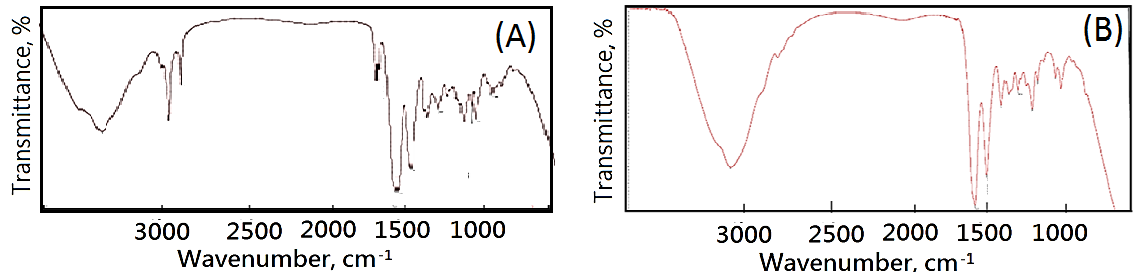
Ching-Cheng Huang, et al. Characteristics and Micromorphology of Designed Regenerative a Cellular Dermal Collagen Particles Derived from a Combined Procedure of Supercritical Carbon Dioxide Fluids and Protease Treatments at Low Temperatures. Ann Adv Biomed Sci 2019, 2(1): 000120.
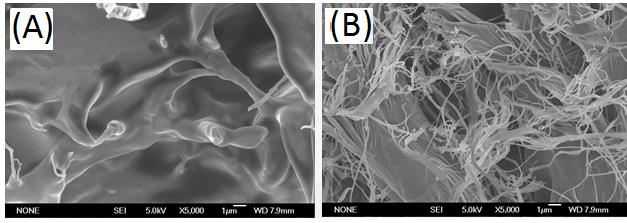
could be observed in SEM as shown in Figure 2(B). The SEM results revealed effect in cellular dermal collagen particles with extra-cellular matrix (ECM) of porcine dermal tissue via supercritical fluid at low temperature.
Copyright© Ching-Cheng Huang, et al.
Conclusion
In this study, a series of new designed regenerative collagen particles with extra-cellular matrix were obtained from porcine dermal by using a novel procedure combining supercritical carbon dioxide fluids technology and protease treatments at low temperatures. An extra- cellular matrix and integrity scaffold-structure could be obtained and observed by SEM. This study provides a simple and time-saving method to removing tissue and form decellularized structurally intact collagen scaffold. The Tdmax values of the resulting regenerative collagen particles with ECM were observed over 350oC, which imply high thermal stability of collagen scaffolds. Hence, the designed collagen scaffolds could be a potential application for minimally invasive surgeries as regenerative collagen particles with extra-cellular matrix.
Acknowledgements
The authors would like to acknowledge PARSD Pharmaceutical Technology Ltd. Co. and Kuin Biotechnology Ltd Co. for financial and technical support
References
-
Liaw DJ, Huang CC, Kang ET (2006) Effect of architecture and environments on polymeric molecular assemblies of novel amphiphilic diblock copolynorbornenes with narrow polydispersity via Ching-Cheng Huang, et al. Characteristics and Micromorphology of Designed Regenerative a Cellular Dermal Collagen Particles Derived from a Combined Procedure of Supercritical Carbon Dioxide Fluids and Protease Treatments at Low Temperatures. Ann Adv Biomed Sci 2019, 2(1): 000120. living ring-opening metathesis polymerization (ROMP). Journal of Polymer Science Part A: Polymer Chemistry 44(9): 2901-2911.
-
Liaw DJ, Huang CC, Sang HC, Kang ET (1999) Photophysical and solution properties of naphthalene-labeled styrene/N, N-dimethyl maleimido propylammonium propane sulfonate copolymer. Langmuir 15(12): 5204-5211.
-
Zhai G, Toh SC, Tan WL, Kang ET, Neoh KG, et al. (2003) Poly (vinylidene fluoride) with grafted Zwitterionic polymer side chains for electrolyte- responsive microfiltration membranes. Langmuir 19(17): 7030-7037.
-
Liaw DJ, Huang CC, Ju JY (2006) Novel star-like multifunctional polymeric materials with predominant cis microstructures derived from α- norbornenyl macromonomer and stable macroinitiator via ring-opening metathesis polymerization and atom transfer radical polymerization. Journal of Polymer Science, Part A: Polymer Chemistry 44(10): 3382-3392.
-
Li ZF, Kang ET, Neoh KG, Tan KL, Huang CC, et al. (1997) Surface structures and adhesive-free adhesion characteristics of polyaniline films after modification by graft copolymerization. Macromolecules 30(11): 3354-3362. Copyright© Ching-Cheng Huang, et al. Ching-Cheng Huang, et al. Characteristics and Micromorphology of Designed Regenerative a Cellular Dermal Collagen Particles Derived from a Combined Procedure of Supercritical Carbon Dioxide Fluids and Protease Treatments at Low Temperatures. Ann Adv Biomed Sci 2019, 2(1): 000120. Copyright© Ching-Cheng Huang, et al.
- Origin, Evolution, and Functional Impact of Short Insertion- Deletion Variants in Human Genomes: A Review
- Harnessing Molecular Glues for Next-Generation Vaccine, Cancer and Cardiovascular Disease Drug Development: A Comprehensive Review
- Lateral Cervical Epidermal Inclusion Cyst in a Paediatric Patient: A Rare Case Report
- Malarial Plasmodium Falciparum with Hepatitis B and C Virus Infections among Blood Donors in Ife Central Local Government Area, Ile Ife, Osun State, Nigeria
- Withanolides and Withaferin A- What’s next in Ashwagandha Research
- Designing of Dual Pulse Photoacoustic Tomography for Imaging of Drug-Response and Tumor Growth