
Humans with Pandemics: A Deep Intuitive of Bio Cultural and Spiritual Representations
Disasters related to infectious disease involve biological interference along with social and cultural involvement which results in a number of mortalities which can be called as an outbreak of an emerging disease that is termed as infectious. The 21st century had an unusual beginning which is experiencing severe acute respiratory syndrome pandemic and a rigorous measure of warrant and acylation that is being termed as social distancing bye professionals and practitioners. Biology history and culture combined defines humans future. An anthropologist in the present situation has a greater role to take up to understand the cultural and ecological constraints to control such pandemic. History is a treasure of evidences having hymns and clues to modify and treat various kinds of diseases which results in epidemic to Pandemic. The present paper is an initiative to understanding of history mythology spirituality social cultural and biological means to understand the present scenario the world is undergoing through related to the pandemic situation.
Introduction
Infectious disease and diseases in particular are known to have a significant effect on both the history and biology. Since the Inception of the 21st century humans on earth have started facing and unusual terror. Peaks of unknown that human mortality rate abruptly increases due to war but this time the severe acute respiratory syndrome epidemic has helped to see such kind of a disaster [1]. Demographically diseases which troll from pandemics to epidemics have scared human population from historical till modern times. It is thus known that such infections enforce both culture and gene at stake [2].
need to take a greater role to ascertain the prognosis of the disease culturally and genetically. Old anthropological sub disciplines have a major role to contribute and it’s a time when the rich anthropological knowledge can help eradicate such infectious disease [3]. As we all know that the study of any kind of disease is a biological and cultural endeavor the Anthropology of a panda make should welcome holistic approach in which the susceptibility to the traditional outcomes of eradicating such disease should be relevant. Anthropology encompasses tribal studies and reduce of traditional medications to keep the community safe from any kind of intruding diseases, 10 the proper application of such traditional knowledge to understand the community spread can be beneficial [2].
Historical Journey of Man with Pandemics
The invisible virus created a terror among the most survived ‘Wise Man’ (human) who survived millions of year and seen uncountable epidemic challenges and now packed in a home with less facility. The question is now where we go from here and does this trauma will leave a permanent epidemic marks on our civilization like happened in history? [4].
The world don’t want to visit those dark areas happened in early like 3000 B.C, Circa, prehistoric epidemic, Plague of Athens in 430 B.C, Antonine Plague, 165-180 A.D, Plague of Cyprian, 250-271 A.D, Plague of Justinian, 541-542 A.D, the black death, 1346-1353 A.D, Cocoliztli epidemic, 1545-1548 A.D, American plague, 16th century, Grate plague of London, 1665-1666, Great plague of Marseille, 1720-1723, Russian Plague, 1770-1772, Philadelphia yellow fever epidemic, 1793, Flu pandemic, 1889-1890, American polio epidemic, 1916, Spanish flu, 1918-1920, Asian Flu, 1957-1958, AIDS pandemic, 1981-present day, H1N1 Swine flu pandemic, 2009-2010, West Afric Ebola epidemic, 2014-2016, Zika Virus epidemic, 2015-present day(World Health Organization; accessed 20 Jan 2013). But now this Novel COVID-19 created a whole new ball game where the entire world came into the pitch and ultimately the entire community leading to psychiatric illness. But in the fact this lockdown also brought a nature balance and led to a permanent repair in ozone layer which beyond repair earlier due to extreme pollutions. From time to time it seems that despite of all these odds our destiny leads us into strong bonding in our families, not only with our country people but also with our world community. Sometimes all of us might feel there is some power which took leadership again to unite this manhood for the betterment of this earth.
This is nothing but the ‘Strength of Humankind’. When we need support and encouragement to fight this pandemic, this communal unity is helping us to look at the situation from another point of view. Maybe it would be a spiritual conversation power with this entire community person that you feel trust and respect for since evolution of culture. The history of our earth says disease and illnesses have wrapped humanity since the historic periods [5]. As per historical and scientific data the widespread of trade urbanization, somehow the process of parochialization created new opportunities for human and animal interactions that sped up such epidemics. Malaria, tuberculosis, leprosy, influenza, smallpox, and others like COVID-19 virus is the result of breaking the ecosystem food chain by humans [6]. Today different experts are giving much visualization, assumptions but what are the view points and role of anthropologists since it’s socially and biologically created and involved by humans. Some of history’s most deadly pandemics portrays that the more civilized humans became expert in exotic trade routes, increased contact with different human populations, animals, and ecosystems more likely pandemics are occurring [7].
Social Distancing: The Brahmastra
Social distancing now became the Brahmastra (Lord Brahma’s weapon) to control the Novel Corona Virus But what are we doing social distancing or physical distancing that need to clarify. The activity of mixing socially with others in a public or private place is really called socializing?. Now the world is caged in their respective homes still the humans are able to express their love affection to their friends and relatives, all are socially bounded and united with each other than how we can say that we are socially distanced? In this digital are we can’t say that we are distanced rather it made the entire community at same level. People now migrant and for food walking miles and miles like early hunters and gatherers [8]. This situation makes us realize who we were and from where and how we came to this stage. At the same time if we are much matured to understand and utilize applied mythology for the benefit of our own struggle.
From the Mythology Point of View
In many societies, people believed that disease and destruction were the wrath of Gods and bad spirits even now in tribal societies the role of cosmology and believe system is more powerful than the real world [9]. This may be the reason they are more balanced that us. The Dongria Kondh tribes of Niyamgiri Hill range, Odisha still worship their mountain as their protector and destroyer and thus sheltered themselves in the mountain since 100s of years [10]. The piggish proposals of many industries and companies unable to motivate these tribes to displace themselves from that mountain. This kind of unscientific perception often led to save the community from disastrous responses that resulted in the deaths of thousands and millions.
Perhaps Indians were bonded over Ramayan and Mahabharata, the great ancient texts of India who gave greater value to humanity and its prosperity in a right way and a thought that uplifted the human mind. Thus such pandemics dragging the Indian minds luckily, to the understanding of the causes of such disease mythlogically interconnecting to their practical activities [11].
Biological Aspects
Human beings are the only animal on earth that has spread across the world, along with it has spread the infectious diseases [12]. To be precise, not every infectious disease gets a pandemic status. Illness and disease have always walked hand-in-hand since time immemorial.
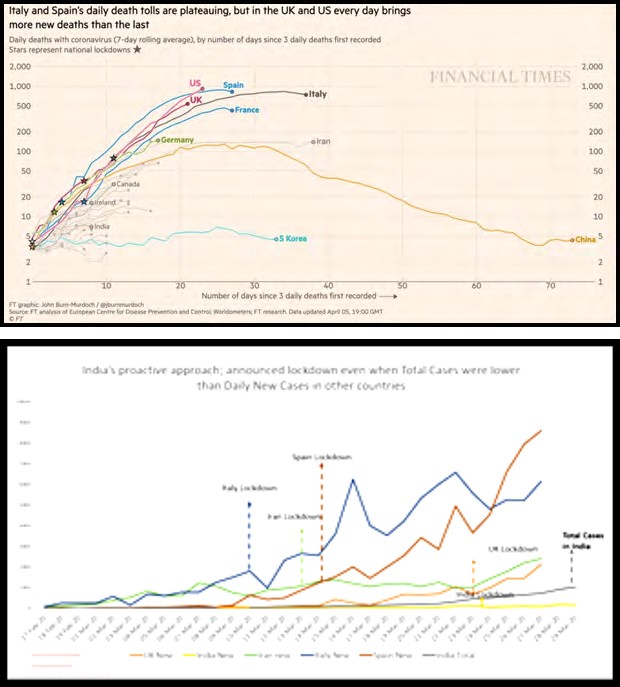
Graph 1: The graph showing world death rates during COVID-19. Source: R4vYJWZa99YuXZ06FYtHx94ztsrd11GvdI49lN-iG18, Accessed on April 07, 2020 The shift of human from hunting gathering to agrarian society and being settled has a marked effect on the spread of the disease and the frequency has increased dramatically [13]. The transport trade has created new avenues for human to human interaction that has sped up such epidemics to take the shape of Pandemic. There are certain known diseases namely malaria, tuberculosis, leprosy, influenza, smallpox that are known to us since ancient times. It is often quoted that civilization would help in developing and destroying.
The most civilized human became, the more likely pandemics would occur. Interestingly despite the persistence of disease we have experienced gradual reduction in mortality rate [14].
A significant threat to global Health is posed by diseases those are infectious, caused by viral pathogens [15]. The globe has faced a number of pandemic threats by different kinds of influenza virus, HCV and HIV.
Graph 2: Graph showing spread of COVID-19 in India and other countries. Source: www.investindia.gov.in/team-india-blogs/omparing-spread-corona-india-vis-vis-7-other-countrie, Accessed on 31st March, 2020.
Every one of us is aware of the fact that influenza virus or more specifically influenza-like virus has created many scares throughout the 20th century and Nations worldwide have come up with many strategies for preparing to fight such pandemics. There is innumerable development in biology, of which systems biology is known to be one of the finest global network analyses utilizing sophisticated software to make productive and predictive models [16]. Virus infections trigger the innate immunity and the innate immune host defenses while failure to such increases the infection. The integrated effort of genomics and proteomics together offer greater coverage of cellular and Molecular events during viral replication [17]. Similar viral exposure doesn’t have same impact on all individuals and thus we call it human variation, which might be result of genetic differences and ecological variation. Considering the potential impact of epigenetics of a disease, studies reinforce on the importance of intrinsic and extrinsic factors within the framework of biological approach clubbed with genetic inputs. The viral diseases and the viruses in particular have been the centre of science, agriculture and medicine for time immemorial and some of our greatest challenges have involved the research on virus. Take the example of smallpox, it has been one of such kind of a disease that was humankind’s greatest killer and has changed the course of history during the European times and it is also a kind of a disease which has been eradicated from the globe [18]. A number of minute viral infections have been prevented and controlled throughout the world with the use of vaccination and other public Health measures. It is also known that certain kind of world cancer burden is also a caused by viral infections and the human papillomavirus infections both can be prevented by vaccination which causes cervical cancer. During the medical and societal influence of a virus, we can say that viruses have always been our great teachers we have learn a lot of lessons from the viral attacks and the restrictions caused by the viruses. Understanding the biology of a virus, it is known that the replication is strictly dependent on the cell structure metabolism and the biochemical machinery of its characteristics [19].
The viral gene products interacts with the crucial regulatory nodes that controls the cell function of a body and it creates a situation that will facilitate the identification and characterization of these nodes and the networks that they control [20]. Gene silencing, transcription control and factors for transcription cellular oncogenes and suppressor proteins are known to be one of the very significant factors that can help in increasing the innate immune system of an individual. Viral genomes encode for the gene products that modulates the host defenses including the immune responses and an elaborate system that has evolved to protect us against the invading microorganisms like the virus [21]. Briefly mentioning that virology has always played a major role in the 20th century biology and a time has come when virologist should take a major role to substantiate their learnt knowledge and apply to eradicate the present pandemic situation. A time has come when a multidisciplinary approach to understand a disease is the need of the hour.
Thus the incorporation of various disciplines to understand the propagation and spread of such virus will help in understanding the characteristic of the disease as well as will be beneficial to eradicate it like we did in earlier times [22, 23, 24, 25, 26, 27, 28, 29, 30, 31, 32].
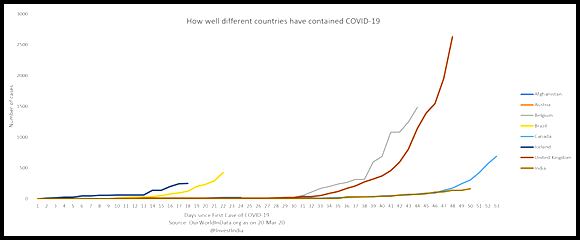
Source: www.investindia.gov.in/team-india-blogs/comparing-spread-corona-india-vis-vis-7-other-ountrie, Accessed on 25th March, 2020
Conclusion
Humans get inspired by the strength of the human spirit and we learn from the saga of mankind that how to be a better person, more sensitive, supportive, kind and loving to each other. This strength of human can become our strength to fight such pandemics. Meanwhile human are capable of forgetting the strengths in the times of need. When he would be reminded of the strengths in him he will become powerful too. We all are just like that if we know we have strength and focus on regaining them only then the entire community become powerful. When we are reading the spiritual and religious ancient texts we might have learn that nothing is negative everything is potentially positive.
Thinking of how we could change the negative forces into positive divine situation to defeat the pandemic potentially is the actual community strength. Coming to the biological conclusion the Coordination of Humanity throughout the world may strengthen the each country collectively in the context of emergency by ensuring each nation roles and responsibilities as a leader. The physical cooperation may work as a trigger point to rapidly reset attentiveness and response strategies during such epidemical emergencies. History says taking into account the leadership of India and its attentiveness in any pandemics always includes culturally and biologically, which should introduce an approach in further too to mobilize it widely. The inactive nature of modern life probably plays a significant role in the epidemic incidence of depression today since the human bodies are designed for regular physical activity. Having different religions, different languages, and different colored skin, we all share same human race and basic values which is the actual strength and will decide whether ‘the human rule over a microorganism or microorganisms ruled over multi- organism’…
References
-
Coltart CE, Lindsey B, Ghinai I, Johnson AM, Heymann DL (2017) The Ebola outbreak, 2013–2016: Old lessons for new epidemics. Phil Trans R Soc B 372(1721): 20160297.
-
Grimaud J, Legagneur F (2011) Community beliefs during a cholera outbreak intervention.
-
Hewlett BS, Hewlett BL (2007) Ebola, culture, and politics: the anthropology of an emerging disease.
-
Faregh N, Kemo S, Tounkara A (2016) Rethinking the role of culture in mental health after the Ebola epidemic | The Lancet Global Health Blog.
-
Hays JN (1998) The Burdens of Disease: Epidemics and Human Response in Western History.
-
Hays JN(2005) Epidemics and Pandemics: Their Impacts on Human History.
-
Catharine Arnold (1918) Eyewitness Accounts from the Greatest Medical Holocaust in Modern History, Handbook of Socialization: Theory and Research.
-
Barnard A (2007) Anthropology and the Bushman.
-
Pathak RK, Sinha AK (2008) Bio-social Issues in Health.
-
Mishra SK, Siva Prasad R, (2020) Displacement, Impoverishment and Exclusion: Political Economy of Development 48 (2): 312-315.
-
Aghadiuno M, Kalsi J (2017) Soul Matters: The Spiritual Dimension within Healthcare.
-
Brix (2010) 21st Century Anthropology: A Reference Handbook.
-
Spencer W (2017) The Journey of Man: A Genetic Odyssey.
-
Tellegen E, Wolsink M (1998) Society and its Environment: An Introduction
-
Evans T (2013) Viral Infections of Humans: Epidemiology and Control.
-
Walhout M, Vidal M, Dekker J (2012) Handbook of Systems Biology: Concepts and Insights.
-
Saraswathy N, Ramalingam P (2011) Concepts and Techniques in Genomics and Proteomics
-
Hopkins DR (1983) The Greatest Killer: Smallpox in History.
-
Chiu W, Burnett RM, Garcea RL (1997) Structural biology of viruses.
-
Walker EJ, Ghildyal R (2017) Viral Interactions with the Nucleus.
-
Carlos E (2005) Viral Genome Packaging: Genetics, Structure, and Mechanism.
-
Mishra AC, Chadha MS, Choudhary ML, Varsha AP (2010) Pandemic influenza (H1N1) 2009 is associated with severe disease in India. PLoS ONE 5: 10540.
-
Jared J (2014) Ebola, Emerging: The Limitations of Cultura list Discourses in Epidemiology. The journal of Global Health.
-
Peters A (2016) The importance of culture in managing epidemics: what Ebola can teach us about Zika – GCSP.
-
Margaret C (2009) World now at the start of 2009 influenza pandemic. Statement to the press by WHO Director-General Dr Margaret Chan. World Health Organization.
-
Banerjee A, Hollis A, Pogge T (2010) The Health Impact Fund: incentives for improving access to medicines. Lancet 375(9709): 166-169.
-
Bhattacharya D (2007) An exploration of conceptual and temporal fallacies in international health law and promotion of global public health preparedness. J Law Med Ethics 35(4): 588-598, 512.
-
Expert forecast on Emerging Biological Risks related to Occupational Safety and Health, European Agency for Safety and Health at Work (EU-OSHA), Luxemburg: Office for Official Publications of the European Communities, 2005.
-
Elbe S (2006) Should HIV/AIDS be Securitized? The Ethical Dilemmas of Linking HIV/AIDS and Security. International Studies Quarterly 50(1): 119-144.
-
Hick JL, Christian MD, Sprung CL (2010) Chapter 2. Surge capacity and infrastructure considerations for mass critical care. Recommendations and standard operating procedures for intensive care unit and hospital preparations for an influenza epidemic or mass disaster. Intensive Care Med 36(1): 11-20.
-
Takala J (2002) Introductory Report: Decent Work—Safe Work. Paper presented at the 16th World Congress on Safety and Health, Vienna.
-
UNAIDS 2006 Report on the global AIDS epidemic.
- The Indispensable Role of Informal Caregivers in Supporting the Aging Population
- Socio-Religious Significance of Kamakhya Temple in Guwahati, Assam
- Is Anthropology Possible?
- A Contribution to the History and Paleobiology of Harput/Elazığ Türkiye and Its Surroundings
- A Study on the Cowrie Shells of the Dimasas in Assam
- The Significance of International Organizations Cooperation in the Efficient Resolution of Global Conflict