
Eve or “Evolution”? : The Question of the Creation of Adam and Eve as the First Humans versus the Theory that Humankind “Evolved” (Self-Changed) Over Millions of Years
Inherent in the Creation (“Intelligent Design”) versus the Theory of Evolution (“natural selection”) War, is the scientific belief in the millennia-long “evolution” of humankind, versus the Christian belief in the creation of the Biblical Adam and Eve circa 7,700 B.C. This paper proposes that there is no such thing as an “evolution” of Earth’s life forms, with “evolution” being defined as self-adaptations over time to specific environments with physical modifications. Over the course of millions of years, God created then, re-designed all Earth’s life forms in successive stages, which accounts for the non-linear progression of said forms and particularly of humanoids. Integrating Mitochondria DNA and archaeological evidence with Judeo-Christian, Muslim and extra-Biblical texts, shows that after God created then re-designed pre-Adamic humans, He created the Biblical Adam and Eve circa 9,700 years ago during the Mesolithic Period as prototypes for present-day man. Moreover, archaeological evidence, plus Judeo-Christian and extra-Biblical texts, suggest that Eve and Adam co-existed with Homo sapiens during the Mesolithic/ Neolithic Periods.
Introduction
The debate over whether the Biblical account of how humans came into being is the correct one or if the scientific account is correct, began with the publication in 1859 of Darwin’s On the Origins of Species by Means of Natural Selection, or The Preservation of Favoured Races in the Struggle for Life. Charles Robert Darwin (1809-1882) proposed that all life on Earth, including human life, evolved – Conceptual Paper gradually and naturally developed and changed over a period of millions of years – and that since the beginning of life on earth, nature has selected only the fittest species to survive. Most scientists have adopted this Theory of Evolution while theologians, especially Christians, yet hold to the belief in the creation of Adam and Eve (circa 9,700 year ago) as the first humans. This paper brings a new perspective to the issue and thus attempts to reconcile the two beliefs by eliminating the boundaries that currently exist between them.
God Creates Primitive Man 7 Million Years Ago During the Pliocene Epoch of the Tertiary Period
The Biblical book of Genesis chronicles the first experiments in the creation of humankind and of man’s succession: And God said, ‘Let us make man in our image, after our likeness [utilizing the “mingled sperm drop” The Holy Qur’an] and let them have dominion over the fish of the sea, and over the fowl of the air, and over the cattle, and over all the earth, and over every creeping thing that creeps upon the Earth.’ So God created man in His own image, in the image of God created He him; male and female created He them. And God blessed them, and God said unto them, ‘Be fertile, and increase, replenish the Earth and master it, and rule the fish of the sea, the birds of the sky, and all the living things that creep on the Earth’ (Genesis 1: 26-28).
According to God’s design, the animal “man” would be a symmetrically-shaped biped, and thus be more like the deities (“in our image”) than were God’s other animals. It would inhale oxygen and exhale carbon dioxide, live primarily on the dry land, reproduce sexually, and be at the top of the visible food chain. The phrase “in our image” meant that 7 million years from his inception, the end product (Homo sapiens sapiens – Adam and Eve and their descendants) would be highly intelligent and similar to the gods (angels) in appearance. On the other hand, man would be made from “dust,” inhale oxygen and exhale carbon dioxide, be able to tolerate direct exposure to sunlight, and for the next 7 million years, be ground bound.
The Biblical verses cited above appear before those that chronicle the creation of Adam and Eve, and indicate that other human-like beings were created prior to that and they thus existed outside the Garden of Eden. These passages (Genesis 1:26-28) clearly indicate that a number of humans (“male and female…them”) who engaged in sexual reproduction (“fruitful/fertile”) were created and thereby “increase [d]” their numbers. Moreover, the words them and male and female are utilized suggesting the two genders were created simultaneously. The word replenish is a clear indication that God had created, or formed, successive species of man as replacements for the earlier species of primitive man (whom He systematically eliminated) but before the end product, Adam and Eve, were formed. Contrary to what many scientists believe, humankind did not “evolve” or self- change, over millions of years. Enoch wrote:
The Lord with his own two hands created mankind: in a facsimile of His own face, both small and great, the Lord created them. And whoever insults a person’s face, insults the face of a king, and treats the face of the Lord with repugnance. He who spits on a person’s face insultingly, will reap the same at the Lord’s great judgment. (The Old Testament Pseudepigrapha, 2 Enoch 44:1-3, excerpts) During the Miocene and Pliocene Epochs (26 MYA - 5 MYA), there existed a much greater diversity of apes than does now exist. 10 million years ago, there were no less than 50 varieties of apes (compared to only four today, excluding the human), and many more forests in which to house them. Earth, at that time, was indeed a planet of apes. That was when God first thought to create man, as it would require the passing of many millions of Earth years to perfect an articulate, intelligent Earth being that could exist and thrive in the flesh. During one of his visits with God, Enoch saw “the first human ancestors and the righteous ones of old dwelling in that place.” (ibid) God told Enoch that “every kind of soul that breathes the breath of all living things” was created on the 5th Day; this must include primitive man. Between 8 and 7 million years ago, God eliminated most of the ape species from Earth. During the Upper Pliocene Epoch, God infused the eggs of the four remaining species of female apes with a miniscule percent of Divine DNA. Thus, about 7 million years ago, He created primitive forms of mankind, with four variations of hybrids existing simultaneously; He did this in order to field-test them and try each for suitability factors. Early man did not have the power of articulate speech and therefore, did not have a spoken language. It is written in The Holy Qur’an, Chapter 76 (Al-Dahr) verse 3: “We have created man from a mingled sperm-drop that We might try him; so We made him hearing and seeing.” Until recently, fossil evidence had suggested that the earliest form of man to walk upright habitually was australopithecus afarensis (AKA “Lucy”) created some 4 million years ago in Ethiopia. In February 2005, the bones of another bipedal hominid were discovered in the wooded grasslands of the Horn of Africa at a site called Mille. The fossilized remains of this hominid also date back to 4 million years. However, a skull was recently discovered in the desert of Chad (central Africa) that dates the earliest experiment with upright walking back to 7 million years. Some anthropologists have concluded that this was a pre- human skull while others believe that it was not, because the bone structure does not line up with an orderly progression of human “evolution.” This hominid would have lived during the Middle to Upper Pliocene Epoch.
Although approximately 8 million years ago God changed many forests into grasslands, 7 million years ago Chad was yet a dense forest. Anthropologists and paleontologists have now come to realize that early mankind lived in a variety of environments, including dense forests (and not just on the grasslands as was previously believed), that early man branched off in many different directions, and therefore, that several species of humans existed simultaneously. God’s first pre-human creatures, who with subsequent genetic manipulations would become modern man 7 million years in the future, would be theoretically, at the top of the food chain and would be rendered more intelligent than any other life form on Earth.
God Re-Designs Mankind Over Millions of Years and, in Time, Places Them Over “All The Earth”
Over the course of millions of years, God selected the most desirable physical traits of this bipedal and increasingly hairless creature, whose origin was always on or near the African continent -- the warmest of all Earth sectors. The African continent was the one continent with enough diverse landscapes upon which the various species of pre- humans could be tried and tested, and up until the creation of Adam, was always ground zero for human advancement. Anthropologists generally separate the main species of the Homo family into the following categories: Homo rudolfensis, Homo ergaster, Homo habilis, Homo erectus, Homo antecessor, Homo heidelbergensis, Homo neaderthalensis, and Homo sapiens (“wise man” or, early-modern man). Moreover, the dating of habilis and erectus fossils discovered in 2000 near lake Turkana in Kenya, indicate that the existence of the two species overlapped: The erectus skull dated back to 1.55 MYA, and the habilis skull to 1.44 MYA, destroying the previously-held belief that man “evolved” in and orderly progression, “one after the other…Instead, they apparently lived side by side in Eastern Africa for almost half a million years” [1].
Over time, God gradually increased the amount of Divine DNA of all subsequent species of man (while retaining the more efficient traits of the earlier models) and at the same time restructured humankind’s physical self. There simply are no “missing links” between the ape and primitive man, or between the successive or the co-existing species of man that God created; therefore, the theory of self-willed, spontaneous physical evolution – physical evolution brought about by environmental changes – is null and void. If humans were able to bring about physical changes at will, those who desire to be, for example, taller and/or thinner would will their bodies to change. Humans would create for themselves the “perfect” bodies and live far beyond normal life expectancy, and far longer than God intends. Another fact that obviates the Theory of Evolution, or the ability for plants and animals to self-change, is that humans of European descent have been living in Africa and other sun-drenched regions for centuries now and have not “evolved” the short, curly hair, the dark- colored eyes, the melanin, the thicker skin and the mostly- hairless bodies of the indigenous peoples – those traits that God bequeathed upon them to enable them to thrive in that environment.
Genesis 1: 26 – 28 appear chronologically, before the account of the Creation of Adam and Eve, which does not appear until Chapter 2, verse 7 (for Adam), and Chapter 2 verses 21 and 22 (for Eve). Adam and Eve were not created until the 7th Day, approximately 9,700 years ago during the early Mesolithic. In addition, Adam was created, then placed in a botanical garden specifically “to dress it and to keep it”, and the Garden only (Genesis 2:15). Moreover, God did not tell Adam and Eve to “be fertile and increase; replenish the earth and master it.” Finally, there were no “fish of the sea” or “fowl of the air” in the “enclosed”, self-contained botanical garden. The “living creature[s] that Adam named were “brought” or transported to him (Genesis 2:19).
Chronologically speaking, Genesis 2:4-7 could be attached to immediately follow Genesis 1:29. It would thereby read the following way: So God created man in His own image, in the image of God created He him; male and female created He them. And God blessed them and God said unto them, ‘Be fruitful, and multiply, and replenish the earth, and subdue it: and have dominion over the fish of the sea, and over the fowl of the air, and over every living thing that moves upon the earth’. And God said, ‘Behold I have given you every herb bearing seed, which is upon the face of all the earth, and every tree, in the which is the fruit of the tree yielding seed; to you it shall be for meat’. [Attach Genesis 2:4-7] These are the generations [successive developments] of the heavens and of the Earth when they were created. In the day that the Lord God made the Earth and the heavens, and every plant of the field before it was in the Earth, and every herb of the field before it grew: for the Lord God had not caused it to rain upon the Earth, and there was not a man to till the ground. And the Lord God formed man of the dust of the ground and breathed into his nostrils the breath of life; and man became a living soul.
Verse 27 cites “God created man” which carries with it the plural connotation of mankind. The word Aadam is Babylonian in origin and was a generic name for all humankind. In support of this, in The Bible Library: Strong’s Hebrew Old Testament Dictionary, the word adam was translated to mean either “an individual or the species” (Reference # 120). However, in further consulting Strong’s Hebrew Old Testament Dictionary, Reference # 1254, indicates that “created He them” transliterates from bará, meaning “a primitive root.” This means that God created primitive mankind before he created the singular, first true human being referred to in the Bible as Adam, a genetic upgrade from Homo sapiens [2].
The “dust” of which the human body is composed, is carbon mainly (which along with water is present in all chief molecules of the human body) but also hydrogen, nitrogen, oxygen, calcium, iron, phosphorous, potassium and sodium. The first experiment in the creation of the animal “man” began approximately 7 million years ago between the Pliocene and Pleistocene Epochs (near the end of Earth’s Fifth Age), and ended with the creation of early-modern man near the end of the Pleistocene Epoch, or the Sixth Age, the 6th Biblical day. In that “Day” (Genesis 2:4) or Age – between the Pliocene and Pleistocene Epochs – the earth, “the dust,” was rich with those elements of which mankind was formed. Apes are comprised of the same elements but differ from humans in DNA sequencing. During the Upper Pliocene Epoch, God infused the eggs of the four remaining genera of female apes with a miniscule percent of Divine DNA. Thus, about 7 million years ago He created primitive forms of mankind (the so-called “fifth ape”), with four variations of hybrids existing simultaneously; He did this in order to field-test them and try each for suitability factors. In retrospect, some fossils that have been classified as “ape” by anthropologists were those of a very primitive “man” to God. The split from ape, meaning the hybridization that led to the creation of modern man, came about due to genetic manipulation — the application of the “mingled sperm drop.” It is written in The Holy Qur’an, Chapter 76 (Al-Dahr) verse 3: “We have created man from a mingled sperm-drop that we might try him; so we made him hearing and seeing.” Early man did not have the power of articulate speech and therefore, did not have a spoken language.
God created primitive humans to inhabit every area of Earth (“all the earth”) and not just the Garden of Eden. Before Adam and Eve, primitive man did inhabit “all the earth” beginning in Africa, and was transported to the east of that continent and then, to the west into the area now known as the Americas. From the Americas, humans were later transported to the northernmost regions of Earth as ice sheets retreated northward and climates became warmer.
God developed all the species of flora intended to grow upon the surface of Earth in His space station’s bio-lab before He transplanted them to Earth, and before the advent of mankind, for as God disclosed to Enoch: “…before I created living souls, I prepared food for them.” (Old Testament Pseudepigrapha, 1 Enoch, 30:1) God “prepared food” for man (as well as for all His other living creatures) prior to their creations. When God did transplant His Garden to Earth as a “paradise,” it was expansive and was located on a mountain plateau. Taking samples from this Garden, God and His angels further transplanted “every plant…and every herb” to pre- determined areas of Earth as food for his living creatures.
God Creates Adam and Eve circa 9,700 Years Ago
During the Upper Paleolithic and early Mesolithic, only Homo sapiens existed outside the Garden of Eden: “…there was not found a help meet” for Adam, means there were other humans, but no other human was his intellectual equal.
And the Lord God caused a deep sleep to fall upon Adam, and he slept [was anesthetized]; and He took one of his ribs and closed up the flesh instead thereof. And the rib, which the Lord God had taken from man, made He a woman, and brought her unto the man. (Genesis 2:21-22) God anesthetized Adam and performed an operation on him. He extracted the advanced DNA from Adam’s bone marrow, separated the dual principle with which Adam was created, then, used his DNA to clone a female counterpart. Colonel Churchward’s discovery of the “Tale of Creation” garnered from “Oriental Naacal writing, supplemented by the Mexican Tablet # 1584” reveals the following information:
Man was created with the dual principle, male and female. The Creator caused this man to pass into a sleep, and while he slept, the principles were severed by Cosmic Forces. When he awoke, he was two: man and woman (1972, 72-74) [3].
Churchward further recounts strikingly similar tales told by the ancient Egyptians, the Hindus, the Chaldeans, and the Hawaiians. For example the Hawaiian creation “myth” chronicles the creation of the prototype of present- day humans that is very similar to that written in the Bible: “Toaroa made man out of red Earth, Araca, and breathed into his nostrils. He made woman from man’s bones and called her Ivi” (75).
After Adam transgressed God’s commandment to not eat of the fruit of “the tree,” He first expressed His disappointment with Adam’s behavior then, revealed to Adam His purpose for creating him as a new species: “For I made thee of the light; and I willed to bring out children of light from thee and like unto thee.” (Lost Books of the Bible, Book I: Adam and Eve, 13:14).
This dynamic duo, Adam and Eve, were perpetual youths; both were apparently cloned, nurtured in a virtual reality laboratory then, placed in the botanic Garden after they had developed to the adolescent stage; they were adolescents by present-day standards. In The Old Testament Pseudepigrapha, the Sibylline Oracles, Book I, Lines 23-34 read:
And then later He [God] again fashioned an animate object, making a copy from his own image, youthful man, beautiful, wonderful. He bade him live in an ambrosial Garden, so that he might be concerned with beautiful works. But he being alone in the luxuriant plantation of the Garden desired conversation, and prayed to behold another form like his own. God himself indeed took a bone from his flank and made Eve, a wonderful maidenly spouse, whom he gave to this man to live with him in the Garden. And he [Adam], when he saw her, was suddenly greatly amazed in spirit, rejoicing, such a corresponding copy [clone] did he see. They conversed with wise words which flowed spontaneously [super intelligently], for God had taken care of everything.
The Apocrypha: Book II Esdras, Chapter 3:5-6 read [4]:
And [God] gavest a body unto Adam without soul, which was the workmanship of thine hands, and didst breathe into him the breath of life, and he was made living before thee. And thou leddest him into Paradise which thy right hand had planted before ever the earth came forward.
In the day that the Lord God made the Earth and the heavens, and every plant of the field before it was in the Earth, and every herb of the field before it grew; for the Lord God had not caused it to rain upon the Earth, and there was not a man to till the ground. But there went up a mist from the Earth, and watered the whole face of the ground. And the Lord God formed man of the dust of the ground and breathed into his nostrils the breath of life; and man became a living soul. And the Lord God planted a Garden eastward [meaning a location that derived the greatest benefit from the rising sun] in Eden; and there he put the man whom he had formed. (Genesis 2:4- 8) When man became a “living soul” he became self- actualized and self-aware, and was endowed with free will. Adam was a special creation, superior to the human species that existed outside the botanic garden, as is noted in Genesis 2:20: “For Adam there was not found a help meet for him.” Therefore he was the only advanced species of man on Earth until Eve was created. At the time Adam was “formed” he was upgraded from the most advanced line of extant humans who have been dubbed Homo sapiens. This transformation from Homo sapiens (wise man) to Homo sapiens sapiens (very wise man) was effected through additional processes of genetic manipulation, or specifically through an increased dose of Divine DNA, which currently amounts to about 2.4% removal from ape DNA [5].
Tanakh: The Holy Scriptures and the Bible (KJV) state that there was no female or mate equal to Adam at the time of his creation. In Tanakh: The Holy Scriptures it is written: “...but for Adam no fitting helper was found” and the Bible states: “...
but for Adam there was not found a help meet for him.” These passages clearly indicate that God did search for another human intelligent enough to equal Adam’s special abilities; this further corroborates that other humans did exist outside the Garden [1].
The common animals – the “beast [s] of the field” – did not reside in the botanic Garden. They were “brought…unto Adam,” or transported to that area, named and classified by Adam, then transported back to their respective habitats. Over the course of time, as God continued his successive re- engineering of animal and plant life on Earth, Adam named “every living creature” that existed during the Mesolithic/ Neolithic Periods, which followed the last Ice Age. This unique man, Adam, was a scientist, to whom God had given special knowledge of what is today called biology and zoology:
And out of the ground [from the earth and fossils] the Lord God formed every beast of the field and every fowl of the air; and brought them unto Adam to see what he would call them: and whatsoever Adam called every living creature, that was the name thereof. And Adam gave names to all cattle, and to the fowl of the air, and to every beast of the field. (Genesis 2:19-20) After Adam and Eve violated God’s commandment to them and were banished from the Garden, Adam said to Eve, “We no longer belong to the inhabitants of the Garden; but henceforth we are Earthy as of the dust, and of the inhabitants of the earth” (Lost Books of the Bible: Book I: Adam and Eve, 65:9). Because the animals of the earth are invariably referred to as “beasts” throughout these books, the word “inhabitants” can only mean that other humans existed on Earth.
Genesis 4:14-15, lend support to the theory that other humans besides Adam, Eve, and their children existed on Earth:
And the Lord said unto him [Cain] ‘Therefore whosoever slays Cain, vengeance shall be taken on him sevenfold.’ And the Lord set a mark upon Cain, lest any finding him should slay him.
These other humans were Homo sapiens, or early- modern man, who were mute and illiterate. Speech and written language, as well as large-scale, organized warfare, did not come into existence among humankind until after the creation of the Biblical Adam and Eve and the advent of their descendants. Written language would come about around 5,000 B.C.E. (3,000 B.C.) after the Biblical Flood and after the fallen angels would re-establish themselves as the gods of Earth.
It is written also in Lost Books of the Bible, Book I: Adam and Eve that, after Adam and Eve were banished from the Garden of Eden, they were distraught and no longer wanted to live. God explained to Adam that Jesus would come to Earth and “save him and his seed…in 5 days and a half” meaning “…5,000 years and a half of that, further meaning 7,500 years. (3:3 and 6) Although the “half” was translated by the editor to mean half of a thousand, it is more likely that the “half” means half of 5,000. The date of the creation of Adam and Eve must also include the time that they spent in the Garden, which was “five and a half hours” in the realm of the heavenly hosts (Old Testament Pseudepigrapha, 2 Enoch 32:3). “One day is with the Lord as a thousand years, and a thousand years as a day” (2 Peter 3:8). If a thousand Earth years is equal to one day in the realm of the heavenly hosts, then 5 ½ hours is equal to about 229 years of Earth time. Putting all this together, between 9,800 and 9,700 years ago is an accurate date of creation for Adam and Eve. During this time, the Upper Paleolithic/Lower Mesolithic, humans created before Adam and Eve were yet hunter-gatherers.
And God said: ‘Behold I have given you every herb bearing seed, which is upon the face of all the Earth, and every tree, in the which is the fruit of a tree yielding seed; to you it shall be for meat. And to every beast of the Earth, and to every fowl of the air, and to everything that creeps upon the Earth, wherein there is life, I have given every green herb for meat’: and it was so. And God saw everything that He had made, and behold [after complex analysis] it was good [the Earth had reached homeostasis]. And the evening and the morning were the sixth day. (Genesis 1:29-31) After their banishment, God transformed Adam so that he would be physically bigger and stronger (Lost Books, Book I: Adam and Eve, 4:2), then informed them that they would now have to grow their own food (become farmers) and thus provide for themselves:
And you shall eat the herb of the field; in the sweat of your face shall you eat bread…therefore the Lord God sent him forth from the Garden of Eden, to till the ground from whence he was taken. (Genesis 3:18, 19-23) God and His angels either directly instructed humankind, or indirectly gave their “hearts wisdom” (Lost Books, Book I: Adam and Eve, 66:8-10) as to which plants and foods were edible and useful to them, and which were not. For example, by 7,000 B.C.E. (9,000 years ago), flax was being cultivated and raised, not for food, but for linseed oil and for linen to be used as clothing. Information disseminated to humans by an advanced species (e.g., expert angel botanists) was the only way that early farmers could know that this banal-looking plant could be so valuable.
In addition, early farmers needed to be instructed about exactly when to harvest this plant. If fiber flax is harvested too early, its fibers will be too weak to spin into yarn, and if harvested too late, the fibers will be stiff, rough, and useless:
The first farmers didn’t have any existing crop as a model to inspire them to develop other ones. They couldn’t have been conscious that, whatever they were doing, there was a tasty result ahead. Why did olive trees yield to Stone Age farmers, while to this day oaks continue to outwit our best and brightest botanists? Wild almond seeds contain an intensely bitter chemical called amygdalin, which breaks down to yield poison cyanide. A snack of wild almonds can kill a person foolish enough to ignore the bitter taste. Lima beans, potatoes, and eggplants are among many other familiar crops whose wild ancestors were bitter and poisonous…there were changes that could not have involved such conscious choices, because in these cases the plant features being selected for were invisible [6].
After the initial planting, it takes olives, figs, dates, and pomegranate crops three years for minimal production, and up to ten years for full production. Moreover, the cultivation of apple, cherry, plum, and pear trees requires “grafting,” a complicated and difficult process “a highly conscious enterprise, carried out according to explicit rules that the Romans described in encyclopedia treatises” (ibid 105). Yet, all these foods mentioned here, and many others, were planted, correctly harvested, and consumed widely by ancient farmers and their families by 3,000 B.C. E. (5,000 years ago).
Berossus [7], who lived after the Biblical account of the Flood was written in Hebrew, and around the time of Alexander the Great (356-323 B.C.E.), was chief priest/ historian for Antiochus I, and to the gods of ancient Babylon, particularly Marduk, the chief god. Jewish historian Flavius Josephus in his Antiquities refers to him as “Berosus the Chaldean” and as being one of the “writers of barbarian histories” (32) especially concerning the Flood. Three of Berossus’ books on Babylonian history were published during the time that Antiochus II ruled (261-246 B.C.E.), particularly those that had been adapted from the writings of other ancient priests, and then preserved in the temple of Bel at Babylon. In his History of Babylonia, Berossus wrote that after the global Flood, a being called Oannes emerged from the Persian Gulf and gave the ancient Babylonians seeds to plant, then schooled them in all aspects of farming. In addition, Oannes informed them about all vegetation that was edible and that which was harmful to humans [8].
“But when Adam and Eve went out of the Garden, they trod the ground on their feet, not knowing they were treading” (Lost Books, Book I: Adam and Eve, 2:1). This means that, while they were in the Garden, they were literally light on their feet as the gravitational force there was indicatively, less than that in the realm of the other humans who existed outside the Garden. After they left the Garden, God started Eve’s ovulation and menstrual cycle so she would be able to conceive and bear children. Because she would become the primary caretaker of her and Adam’s offspring, God then reduced her duties so as to free up more of her time for breastfeeding and nurturing. When God told Eve that her desire should be to Adam “and he shall rule over you,” He was speaking to her, and to her only, because of what she had done; God knew that this new system would work better for the two of them. God did not decree that all men of all time should dominate, deny, abuse, and persecute women.
While they lived in the Garden of Eden, Eve was called merely “woman.” After she was rendered capable of bearing offspring, Adam gave her the name “Eve, because she was the mother of all living [present-day humans]” and DNA evidence suggests that she is. “Now a woman is called in the Hebrew tongue, Issa; but the name of this woman was Eve, which signifies the mother of all living” [9].
God told them both that they would eventually die a physical death. He next instructed an angel to make “coats of skin” for them to protect their own sensitive “skin” that was spread over them so “it may bear cold and heat.” And Adam called his wife’s name Eve because she was the mother of all living. Unto Adam also and to his wife did the Lord God make coats of skins and clothed them. (Genesis 3: 14-19) That happened around 9,600 years ago, when Earth was yet recovering from the previous Ice Age, when median temperatures were considerably lower in the Middle East than they are now, and when the inhabitants of Mesopotamia wore coat-like garments.
Because this species of man had failed its test, and was not yet spiritually perfected, and therefore not yet ready to “live forever” or to be immortal in its present form, it was necessary to keep it away from the tree of immortal life (Genesis 3:22). God expelled them from the Garden then placed a mechanized guard (a “cherubim”/robot) at the entrance (on the eastern side) to keep them from getting back in:
And the sword of the cherub seemed to flame afar off. But when he raised it over Adam and Eve, the flame thereof did not flash forth. Therefore did the cherub think that God was favourable to them, and was bringing them back into the Garden. He could not go up to Heaven [the space station] to ascertain God’s order regarding their getting into the Garden; he therefore abode standing by them, ...for he was afraid lest they should enter the Garden without leave from God, who then would destroy him [10].
The word “heaven” is derived from the Hebrew word shamayim, which means “heights,” “elevations,” “high places,” “sky,” “aloft,” and “the higher ether1 where the celestial bodies revolve” (Strong’s Hebrew Dictionary, Reference #’s 8064 and 8065). Soon, other cherubim and angels embarked from the “kingdom of heaven,” came down to Earth, and landed in the Garden:
At that time the heavens and the Earth shook [landing shuttle]; and other cherubim came down from heaven to the cherub who guarded the Garden...Then, again, other angels came down nigh unto the place where Adam and Eve were. (ibid. 54:9-10) Their pronouncements were that God had decreed that Adam and Eve were not to be allowed to re-enter the Garden. Adam, an authentic superman, was 130 (biologically equivalent to age 13) when Seth was born, as a verse in the book of Genesis corroborates (Genesis 5:3). Adam and Eve were endowed with special abilities and powers above and beyond those of Homo sapiens – powers that gradually evanesced after they disobeyed God’s directives to them. In The Old Testament Pseudepigrapha, 2 Enoch, 30:12, it is written that God spoke to Enoch about how He had created Adam [11].
I created him [Adam] from the invisible [sub-atomic particles] and the visible [physical matter]...and I placed him on Earth, a second angel, honorable, great and glorious, and I appointed him as ruler to rule on Earth and to have my wisdom, and there was none like him on Earth of all my existing creatures.
Then God the Lord said unto Adam, ‘When you were under subjection to Me, you had a bright nature within you, and for that reason couldst you see things afar off. But after your transgression your bright nature was withdrawn from you: and it was not left to you to see things afar off, but only near at hand; after the ability of the flesh; for it is brutish.’ (Lost Books, Book 1: Adam and Eve, 8:2) [10].
Although the normal functioning of the human eye is amazing (it provides full color and stereoscopic vision, enables humans to detect low objects up to 15 miles away, and to almost simultaneously focus sharply on up- close images), it limits humans to the perception of three- dimensional images and only of those objects that reflect light. The angels, who were “cut from the fire” are made of pure light, and therefore in their spiritual form, cannot and do not reflect light. Initially, God had endowed the eyes of Adam and Eve with superior powers of visual accommodation so they were able to see “afar off” as well as to see the angels that co-existed with them while they were inside the Garden. However, after they were banished, their vision was altered: “Then Adam, when he heard the word of God and the fluttering of the angels whom he did not see, but only heard the sound of them with his ears, he and Eve wept.” (55:2) Other supernatural attributes of Adam and Eve were also altered. God explained to them:
But when I heard of your transgression, I deprived you of that bright light. Yet, of My mercy I did not turn you into darkness, but I made you a body of flesh, over which I spread this skin, in order that it may bear cold and heat. (23:7) Adam further describes the traumatic deterioration of his super-human powers:
Then Adam, when he heard the Word of God, and the fluttering of the angels whom he did not see, but only heard the sound of them with his ears, he and Eve wept, and said to the angels: ‘O spirits...when I was in my former bright nature, then I could see you...But now that I have transgressed, that bright nature is gone from me, and I am come to this miserable state. And now am I come to this, that I cannot see you, and you do not serve me as you were wont, for I am become animal flesh’ (55:2-4).
Several months passed before Adam and Eve ceased their attempts to re-enter the Garden of Eden. According to Lost Books of The Bible, Book II: Adam and Eve, they were devastated and hung around the entrance for months pleading with God to let them back in, but He refused. Still possessing some superhuman capabilities, they did not sleep, drink, nor eat for months, as they appealed to God for a second chance. They resided in a nearby cave -- The Cave of Treasures -- (as Homo sapiens resided mainly in caves) never sat or lay down, but stood for many days and nights in prayer. They were yet very much like God’s angels who also never sit. For the first time they witnessed the falling and rising of the sun and felt the changes in weather and temperature; as time passed, they experienced hunger, weariness, sleepiness, fear, worry, anxiety, and pain:
And Adam said to God, ‘While I was in the Garden I knew neither heat, nor languor, neither moving about [walking on the ground], nor trembling, nor fear; but now since I came to this land [beyond the gate] all this affliction has come upon me.’ (Lost Books of the Bible, Book I: Adam and Eve, 22:3) [10].
Gradually, however, Adam and Eve became accustomed to all the physical, physiological, and psychological vicissitudes of life that Homo sapiens had long since taken for granted. God commanded them to go inside a cave and eat the giant figs that He had provided for them. However, they were afraid to eat “earthly food…lest if they ate, their stomach should be burdened and their flesh thickened, and their hearts take to liking earthly food.” (Book I: Adam and Eve, 64:4).
Then God looked upon them, and at once fitted them for eating food, so that they should not perish. And they both knew from that hour that they were altered beings, for that now their bodies had strange functions; and all flesh that requires food and drink for its existence, cannot be in the garden (65:6-8). Then they arose, and went to the bank of the stream of water, that was on the south border of the garden. Then the word of God came to Adam and said unto him, ‘O Adam, your body is become brutish, and requires water to drink. Take you and drink…’ (66:2-3).
As Satan wasted no time in attacking the two while they were at their weakest, God sent an angel, or “Lord” to teach, protect, and look after them until they became unaccustomed to the lifestyle in which everything had been provided for them, and in which they had had no cares or concerns. A few months later, Adam and Eve became farmers:
And they went down to a land of dark soil, and found there, corn, growing in the ear and ripe, and figs to eat…and God gave Adam’s heart wisdom, to work out the corn until it became bread [cornbread]. He returned to the cave rejoicing at what he had learned of what is done with wheat, until it is made unto bread for one’s use (66: 8-10).
Adam then petitioned God’s permission to marry Eve, and his request was granted. Adam and Eve were instructed to fast for 40 days and nights before the wedding, which they did, so their union would be “pure and undefiled.” Their guardian angel advised Adam to present to Eve wedding gifts of gold, incense, and myrrh, married them in the sight of God, and instructed them in sexual intercourse: “Be ye, thou and she, one flesh” (73:4). At this point in time, after over 100 Earth years had passed, and after she had reached the biological equivalency of age 12, Eve’s menstruation/ ovulation cycle began. And after having also lived for over 100 years and after also having attained sexual maturity, “Adam knew Eve, his wife; and she conceived and bore Cain, and said, ‘I have gotten a man from the Lord.” (Genesis 4:1). The angel that God dispatched to help Adam and Eve adjust to life outside the Garden continued instructing them on how to grow and harvest their own food:
And they dwelt on the Earth working, in order to continue in the well-being of their bodies; and were so until the nine months of Eve’s childbearing were ended, and the time drew near when she must be delivered…And God looked at His
maid-servant Eve, and delivered her, and she brought forth her first-born son, and with him a daughter (The Lost Books of the Bible, Book I: Adam and Eve, 74:1-5).
Josephus wrote it this way: “Adam and Eve had two sons; the elder of them was named Cain; which name when it is interpreted, signifies a possession. The younger was Abel, which signifies sorrow. They had also daughters” (Antiquities, Book I: Chapter 2, v. 1, p. 31).
Anatomist Alan Thorne became intrigued enough with the discovery of Australian Aborigines, Mungo Lady and Mungo Man, that he ordered tests to be conducted on these and other Mungo fossils, and published the results in January 2001. The first discovery was that the Australian Aborigine fossils dated back to 60,000 years. Geneticist Gregory Adcock of Australian National University then extracted the DNA from the interior of the bones in a manner so as to avoid contamination. He “compared mitochondria DNA from an early-modern Australian” [Mungo Man] with that of the mitochondria DNA of contemporary man, and they did not match. Furthermore, “His [Mungo Man’s] mitochondria DNA signature did not match anyone’s, living or fossil, on Earth. There was no evidence that he was genetically related to ancient Africans” [12]. Anthropologist Alan Mann of Princeton University remarked: “The people of Mungo were totally modern looking and were expected to carry the DNA we have, but they didn’t” (ibid, 56).
Plainly speaking, because mankind today is descended for Adam and Eve by way of the Biblical Noah, thoroughly- modern man does not have the same mitochondria DNA, as did ancient humans. All Homo sapiens, as well as the descendants of Cain, were destroyed during the sixth extinction -- the Biblical Flood. After this minor extinction of life on Earth, there was left only one species of man, the family of Noah, of the line of the Biblical Adam and Eve. God made Adam, and later Noah, different from other extant humans -- the Homo sapiens. Noah was specially rendered with a varied enough gene pool so his descendants would be able to successfully re-populate and thrive in the various climates and ecosystems of Earth. Based on the DNA evidence cited above, it is suggested here that all present-day humans are descended from the Biblical Noah, are of Adam and Eve’s blood, and are therefore, all literally the children of Adam and Eve. And thus began the saga of thoroughly modern man.
God Destroys All Humankind except Noah and His Family
And it came to pass, when men began to multiply on the face of the Earth, and daughters were born unto them, that the sons [creations] of God saw the daughters of men that they were fair; and they took them wives of all which they chose. And the Lord said: ‘My Spirit shall not always strive with man, for that he also is flesh: yet his days shall be a hundred and twenty years.’ There were giants in the Earth in those days: and also after that, when the sons of God came in unto the daughters of men, and they bare children to them, the same became mighty men which were of old, men of renown. (Genesis 6:1-4) During the time when H. s. s. began losing his longevity, or the Lord’s “spirit,” God decreed that the ministrations of man’s physical body could yet maintain the “flesh” for up to 120 years. “The sons of God” as they were called in the Bible, were His creations, referred to as the “Watchers” in the books of Enoch. Corroborating evidence of the existence of giants during the Mesolithic and Neolithic Periods is found in The Old Testament Pseudepigrapha, 1 Enoch 7:1-6 [10].
And they took wives unto themselves, and everyone (respectively) chose one woman for himself, and they began to go unto them. And they taught them magical medicine, incantations, the cutting of roots, and taught them (about) plants. And the women became pregnant and gave birth to great giants whose heights were three hundred cubits. These (giants) consumed the produce of all the people until the people detested feeding them. So the giants turned against the people in order to eat them. And they began to sin against birds, wild beasts, reptiles, and fish. And their flesh was devoured the one by the other, and they drank blood. And then the Earth brought an accusation against the oppressors.
Greek poet Hesiod [13] (700s B.C.E.) in his Works and Days (1914) espoused that there were four main Ages of the new man. The interpretation here of Hesiod’s Ages is unlike the traditional ones that correspond to the archeological Ages that include the Neolithic’s Iron Age (1,500 to 1,000 B.C.). Besides, Hesiod wrote his Works and Days millennia before present-day archaeologists established the Paleolithic, Mesolithic, and Neolithic Ages of man. The Ages that Hesiod wrote about seem to correspond precisely to what happened to Adam and Eve and their descendants [13].
The first Sibyl prophesied about the five “generations” of humans (from Adam through Noah) that existed before the Biblical Flood. The chronological events described in The Old Testament Pseudepigrapha, 1 Sibyl, of the Oracles, Lines 65- 216, corroborate precisely with Hesiod’s “Ages” and with the Biblical account of what happened on Earth from the time of the Creation of Adam and Eve to the advent of the Flood.: “And God saw the wickedness of man was great in the Earth, and that every imagination of the thoughts of his [man’s] heart was only evil continually” (Genesis 6:5). God then made the decision to destroy all humankind (by way of a global Flood around 5,500 B.C.E.) except Noah and his family. (Genesis 6:8 and Genesis 7)
Archaeological Evidence Corroborates the Biblical Flood
William Ryan and Walter Pittman [14] are senior scientists at the Lamont-Doherty Earth Observatory at Columbia University. During their remarkable careers, they have conducted extensive research in marine biology, including research into the possibility of an ancient global deluge. In their book, Noah’s Flood, they wrote that as a result of “the dating of the shells belonging to the first marine mollusks to enter and colonize the drowned rim of the Black Sea,” that they were able to give “a precise age for the flood” (Pittman & Ryan 2000, 152). Explorer Robert Ballard radiocarbon dated shells collected, or dredged, from the sea bottom. The oldest freshwater shells were determined to be about 7,460 years old, and the saltwater shells to be about 6,820 years old indicating a transition from a freshwater lake to a saltwater lake at around the time of the dating of the oldest freshwater shells (about 5,460 B.C.). In addition, Ballard, using side-scan sonar, discovered an ancient shoreline off what is now the Black Sea to be about 550 feet below the surface of the current sea level. The original lake was smaller in size and completely freshwater, and freshwater yet enters the Black Sea from its tributaries the Danube, the Dnepr, the Dnestr, and the Don Rivers. However, the current Black Sea remains mostly saltwater and is larger than the original freshwater sea -- a result of having been inundated by the Mediterranean, which misplaced the original freshwater. Ryan and Pittman have determined that the transition from the ancient shoreline to the newer one (which directly corresponds with the transition from freshwater to saltwater) happened around 5,500 B.C. They and their colleague, researcher Glen Jones, believe that the transition was a “rapid” one. “Jones had previously thought that the consumption of the dissolved oxygen in the water [called “anoxia”] of the Black Sea, had taken one to two thousand years...all that saltwater poured in during the big catastrophic flood...and shut down the breathing of the Black Sea” (2000 149).
Other ancient coastlines have been discovered and noted all over Earth, most notably, around the South China Sea and the Sea of Japan. The newer coastlines and farming villages were established at about the same time as those in Mesopotamia, during the Neolithic Period. In Robert Kunzig’s article featured in the November 2002 issue of Discover, details about the Neolithic village “now called La Marmotta” are written. Archaeologists and divers have explored the remains of this village, whose ruins now lie “at the bottom of Lake Bracciano, about 20 miles northwest of Rome.” It has been estimated that this village existed roughly between 5,700 B.C., and 5,200 B.C., when it was “abandoned, suddenly and mysteriously” (36). More careful carbon dating will undoubtedly point to the actual time of the destruction of this village, once located in the Mediterranean area, as being around the time of the Biblical Flood, or 5,500 B.C. Since the time of the submersion of this village and the sudden disappearance of its inhabitants, the coastline of Lake Bracciano has also risen about 25 feet above its original level.
Concerned parties have posed very relevant concerns about whether or not the Biblical Flood ever took place. The reasons for these concerns are understandable. Geologic conditions on Earth today are the same, or are very similar to, those that were present 8,000 years ago. The approximate amount of water needed to cover Mount Everest (29,028 feet/8,848 meters high), the highest elevation of land on Earth, is 4,441,800,000 cubic miles; in other words, a whole lot. According to the National Geological Survey, the total amount of water available on Earth, including that below the surface and that stored in ice caps and glaciers, is equal to far less than that, a total of 326,000,000 cubic miles. And because God placed the waters of the seas in huge pits and likewise set the boundaries of those bodies of water (especially saltwater bodies) so that they should not overflow those boundaries, that water, by itself, could not flood the entire Earth in the amount necessary to rise above Mt. Everest. Although the freshwater of the original Black Sea was misplaced because of the inundation of saltwater from the Mediterranean, the question yet remains: Where did all the additional water necessary and powerful enough to cause a breach in the boundary of the Mediterranean Sea and to flood the entire Earth come from?
Enoch was a witness to all events that had ever taken place on Earth up to his time, and to all future events. This is why, before his final ascent into heaven, he was so apt to admonish his sons to stand firmly in righteousness no matter what “cruel yoke” should come upon them. One of the events he was witness to was the Flood which God told Enoch He would bring upon Earth for the purpose of destroying all corrupted flesh. It is written in 1 Enoch 54:7-8 that Enoch prophesied:
And in those days, the punishment of the Lord of Spirits shall be carried out, and they [angels] shall open all the storerooms of water in the heavens above, in addition to the fountains of water which are on Earth.
In the Slavonic Old Testament Pseudepigrapha, Apocalypse of Enoch (Enoch 2), it is written that later, after the above revelation and prophecy, God’s angels took Enoch up to heaven (a space station?) and allowed him to observe those angels who were in charge of Earth’s precipitation:
They bore me [Enoch] up on to the first heaven and placed me on the clouds. And there I looked and again I looked higher...and they placed me on the first heaven and showed me a vast ocean, much bigger than the Earthly Ocean. (3:2-3) Enoch also saw the angels who “guard the storehouse of the snow and ice...and the treasuries of the clouds”. (2 Enoch: 4 - 5) So the postulation here is that, in order to flood, and to thereby cleanse the entire Earth, the following would have had to take place: Earth’s glaciers had to be melted; Earth’s ground waters had to be released; and the rains that were generated from that “vast ocean” -- the heavenly reservoir -- had to fall mercilessly upon Earth, and all this simultaneously. So, the angels simultaneously unleashed all the Earthly water and the additional water needed to inundate the entire Earth “in cascading streams” from “heaven.” This postulation is supported by the passage in Genesis 7:11 that reads, “...the same day were all the fountains of the great deep broken up, and the windows of heaven were opened.” In 1681, English clergyman Thomas Burnet (1635- 1715) published The Sacred Theory of the Earth. In it, he proposed that after the Flood, the “waters retired into their Channels and Caverns within the Earth.” Some geologists and other interested parties have postulated that, because no sizable caverns beneath Earth’s surface have ever been found, this is not possible. As so very little of inner Earth has ever been explored by present-day man, the non-existence of such caverns within the bowels of Earth cannot presently be proved. Nonetheless, a study published in Science in 2014, titled “Dehydration Melting at the Top of the Lower Mantle” postulates that there is more water existing “deep into the Earth’s interior” than there exists on its surface and that there is the “possibility of a deep H2O reservoir” (Schmandt, Jacobsen, et al. p. 1265).
Information in The Old Testament Pseudepigrapha, 1 Enoch, bears out the belief of Burnet regarding where the water went after the Flood as Enoch described what the angels showed him. Enoch bore witness to the entire event, including that which happened at the end of the Flood:
Again I kept seeing in the vision until those cascading streams were dissipated from that high ceiling; the fountains of the Earth were normalized, and other [specially formed] pits [“channels and caverns”] were opened. Then the water began to descend into them until the ground became visible;
that boat settled upon the Earth, the darkness vanished, and it became light. (89:6-9) In May of 2005, residents of Bolotnikovo, Russia awoke one morning to discover that their lake, White Lake, had literally disappeared. The lake was located about 240 miles east of Moscow near the Oka River. An eyewitness saw the water of the once 48-feet-deep, and 1,320-feet-wide lake being violently “sucked” into an underground abyss along with the fish that were in it and some of the vegetation that was on the shore of the lake. What is now left is but a crater of dry land of the same dimensions. Similarly, in May 2007, park rangers of the Chile National Forest Service discovered a vast, moist bed of land where a sizable glacial lake (measuring 217,800 square feet by 100 feet deep) had once been. The lake, located in the Southern Andes, was last seen whole and complete in March 2007. No recent earthquake or other geologic activity that would indicate that the lake had seeped underground has been noted.
During the Biblical Flood, God and His crew watched over the Ark and guided it to rest on top of Mount Ararat (Jewish version) or Mount Al Judi (Islamic version), in the ancient land of Phrygia, present-day Turkey. Josephus wrote this about the Ark: “After this, the ark rested on the top of a certain mountain in Armenia; which when Noah understood, he opened it…However, the Armenians call this place The Place of Descent; for the ark being saved in that place, its remains are shown there by the inhabitants to this day” (34).
In considering the Biblical account of the number of days that passed before the inhabitants of the Ark emerged (Genesis 7 and 8) as well as that of Josephus [9] (33) the number of days that passed were between 211 and 244. After this extinction by water began, Noah and his family and all the creatures on board the Ark emerged, but only the highland areas around this resting place of the Ark were dry enough to establish a small farming community. Noah became a “husbandman and he planted a vineyard”, as the grape plant can grow and thrive during periods of high heat and very low rainfall and even on the sides of hills and mountains. The roots of this remarkable plant can extend vertically into the earth up to 6 meters (20 feet) and laterally up to 10 meters (33 feet) to find even the smallest amount of moisture and nutrients upon which it can thrive. Around 5,000 B.C., the area of Africa now known as the Sahara had lakes and streams and was mainly grassland; this may have been due at least in part, to the Biblical Flood. However, by 4,000 B.C., the land had begun to dry and become a desert as the dry land expanded southward. Currently, the Sahara is the largest desert on Earth (about the size of the continental United States), and due mainly to the lack of rainfall on that region, continues to expand southward by an estimated 30
miles each year.
It is likely that God increased the mean temperature of Earth for a short period of time to accelerate the drying process. Even so, it took decades more for the rest of Earth to become dry enough for Noah, his family, their descendants, and all the living creatures that emerged from the Ark with them, to expand outward from this, ground zero, and it took centuries more before sizeable civilizations could be re- established.
The replenishment of the new species of man and the re-establishment of agricultural civilizations began about 5,000 years B.C., just after the Flood, and coincides with the carbon-test dates for the earliest villages established in Mesopotamia, particularly in the area of the Fertile Crescent. This also signals the sudden end of the Mesolithic Age (as has been established by present-day geologists and archaeologists) along the Mediterranean coastline, followed in quick succession by the “Neolithic Revolution.” This “revolution” happened with the help of God and His angels who provided mankind with the seeds and knowledge needed to re-establish farming communities that later developed into civilizations. Just as “God gave Adam’s heart wisdom,” so he gave righteous wisdom to all humankind particularly regarding crop cultivation.
The Advent and Rise of the Great Ancient Civilizations after the Flood, Circa 5,000 B.C.
And the whole Earth was of one language, and of one speech. And it came to pass, as they journeyed from the east, that they found a plain in the land of Shinar [Sumer], and they dwelt there [Babylon]. (Genesis 11:1-2) The discoverers of the 5,000 year-old “iceman” named Otzi, traced his ancestry to ancient European farmers who lived around 7,000 years ago. Scientists matched Otzi’s DNA to that of humans who had migrated from Turkey into all of Europe around 5,000 B. C. The replenishment of the new species of man and the re-establishment of agricultural civilizations began about 5,000 years B.C., just after the Biblical Flood, and coincides with the carbon-test dates for the earliest villages established in Mesopotamia, particularly in the area of the Fertile Crescent. This also signals the sudden end of the Mesolithic Age (as has been established by present-day geologists and archaeologists) along the Mediterranean coastline, followed in quick succession by the “Neolithic Revolution.” Coincidentally, Syrian Christians originally set their date of Creation at 5490 B.C., and the Eastern Orthodox Church established 5508 B.C. as its year of Creation. These two dates of Creation directly coincide with the re-establishment of settlements and civilizations after the Great Flood.
Over a thousand years had passed since the Biblical Flood. Earth had now dried sufficiently and the new shorelines of Earth’s rivers, lakes, and seas (oceans) were well established. Humankind felt confident of God’s rainbow covenant, and in time, the descendants of Noah emigrated southwest out of the highlands and into the plains in their quest to “replenish the Earth.” The Earth gods came out of hiding and quickly re-established themselves and their rule on Earth, as God had allowed it. In the History of Babylonia, Berossus accounts for beings that were part man and part fish that emerged from the Persian Gulf and instructed the Babylonians in the arts and sciences, farming, writing, and in all other useful knowledge. What the Babylonians saw were morphed angels emerging from fish-shaped submarines [8].
The fallen angels re-built magnificent civilizations and monuments starting in Mesopotamia, and “the children of men” emulated their gods and attempted to build a “city” and a “tower” of their own. While under the influence of the wannabe Satan and his legions of Earth gods, the Babylonians attempted to build a tower of war against God. Almighty God “came down [from the mountain/southwest Zagros] to see the city and tower,” understood the evil motivations and intents for the tower then, destroyed it: “The Lord did there confound the language of all the earth: and from there scatter them abroad [from Babylon] upon the face of all the earth” (Genesis 11:9).
These are the families of the sons of Noah, after their generations, in their nations, and by these were the nations divided in the Earth after the flood. (Genesis 10:32) The family members with melanin in their skin were placed in the areas of Earth where sunlight is most intense, simply because their superficial attributes enabled them to survive and thrive under those conditions. The family members without melanin were transported north to colder regions for the same reason. Therefore, Shem’s descendants initially populated the Middle East/ Sinai Peninsula (Syria, Assyria, Persia, Arabia, Libya); Ham’s settled initially in the Near East and moved on into Africa as far south as Nubia (Palestine, Canaan, Egypt); Japeth’s settled first, in the areas near the Black and Caspian Seas (Greece and Cyprus) then moved northward. And from these locations, humans were allowed to spread out even more as time passed and Earth continued to dry (Figure 1).
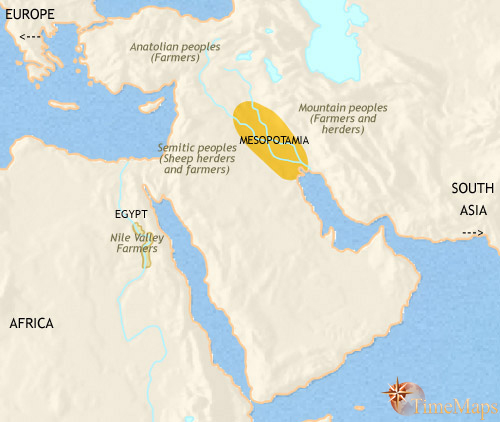
Figure 1: Neolithic civilizations were re-established in riverine environments “upon the face of all the earth” simultaneously. Those who were dispersed to nearby locations walked while being guided along by airborne crafts. The Sena people of Zimbabwe believe that their ancestors migrated south from northern Africa while being led by a very bright star in the sky. This is similar to how God led Moses and the descendants of Israel out of Egypt and into the Promised Land.
By 4,000 B.C.E. farming villages had been re-established in the Indus River Valley of Pakistan and in the Hwang Ho Valley of China, and 3,000 B.C.E. saw the rise of the great ancient civilizations and a form of writing called cuneiform (Danzer 2000) [15]. The gods taught the families of man computer-generated languages, the oldest being Akkadian, the language of the Sumerians. Approximately two thousand years ago, the Apostle Paul wrote the following:
[God] hath made of one blood [DNA composition] all nations of men for to dwell on all the face of Earth, and hath determined the times before appointed, and the bounds of their habitation. (Acts 17:26)
Conclusion
A book written by K. A. Hamlin (From Eve to Evolution. 2015. $24.00 Chicago: University of Chicago Press) is the first published full-length study of American women’s responses to evolutionary theory and illuminates the role science played in the nineteenth-century women’s rights movement. Kimberly A. Hamlin reveals how a number of nineteenth- century women, raised on the idea that Eve’s sin forever fixed women’s subordinate status, embraced Darwinian evolution—especially sexual selection theory as explained in The Descent of Man—as an alternative to the creation story in Genesis. My research, supports the tenets espoused in Hamlin’s book, as it, proposes evidently, that God did not intend for women of all time to be denied rights as humans beings. Moreover, my research elevates Eve to the status as the giver of life to all mankind.
Scientists and physicians have known for some time now that under the skin, all mankind today are 99.99% alike. The .01 percent difference in the genetic makeup of all humankind is what accounts for the superficial differences among humans [16, 17, 18, 19, 20, 21, 22].
‘If you ask what percentage of your genes is reflected in your external appearance, the basis by which we talk about race, the answer seems to be in the range of .01 percent,’ said Dr. Harold P. Freeman, the chief executive, president and director of surgery at North General Hospital in Manhattan, who has studied the issue of biology and race [23].
Ironically, most humans place more importance on those distinguishing physical variations than on the 99.99% that connects the human race. Forensic anthropologists also know that all people on the planet today descended from one small gene pool. There are few variations in the mitochondria DNA of the nearly 8 billion humans on Earth, and this leads directly back to one female, the Biblical Eve. Additional irony includes the fact that Darwin proposed that all of Earth’s life forms can trace their ascent to one common ancestor. What divides mankind today is not “race” (since there is only one) but culture and politics, yes, but more importantly, old, deep- seated, Satan-inspired hate, borne of selfishness, envy, fear, and ignorance. Indeed, the progeny of Noah were separated into families and placed “on the face of all the earth,” but all evidently, remain one family.
Notes
1. In physics, “ether” is generally believed to be the matter, or substance (the medium), in outer space through which light travels and radio waves are transmitted. 2. It is important to note here that Satan was never banned from God’s presence, and that God and Satan collaborated on many aspects of the governance of planet Earth as well as on the fate of humans.
References
-
Tanakh: The Holy Scriptures (1985) Jerusalem: Jewish Publication Society. In: Wilford JN (Ed.), (2007, August 8). “Man’s Evolutionary Line Blurred.” The Press- Enterprise, pp: A12.
-
The Bible Library [CD-ROM] (1998) Oklahoma City, USA: Ellis Enterprises.
-
Churchward J (1972) The Sacred Symbols of Mu. New York, USA: Paperback Library.
-
Apocrypha: King James Version. (2001) Great Britain: University Press, Cambridge.
-
Campbell BG, Loy JD (1996) Humankind Emerging. New York, USA: Harper Collins.
-
Diamond J (1994) How to Tame a Wild Plant. Discover 15(9): 100-106.
-
Berossus (2009) In Wikipedia the Free Encyclopedia.
-
Cory IP (1832) Fragments of Chaldean History, Berossus: From Alexander Polyhistor. Of the Cosmogony and Deluge.
-
Josephus F (1987) The Works of Josephus. (W. Whiston, Trans.) Peabody: Hendrickson Publishers, Inc.,USA.
-
Lost Books of the Bible and the Forgotten Books of Eden (1927) Newfoundland: Alpha House Incorporated.
-
(1983) The Old Testament Pseudepigrapha: Apocalyptic Literature and Testaments. In: Charlesworth JH (Ed.), New York, USA: Doubleday, Vol. 1.
-
D Agnese J (2002) Not out of Africa. Discover 23(8): 52- 57.
-
Hesiod’s Works and Days (1914) (H. Evelyn-White, Trans.).
-
Pitman W, Ryan W (2000) Noah’s Flood. New York, USA: Touchstone.
-
Danzer GA (2000) An Atlas of World History. Ann Arbor, USA: Borders Group, Inc.
-
Choice ET (2015) Scriptural and Secular Parallels, West Conshohocken, USA: Infinity.
-
Churchward J (2001) The Lost Continent of Mu. Las Vegas, USA: C.W. Daniel Company.
-
The Holy Bible (1611) King James Version, New York, USA: American Bible Society.
-
The Holy Quran (1994) In: Farid MG (Eds.), United Kingdom: Islam International Publications, Limited.
-
Kunzig R (2002) La Marmotta. Discover 23(11): 34-41.
-
PBS NOVA (2016) Iceman Reborn.
-
Polyhistor (2006) Of the Cosmogony and Deluge.
-
Scientists Find Little to Support Classifications by Race (2000) The Press-Enterprise, pp: A19.
- The Indispensable Role of Informal Caregivers in Supporting the Aging Population
- Socio-Religious Significance of Kamakhya Temple in Guwahati, Assam
- Is Anthropology Possible?
- A Contribution to the History and Paleobiology of Harput/Elazığ Türkiye and Its Surroundings
- A Study on the Cowrie Shells of the Dimasas in Assam
- The Significance of International Organizations Cooperation in the Efficient Resolution of Global Conflict