
Determination of the CDR (CDR1, CDR2) « Complementary- Determining Region Invertebrate Primitive Antibody from Sea Star »
The IPA (Invertebrate Primitive Antibody) was recently discovered, in the same time of Asterias rubens lymphocytes, humoral specific immune responses and Genomic assays with the sea star IGKappa gene. or anti Horse-radish peroxidase. CDR1 and CDR2 were described in this paper. That corroborates the name of Invertebrate Primitive Antibody and not IG Like protein as it is thought by some people.
Introduction
5’GGA TCC GGA GGA ATG CGTGGCAACATGGCGTCTCTATGGATGTTCTTCTT TGTCGTGGGGATAACTTTACAACGGAGTTTGGCGATTTACACGTTTCGCG AGCAACCGTCGGACACTAGCGCGTTGCAGGGGAGCACAGTGGTGCTTCAC TGCTCCGTTGAGCAGTACATAAACACCACGGCCATCGTTTGGTGGAGCCG TGACTCGGTCATCAGCCACAACAAAGACCTGAAACTGTCCAGTCTAAACA CCGACCAGCTCCAAAGGTACTCGATTTCAGGCGACGCATCTCGGGGGGAA TTCAACCTTAAAATAGTGAACTTTACCGCCACAGACGCCGCCAGTTACCG CTGTCAGATG TAA GAA TTC3’ with the translation https://web.expasy.org/translate/ Determining Regions called more briefly CDR1, CDR2 and CDR3. Or Complementary-Determining Regions
Material and Methods
A recalling of the anti HRP sea star sequence acid sequence and corresponding ones from primate antibodies [2, 3]. First, anti-HRP sequence in nucleotides is given (Figure 1):
gga tcc gga gga atg cgt ggc aac atg gcg tct cta tgg atg ttc ttc ttt gtc gtg ggg G S G G M R G N M A S L W M F F F V V G ata act tta caa cgg agt ttg gcg att tac acg ttt cgc gag caa ccg tcg gac act agc I T L Q R S L A I Y T F R E Q P S D T S gcg ttg cag ggg agc aca gtg gtg ctt cac tgc tcc gtt gag cag tac ata aac acc acg A L Q G S T V V L H C S V E Q Y I N T T gcc atc gtt tgg tgg agc cgt gac tcg gtc atc agc cac aac aaa gac ctg aaa ctg tcc A I V W W S R D S V I S H N K D L K L S agt cta aac acc gac cag ctc caa agg tac tcg att tca ggc gac gca tct cgg ggg gaa S L N T D Q L Q R Y S I S G D A S R G E ttc aac ctt aaa ata gtg aac ttt acc gcc aca gac gcc gcc agt tac cgc tgt cag atg F N L K I V N F T A T D A A S Y R C Q M taa gaa ttc Or in Another way: MRGNMASLWMFFFVVGITLQRSLAIYTFREQPSDTSALQGSTVVLHCSVEQYINTTAIVWWSRDSVISHNKDLKLSSLNTDQLQRYSIS- GDASRGEFNLKIVNFTATDAASYRCQMFA Figure 1: Sea star (Starfish) IGKappa gene sequencing.
Results
2 tables issued from IMGT resume the following analysis below:
| Species | Gene and allele | Domain | Domain label | Smith- Waterman score | % identity | Overlap | Show alignment |
|---|---|---|---|---|---|---|---|
| Pongo abelii | IGKV1-5*01 | 1 | V-KAPPA | 121 | 33.3 | 90 | ⦿ |
| Pongo Pygmaeus | IGKV1-8*01 | 1 | V-KAPPA | 121 | 33.3 | 90 | ○ |
| Homo sapiens | IGKV1-5*03 | 1 | V-KAPPA | 119 | 33.3 | 90 | ○ |
| Homo sapiens | IGKV1-5*04 | 1 | V-KAPPA | 119 | 33.3 | 90 | ○ |
| Homo sapiens | IGKV1-5*05 | 1 | V-KAPPA | 119 | 33.3 | 90 | ○ |
| Species | Gene and allele | Domain | Domain label | Smith- Waterman score | % identity | Overlap | |
| Pongo Pygmaeus | IGKJ4*01 | 1 | 7 | 100 | 1 |
Table 1: Closest reference Gene and allele(s) from the IMGT V domain directory: (All Species).
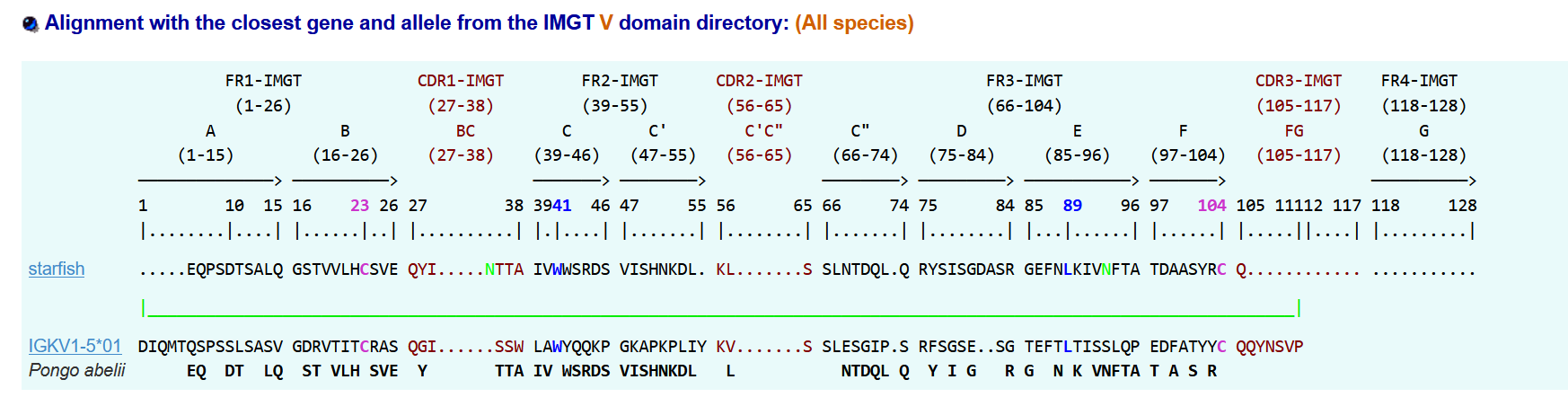
>starfish|IGKV1-5*01|33.3|||Pongo abelii .....EQPSDTSALQGSTVVLHCSVEQYI.....NTTAIVWWSRDSV- ISHNKDL.KL.......SSLNTDQL.QRYSISGDASRGEFNLKIVNFTAT- DAASYRCQ.......................
The conserved amino acids (positions 23, 41, 89, 104) are found in the starfish sequence.
This molecule appears to have an IG AA sequence as seen from the above analysis. • If it aligns with the Pongo IGKV1-5, the percentage of alignment is 33%, so it is a sequence that seems to have similarities to an IGKV gene when it comes to conserved amino acids.
Discussion
It appears clearly that CDR1 and CDR2 exist in the sea star primitive antibody and not clearly for CDR3 (1 amino acid which is conserved). Undoubtly: These new parameters [4] corroborate the existence of an Invertebrate Primitive Antibody and NOT IG-LIKE as it is often said. We recall also the discovery by us of T and B sea star lymphocytes [5] Humoral specific response [6] Genomic data [7] ALL these elements assess the existence of an IPA: Invertebrate Primitive Antibody which shares strong sequence alignments(at least for CDR1 and CDR2) with the Primate: Pongo pygmaeus.
References
-
Leclerc M, et al. (2014) SAJ Biotechnol 1: 104.
-
Ehrenmann F, et al. (2010) Nucleic Acid Res 38: D301-D307.
-
Ehrenmann F, et al. (2011) Cold Spring Harbor Protoc 6: 737-749.
-
Polonelli L, et al. (2008) Plos 3(6): e237.
-
Leclerc M, et al. (1993) Thymus 21(3): 133.
-
Brillouet C, et al. (1984) Cell Immunol 84(1): 138.
-
Vincent N, et al. (2014) Meta Gene 2: 320.
- Are the Vaccines the Only Solution to Prevent the COVID-19 Pandemic? Part Two
- Clinical Characteristics of Women in this New Global Immunodeficiency
- Cell Dynamics in HIV Pathogenesis: Insights and Implications
- Prioritizing Care for High-Risk COVID-19 Patients in the EU: 10 Civic Recommendations to the Institutions
- Comprehensive Insights into ModRNA Vaccines: Persistent PP-Spike Recombinant Protein, Hyperimmune/Inflammatory Reactions, Thrombotic Vasculopathy, Chronic Organ Complications and Excess Deaths
- Impact of Dietary Choices on Immune System Functionality