
Seasonal Variation of Proteins and Amino Acids Content in Various Parts of Aegle Marmelos (L.) Corr
Bael or Aegle marmelos is a spiritual, religious and medicinal plant, native of India and Bangladesh and spread throughout South East Asia. Bel has many benefits and uses such as to cure tuberculosis, hepatitis, dysentery, constipation, peptic ulcer, piles, cancer, blood purifier, skin rash, breast milk, useful in worm infestation and stomach related problems. The seasonal variation proteins and amino acids of leaves, wood, barks and roots of Aegle marmelos (L.) Corr. The comparative account of proteins contents of Aegle marmelos showed higher level in bark (range 5.647 to 6.194 mg/g dry wt.) than wood (range 3.196 to 4.435 mg/g dry wt.), leaves (range 4.264 to 5.964 mg/g dry wt.) and roots (3.288 to 7.950 mg/g dry wt.). Comparative account of amino acids contents of Aegle marmelos showed higher level in leaves (range 0.423 to 0.613 mg/g dry wt.) than wood (range 0.259 to 0.404 mg/g dry wt.), bark (range 0.388 to 0.506 mg/g dry wt.) and roots (0.257 to 0.330 mg/g dry wt.).
Materials and Methods
1) The protein was quantitatively estimated by the Lowey, et al. [6] method. Chemicals: 0.1% N NaOH - (4gm in 1000ml), 2% Na2CO3 - (2gm in 100ml distilled water), 0.5% CuSO4- (0.5gm in 100ml distilled water), 1 % Na-K-tartarate and 5 % Trichloro acetic acid/per chloric acid. Reagents: Lowry A-2% Na2CO3in 0.1% N NaOH, Lowry B- 5% CuSO4 in 1% Na-K-tartarate and Lowry C-98ml A and 2 ml B, Lowry D - Folin phenol reagent. Procedure: 1gm of plant material was homogenized with 10ml, 80% ethanol. The extract was centrifuged at 5000 rpm for 5 min. and the supernatant was discarded. 5%, 10 ml Trichloro acetic acid (TCA) or Per chloric acid (PCA) was add to residue and incubated at 800C for 20 minutes. The pellet was centrifuged and the supernatant was discarded. Residue was washed with 10 ml distilled water and again recentrifuged. The supernatant was discarded. 2%, 10ml Na2CO3 in 0.1 N NaOH was added to the residue and incubated for an hour at 30°C and again centrifuged and residue was discarded. The final volume of supernatant was measured and it was used as a sample for protein. 1ml of aliquot of sample was taken and 5ml reagent C was added to it mixed it thoroughly. The sample was incubated for 10 minutes and 1ml of reagent D was added to it. The colour intensity was read at 660 nm. Using Spectrophotometer. The protein concentration of an unknown sample was calculated byusing standard graph.
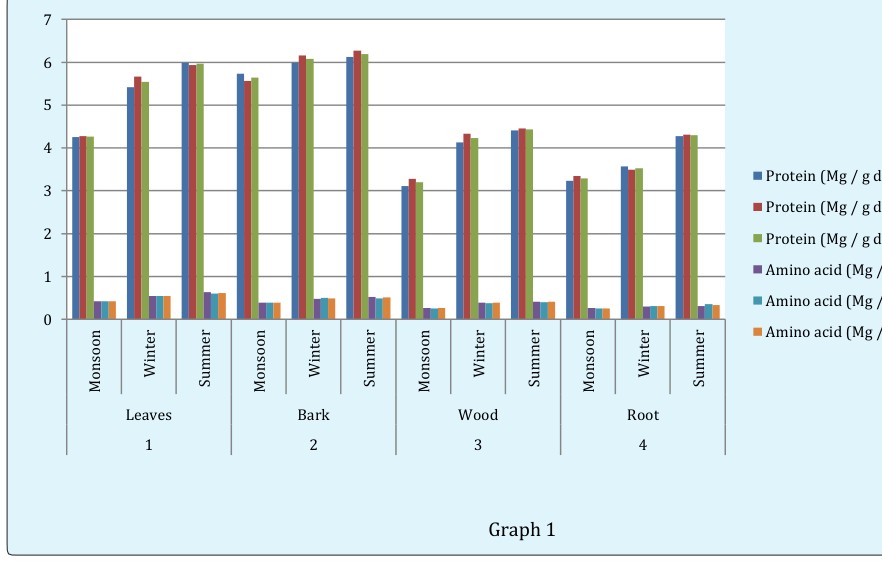
The amino acids content of leaves was 0.613 mg/g dry wt. in summer, 0.542 mg/g dry wt. in winter and 0.423 mg/g dry wt. in monsoon. Higher being observed during summer i.e. 0.613 mg/g dry wt. The range of amino acids content in bark 0.388 mg/g dry wt. to 0.506 mg/g dry wt. Maximum concentration of amino acids was noted during summer 0.506 mg/g dry wt. The range of amino acid content of wood from 0.259 mg/g dry wt. to 0.404 mg/g dry wt. The amino acids content of root was lower (0.257 mg/g dry wt. to 0.330 mg/g dry wt.) as compared to leaves, stem and wood of all seasons. Generally, the concentration of amino acids were found to be in increasing order of root< wood< bark < leaves (Table 1 & Graph 1).
2) The estimation of total amino acid was carried out by Krishnamurthy, et al. [7] method. Reagents: Alcoholic ninhydrin. (100 ml alcohol + 400 mg ninhydrin) and Glycine (Std.) (10mg glycine + 100ml distilled water) Procedure: 500 mg plant material was ground in mortar and pestle with few drops of cold 80% ethanol. Then 2.5ml of distilled water and 10ml of boiling 80% ethanol were added to it. The extract was centrifuged for 15 minutes at 10,000rpm. Residue was discarded the supernatant was collected and total volume was made 15ml with distilled water. Test tube was kept at 60°C for 20 minutes. The test tube was cooled and 1ml 50% ethanol was added. Read at 420 nm in spectrometer. Glycine was used as stand rand.
Results and Discussion
The protein content of leaves was higher (5.964 mg/g dry wt.) in summer over than winter (5.546 mg/g dry wt.) and monsoon (4.264 mg/g dry wt.). The range of protein content of bark was noted from (5.647 mg/g dry wt. to 6.194 mg/g dry wt.). The ranges of protein content in wood were from (3.196 mg/g dry wt. to 4.435 mg/g dry wt.) and show higher in summer. The protein content of root was higher (4.295 mg/g dry wt.) in summer over than winter (3.529 mg/g dry wt.) and monsoon (3.288 mg/g dry wt.). The protein content of seeds was higher (26.648 mg/g dry wt.) as compared to leaves, stem and roots of all seasons. The protein content showed increasing order of root < wood <leaves<bark (Table 1 & Graph 1).
| Sr. No | Plant part | Season | Protein (Mg / g dry wt.) | Amino acid (Mg / g dry wt.) | |||||||||||||
|---|---|---|---|---|---|---|---|---|---|---|---|---|---|---|---|---|---|
| 1 Year | 2 Year | Mean | 1 Year | 2 Year | Mean | ||||||||||||
| 1 | Leaves | Monsoon | 4.258 | 4.270 | 4.264 | 0.420 | 0.425 | 0.423 | |||||||||
| Winter | 5.423 | 5.668 | 5.545 | 0.544 | 0.539 | 0.542 | |||||||||||
| Summer | 5.995 | 5.932 | 5.964 | 0.628 | 0.598 | 0.613 | |||||||||||
| 2 | Bark | Monsoon | 5.728 | 5.565 | 5.647 | 0.390 | 0.386 | 0.388 | |||||||||
| Winter | 5.995 | 6.158 | 6.077 | 0.480 | 0.496 | 0.488 | |||||||||||
| Summer | 6.120 | 6.268 | 6.194 | 0.520 | 0.492 | 0.506 | |||||||||||
| 3 | Wood | Monsoon | 3.112 | 3.280 | 3.196 | 0.262 | 0.256 | 0.259 | |||||||||
| Winter | 4.128 | 4.330 | 4.229 | 0.386 | 0.380 | 0.383 | |||||||||||
| Summer | 4.412 | 4.458 | 4.435 | 0.410 | 0.398 | 0.404 | |||||||||||
| 4 | Root | Monsoon | 3.228 | 3.348 | 3.288 | 0.264 | 0.250 | 0.257 | |||||||||
| Winter | 3.570 | 3.487 | 3.529 | 0.298 | 0.312 | 0.305 | |||||||||||
| Summer | 4.278 | 4.312 | 4.295 | 0.310 | 0.350 | 0.330 |
Table 1: Seasonal variation of proteins and amino acid content of different plant parts of Aegle marmelos.
1. Pushpendra KP, Jyoti S, Lokesh S, Narendra KP, Dubey
BK (2012) Aegle marmelos: A review on its Medicinal Properties. Int J Pharma Phytopharmacol Res 1(5): 332-341.
2. Rekha W, Viji J, priyadarshini P (2010) In vitro propagation of Aegle marmelos (L.). corr from mature trees though Enhanced axillary Branching. Asian J Exp Biol Sci 1(3): 669-676.
3. Remya M, Sharma MRC, Haidar S (2009) In vitro effect of Aegle marmelos on human sperm motility. Journal of medicinal plant research 3(12): 1137- 1139.
4. Dhankar S, Ruhil S, Balhara M, Dhankar S, Chhillar A
(2011) Aegle marmelos(Linn) Correa: A potential
source of phytomedicine. J Med Plant Res 5(9): 1497- 1507.
5. Ariharan VN, Nagendraprasad P (2013) Mahavilva a sacred tree with immense medicinal secrets: a mini review. Rasayan J Chemistry 6(4): 342-352.
6. LowreyO H, Rosenbrough NJ, Farr AL, Randall RJ
(1951) Protein measurement with The Folin- Phenol reagent. J BioI Chem 193(1): 265-275.
7. Krishnamurthy R, Ambazhagan M, Bhagwat KA
(1989) Testing salt tolerant Variability In the nutritional quality of seeds produced by rice cultivars Subjected to Salinity. Seed Science and Technology 17: 269-275.
- Gallic and Citric Acid Present in the Peels of Tropical Fruits as an Alternative in the Fight against Cancer
- Treating the Forehead Lines with Combination of Forehead and Glabellar Botulinum Toxin Among Japanese Patients
- Clinical Evaluation of Patients Suffering from Breast Cancer & Determination of Treatment Therapies and Better Strategies Related to Breast Cancer
- Medieval Recipes by Al-Zahrāwī for Heart Palpitations Treatment
- Etiology and Prescription Errors of Myocardial Infarction in Different Health Care Systems of Azad Kashmir
- Early Diagnosis and Multidisciplinary Management of Turner Syndrome: A Paediatric Case Study