
Overview of 5G Technology: Streamlined Virtual Event Experiences
This abstract examines how virtual event experiences may be altered by 5G technology through improved connection and immersive interactivity. This essay looks at how 5G networks could offer faster data speeds, extremely low latency, and more network capacity. These advancements enable smooth content transmission, real-time communication, and the use of virtual reality apps. Furthermore, it highlights how 5G is affecting a number of industries, including business, education, and entertainment, and it demonstrates how it may be used to build virtual environments that accurately capture the atmosphere of real events.
Introduction 5G Technologies
COVID-19 has changed entrepreneurship and innovation events, with a sustained concentration on digital platforms, even after the pandemic limits have ended [1]. Traditional in-person events are being rapidly replaced by virtual event platforms, which offer participants a smooth and engaging experience. These innovations take advantage of 5G technology’s capacity to boost connections, allowing for immersive experiences and real-time communication. Virtual event experiences have evolved from a simple link to a fully immersive experience by utilizing 5G’s capability, providing both organizers and attendees with a plethora of options. The role that 5G technology will play in improving virtual event experiences cannot be understated. Virtual and augmented realities are leading the way in these technological advancements. According to Elbamby et al., virtual reality will transform how people experience virtual events and play a major part in 5G networks. Park J, et al. [2] claims that it offers users realistic and immersive environments in which to engage with virtual objects, engaging a variety of senses. Furthermore, due of the capabilities of 5G networks, future technologies like virtual and augmented reality would have considerably more potential [3]. Virtual and augmented reality technologies depend on the 5G network’s high signal transmission capacity, rapid transmission rates, and small network overhead [4]. The convergence of 5G and AR/VR technologies enables a more complex and varied interactive virtual event experience.
Trends in Connectivity
The most recent wireless communication technology, 5G, is about to roll out and is predicted to drastically change connections and open up a plethora of new and creative applications and services. 5G offers more throughput, greater capacity, and faster transmission, laying the foundation for flawless virtual event experiences. According to Ahmad H, et al. [5] 5G technologies offer more throughput, larger capacity, and faster connectivity.
In addition to enabling extended machine-to-machine communication services depending on certain application situations, 5G technology also makes it possible to increase mobile broadband connection, minimize data transmission delays, and maintain reliable communication. As a result, users may enjoy high-quality video streaming, instant interaction, and simple access to virtual event venues.
5G’s Importance for Virtual Events
Since 5G makes it simpler for attendees to have immersive experiences, it is crucial for virtual events. By leveraging the ability to virtualize and spread network activities, 5G enables effective data processing and transmission while guaranteeing consistent connectivity and reduced latency [6]. Strong and constant connectivity is essential for virtual events. 5G technologies make it possible to have more reliable communication, less latency in data transmission, and better mobile broadband connectivity. It also supports a wide range of applications with rich communication services.” 5G technology offers the foundation required to guarantee that participants may actively participate and interact in the virtual event environment.
Progression from Connectivity to Absorption
When it comes to virtual events, being connected is not enough; immersion is necessary. Thanks to virtual reality and augmented reality (VR/AR) technologies, attendees can fully immerse themselves in the event experience. With the help of these technologies, people can feel as though they are physically present in incredibly lifelike virtual settings. The prospects for flawless virtual event experiences are completely realized with the introduction of 5G technology. The rollout of 5G will be highly advantageous for developing technologies such as virtual and augmented reality. Because of the incredible and immersive experiences that virtual reality and augmented reality technologies produce, users can explore and interact with virtual worlds that were previously unthinkable. These could involve traveling to the solar system, experiencing a virtual tour of historical landmarks, or viewing a live concert from the greatest seat in the house.
However, 5G networks might not be able to handle the massive amounts of real-time data transfer needed for VR/ AR technology. In order to address this problem, efforts are being made to guarantee uninterrupted data delivery and enhance network architecture. One example of progress in this area is the virtualization of network services, which enables more effective resource allocation and real-time capacity modifications to match the demands of virtual events. By utilizing virtualization, the network may enhance data transfer and resource distribution more effectively, resulting in more engaging user experiences. This ensures stable, fast connections with low latency and enough bandwidth for online events.
Improve Immersion Experiences
The cutting-edge capabilities of 5G may be used by virtual event planners to give attendees more immersive experiences. 5G’s higher bandwidth, throughput, and transmission speed enable large-scale machine-type communications, reliable communication, reduced latency, and faster communication. In addition to real-time communication and high-quality video streaming, users can take advantage of other immersive features including precise spatial audio and haptic feedback. Virtual and augmented realities are two widely used services in 5G networks [7]. However, current 5G network limits could not be adequate for some applications, like virtual conference rooms, remote surgery, and haptic technology, given the possibility to exceed capacity and latency restrictions. Nonetheless, current endeavors in the realm of 5G investigation and advancement endeavor to overcome these constraints and completely actualize the possibilities of virtual event exchanges. By utilizing 5G’s capabilities, virtual event experiences have the potential to surpass conventional limitations and produce a truly immersive world. By utilizing 5G’s capabilities, virtual event planners may significantly alter how attendees connect and engage with their surroundings. With haptic technology, users can use their touch senses to experience the virtual world in addition to their visual and auditory senses. This level of immersion might significantly enhance the whole experience and add intrigue and realism to virtual events. Furthermore, participants can participate in virtual events without interruption or delay because to 5G’s low latency and quick data transfer capabilities. Moreover, 5G technology enables the incorporation of augmented reality into virtual event experiences [8]. With the combination of augmented reality and 5G, users will be able to superimpose virtual objects on top of the real world, creating a mixed reality experience that blurs the lines between the real and virtual worlds. This can offer virtual event planners a plethora of opportunities to craft distinctive and captivating experiences, such as virtual exhibition halls where guests can explore and interact with virtual booths and products, or virtual classrooms where attendees actively participate in interactive learning activities. Furthermore, 5G’s high bandwidth and fast data transmission rate enable instantaneous cooperation and communication in virtual events [4].
Revolutionize virtual events
5G has a tremendous potential to revolutionize virtual events. The potential for 5G to revolutionize virtual event experiences stems from its quick transmission speed, large signal bandwidth, and little network latency. Attendees at virtual events may expect continuous connection and increased interaction thanks to 5G network capabilities. These networks may provide very low latency, minimizing lag and delay in the virtual world and enabling real-time interactions. Low latency, or the least amount of time that data takes to transmit, is critical for virtual events because it ensures that attendees may actively engage in events that happen in real time without experiencing any noticeable delays. Furthermore, the 5G network makes it possible to send large amounts of data quickly and efficiently, including complex virtual worlds or high-quality films, ensuring that consumers have smooth and captivating experience virtual worlds or high-quality films, ensuring that consumers have a smooth and captivating experience. Moreover, 5G might simplify the process of incorporating augmented reality into virtual event experiences. The ability to overlay virtual things on the real environment thanks to this link results in a mixed reality experience that makes it challenging to tell the difference between the real and virtual worlds. Having the ability to engage in real-time interactions with virtual settings and objects enhances participant immersion and engagement levels throughout the entire event. Moreover, 5G facilitates the transmission of haptic feedback, augmenting the immersive experience. Attendees at virtual conferences or exhibits can feel sensations that closely resemble those in the real world in addition to seeing and hearing virtual content thanks to haptic technology, which provides tactile feedback. With 5G technology, online event coordinators.
Unlocking the Potential with Seamless Virtual Events And 5G Technology
In order to maximize the potential of 5G, it is crucial to carefully assess a number of crucial components to guarantee flawless virtual event experiences. The infrastructure needed to enable a 5G connection must be provided first and foremost. This entails installing 5G base stations and setting up the required network infrastructure to offer consistent and broad coverage. Furthermore, virtual event platforms and apps need to perform better in order to be compatible with 5G networks.
Code and content need to be tuned to fully utilize 5G’s low latency and quick data transmission capabilities. Utilizing technologies like content delivery networks and edge computing is another way to lower latency and guarantee seamless streaming of virtual event content. Furthermore, in order to guarantee that virtual events are designed with 5G capabilities in mind, cooperation between content producers, network providers, and organizers of virtual events is crucial. This will enable seamless integration of immersive technologies and enable full advantage of 5G’s potential. Additionally, user devices are essential to ensuring a flawless virtual event experience over 5G networks. Immersion technologies such as virtual reality and augmented reality require certain gear in order to work effectively. Immersion technologies such as virtual reality and augmented reality require certain hardware and software features in order to work successfully. Additionally, they must to be able to accommodate the fast data transfers and low latency requirements of 5G networks. To maximize 5G’s potential for flawless virtual event experiences, event organizers must take these factors into account. Chamola V, et al. [8] claims that 5G has the ability to completely transform virtual event experiences by providing immersive technologies like virtual reality and augmented reality, as well as trustworthy connections.
Case Studies
Now let’s examine a few case studies that demonstrate the effective integration of 5G technology into virtual events. The Tokyo Olympics 2021 offered a singular chance to demonstrate the potential of 5G technology in virtual event engagements. The organizers took advantage of 5G’s capacity to offer viewers anywhere immersive viewing experiences. Virtual reality video streaming greatly enhanced the virtual event experience by immersing spectators in the action and creating a sense of total immersion. Viewers were given access to a fast and sizable enough network connection through 5G wireless connections, enabling the continuous streaming of virtual reality video content.
The Mobile World Congress (MWC), a significant yearly gathering for the mobile industry, draws lots of visitors from around the globe. The 2022 edition’s organizers collaborated with a reputable telecommunications provider to incorporate 5G technology across the entire event. The MWC’s deployment of a customized 5G network successfully enhanced the virtual event experiences of participants. This includes the use of collaboration tools for meetings and business networking, interactive augmented reality experiences, and the real-time transmission of virtual reality information. These case studies show how effectively events can be simulated with 5G technology.
They give an example of how 5G may improve virtual event experiences by giving participants more immersive technologies, continuous connectivity, and opportunities for involvement. Virtual reality video has become the ideal use case for 5G wireless connections in virtual events because it can offer an immersive viewing experience while satisfying low-latency, high-bandwidth network requirements.
Challenges and Benefits of Implementing 5G
Even while 5G technologies have a lot of potential to offer flawless virtual event experiences, there are still issues that must be resolved before it can be used. The ability of 5G networks to transfer massive volumes of real-time data, which is necessary for immersive technologies like augmented and virtual reality, is one of the major challenges. This could be a hindrance to taking full advantage of 5G’s advantages for immersive virtual events, as these apps might be able to consume more data than 5G networks can now provide. Furthermore, because haptic technologies and remote surgery require extremely low latency, using 5G for virtual events may provide difficulties. But these difficulties also present chances for innovation and progress in the 5G space. Technologies and solutions that boost network capacity and lower latency are necessary to fully utilize 5G for virtual events. There are other benefits to utilizing 5G technology for virtual events as well.
Among the benefits are: - Improved connectivity: 5G networks offer reduced latency and quicker data transfer rates, improving both connectivity and the virtual event experience as a whole. - Continuous streaming: 5G’s quick data rates ensure that virtual events run smoothly and in high resolution, allowing spectators to fully immerse themselves in the immersive viewing experience. - Immersive and fascinating experiences: Users can actively participate in virtual events and enhance the overall immersive experience thanks to 5G’s low latency and small latency, which enable real-time interaction and cooperation. - Increased accessibility: A larger audience can attend virtual events thanks to the widespread availability of 5G networks. In conclusion, the possibilities for virtual event experiences with 5G.
Virtual event experiences might be quite intriguing with 5G. Via seamless connections, enhanced engagement, and immersive viewing experiences thanks to technologies like immersive technology, fast data transfer, and low latency, 5G has the ability to completely transform virtual events.
By utilizing 5G networks, virtual event planners can provide attendees interesting and continuous experiences. 5G technology enables significant real-time data transfer while meeting strict network standards for low latency and high capacity. Because of this, it makes virtual reality video easier to develop as the best use case for virtual events [9]. Moreover, the advancement of 5G technology may stimulate the creation of novel applications and use cases for virtual events. Haptic gadgets, remote surgery, and virtual conference rooms are a few possible uses. Virtual event experiences stand to be fundamentally transformed by 5G, thanks to its immersive technologies, lower latency, and improved connection.
Applications of AI
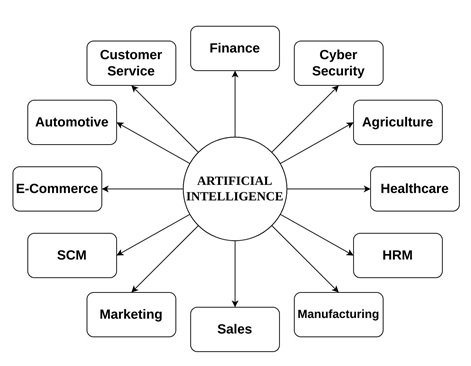
The influence of AI is evident in almost every field, from chatbot to space exploration. As the algorithms become increasingly sophisticated and machines learn to emulate human cognition, the innovation potential seems boundless. The business sector, in particular, has experienced significant advancements in various domains since the integration of AI. Virtually every facet of business now leverages AI technologies (Figure 1). In this section, we will briefly explain some of the important applications of AI in crucial business sectors.
Healthcare
Is one of the prime sectors which have numerous applications of Artificial Intelligence and Robotics? AI uses ML and NLP to analyze various kinds of healthcare data, both structured and unstructured. AI-enabled systems are used for patient diagnosis and treatment through tools like IBM Watson for Oncology, which provides treatment recommendations based on datasets of cancer patients. Additionally, AI is used for nursing and managerial assistance, such as in predictive analytics for operational efficiency and robotic-assisted surgery for precision and flexibility [10, 11]. However, there are some challenges faced by AI implementation in healthcare. Lack of Laws and Regulations to monitor the safety and efficiency of AI systems. Since healthcare data are dynamic and need constant updates, AI systems will also have to undergo frequent updating and training. Sourcing data for this training is very difficult under the current scenario.
Agriculture
Can be considered the largest industry in the world, as well as the most critical part of the economy. Since the dawn of civilization Agricultural sector has played a vital role in the development of our societies. The development of the agriculture sector also raises the challenges associated with it, such as diseases on crops or livestock, pest infestations, unscientific soil treatment, and improper drainage, and irrigation systems, etc [10, 11]. The Agriculture Supply Chain can be divided into preproduction, production, processing, and distribution. In the preproduction stage, Machine Learning can be used in analyzing the soil and predicting the yield, which in turn helps to identify the proper irrigation needs. In the production stages, ML can help in disease detection, weather forecasting, etc. ML can also be used for scientific processing to ensure optimum output. ML can play a crucial role in the distribution stage as well by analyzing the proper requirement of warehousing, and transportation and can even predict the consumer approach. These are just a few of many examples. With innovations in AI and ML, it will surely revolutionize the sector in many positive ways.
Cyber Security
Is one of those fields that could benefit more from the introduction of Artificial Intelligence? AI has numerous applications in the field of Cyber security including but not limited to threat detection by analyzing large data to check for anomalies, Vulnerability assessment by analyzing network and system configurations, analyzing user behavior patterns to detect variations or abnormalities, taking automated actions to contain the threats as soon as it is detected, data privacy is ensured by eliminating unauthorized access. With the continuous evolution of technology, the growing number and severity of cyber threats pose challenges that conventional security systems may struggle to address effectively. But with the introduction of AI, we can have much better protection against cyber threats. Despite all this we need to accept the fact that with greater security systems comes greater threats, so continuous effort will be needed to ensure the threats are contained before they can cause any devastating damage.
Logistics and Supply Chain Management
Had a remarkable transformation in efficiency and quality of service with the introduction of AI. With the help of ML and Data Analysis techniques the optimization and efficient use of warehouses can be achieved, also AI can analyze the more accurate and easier routes for transportation and the efficiency of delivery can be improved. The growth in AI technologies is promising; it can bring about revolutionizing changes in the field of Logistics and SCM. The total supply chain can be monitored by AI in real-time, by analyzing large datasets, AI can provide recommendations for optimizing the routes and thereby minimize idle time, reducing emissions and improving overall efficiency. AI can also devise innovative sourcing and procurement strategies through Data analysis.
The Automotive Industry
Uses Machine Learning and Data Science in the sub processes including development, procurement, production, marketing, sales, after-sales services, etc. Apart from this one of the prominent uses of AI in the automotive industry is self-driving vehicles. ML and Data Science are used in voice recognition, facial and traffic sign recognition, and optimization of operations of the vehicle. AI is used in the design and development of vehicles by using algorithms to create and evaluate thousands of design options based on specific parameters. AI is also being used to test different scenarios such as crash tests, issues in designs, etc. AI also helps in increasing road safety and reducing road accidents through the use of technologies like Advanced Driver Assistant Systems (ADAS), Real-time data analysis, intelligent traffic management, and predicting the maintenance needs of the vehicle parts. Overall, AI can analyze large volumes of data in real time, which allows smart cars to make informed decisions, anticipate potential risks, and take proactive measures to improve road safety.
Human Resource Management (HRM)
Is the most unique and important functioning of an organization because it handles the most unpredictable and most important resource in the entire Organization. With the introduction of AI, the HR function has changed from being a typical administrative function to a Strategic one, focusing on managing the performance of vital workers and important job. In HRM, AI can provide Intelligent Automation to reduce repetitive and manual tasks; it can facilitate Data-driven decision-making by analyzing large data in real-time and giving recommendations, AI can also eliminate human biases and inconsistencies in HRM, enabling faster, unbiased, and more consistent decision making. An organization can retain and nurture valuable talents through employee engagement tools; AI can facilitate various tools throughout the employee lifecycle.
Customer Service
Is an important area that has transformed as a result of AI integration? One of the major advantages of AI implementation in customer service is that it can help do repetitive tasks such as answering frequently asked questions, handling basic inquiries, and providing automated responses. This process flow will help in reducing the labor force of a company. Additionally, AI-powered chatbot can provide quick and efficient customer support, available 24/7, which improves response times and customer satisfaction. AI has also been able to provide personalized experiences to each customer. Personalization is very important for the long-term success of any organization, it has been shown that customers are more likely to trust and engage with businesses that offer personalized experiences. By leveraging AI, companies can streamline their customer service processes and improve overall efficiency.
The finance sector
Has also had the assistance of AI in recent times. The most important application of AI in finance is the security it offers. Since the growth of online banking and digital payments, the financial sector faced a large number of cyber threats. Now with the help of AI algorithms, vast amounts of data can be analyzed in real-time to identify patterns, trends, and anomalies in financial data which will help in fraud detection and spot money laundering activities, etc. Credit scoring, Trading, portfolio management, and investment decision-making have all become automated with the introduction of ML in the finance sector. Banking sectors use in-app banking experience with AI-enabled Chatbot, AI can find out the financial status of a customer from their smartphones, even if the customer is not very active in the banking processes. These data can be utilized by financial institutions to assess the creditworthiness of the individual. Transaction Data enrichment (TDE) is one of the other applications of AI in finance. Usually, the transaction details from banks will have a lot of technical entries, which is hard for a normal customer to understand. TDE helps to convert these details into a more customer-friendly format, which helps the customer to understand the budget, transaction habits, etc more easily. Automated Trading Systems, Risk Evaluation, and Personalized wealth management are some of the many applications of AI in the field of Finance.
E-commerce
Marketing is a rapidly growing field. People find it easier to shop from the comfort of their couch rather than roaming around in the mall. As the number of internet users increases so does the ecommerce sales per year. This exponential growth of e-commerce is fueled by AI applications. The important applications of AI in E-commerce are AI assistants/ Chatbot, Recommendation engines, Intelligent Logistics, and Optimal Pricing. Intelligent Logistics helps to streamline the entire supply chain process by forecasting the demand, optimizing routes, warehouse management, returns management, and AI technology is also able to give real-time visibility of the entire supply chain. Nonetheless, there are challenges in using AI in e-commerce. AI relies on a large volume of Data. Obtaining and storing this much data is a rigorous task. AI can be biased and unfair in product recommendations and pricing if the data used for training is biased. Even with so much advancement in the field of AI, some customers are skeptical about AI since customer satisfaction without human intervention is unlikely. Integration complexity and implementation and maintenance costs are also extortionate.
Marketing
Is also one of the many fields that have been revolutionized by the Integration of Artificial Intelligence? AI technologies have become increasingly prevalent in marketing strategies, offering new opportunities for businesses to enhance their customer engagement, optimize campaigns, and gain valuable insights. Some of the real-world examples of AI applications in marketing are Predictive analytics to make predictions on customer behavior or future trends by analyzing the vast amount of data, Chatbot to respond to customer inquiries, Recommendation systems to provide personalized product or content recommendations to customers, and Social Media analysis to understand customer sentiments, trends, and preferences. Apart from this AI helps in Personalized Marketing, Programmatic Advertising, Market Research and Segmentation, Customer Service, Competitor Analysis, etc. With the increasing use of AI in marketing, managers need to acquire new skills to effectively incorporate AI technology into their marketing strategies. They also need to be able to work with data scientists and other technical experts to develop and implement AI-powered marketing initiatives. Additionally, managers need to be aware of ethical considerations related to AI, such as privacy and bias issues.
Sales
Play a major role in the success of an organization. Sustained and consistent growth in sales volume is essential for an organization’s success. In the current scenario, AI is instrumental in sales by providing valuable insights, automating processes, and improving customer interactions. It can analyze large volumes of data to identify patterns and trends, enabling sales teams to make data-driven decisions. Additionally, AI can automate repetitive tasks, such as lead generation and qualification, allowing sales representatives to focus on relationship-building and deal closure. AI facilitates autonomous sales processes, personalized customer interactions, and changes in organizational structures and sales roles. In addition to these benefits, the implementation Kathirvel A, et al. [12, 13, 14] of AI in sales may also result in certain drawbacks, including unforeseen changes in organizational structures, job replacements, job loss, and changes in the required skill sets of workers, etc. However, when considering the broader perspective, the benefits that AI brings to sales will consistently outweigh the drawbacks.
The Manufacturing
Sector is in a transformation phase with the integration of Artificial Intelligence, the Internet of Things (IoT), Machine Learning, and advanced automation techniques. The Manufacturing process has become more productive with increased quality of products with the help of AI. By examining the data received from machines, sensors, controllers, and quality inspections, AI can optimize production operations, reduce downtime, and enhance overall efficiency. Some AI applications in manufacturing include Predictive maintenance, quality control, production optimization Harshita BJS, et al. [15], Supply chain management, and Automation. Manufacturing problems can be solved with the help of AI’s unique ability to identify multivariate, nonlinear patterns in performance data. Implementing AI technology to achieve short-term goals will result in efficiency, flexibility, and cost reduction [16, 17]. Growing product complexity, dynamic nature of customer demand, competition, skeptical approach towards AI and AI technologies of workers and customers, complex nature of AI models, etc are some of the challenges faced in the integration of AI in the manufacturing sector [16, 17].
Conclusion
To provide a seamless incorporation of 5G technology into virtual event experiences, problems concerning real-time data transfer, latency, and capacity need to be fixed. Virtual event planners may be able to overcome these obstacles and leverage 5G to provide attendees incredibly smooth and immersive experiences. To sum up, 5G holds great potential for providing smooth virtual event experiences. Low latency and quick data transmission are two characteristics of 5G that could facilitate virtual and augmented reality that are very immersive. This has the potential to drastically alter how virtual events are conducted [18].
References
-
Jauhiainen JS (2021) Entrepreneurship and Innovation Events during the COVID-19 Pandemic: The User Preferences of VirBELA Virtual 3D Platform at the SHIFT Event Organized in Finland. Sustainability 13(7): 3802.
-
Park J, Bennis M (2018) URLLC-eMBB Slicing to Support VR Multimodal Perceptions over Wireless Cellular Systems. IEEE Global Communications, USA.
-
Onwuegbuzie IU (2022) 5G: next generation mobile wireless technology for a fast pacing world. Journal for Pure and Applied Sciences (JPAS) 1(1): 1-9.
-
Liang X, Liu F, Wang L, Zheng B, Sun Y (2023) Internet of Cultural Things: current research, challenges and opportunities. Computers Materials & Continua 74(1): 469-488.
-
Ahmad H, Islam MZ, Ali R, Haider A, Kim HS (2021) Intelligent stretch optimization in information centric Networking-Based tactile internet applications. Applied Sciences 11(16): 7351.
-
Tang Q, Yu FR, Xie R, Boukerche A, Huang T, et al. (2022) Internet of Intelligence: A survey on the enabling technologies, applications, and challenges. IEEE Communications Surveys & Tutorials 24(3): 1394-1434.
-
Kitanov S, Petrov I, Janevski T (2021) 6g Mobile Networks: Research Trends, Challenges and Potential Solutions. Journal of Electrical Engineering and Information Technologies 6(2), 67-77.
-
Chamola V, Hassija V, Gupta V, Guizani M (2020) A Comprehensive Review of the COVID-19 Pandemic and the Role of IoT, Drones, AI, Blockchain, and 5G in Managing its Impact. IEEE Access 8: 90225-90265.
-
Liu Z, Li Q, Chen X, Wu C, Ishihara S, et al. (2020) Point Cloud Video Streaming in 5G Systems and Beyond: Challenges and Solutions. IEEE Network 35(5): 202-209.
-
Sudha D, Kathirvel A (2022) The effect of ETUS in various generic attacks in mobile ad hoc networks to improve the performance of Aodv protocol. International Journal of humanities law and social sciences Kanpur philosophers 9(1): 467-476.
-
Sudha D, Kathirvel A (2022) An Intrusion Detection System to Detect and Mitigating Attacks Using Hidden Markov Model (HMM) Energy Monitoring Technique. Stochastic Modeling Applications 26(3): 467-476.
-
Kathirvel A, Danny BJ, Preetham S, Hinn Joe TO, Roak KC, et al. (2023) Systematic Number Plate detection using improved YOLOv5 detector. Institute of Electrical and Electronics Engineers Inc publisher.
-
Kathirvel A, Mavuri S (2023) Digital Assets Fair Estimation Using Artificial Intelligence. International Conference on Vision Towards Emerging Trends in Communication and Networking (ViTECoN), India.
-
Kathirvel A, Pavani A (2023) Machine Learning and Deep Learning Algorithms for Network Data Analytics Function in 5G Cellular Networks. International Conference on Inventive Computation Technologies (ICICT), Nepal.
-
Harshita BJS, Kathirvel A (2023) MMF Clustering: A On-demand One-hop Cluster Management in MANET Services Executing Perspective. International Journal of Novel Research and Development 8(4): 127-132.
-
Kathirvel A, Gopinath VM, Naren K, Nithyanand D, Nirmaladevi K (2024). Manufacturing Smart Industry Perspective an Overview. American Journal of Engineering and Applied Sciences 17(1): 33-39.
-
Gobinath VM, Ayyaswamy K, Kathirvel N (2024) Information Communication Technology and Intelligent Manufacturing Industries Perspective: An Insight. Asian Science Bulletin 2(1): 36-45.
-
Sudha D, Kathirvel A (2023) The performance enhancement of Aodv protocol using GETUS. International Journal of Early Childhood Special Education (INT-JECSE) 15(2): 115-125.
- Group Consensus of Nonlinear Hybrid Multi-Agent Systems with Self-Triggering Event Mechanism
- Optimum Vector Combinatorial Theory and Its Applications
- Manifold Systems Applied Theory for Innovative Robotic Technology
- Collaborative Robots: Human-Robots Coexistence in Industrial Environments
- Utilizing Idle Time for Job Clusters Reduces Inventory and Total Job Completion Time for Single Machine Scheduling
- Embracing the Future of Robotics with ART