
Covid-19 Vaccinations and Menstrual Cycle Alteration
The rapid development of safe and effective vaccines against Coronavirus Disease 2019 (COVID-19) has been a triumph of medical sciences, but vaccines only work if people take them. COVID-19 vaccination may be associated with change in menstrual cycle length following vaccination. Although there is extensive evidence that COVID-19 vaccination does not affect fertility, misinformation that it could has been a major source of vaccine hesitancy among young women. As the vaccination program was rolled out to younger age groups, some people noticed menstrual changes after COVID-19 vaccination, and many members of the public found these reports concerning. Research was needed to generate robust data to inform healthcare professionals and the public about these potential side effects. Menstrual changes have been reported in association with a variety of vaccines, including those against pathogens other than severe acute respiratory syndrome coronavirus 2 (SARSCoV- 2), so the aim of this work is to describe SARS-CoV-2 infection and the menstrual cycle changes because of it.
Introduction
The menstrual cycle involves complex interactions between various tissues, hormones, and organ systems. As such, the menstrual cycle is sensitive to endogenous and exogenous factors, including infection and changes in lifestyle. Over a year into the global COVID-19 pandemic caused by SARS-CoV-2, there is increasing interest in understanding the post-acute sequelae of SARS-CoV-2 (PASC) following infection. Emerging evidence suggests that SARS- CoV-2 infection, COVID-19 vaccination, and/or psychological stress related to the COVID-19 pandemic may influence the menstrual cycle [1].
People across the world are getting vaccinated against the virus as COVID-19 spreads. The possibility of adverse reactions to COVID-19 vaccinations has always been a source of concern [2, 3, 4]. It is also unclear whether COVID-19 immunizations impact female vaccinators’ menstrual cycles. Unfortunately, menstrual cycle outcomes were not collected in clinical studies of the current COVID-19 vaccines [5, 6, 7]. The menstrual cycle of a woman runs from the first day of her menstruation to the first day of her next cycle. Many factors, including nutrition, sleep, and exercise, as well as illness, travel, and stress, are known to influence the length of the menstrual cycle [8]. COVID-19 vaccines have caused a variety of side effects in people, including pain at the injection site, nausea, aches, fever, and fatigue. In more severe situations, patients may have insomnia, lack of appetite, and feelings of depression. Furthermore, vaccination may shorten or lengthen the menstrual cycle by influencing the secretion and stability of estrogen, progesterone, follicle-stimulating hormone, luteinizing hormone, and other hormones associated with female reproduction [9]. Figure 1 shows the COVID-19 vaccine impact on the menstrual cycle.
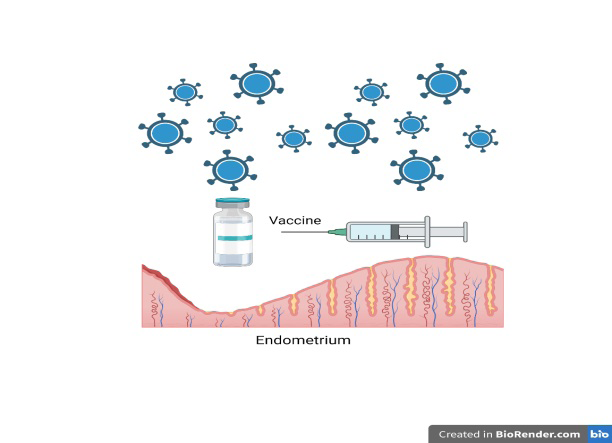
Recently, researchers from Oregon Health & Science University studied 3,959 people aged 18 to 45 years old (vaccinated 2,403; unvaccinated 1,556) in the United States for three consecutive cycles before receiving their first vaccine dose, followed by vaccine-dose cycles (cycles 4-6) or, if unvaccinated, six cycles over a similar period [10, 11]. The majority of those vaccinated (55%) utilized the Pfizer- Biotech vaccine (Moderna 35%, and Johnson & Johnson/ Janssen 7%). The investigators calculated the mean within- individual variation in the cycle and menstrual duration (three pre-vaccine cycles vs first and second dose cycles in the vaccinated cohort, and the first three cycles vs cycles four and five in the unvaccinated cohort). They used mixed- effects models to calculate the corrected difference in the cycle and menstrual length change between vaccinated and unvaccinated women. The results of the study showed that the onset of menstruation was about a day later than usual after vaccination. The overall number of menstruation days, on the other hand, did not change following vaccination. The COVID-19 vaccine causes a little alteration in cycle length but not in menses length. Further research is needed to establish the influence of COVID-19 vaccines on other elements of women’s menstrual cycles, such as if they produce abnormal bleeding or other symptoms, according to the study [12, 13].
It is important to note that most people who report such a change following vaccination find that their period rapidly returns to normal and extensive investigation has found no evidence that COVID-19 vaccination adversely impacts female fertility. Nonetheless, people are concerned by these reports. Investigating the potential link between COVID-19 vaccination and menstrual changes is important for maintaining public trust in the vaccination program and, if a link is found, to allow people to plan for potential changes to their cycles [14].
Conclusion
The impact of COVID-19 on the menstrual cycle is largely unknown. People who reported changes in their menstrual cycle after SARS-CoV-2 infection reported more COVID-19 symptoms than those who did not. There has not been much research on how COVID-19 vaccines or other vaccines alter the menstrual cycle on a worldwide scale. These findings serve as a guide for women who want to learn more about the COVID-19 vaccine’s side effects and make their own decisions.
Competing Interests
The authors declare no conflicts of interest.
Funding
Nil
References
-
Khan SM, Shilen A, Heslin KM, Ishimwe P, Allen AM, et al. (2022) SARS-CoV-2 infection and subsequent changes in the menstrual cycle among participants in the Arizona CoVHORT study. American Journal of Obstetrics & Gynecology 226(2): 270-273.
-
Polack FP, Thomas SJ, Kitchin N, Absalon J, Gurtman A, et al. (2020) Safety and efficacy of the BNT162b2 Mrna Covid-19 vaccine. New Engl J of Med 383(27): 2603- 2615.
-
Oliver SE, Gargano JW, Marin M, Wallace M, Curran KG, et al. (2021) The advisory committee on immunization practices interim recommendation for use of Moderna COVID-19 vaccine-United States, December 2020. MMWR Morbidity and mortality weekly report 69(5152): 1653-1656.
-
Hussain MS, Shama G (2022) The Burden of Cardiovascular Diseases Due to COVID-19 Pandemic. The Thoracic and Cardiovascular Surgeon 70(5).
-
Sadoff J, Gray G, Vandebosch A, Cárdenas V, Shukarev G, et al. (2021) Safety and efficacy of single-dose Ad26. COV2.S vaccine against Covid-19. New Engl J of Med 384(23): 2187-2201.
-
Baden LR, El Sahly HM, Essink B, Kotloff K, Frey S, et al. (2021) Efficacy and safety of the mRNA-1273 SARS- CoV-2 vaccine. New Engl J of Med 384(5): 403-416.
-
Hussain MS, Singh S, Dhingra G, Khatri H, Tanwar S, et al. (2022) Advances in the Adverse Effects of Covid-19 Vaccination and the Concept of Vaccine Development. Journal of Pharmaceutical Research International 34(48B): 19-38.
-
Hussain MS, Tyagi S, Kaur G, Bahl G (2022) The Evolving COVID-19: Omicron. Int J Biomed Res 2(6).
-
Hussain MS (2022) Covid-19 Vaccine Efficacy on Omicron Variant. Bioequivalence & Bioavailability International Journal 6(1): 000162.
-
CDC (2022) COVID-19 vaccination. Centers for Disease Control and Prevention.
-
Padda J, Khalid K, Hitawala G, Batra N, Pokhriyal S, et al. (2021) Depression and its effect on the menstrual cycle. Cureus 13(7): e16532.
-
Edelman A, Boniface ER, Benhar E, Han L, Matteson KA, et al. (2022) Association between menstrual cycle length and Coronavirus Disease 2019 (COVID-19) vaccination: A U.S. Cohort. Obstetrics and Gynecology 139(4): 481- 489.
-
Gibson EA, Li H, Fruh V, Gabra M, Asokan G, et al. (2022) Covid-19 vaccination and menstrual cycle length in the Apple Women’s Health Study. NPJ Digit Med 5(1): 165.
-
Alvergne A, Von Woon E, Male V (2022) Effect of COVID-19 vaccination on the timing and flow of menstrual periods in two cohorts. Frontiers in Reproductive Health 4: 952976.
- Effects of 5-HTP and Melatonin on the Sleep Cycle of Medical Students
- Adsorption of Bisphenol A on NH4OH- Modified Rice Husk and Sugar Cane Bagasse Biochar
- Comparative Assessment of the Reinforcement Efficiency of Palm Fruit Fibre and Coconut Fibre in High Density Polyethylene (HDPE) Matrix Composite
- Importance of Bio Compounds Naturally Present in Food with Functionality in Animal Metabolism
- Sub-Acute Study on the Cardiotoxic Effects of Monosodium Glutamate Ingestion in Albino Rat
- Weight Management and Its Natural Solutions: A Review