
Exhaust Emissions Characterization of a Single Cylinder Diesel Engine Fueled with Biodiesel-Ethanol-Diesel Blends
<p>Energy is one of the most important resources to mankind for his sustainable development. The decline of available oil reserves and more stringent environmental regulations have motivated the global interest in renewable energy sources. Due to exponential growth in industrialization, the demand for conventional automotive fuels is also increased sharply which adversely affects not only the economy but also the environment. This makes the search for an alternative fuel more important today. In this research, the blends of ethanol and biodiesel with diesel in varying proportions were used to access the emission levels of the blends. The emission levels were investigated under various operating conditions of the engine. Emission levels of carbon dioxide (CO2), carbon monoxide (CO), hydrocarbon (HC), oxides of nitrogen (NOx), oxides of sulfur (SOx) emissions and exhaust gas temperature were investigated. The results showed that the BED30 fuel gave the best exhaust emission. The tests were carried out on a horizontal single-cylinder, 4-stroke, air-cooled, 3.68 kW engine, TecQuipment TD115 MK-II model. The engine was coupled to a manometer (model: Z30EBIX25) and DG eddy current dynamometer (model: WB2.7 PB43) with rated power of 3.68 kW at 2600 rpm and was operated at a constant load of 1000 g. The test results showed that, there was a considerable increase in exhaust temperature with the blends compared to the diesel. The exhaust gas temperature of BED30 appeared to be similar to that of the diesel at all speed conditions. The results also showed that the blends gave less CO compared to diesel. The minimum and maximum reduction of CO was 9.5 and 49.1% respectively of the blends, as compared to diesel. The emissions of NOx, SOx and CO2 increased with increase in ethanol in the blends. All the findings compared favorably with the results of other researchers.</p>
Introduction
The increasing demand for energy in the world increases the consumption of fuels. As a result, access to the conventional fossil fuels is becoming more and more difficult and an increasing trend for the price of oil would be a disaster for the economic recovery. The peaks in oil price are generally related to the countries’ concern for energy availability. Apart from economic aspects, the main problem is that fossil fuels are non-renewable. The global interest in “alternative energy” or “renewable energy” sources is due to the mentioned problems in addition to the environmental issues of fossil fuels. Alternative energy is basically a type of energy produced from a source other than conventional fossil fuels, such as, oil, natural gas, and coal.
According to the International Energy Agency’s (IEA) world energy outlook, the total energy consumption in the world will increase by a rate of 1.5% per year until 2030. Figure 2 shows the share of different types of energy resources in this scenario (IEA, 2009) [1]. Fossil fuels such as coal, oil and gas produce huge amounts of CO2, the major greenhouse gas, when they are used in transportation, electricity or heat production processes. The best alternative energy resources to replace the fossil fuels are renewable energy carriers such as zero-carbon fuels. When renewable energy sources are used to produce energy for transportation, heat and power they produce little or no carbon dioxide. For this reason, they are often referred to as being 'zero carbon'.
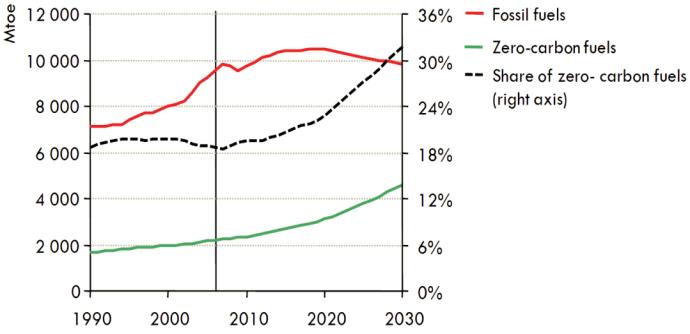
There is no single solution to global warming, which is primarily a problem of too much heat-trapping carbon dioxide (CO2), methane and nitrous oxide in the atmosphere. The technologies and approaches outlined by many researchers are all needed to bring down the emissions of these gases by at least 80 percent by 2080 [2]. The use of biodiesel and biofuel has been found to be of great contributor of the reduction of global warming.
Materials and Methods
Materials/Equipment
Ethanol: The chemical formula for ethanol is C2H5OH, sometimes written EtOH or C2H6O. It is also known under the names ethyl alcohol or hydroxyl ethane and is the type of alcohol found in alcoholic beverages. Ethanol is a rather simple organic molecule consisting of a group of carbon and hydrogen atoms, with a hydroxyl group (oxygen and a hydrogen atom) attached. The ethanol molecule is small and light, having a molecular weight of46g/mol [3]. The ethanol used in the research was produced from sawdust of Masonia (Masonia Altissama) wood using simultaneous saccharification and fermentation (SSF) processes.
Bioinformatics & Proteomics Open Access Journal
Biodiesel: Biodiesel is a clean burning alternative fuel produced from domestic, renewable resources such as plant oils, animal fats, used cooking oil and even from algae [4]. Biodiesel contains no petroleum, but can be blended at any level with petroleum diesel to create a biodiesel blend [4]. Biodiesel blends can be used in compression ignition engines with little or no modifications [5]. It has been reported that among vegetable oils, edible and non-edible oils are both used to produce biodiesel [5]. However, the use of edible vegetable oils for biodiesel production could exacerbate world hunger as it competes with food production, so it is justified to use non-edible oil for the production of biodiesel. So, expanded cultivation programs of non- edible oil in margined and non-arable land of plant such as, karanja, jatropha, mahua, and neem will be the best choice as source of biodiesel production. The biodiesel was produced from neem oil, which was extracted from neem seeds (Azadirachta indica), by transesterification method. Diesel fuel: Diesel fuel in general is any liquid fuel used in diesel engines, whose fuel ignition takes place, without any spark, as a result of compression of the inlet air mixture and then injection of fuel [6]. Chris [6] further stated that the most common type of diesel fuel is a specific fractional distillate of petroleum fuel oil, but alternatives that are not derived from petroleum, such as, biodiesel, biomass to liquid (BTL) or gas to liquid (GTL) diesel, are increasingly being developed and adopted. Diesel engines have found broad use as a result of higher thermodynamic efficiency and thus fuel efficiency. To distinguish these types, petroleum-derived diesel is increasingly called petro-diesel [7]. Diesel fuel originated from experiments conducted by German scientist and inventor Rudolf Diesel for his compression-ignition engine he invented in 1892. Diesel originally designed his engine to use coal dust as fuel, and experimented with other fuels including vegetable oils, such as peanut oil, which was used to power the engines which he exhibited at the 1900 Paris Exposition and the 1911 World's Fair in Paris [7]. The diesel fuel used for this research was purchased at AYM Shafa filling station along Abubakar Tafawa Balewa Road, near Yelwa Bauchi, Nigeria.
Automotive emission analyzer: Portable Emission Analyzers are especially useful for, research, auto repairs, inspections, safety checks, and general engine tuning. It is simply used by inserting a probe into the exhaust pipe and press a key to initiate measurements. Readings appear on a back-lit liquid-crystal display on the front of the analyzer. Emissions of unburned hydrocarbons (HC), concentrations of carbon monoxide (CO) and carbon dioxide (CO2), oxides of nitrogen (NOX) and oxides of sulfur (SOx) were measured using NHA-506EN Automotive Emission Analyzer (Nanhua), which was obtained from the Nigerian Institute of Transport Technology (NITT), Zaria, and Kaduna State – Nigeria. The Engine Test Bed (ETB) and the Automotive Emission Analyzer (AEA) used to conduct the experiments are shown in Plate I and Plate II respectively, while the details of the ETB are given in Table 1.
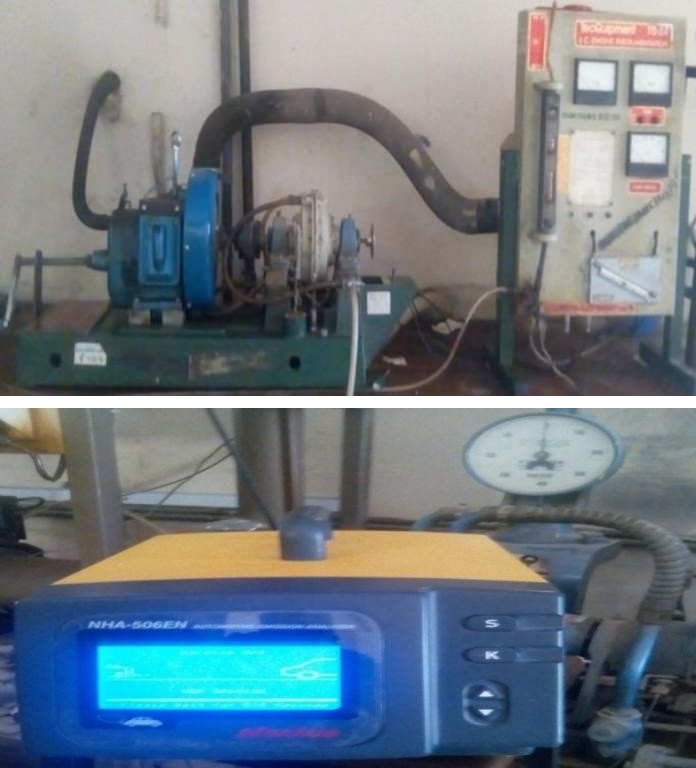
Plate I: Diesel engine test bed.
Plate II: NHA-506EN automotive emission analyzer.
| Parameters | Specifications | ||||
|---|---|---|---|---|---|
| Engine type | Horizontal single cylinder 4-stroke diesel | ||||
| Number of cylinders | 1 | ||||
| Overall dimension, mm | 535 x 326 x 445 (L x W x H) | ||||
| Bore stroke, mm | 75 x 75 | ||||
| Compression ratio | 20.5:1 to 22:1 | ||||
| Cooling method | Air cooling by blowing |
Bioinformatics & Proteomics Open Access Journal
| Method of lubrication | Centrifugal lubrication, combined oil mist and splash OHC 2 valves |
|---|---|
| Valve configuration | 1.2 liters |
| Oil sump capacity | 4.5 liters |
| Fuel tank capacity Maximum output, kW | 3.68 |
| Rated speed, rpm Advance angle injection 200 – 240 before TDC | 2600 |
Table 2: Test engine characteristics.
Methods
Blending of the samples: The biodiesel, the ethanol and the diesel were blended in dry flask equipped with a magnetic stirrer. The biodiesel-ethanol-diesel blends were produced with (%, v/v) 5, 10, 15, 20, 25, 30 and 35% ethanol with 85, 80, 75, 70, 65, 60 and 55% diesel, and biodiesel was kept at 10% throughout. Thus, the blends were labeled as BED5, BED10, BED15, BED20, BED25, BED30 and BED35, respectively.
Results and Discussions
Exhaust gas temperature
The exhaust gas temperatures from the test engine are higher with all the fuel blends than with diesel fuel due to the higher heating value of the blends. The exhaust gas temperature of BED30 appeared to be similar to that of the diesel at all speed conditions, except at 1920 rpm, where it is a bit higher (1270C for the diesel and 1420C for the BED30). The BED30 also appeared to be the best among the blends due to the lower heating value at all speed conditions. The variation of the exhaust temperature with engine speed tend to be linear, except for BED15, BED20 and BED30, and the highest value was below 2000C at all the speed conditions as shown in Figure 2; this confirmed with the study carried out by Yahuza et al. [8]. The higher exhaust temperature with the fuel containing higher amount of ethanol is indicative of lower thermal efficiency, less of the energy input in the fuel was converted to useful work, and the remaining heat is given out as exhaust temperature. This agrees with the findings reported by Yahuza, et al. [8] and Pramanik [9]. However, Hansen, et al. [10] stated that higher efficiency may be an indicator of better combustion behaviour of the ethanol- diesel blends, resulting in higher temperature and consequently higher exhaust temperature. Hansen, et al. [10] explanation for the high exhaust gas temperature is the fact that higher ignition delays results in a delayed combustion and higher exhaust temperature. Meanwhile, studies on 2 engines by Agarwal [11] reported that the difference of the exhaust temperature was less than 2% when fuelled with fossil diesel and ethanol. His results showed that temperatures, when the engine was fuelled with ethanol-diesel, were a little higher than those obtained with fossil diesel, ranging from 1.8% to 11.5%. Agarwal [11] reported that when ethanol concentration is increased the exhaust gas temperature increases by a small value, while using 20% ethanol, higher exhaust gas temperature is attained, which is indicating more energy loss in this case.
Carbon dioxide (CO2) Emission at Different Speed Conditions
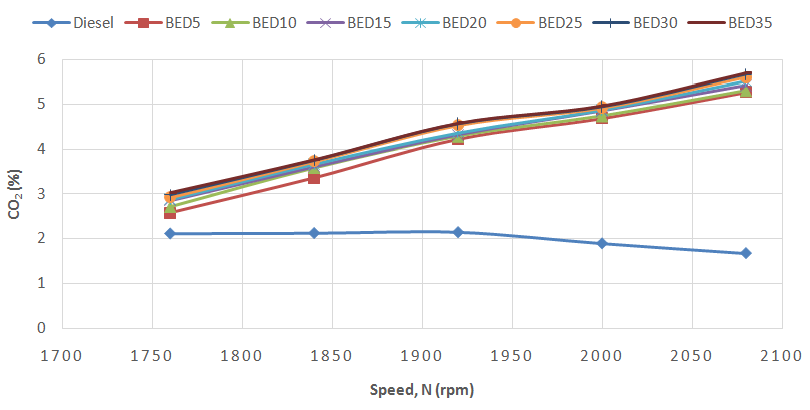
The carbon dioxide emission depends upon the complete combustion of the fuel. Since all the blends have more oxygen content than diesel because of the presence of ethanol, this results in complete combustion. Due to the complete combustion of the fuel blends, carbon dioxide emission also increases. It can be seen from Figure 3 that the carbon dioxide emission using diesel fuel is lower because of the incomplete combustion as compared to the blends. At all speed conditions, BED30 and BED35 exhibited the highest values of CO2 emission, because of the complete combustion and are the best among the fuel blends as indicated in Figure 3. The increase in CO2 is directly propositional to the increase in the amount of ethanol as shown in Figure 2 this is because ethanol contained more oxygen. Carbon dioxide (CO2) has great effect on the greenhouse gases, in that it has the tendency to form a blanket effect on the atmosphere which aids the global warming. The CO2 generally increases with increase in engine speed. At 1760 rpm the CO2 emission of BED5 is lowest but the diesel has the lowest CO2 at 2080 rpm. At 2000 rpm the CO2 emission is almost same for all the blends. Hansen, et al. (2011) [10] reported more CO2 emission by the ethanol-diesel blends tested, while Agarwal (2007) [11] found that the CO2 emissions from a diesel engine were higher. At the highest speed of 2080 rpm the CO2 emitted for BED30 is 7% as compared to 1.9% at 1760 rpm. CO2 emission indicates how efficiently the fuel burns inside the combustion chamber.
Bioinformatics & Proteomics Open Access Journal
![Figure 3: The increase in CO2 is directly propositional to the increase in the amount of ethanol as shown in Figure 2 this is because ethanol contained more oxygen. Carbon dioxide (CO2) has great effect on the greenhouse gases, in that it has the tendency to form a blanket effect on the atmosphere which aids the global warming. The CO2 generally increases with increase in engine speed. At 1760 rpm the CO2 emission of BED5 is lowest but the diesel has the lowest CO2 at 2080 rpm. At 2000 rpm the CO2 emission is almost same for all the blends. Hansen, et al. (2011) [10] reported more CO2 emission by the ethanol-diesel blends tested, while Agarwal (2007) [11] found that the CO2 emissions from a diesel engine were higher. At the highest speed of 2080 rpm the CO2 emitted for BED30 is 7% as compared to 1.9% at 1760 rpm. CO2 emission indicates how efficiently the fuel burns inside the combustion chamber.](/fulltextimages/1715/fig_3.png)
Carbon monoxide (CO) Emission at Different Speed Conditions
The results for the carbon monoxide emission of the blends and diesel at different speed conditions are shown in Figure 4. The carbon monoxide emission depends upon the oxygen content and cetane number of the fuel. The blends have more oxygen content than the diesel fuel; so, the blends having more oxygen content are involved in complete combustion process. The maximum carbon monoxide emission was observed at 1760 rpm of the engine speed when run on diesel fuel. So, it can be seen clearly that the fuel blendBED35 gives low carbon monoxide emission than the other fuels at all speed conditions. The increase of the ethanol percentage in the fuel blend reduces the CO as the BED35 has the least CO. This is possible because of the additional oxygen present in the ethanol, which assists in making the combustion more complete.
Figure 4 illustrates the variation of CO emission with engine speed. It can be seen that at 1760 rpm the BED35 has the least CO emission followed by the BED30. The CO emission is lower at 2000 rpm for all the blends. This shows that with more speed, the engine requires additional oxygen for its combustion which was not readily available with the additional injection of fuel. This tends to increase the emission of CO. This result is in line with the findings of studies conducted by Yahuza, et al. [8], Hansen, et al. [10], Kalligeros, et al. [12] and Marshall, et al. [13] that show the use of ethanol-diesel and biodiesel fuels result in the reduction of unburned HCs and CO emissions. The most noticeable reduction appeared at intermediate speed of 1920 rpm. At low speed condition, cylinder temperature was too low, that increased with loading due to more fuel injected inside the cylinder. Findings of Kalligeros, et al. [12] indicated that for low speed, CO reduction was practically unaffected by the addition of any fuel to diesel. The study further stated that Bioinformatics & Proteomics Open Access Journal
at elevated temperature, performance of the engine improved with relatively better burning of the fuel resulting in decreased CO.
Hydrocarbon (HC) Emission at Different Speed Conditions
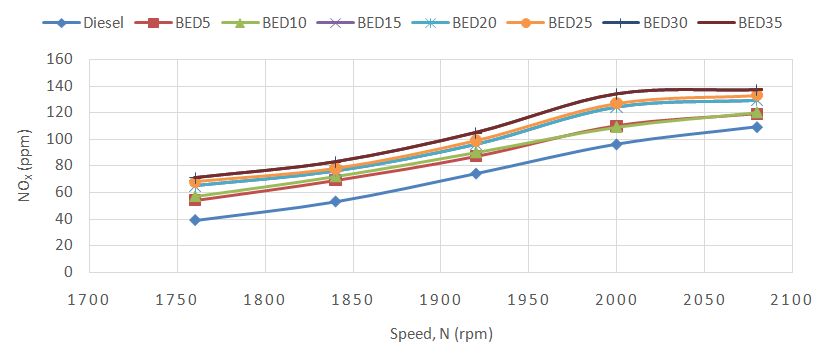
NOX emissions depend on the oxygen concentration and the combustion time. At all speeds conditions, NOX emission of the blends is always higher than that of standard diesel due to the oxygen concentration and combustion timing. Since ethanol has very low cetane number, the cetane numbers of the blends are lower than that of standard diesel. This causes increase in the NOx emission of the blends. The shorter ignition delay could be a reason of increased NOx emission. BED15 and BED20 show similar values at all speed conditions. Similarly, ED30 and ED35 show the same trend. All the fuel blends have values of NOX which is above 110ppm at high speed (above 2000 rpm), while that of diesel was below this value at the rate of the same speeds (Figure 6). At 2080 rpm, BED35 has more NOx emission than all the blends, with BED5 having least. As speed is increased, so does all NOx emission in all the blends. However, the diesel gave the least NOx emission at speed of1760 rpm. At low speeds, engine block and cylinder temperature was not very hot therefore little amount of NOx was produced. But studies by Puhan, et al. [15] show reduction in NOx consistently for some tests done. They stated that the emission of NOx is determined by oxygen concentration, peak pressure, combustion temperature and time. From this, it can be concluded that any change in combustion temperature and stoichiometry will affect the production of NOx. In summary, it can be seen from Figure 6 that there was a gradual increase of NOx emission in all the fuels as the speed is increased.
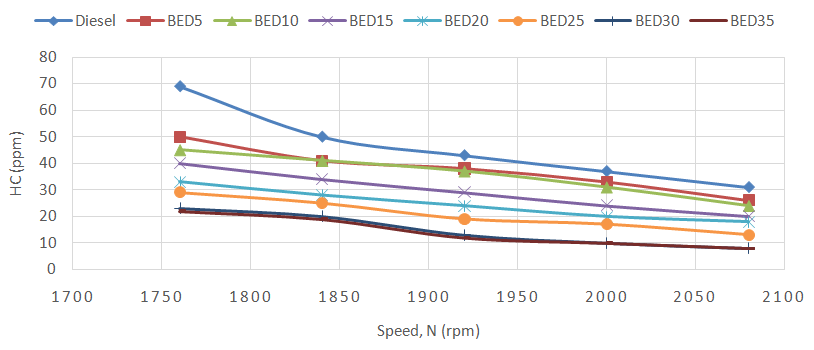
The blends have more oxygen content than that of standard diesel. So, it is more likely to undergo complete combustion process than diesel. The hydrocarbon emissions of the blends are lower than that of standard diesel due to complete combustion process. When percentage of ethanol increases in the blend, hydrocarbon decreases. Figure 5 clearly shows that fuel blend BED35 gave lower hydrocarbon emissions than the other blends. BED5 at all speed conditions gave an amount of hydrocarbon close to that of BED10, while that of diesel fuel is higher at all the speeds. The HC of diesel decreases with increase in speeds; the trend is the same with the remaining fuel blends. BED30 and BED35 have almost the same values at all speeds, as indicated in Figure 5. The HC emissions throughout the study were low. At 1760 rpm, the HC emissions were lower than that at 1840 rpm. However, at 1920 rpm the HC emission dropped further by about 6% for all the blends. On the whole, there was a decrease in the HC with increase in the speed. The result also highlighted the fact that at low speed, the HC emission of the BED35 is considerably less than that of BED30 and both tend to lower further at 1760 rpm. Hansen, et al. [10] findings attest reductions in CO and HC emissions for ethanol-diesel blends. The reasons are attributed to the oxygen content of the fuels. Studies by Monyem and Gerpen [14] show that unburned hydrocarbons generally emanate from the regions in a cylinder where there is a poor fuel/air mixture to such a high extent that the ratio exceeds the combustion limit. The BED30 and BED35 showed consistently low level of HC emission when compared to both the rest of the blends and the diesel at all speeds.
Oxides of Nitrogen (NOX) Emission at Different Speed Conditions
![Figure 5: The HC emissions throughout the study were low. At 1760 rpm, the HC emissions were lower than that at 1840 rpm. However, at 1920 rpm the HC emission dropped further by about 6% for all the blends. On the whole, there was a decrease in the HC with increase in the speed. The result also highlighted the fact that at low speed, the HC emission of the BED35 is considerably less than that of BED30 and both tend to lower further at 1760 rpm. Hansen, et al. [10] findings attest reductions in CO and HC emissions for ethanol-diesel blends. The reasons are attributed to the oxygen content of the fuels. Studies by Monyem and Gerpen [14] show that unburned hydrocarbons generally emanate from the regions in a cylinder where there is a poor fuel/air mixture to such a high extent that the ratio exceeds the combustion limit. The BED30 and BED35 showed consistently low level of HC emission when compared to both the rest of the blends and the diesel at all speeds.](/fulltextimages/1715/fig_5.png)
Bioinformatics & Proteomics Open Access Journal
Oxides of Sulfur (SOX) Emission at Different Speed Conditions
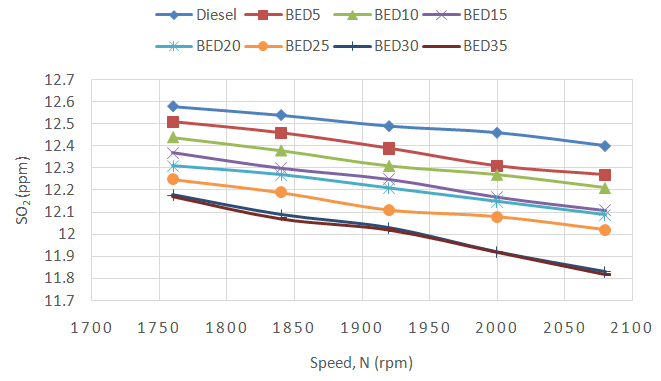
odor. Oxidation of sulfur dioxide produces sulfur trioxide which is the precursor of sulfuric acid which, in turn, is responsible for the sulfate particulate matter emissions. Sulfur oxides have a profound impact on environment being the major cause of acid rains. It can be seen, from Figure 7, that the SO2 decreases with increase in the speed of the engine and BED30 and BED35 appeared to be the best candidates with lowest SO2 emission when compared with diesel and the blends. The decrease of the SO2 emission as the speed increases indicated that the fuel consumption is low at high speed, and this agrees with the findings reported by Yahuza, et al. [8] and Hansen, et al. [10]. The SO2 content of the diesel and the blends is below 13 ppm which indicated a better sulfur content, because most biodiesels contain less than 15 ppm sulfur as reported by Mittelbach and Remschmidt [17]. The sulfur limit for highway diesel fuel is 0.015% (15 ppm) [17].
Figure 7 shows the results for the oxide of sulfur emission of the blends and diesel at different speed conditions. When fuel is burnt in an engine, any sulfur will be converted into sulfur dioxide (SO2) gas. This readily dissolves in water to produce an acid, which accounts for the irritation to your respiratory tract if you inhale it and it also affects the ecology [16]. Sulfur dioxide (SO2) is generated from the sulfur present in diesel fuel. The concentration of SO2 in the exhaust gas depends on the sulfur content of the fuel. Low sulfur fuels of less than 0.05% sulfur are being recommended for most diesel engine applications [16]. SO2 is a colorless toxic gas with a characteristic, irritating Bioinformatics & Proteomics Open Access Journal
Summary and Conclusion
Summary
Experimental investigation was carried out for different blends of ethanol (produced from sawdust of Masonia), biodiesel (produced from neem oil) and diesel (purchased from AYM Shafa filling station Bauchi). The emissions (CO, CO2, HC, NOx and SOx) were evaluated and compared with the diesel. The test results show that there was a considerable increase in exhaust temperature with the blends compared to the diesel. Meanwhile, the exhaust gas temperatures of all the fuel blends are higher than the diesel fuel due to the higher heating value of the blends. The exhaust gas temperature of BED30 appeared to be similar to that of the diesel at all speed conditions this confirmed the results reported by Senthil and Manimaran [2], Tsolakiset, et al. [18], Rakopoulos, et al. [19] and Agarwal and Das [20, 21]. The results, also show that the blends gave a less carbon monoxide (CO) compared to petroleum diesel. The minimum and maximum reduction of CO was 9.46 and 49.14%, as compared to diesel. The emissions of NOx, SOx and CO2 increased with the increase in ethanol in the blends.
Conclusion
From the experimental investigation the following conclusions may be drawn: • There was a considerable increase in exhaust temperature with the blends compared to the diesel, but the exhaust temperatures of the blend were higher than that of the diesel fuel in the study. The maximum value of exhaust temperature was obtained with the BED35 (1940C) followed by the BED30 (1920C), at
1760 rpm. However, there is a steady rise of this temperature as the power of the engine is increased
- The CO2 generally increases with increase in engine speed. At 1760 rpm the CO2 emission of BED5 is lowest but the diesel has the lowest CO2 at 2080 rpm. At 2000 rpm the CO2 emission is almost same for all the blends, thus, CO2 emission indicates how efficiently the fuel burns inside the combustion chamber
- The increase in the amount of ethanol in the fuel blend reduces the CO as the BED35 has the least CO. This is possible because of the additional oxygen present in the ethanol, which assist in making the combustion, will tend to move the combustion process in coming to completion
- The BED30 and BED35 had shown a consistent low level of HC emission when compared to both the rest of the blends and the diesel at all the speeds
- At 2080 rpm, BED35 has more NOx emission than all the blends, with BED5 having the least. As the speed is increased, so does all NOx emission in all the blends. However, the diesel gave the least NOx emission at speed of 1760 rpm, because at low speeds, engine block and cylinder temperature was not very hot; therefore, little amount of NOx was produced; and
- The SO2 decreases with increase in the speed of the engine and BED30 and BED35 appeared to be the best candidates with lowest SO2 emission when compared with diesel and the blends. References
1. IEA (2009) World Energy Outlook 2009. International
Energy Agency, Paris.
Bioinformatics & Proteomics Open Access Journal
2. Senthil KR, Manimaran R (2014) Performance and emission characteristics on 4 Stroke single cylinder CI engine using cottonseed bio fuels. International Journal of Engineering Research & Technology (IJERT) 2(11): 36-43.
3. Martinez‐Frias J, Francis H (2012) Improving Ethanol
Life Cycle Energy Efficiency by Direct Utilization of Wet Ethanolin HCCI Engines. ASME (American Society of Mechanical Engineers).
4. Bote MA, Dange HM (2014) Performance analysis of single cylinder four stroke petrol engine using petrol blended with Thumba oil 3(2): 34-39.
5. Sindhu G, Swetha M (2011) Production of biodiesel by Transesterification of different plant oils. SAE 930934.
6. Chris Collins (2007) Implementing Phytoremediation
of Petroleum Hydrocarbons. Methods in Biotechnology 23: 99-108.
7. Ayhan Demirbas (2008) Biodiesel: A Realistic Fuel
Alternative for Diesel Engines. Springer, Berlin, pp: 74.
8. Yahuza I, Dandakouta H, Ibrahim ME (2016)
Performance Evaluation of Ethanol-Diesel Blend in Compression-Ignition Engine. Journal of Bioprocess Biotech 6: 281.
9. Pramanik K (2003) Properties and use of jatropha curcas oil and diesel fuel blends in compression ignition engine. Renewable Energy 28(2): 239-248.
10. Hansen AC, Hornbaker RH, Zhang, Q, Lyne PWL
(2011) On farm Evaluation of Diesel Fuel Oxygenated with Ethanol. ASAE Paper No. 03-5620. ASAE.
11. Agarwal AK (2007) Biofuels (alcohols and biodiesel) applications as fuels for internal combustion engines. Progress in Energy and Combustion Science 33: 233- 271.
12. Kalligeros S, Zannikos F, Stournas S, Lois E,
Anastopoulos G, et al. (2003) An investigation of using biodiesel/marine diesel blends on the performance of a stationary diesel engine. Biomass and Bioenergy 24(2): 141-149.
13. Marshall W, Schumacher LG, Howell S (1995) Engine
Exhaust Emissions Evaluation of a Cummins L10e When Fuelled with a Biodiesel Blend. NIPER-BDM Oklahoma, University of Missouri MARC IV.
14. Monyem A, H Van Gerpen J (2001) The effect of biodiesel oxidation on engine performance and emissions. Biomass and Bioenergy 20(4): 317-325.
15. Puhan S, Vedaraman N, Ram BVB, Sankarnarayanan
G, Jeychandran K (2005a) Mahua oil (MadhucaIndica seed oil) methyl ester as biodiesel-preparation and emission characteristics. Biomass and Bioenergy 28(1): 87-93.
16. IEA (International Energy Agency) (2014) Bio fuels for Transport-An International Perspective.
17. Mittelbach M, Remschmidt C (2006) Biodiesel: The
comprehensive handbook. Austria: Martin Mittel bach.
18. Tsolakis A, Megaritis A, Wyszynski ML, Theinnoi K
(2011) Engine performance and emissions of a diesel engine operating on diesel-RME (rapeseed methyl ester) blends with EGR (exhaust gas recirculation). Energy 32: 2072-2080.
19. Rakopoulos CD, Antonopoulos KA, Rakopoulos DC,
Hountalas DT, Giakoumis EG (2006) Comparative performance and emissions study of a direct injection diesel engine using blends of diesel fuel with vegetable oils or bio-diesel of various origins. Energy Conversion and Management 47: 3272-3287.
20. Agarwal AK, Das LM (2001) Biodiesel Development
and Characterization for Use as a Fuel in Compression Ignition Engines. Journal of Engineering for Gas Turbines and Power 123(2): 440-447.
21. Agarwal AK (2011) Biofuels (alcohols and biodiesel) applications as fuels for internal combustion engines. Progress in Energy and Combustion Science 37: 100- 128.
- Carbon Code for Analysis of Protein Stability in Protein Mutation
- Number of Contiguous Amino Acids in Nanon of 16A Diameter
- Identification of Hub Genes and Pathways in Cervical Cancer by Statistical and Bioinformatics Analysis
- Effect of Dietary Inclusion Levels of Moringa Olerifera Oil on the Growth Performance and Nutrient Retention of Broiler Starter Chicks
- Proteomics Loans in Kinetoplastids during the Last Decade
- “Identification of SARS-CoV-2 in Human Genome based on Protein Dynamics Conversion and Target Genes Marking via Bioinformatics Approaches”