
Flattned Nose Revealing Syphilitic Aortitis
Flattled nose also called syphilis nose is a deformation of the nose due to the destruction of the cartilage of the nasal septum: the lower segment of the nose collapses, undergoing recoil and retract, becoming embedded in the upper segment. It is characteristic of congenital and tertiary syphilis [1]. We report the case of syphilitic aortitis revealed by flattened appearance of the nose.
Introduction
Syphilis, before the era of antibiotics, reigned among the leading causes of cardiovascular disease [1]. In its tertiary phase, it can be responsible for several vascular manifestations of varying severity. It occurs on 30% of patients not treated during the primary phase, symptomatic on 10 to 15% of cases [2]. We illustrate through this observation a case syphilitic aortitis revealed by flattened appearance of the nose.
Observation
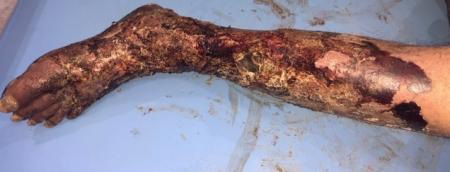
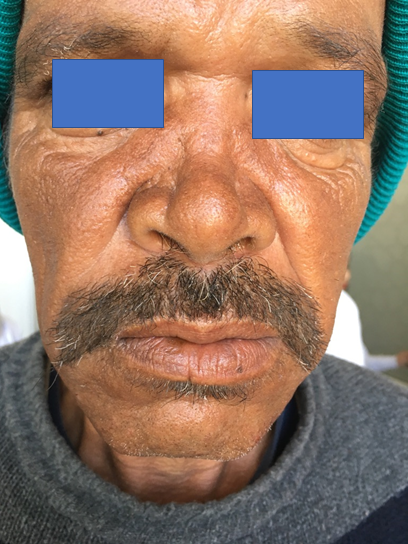
A 45-year-old man, with no particular medical history, seen in dermatological consultation for necrotic lesion on the lower limb. Clinic examination found necrotic plaques on the left leg and foot with bilateral edema and weak peripheral pulses (Figure 1). The rest of examination showed a collapse of the root of the nose (Figure 2), not noted by the patient and not objectified in his old photos, giving the appearance of a lorgnette nose. Tertiary syphilis was suspected and confirmed by syphilitic serology (VDRL
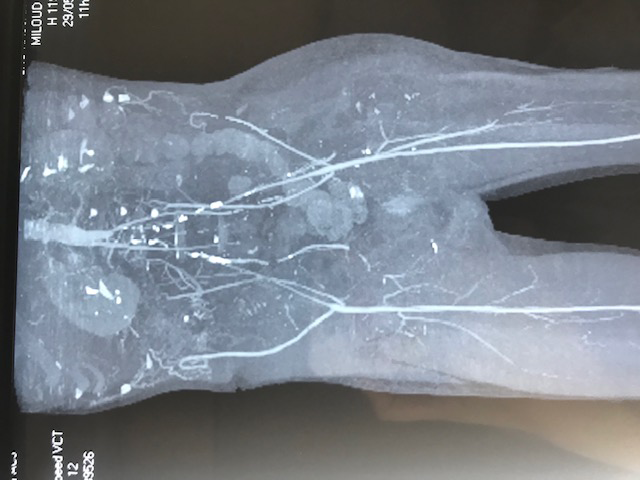
1/16 TPHA > 2560). The evolution was marked by an extension of the lesions taking all the leg and the left foot, surmounted by place by hemorrhagic and meliceric crusts. The vascular examination finds an abolition of the tibial and femoral pulses. An abdominal CT angiography was performed objectifying a chronic aorto bi-iliac occlusion (Figure 3), for which he benefited from a trans-femoral amputation and put on statin, antiplatelet, preventive anticoagulation and penicillin.
Discussion
Syphilis is a sexually transmitted and contagious infectious disease caused by Treponema pallidum. We distinguish currently recent syphilis grouping together primary-secondary syphilis and latent syphilis of less than one year for Anglo-Saxons or two years for Americans and late syphilis grouping together latent syphilis over a year or two years and syphilis tertiary [3].
Cutaneous manifestations of tertiary syphilis are diverse, dominated by: gums, chronic ulcerations and tubercles. However, the most cited cardiovascular manifestations in the literature are: aortic aneurysm, aortic valvular insufficiency, aortic root dilatation and coronary ostial stenosis. Aortic occlusion has been rarely reported in the literature, but remains very noisy in terms of clinical.
Although, often regarded as unexpected diagnosis, actually cases of cardiovascular syphilis continue to be reported. Presumably, Treponeme pallidum invades the aortic wall and the inflammator response progresses towards obliterative endarteritis and necrosis of the muscular and the elastic fibers in the aortic media. The consequent is the weakness of the aortic wall, wich can lead to severe complications [4].
Conclusion
Even the absence of cardiovascular risks factors or primary infection, cardiovascular syphilis has to stay in mind, specially in young sexually active patients. It should not be forgotten the « great imitator » character of the syphilis.
Conflicts of Interest : No conflicts to declare
References
-
Mudry A (2021) Nose like the foot of a pot. Eur Ann Otorhinolaryngol Head Neck Dis 138(3) : 205-207.
-
Jackman Jr. JD, Radolf JD (1989) Cardiovascular syphilis. Am J Med 87: 425-433.
-
Saraiva RS, Cesar CA, de Mello MAA (2010) Syphilitic aortitis: Diagnosis treatment. Case Report. Rev Bras Cir Cardiovasc 25(3): 415-418.
-
Drago F, Merlo G, Rebora A, Parodi A (2018) Syphilitic aortitis and its complications in the modern era. G Ital Dermatol Venereol 153(5): 698-706.
- Epithelioid Granuloma; 3cases with Different Clinical Features
- Advancing Representation in Dermatology Clinical Trials: Ethical, Scientific, and Regulatory Imperatives for Inclusion Across all Fitzpatrick Skin Types
- A Case of Atopic Dermatitis with Concurrent Psoriasis Vulgaris: Successful Treatment with Upadacitinib
- Innovation Lifting Eyeshadow: A Synthesis of Makeup and Optical Illusion
- Distinguishing Superficial Actinic Porokeratosis from Actinic Keratosis with UVF Dermoscopy: A Case Report
- High Mobility Group Box 1 (HMGB1) in Cutaneous Inflammation: An Immune Modulator Bridging Cellular Stress, Ferroptosis and Danger Signaling