
Clinical Study of Diabetes Mellitus with Effectiveness of Homoeopathic Medicine Sulphur, by Managing Diet and Regimen
Diabetes mellitus (DM), universally recognized as diabetes, is a clutch of metabolic disorders categorized by a high blood sugar level over a sustained era. Indicators are high blood sugar include frequent urination, augmented thirst, and amplified hunger. If port unprocessed, diabetes can be a source of numerous snags. Acute hitches can omit diabetic ketoacidosis, hyperosmolar hyperglycaemic state, or demise. Grim of long-term impediments include cardiovascular illness, stroke, chronic kidney disease, foot ulcers, and destruction to the eyes. The chief impartial of our scrutiny is to determine the efficacy of the homoeopathic medicine, Sulphur in managing diabetics mellitus and providing through broad-spectrum administrations are recommended subsequently from side-to-side clinical examination and case taking. Here, five cases analysed by means of diabetics reserved in to deliberation and through this study I intend to portray and delineate the Sulphur medicine spectacles with marked action upon the diabetics with the assortment of similimum and beside by fetching the hilarity of symptoms to underneath resistor and has been substantiated to provoke the deranged vitality in patients with diabetics and bring them ease.
Introduction
The term “diabetes” or “to pass through” was first used in 230 BCE by the Greek Apollonius of Memphis. The disease was considered rare during the time of the Roman empire, with Galen commenting he had only seen two cases during his career. This is possibly due to the diet and lifestyle of the ancients, or because the clinical symptoms were observed during the advanced stage of the disease [1]. Galen named the disease “diarrhoea of the urine”. The earliest surviving work with a detailed reference to diabetes is that of Aretaeus of Cappadocia. He described the symptoms and the course of the disease, which he attributed to the moisture and coldness, reflecting the beliefs of the “Pneumatic School”. He hypothesized a correlation between diabetes and other diseases, and he discussed differential diagnosis from the snakebite, which also provokes excessive thirst. His work remained unknown in the West until 1552, when the first Latin edition was published in Venice.
There are three main types of diabetes mellitus. As of 2017, an estimated 425 million people had diabetes worldwide, with type 2 diabetes making up about 90% of the cases [2]. This represents 8.8% of the adult population, with equal rates in both women and men. Trends suggest that rates will continue to rise. Diabetes at least doubles a person’s risk of early death. In 2017, diabetes resulted in approximately 3.2 to 5.0 million deaths. The global economic cost of diabetes related health expenditure in 2017 was estimated at US$727 billion. In the United States, diabetes cost nearly US$245 billion in 2012. Average medical expenditures among people with diabetes are about 2.3 times higher. The WHO estimates that diabetes resulted in 1.5 million deaths in 2012, making it the 8th leading cause of death. However, another 2.2 million deaths worldwide were attributable to high blood glucose and the increased risks of cardiovascular disease and other associated complications (e.g. kidney failure), which often lead to premature death and are often listed as the underlying cause of death certificates rather than diabetes [3]. For example, in 2017, the International Diabetes Federation estimated that diabetes resulted in 4.0 million deaths worldwide, using to estimate the total number of deaths that could be directly or indirectly attributed to diabetes [4].
In 2017, 425 million people had diabetes worldwide, up from an estimated 382 million people in 2013 and from 108 million in 1980.Accounting for the shifting age structure of the global population, the prevalence of diabetes is 8.8% among adults, nearly double the rate of 4.7% in 1980. Type 2 makes up about 90% of the cases [5]. Some data indicate rates are roughly equal in women and men, but male excess in diabetes has been found in many populations with higher type 2 incidence, possibly due to sex-related differences in insulin sensitivity, consequences of obesity and regional body fat deposition, and other contributing factors such as high blood pressure, tobacco smoking, and alcohol intake.
Materials and Methodology
Five cases with Diabetes Mellitus are selected I had processed the study as randomly selected each individual with same probability of being at any stage during the sampling process, and each subset of individuals has the same prospect of being chosen for the sample as any other subset of individuals. For my study both sexes are selected with their major complaint. Patients with other systemic illness, chronic disease and pregnant women are avoided. Cases were taken and administration of relevant Homoeopathic similimum with proper dose and potency based upon the Homoeopathic principles.
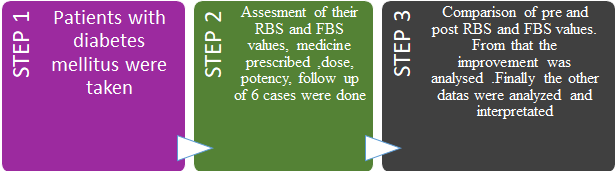
In this study the case will be prescribed on the basis of characteristic symptom after detailed case taking will be done with the help of Sarada Krishna homoeopathic medical college standardised case record. After diagnosis of the cases based on clinical presentation like of increased taste, increased appetite, increased maturation in-between short duration dryness of skin, weight loss, hair fall, fatigue, weakness are the symptoms renowned. Diagnosis occurs on the core of strong detached history and test analysis.
The study was to determine the common causes of Diabetic mellitus and to evaluate the role of Homoeopathic remedies in its management with assessment of urine analysis as well as blood investigation of FBS and PPBS. Homoeopathic medicines based on the symptom similarities (acute totality). After analysis and evaluation of the cases further follow-ups and FBS and PPBS level were evaluated. Prescription will be done on the basis of totality the symptoms after reference with standard text books of Materia Medica according to guide lines of Organon of Medicine. Prescription and repetition down in the Organon of Medicine. Improvement criteria are mainly done on the basis of symptomatic relief. Follow-up of the cases for six months was prepared. After medication urine analysis and blood investigations are assessed for the improvement criteria as well as the cases will be based on pre and post analysis are updated, according to the principles.
Results and Discussion
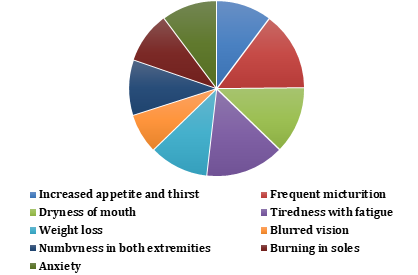
The outcome of the study conducted in 5 cases are recorded here. These cases crop up enduringly least period of 6 months and the results are mentioned below. Statistical analysis was done in order to test the significance of the Pre-test and Post-test scores. The results were examined in relation with fasting blood sugar level and post prandial blood sugar level have been made into chart and recorded in the study. The effectiveness of homoeopathic remedy Sulphur selection is based on chronic totality and constitutionally adopted [6]. Hahnemann says in his lesser writing “but we moderns on the contrary are of course and this I would almost concede to you for the sake of peace, if this verdict only applied to some of us” [7]. He also explains about the importance of the diet and regimen in the aphorisms 259 to 264, emphasizes on the importance which a patient should maintain on his or her diet and regimen in order to let the medicine have a complete action on the being [8]. As to food, all modules of human being who request to be preserved of a lingering illness, can hurt few limitations [9] (Table 1).
| Nature of symptoms | Before | After |
|---|---|---|
| Increased thirst and appetite | 19 | 1 |
| Frequent micturition < night | 20 | 1 |
| Dryness of mouth | 17 | 2 |
| Tiredness with fatigue | 20 | 1 |
| Weight loss | 15 | 1 |
| Blurred vision | 10 | 2 |
| Numbness in both extremities | 14 | 0 |
| Burning sensation in soles | 13 | 1 |
| Anxiety | 14 | 1 |
Table 1: Showing the distribution of patients according to the symptoms According to Stuart Close “The homoeopathic cure was obta
Table 1: Showing the distribution of patients according to the symptoms According to Stuart Close “The homoeopathic cure was obtained without suffering, without the production of any drug symptoms, in appositive and direct manner, by the action of sub-physiological doses; in other words, by the minimum dose, which was a dose so small that it was not capable of producing symptoms when used therapeutically” [10]. “The more similar the remedy, the more clearly and positively the symptoms of the patient take on the peculiar and characteristic form of the remedy, the greater the susceptibility to that remedy, and higher the potency required” (Figure 2).
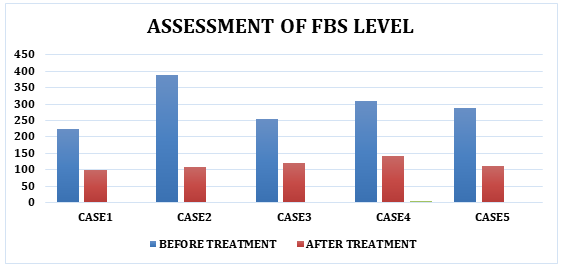
In Homeopathy, it is assumed that entire life processes either on physical, mental or psychological levels depend on the strength of the vital force. In Organon of medicine, aphorism 83-104, mentioned about case taking. By detailed case taking we can able to select the individualised homoeopathic medicine which cures the patient [8]. In the book of “The principle and art of homoeopathy “by Richard Hughes he mentioned that,” Homeopathy offers a life of service to humanity, and it is the only method of healing that surely sets the sick man and sick woman on the permanent road to recovery. We must remember that though we may fail, the failure is ours; it is not the failure of Homeopathy. The better knowledge we have of the “tool of our trade” the better use we should make of them” [11] (Figure 3).
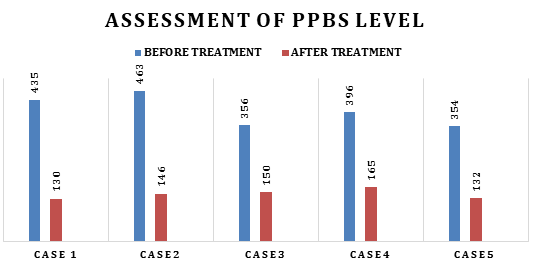
In homeopathy, health is considered as mental, physical and emotional wellbeing. The disease is the dynamic disturbance of harmonious relation between the material body and vital force that stimulates the body in health. In Homeopathy, cure is only achieved by the complete elimination of symptoms and even effects of other treatments. The cases where continued treatment is necessary, it is called “palliation” not “cure” [8]. The vital force stimulates the material organism in health and disease. In homeopathy, the person is taken as a whole and diseased organ symptom alone are of no value.
Action of Sulphur with Indicated Symptoms
Conclusion
Commencing this study, we initiate the Homoeopathic medicines, Sulphur was effective in the management of diabetes. The commonest potency used 0/3 and mostly affected victim is female [10]. Thus the Homoeopathic ultra-dilutions act best in diabetics and render benefits to mankind. Further progress is considered for 6 months of period to analyse and evaluate. The cases were enquiring with the quality-of-life questionnaire in order to know the improvement in the quality of life [11]. Grading of symptoms was one of the key points that should be noted [12]. The cases were prescribed after careful analysis based on totality of symptoms which were then correlated with drug symptoms [13].
On analysis of lab investigation of fasting blood sugar level and post prandial blood sugar level improvement criteria and scores of pre-tests and post-test are observed following by the role of diet and regimen, treatment in the management of Homeopathic medicines diabetics was found to be effective [14]. Theses crises may be in the form of sudden stress, anxiety, indiscretions of diet or hygiene, some apparently simple thing out of all proportions to the serious consequences [15]. All those countless assumptions regarding the nature of symptoms, as well as the homoeopathic scheme of medication known by means of modest maxims, explicit medicines simply and rapidly, without metaphysical explanation [16].
Based on most study, large factor is diet and regimen to control the sugar level as a result, the patient was advised to take low carbohydrate food and saturated fat intake with healthy fats [17]. Healthy fats like polyunsaturated fatty acids help in controlling the insulin levels in your body [18]. This helps in lowering your blood glucose levels. However, you need to take healthy fats in the right quantity to regulate your blood sugar levels. Ensure routine check-up, do not neglect even any minor wounds, cuts, abrasions are prone to infection [19, 20, 21, 22]. This study interpreted, when a marked reduction was realized in post-test values in comparison with pre-test values. Thus, we can conclude that administration of homoeopathy remedy Sulphur in treatment could give good relief in the managing reducing the intensity of symptoms as well as the disease, diabetics.
References
-
Diabetes Blue Circle Symbol (2006) International Diabetes Federation.
-
WHO (2023) Diabetes. Fact Sheet N°312.
-
Kitabchi AE, Umpierrez GE, Miles JM, Fisher JN (2009) Hyperglycemic crises in adult patients with diabetes. Diabetes Care 32 (7): 1335-1343.
-
Krishnasamy S, Abell TL (2018) Diabetic Gastroparesis: Principles and Current Trends in Management. Diabetes Therapy 9: 1-42.
-
Chiang JL, Kirkman MS, Laffel LM, Peters AL (2014) Type 1 diabetes through the life span: a position statement of the American Diabetes Association. Diabetes Care 37(7): 2034-2054.
-
Kent JT (2002) Repertory of the Homoeopathic Materia Medica. Kuldeep Jain, Jain Publishers (P) LTD, New Delhi, India.
-
Hahnemann S (2006) The chronic diseases, their peculiar nature and their homoeopathic cure. HOMEOTRADE, New Delhi, India.
-
Hahnemann S (2004) Organon of Medicine. In: 5th, 6th (Edns.), Kuldeep Jain, B. Jain Publishers, New Delhi, India.
-
Roberts HA (1997) The Principles and Art of Cure by Homoeopathy: A Modern Textbook. B. Jain Publishers.
-
Close S (1991) The Genius of Homeopathy Lectures and Essays on Homeopathic Philosophy. Mede-T.
-
Hughes R (1994) The principles & practice of homoeopathy Noida. B Jain Publishers, Uttar Pradesh, India.
-
Nash EB (2002) Leaders in Homoeopathic Therapeutics with Grouping and Classification. Kuldeep Jain, B. Jain Publishers (P) LTD, New Delhi, India.
-
National Institute of Diabetes and Digestive and Kidney Diseases (2014) Causes of Diabetes.
-
Ripsin CM, Kang H, Urban RJ (2009) Management of blood glucose in type 2 diabetes mellitus. American Family Physician 79(1): 29-36.
-
Boericke W (1927) Pocket Manual of Homeopathic Materia Medica with Addition of repertory. 9th (Edn.), Philadelphia, PA Boericke and Runyon pp: 1188.
-
Brutsaert, Erika F (2017). Drug Treatment of Diabetes Mellitus.
-
International Diabetes Federation (2017) IDF Diabetes Atlas. In: 8th (Edn.), Brussels, Belgium: International Diabetes Federation.
-
World Health Organization (2014) bout diabetes.
-
Jaworska J, Dziemidok P, Kulik TB, Rudnicka Drozak E (2004) Frequency of self-monitoring and its effect on metabolic control in patients with type 2 diabetes. Annales Universitatis Mariae Curie-Sklodowska. Sectio D: Medicina 59(1): 310-316.
-
Roach P (2004) Better systems, not guidelines, for glucose monitoring. BMJ 329: 7479.
-
Pulse (2019) Government set to double NHS diabetes Prevention programme. Diabetes.
-
Diabetes UK (2019) I have Type 1 diabetes-what can I eat.
- Investigation of Polymorphisms in PPAR-Ɣ and TRHR Genes and their Impact on Turkish Diabetic and Obese Individuals
- The Impact of Aircraft Noise Exposure on the Efficacy of Empagliflozin Therapy in an Animal Model of Obesity
- Rooibos Mitigates Metabolic and Inflammatory Dysfunctions in Mice Fed a High-Carbohydrate Diet
- Synergistic Effect of Combined Leaf Extract of Vernonia amygdalina, Ocimum gratissimum, and Zingiber officinale Tuber on Phytochemical Profile, Antioxidant Activity, Serum Insulin, and Biochemical Parameters in Streptozotocin-Induced Diabetic Rats
- Investigation of Cardiovascular Responses to Aerobic Exercise in Obese University Students
- A Look at the Phase Angle Obtained by Electrical Bioimpedance