
Factors Associated with Suicide among Police Officers in Brazil: An Integrative Literature Review Study
The study aimed to identify factors associated with suicide among police officers in Brazil. This is an integrative literature review that was based on the following guiding question: "What are the factors associated with suicide among police officers in Brazil?". Searches were performed in November 2023 in the scientific databases Virtual Health Library (VHL) (https:// pesquisa.bvsalud.org/portal/) and PubMed (https://pubmed.ncbi.nlm.nih.gov/), from the search key: ((POLICE) AND (SUICIDE)) and (BRAZIL). The descriptors used were extracted from the Mesh/National Library of Medicine platform. Original articles published in the last 10 years that presented characteristics, profile and risk factors associated with suicide were included. Literature review studies, dissertations, theses, letters to the editor and articles in duplicate were excluded. The studies were published between 2007 and 2022. The sample consisted of quantitative descriptive studies (n=3), retrospective cohort (n=1) and ecological time series (n=1). The surveys had samples mostly composed of military police men; only one study investigated federal highway police. The factors associated with suicide and suicidal ideation among police officers in Brazil were financial complications, psychopathological comorbidities, male sex, young age and incipient career graduation.
Introduction
Police activity represents a stressful occupation with a significant negative impact on the mental and physical health of the professional and can generate high rates of depression, anxiety, exhaustion and lead to suicide [1]. Rescuers such as police, firefighters and paramedics have in their occupational routines occupational events capable of providing greater risks to mental health such as suicidal thoughts and behaviors. In contrast, factors such as companionship and pre-recruitment screening can serve as protective agents against the appearance of disorders or maintenance of psychiatric conditions in this population [2].
Among the feelings of risk, hopelessness represents a manifestation of psychological vulnerability that has an important relationship with the reduction of personal fulfillment of the police officer. This condition generates a negative potential for the mental health of police officers, which, in addition to depression and emotional exhaustion, is associated with a higher risk of suicide [3].
Thus, it is necessary to identify and understand the factors that are related to suicidal ideation among security professionals, due to their exposure to stressors that can intensify an important psychological imbalance [4]. Given the above, this integrative literature review aimed to identify the factors associated with suicide among police officers in Brazil.
Material and Methods
This is an integrative review conducted through the systematic search for scientific studies, critical evaluation and synthesis of available evidence on the investigated topic. The methodological tool adopted in the execution of the investigation was PRISMA (Preferred Reporting Items for Systematic Reviews and Meta-Analyses). The study was conducted considering six methodological steps [5]: a) definition of the guiding question; b) systematic search of evidence; c) categorization of studies; d) evaluation of selected studies; e) interpretation of evidence; f) synthesis and presentation of the results.
The following guiding question was defined: “What are the factors associated with suicide among Brazilian police officers?”. Searches were performed in November 2023 in the scientific databases Virtual Health Library (VHL) (https:// pesquisa.bvsalud.org/portal/) and PubMed (https:// pubmed.ncbi.nlm.nih.gov/), from the search key: ((POLICE) AND (SUICIDE)) AND (BRAZIL). The descriptors used were extracted from the Mesh/National Library of Medicine platform.
Original articles published in the last 10 years that presented characteristics, profile and risk factors associated with suicide were included. Literature review studies, dissertations, theses, letters to the editor and articles in duplicate were excluded.
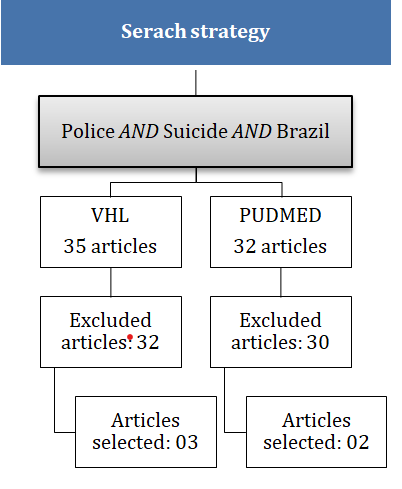
The search resulted in 67 studies published in the last 10 years, from the use of descriptors in both databases (35 in VHL and 32 in PUBMED). Then, the title, abstract and keywords were read to identify the objective of the studies and selection criteria; at this stage, 19 studies were selected. These were analyzed in full and 14 articles were excluded. Thus, five investigations made up the final sample of this review (Figure 1). A data collection form was used for critical analysis of the studies, consisting of the following information: title; authors; year; place of study execution; sample; objective; design and main results.
Results
The studies were published between 2007 and 2022. The sample consisted of quantitative descriptive studies (n=3), retrospective cohort (n=1) and ecological time series (n=1). The surveys had samples mostly composed of military police men [6, 7, 8, 9]; only one study investigated federal highway police officers [10]. Table 1 shows the characteristics of the selected studies.
| Author and year | Objective | Design | Scenario and sample | Main results |
|---|---|---|---|---|
| Maia DB, et al. [6] | To determine the current prevalence of post-traumatic stress symptoms in Brazilian police officers and compare groups with and without symptoms in terms of associated morbidity | Cross- sectional, descriptive, quantitative study | The participants were 157 male police officers from the elite police unit of the state of Goiás, Brazil | Overall post-traumatic stress disorder (PTSD) prevalence rates were 8.9%. Compared to the “no PTSD” group, officers with “full PTSD” were five times more likely to be divorced (21.6%), felt their physical health was worse (64.3%), had more doctor visits in the last 12 months and most frequently reported suicidal ideation throughout their lives (35.7%) |
| Alves VM, et al. [7] | To identify symptoms of anxiety and depression, chronotype and the presence of suicidal ideation in nurses and military police officers from Arapiraca/Alagoas, Brazil | Quantitative descriptive study | Interviews were carried out at the Urgency and Emergency Hospital and at the Military Police Battalion, in Arapiraca, with the participation of 53 nurses and 111 military police officers | Of the police officers interviewed, 55% had minimal anxiety levels, 22% mild, 12% moderate and 9% severe; 27% of them were at high risk for depression and 5% reported suicidal ideation at the time of the interview. They cited stress, anxiety and/or depression and financial problems as the main reasons for suicidal ideation. |
| Gomes DAR, et al. [8] | To evaluate the incidence and sociodemographic profile of suicide in a military subpopulation in Southern Brazil | Retrospective cohort study | Study carried out with data extracted from files of the Military Police of Rio Grande do Sul | Younger age associated with lower military rank represented independent predictors of suicide in this population |
| Pereira GK, et al. [9] | To investigate social-occupational characteristics in cases of suicides of military police officers in Santa Catarina, Brazil, which occurred between 2012 and 2016 | Cross- sectional, descriptive, retrospective and quantitative study | The data were extracted from the Santa Catarina Integrated Human Resources Management System, related to the suicide of 14 military police officers that occurred between 2012 and 2016 | All police officers were men, with some percentage of their wage allocated to paying loans or financial debts, the majority with around 22.5% of their wage committed for this purpose. The majority of the sample was married, with children and educated up to high school; 50% of the sample was aged between 40 and 47, graduated in their career as enlisted personnel |
| Marins EF, et al. [10] | To analyze the trend in mortality from all causes in Brazilian federal highway police officers from 2001 to 2020 | Ecological time series study | Study based on official mortality data from the Brazilian Federal Highway Police registration system and death certificates from the federal registration system. | Among 346 deaths, 189 were from unnatural causes (11 were from undefined causes). Traffic accidents (n=96; 28.7%), cardiovascular diseases (n=58; 17.3%), interpersonal violence (n=51; 15.2%) and suicides (n=35; 10.5% ) were the main causes of death. The majority of unnatural deaths occurred among police officers who were between the ages of 19 and 35 (87.3%) and had worked for 15 years (70.2%) |
Table 1: Characteristics of the selected studies, 2023.
Discussion
The relationship between suicidal behavior and the police profession may be associated with problems that go beyond their occupational activities, such as financial limitations [7, 9], sex [6] and age [8, 10]. Posttraumatic stress disorder (PTSD) appears to be an important condition associated with suicide. In a sample of 157 police officers, 8.9% had full PTSD and 16% had partial PTSD, and the officers with full PTSD, compared to those without PTSD, were five times more likely to divorce and present, more often, suicidal ideation, a condition that can eventually lead to self-extermination [6].
The commitment of professional wage income by loans and debts was a factor that was related to the history of suicide and suicidal ideation [9]. The fear of not complying with financial obligations can cause a psychological imbalance and generate pathological conditions such as anxiety, stress and depression, factors associated with suicidal ideation [7].
Characteristics such as younger age, male sex and low career graduation were associated with suicide among police officers [8, 10]. This result may be associated with psychological overload in early career, a condition of greater difficulty to deal with stress. In contrast, married men with children also presented suicidal ideation, which may suggest an insufficient income for family support or compliance with financial obligations [9].
There was a shortage of studies conducted in Brazil and other police institutions such as Civil and Federal. This limits the comparability of the identified evidence. However, the results become relevant as police institutions identify, preventively; the factors associated with suicidal ideation and can create strategies that help professionals deal with the obstacles inherent in police practice.
Conclusion
The factors associated with suicide and suicidal ideation among police officers in Brazil were financial complications, psychopathological comorbidities, male sex, young age and incipient career graduation. New studies should be developed on the theme addressed, including also other police institutions, offering samples and more comprehensive epidemiological scenarios.
References
-
Queirós C, Passos F, Bártolo A, Marques AJ, Silva CF, et al. (2020) Burnout and stress measurement in police officers: Literature review and a study with the operational police stress questionnaire. Front Psychol 11(587).
-
Stanley IH, Hom MA, Joiner TE (2016) A systematic review of suicidal thoughts and behaviors among police officers, firefighters, EMTs, and paramedics. Clinical psychology review 44: 25-44.
-
Civilotti C, Maran DA, Garbarino S, Magnavita N (2022) Hopelessness in Police Officers and Its Association with Depression and Burnout: A Pilot Study. Int J Environ Res Public Health 19(9): 5169.
-
Syed S, Ashwick R, Schlosser M, Jones R, Rowe S, et al. (2020) Global prevalence and risk factors for mental health problems in police personnel: a systematic review and meta-analysis. Occup Environ Med 77(11): 737-747.
-
Mendes KDS, Silveira RCCP, Galvão CM (2008) Integrative review: Research Method for incorporating evidence in health and nursing. Texto Context Enferm 17(4): 758- 764.
-
Maia DB, Marmar CR, Metzler T, Nóbrega A, Berger W, et al. (2007) Post-traumatic stress symptoms in an elite unit of Brazilian police officers: Prevalence and impact on psychosocial functioning and on physical and mental health. Journal of Affective Disorders 97(1-3): 241-245.
-
Alves VM, Santos MBF, Nascimento LMS, Ferro GC, Silva LKB, et al. (2015) Suicidal ideation and chronotype assessment in nurses and police officers. Medical Express 2(3): M150305.
-
Gomes DAR, Araújo RMF, Gomes MS (2018) Incidence of suicide among military police officers in South Brazil: An 11-year retrospective cohort study. Comprehensive Psychiatry 85: 61-66.
-
Pereira GK, Madruga AB, Kawahala E (2020) Suicides in a police-military organization in southern Brazil. Cad health collection 28(4): 500-509.
-
Marins EF, Ferreira RW, Freitas FC, Dutra GFA, Vasconcelos Júnior JR, Caputo EL (2020) Mortality in Brazilian federal highway police officers: time series from 2001 to 2020. Rev saúde pública 56: 82.
- Epidemiological Surveillance and Rumors on Social Media
- Awareness and Treatment of Uncontrolled Hypertension in US Overweight/Obese Youths Aged 16–24 Years, NHANES 2021–2023
- Strengthening EPI Through Parental Engagement: Lessons from Dhaka Slums for IA-2030
- Mothers Knowledge of the Prevalence, Causes, Effects, Prevention and Control of Diarrhoea among Children in Ife East Local Government Area, Ile Ife, Osun State, Nigeria
- Covid-19 Reinfections Case Series from October 2023 to October 2024 in A General Medicine Office in Toledo (Spain)
- Water Contact! One Risk Too Many: Risk Factors Associated with Schistosoma haematobium infection in Osun State, Nigeria