
A Study on the Alcohol Beverages Drinking Effect on Potential CTS Symptoms
Carpal tunnel syndrome (CTS) is an illness, not an injury, and health factors such as obesity, smoking, heavy alcohol consumption, diabetes, and thyroid disease are much more likely to contribute substantially to the onset of carpal tunnel syndrome than workplace activities. CTS are considered as a clinical entity and diagnosis is still based upon symptoms of numbness, tingling and/or burning in the distribution of the median nerve in the hand. The present study has been conducted among personnel engaged in connecting rod manufacturing workers, to check the susceptibility to CTS symptoms by classifying the workers on the basis of drunkard and non-drunkard. The population included all the manufacturing unit workers irrespective of age, gender or ethnic group. All full-time workers with at least 6 months on the job were invited to participate in the study. Of the 113 eligible workers, 103 agreed to participate (91%) in the study. So a sample size of 103 workers was used (N = 103). In the statistical analysis of Chi-square and odds ratio test revealed that alcohol drunkard worker has 2.62 times greater risk of having CTS symptoms as compared to non-drunkard workers. Hence, there is a significant difference amongst the number of CTS sufferers in non-drunkard and drunkard group.
Introduction
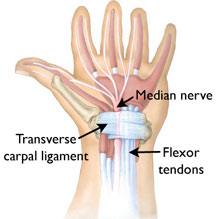
Carpus is derived from the Greek work “karpos” which means “wrist”. Carpal tunnel is a closed space between the fibrous band which functions as support for the wrist joint and the wrist bone. Median nerve providing sensations to thumb, index, middle and radial half of ring fingers passes through this tunnel (http://www.answers.com/topic/carpal-tunnel- syndrome). Carpal tunnel syndrome (CTS) is the most commonly studied entrapment neuropathy caused by compression of the median nerve as it passes through the carpal tunnel beneath the flexor retinaculum. It is a classic example of chronic compression neuropathy of the median nerve within the carpal tunnel at the wrist and a frequently encountered cause of pain, numbness and tingling in the upper extremities [1, 2]. The impairment of the median nerve within the carpal canal is secondary to compression of the median nerve within the carpal tunnel resulting in mechanical compression and local ischemia. CTS are considered as a clinical entity and diagnosis is still based upon symptoms of numbness, tingling and/or burning in the distribution of the median nerve in the hand. Activity of Repetitive hand movement may cause thickening of the synovial lining of the tendons that share the carpal tunnel with the median nerve. Usual symptoms include numbness, tingling and pain predominantly in the median nerve distribution of the hand; however, the symptoms can frequently be present in all fingers of the hand or proximally in the forearm. The carpal tunnel syndrome symptoms may or may not be accompanied by objective changes in sensation and strength of median-innervated structures in the hand [3]. The carpal tunnel condition becomes so severe that it cannot let the proper function due to pressure on the median nerve where it passes into the hand via a gap (carpal tunnel) under a ligament at the front of the wrist [4]. People with CTS experience difficulty in performing tasks such as unscrewing bottle tops, fastening buttons, or turning keys. CTS occur most commonly among age group above 30 [5]. To fully understand carpal tunnel syndrome and what causes it, it is essential to understand the anatomy of the human wrist.
Anatomy of Hand and Wrist
The structure of human hand shows that the index finger, middle finger and the thumb are innervated by the median nerve. The ulnar nerve innervates the small finger and the ring finger is stimulated by joint action of median nerve and ulnar nerve [6]. Radial nerve goes towards the backside of the hand, and is connected to skin to provide support to the back structure of hand. The passage of median nerve, ulnar nerve and radial nerve in human hand are shown in Figure 1.
Research Gap
As per literature review, alcohol drinking habit is considered as a risk factor for CTS [7]. Associations between CTS and risk factors, such as alcohol drinking status are uncertain and have not been assessed with adequate power in occupational studies. So in present study, an attempt has been made to show relation of alcohol drinking habit with potential CTS symptoms on workers engaged in manufacturing industry.
Experimentation
Participants: In this study, the survey has been conducted on (sample size, N = 103) connecting rod manufacturing workers. The study was conducted by questionnaire, exposure evaluation, physical examination, interviews, medical inspection and job observation. The data has been collected in general day shift and normal working environment operation in connecting rod manufacturing industry. The population included all the unit workers irrespective of age, gender or ethnic group. All full-time workers with at least 6 months on the job were invited to participate in the study. Of the 113 eligible workers, 103 agreed to participate (91%) in the study. The participant ranges in age from 24 to 60 years with a mean of 42.85 (standard deviation (SD) = 8.72) years. The mean body mass index (BMI; kg/m²) of the participants of this study is 23.89 kg/m2 (SD 2.55), and it ranges from 18.72 kg/m2 to 32.46 kg/m2. The workers had been performing work for a mean of 14.69 years (SD 7.37).Forty two percent (N=43) of the subjects are alcohol drunkard. Fifty eight percent (N=60) of the subjects are non-drunkard.
Results
Carpal tunnel syndrome is an illness, not an injury, and health factors such as obesity, smoking, heavy alcohol consumption, diabetes, and thyroid disease are much more likely to contribute substantially to the onset of carpal tunnel syndrome than workplace activities [8, 9]. Nathen et al. [7] investigated the effects of three legal drugs (tobacco, caffeine, and alcohol) on the prevalence of carpal tunnel syndrome (CTS) confirmed by nerve conduction studies (definite CTS) in two groups of American industrial workers: 656 nonclaimant workers and 808 working patients referred for upper extremity symptoms. In male workers, history of alcohol abuse and current beer consumption independently predicted 3.0% of the explainable risk for definite CTS. It indicates alcohol beverages drinking may affect the occurrence of potential CTS symptoms [10, 11]. Alcohol drinking may contribute to carpal tunnel syndrome by affecting the blood flow to the median nerve. To study the impact of potential CTS symptoms on alcohol drunkard workers in industry, raw data from health surveillance in manufacturing industry workers is classified according to category of alcohol drinking status and potential CTS sufferers as shown in Table 1.
| Symptom | Drunkard | Non-drunkard |
|---|---|---|
| CTS sufferers | 21 | 16 |
| Non CTS sufferers | 22 | 44 |
Table 1: Exposure level based (2 × 2) contingency table for chi-square test.
| Description | Group 1 | Group 2 | Total |
|---|---|---|---|
| Symptom Present (Test positive) | A | b | a+b |
| Symptom not Present (Test negative) | C | d | c+d |
| Total | a+c | b+d | a+b+c+d=n |
Table 2: A 2 × 2 contingency table set-up used for chi- square test.
| Column 1 | Column 2 | Total | |
|---|---|---|---|
| Row 1 | 21 | 16 | 37 |
| Row 2 | 22 | 44 | 66 |
| Total | 43 | 60 | 103 |
Table 3: Survey based observed frequency for Drunkard and Non-Drunkard group.
| Column 1 | Column 2 | Total | |
|---|---|---|---|
| Row 1 | E1=43x37/103=15.447 | E2=60x37/103=21.553 | 37 |
| Row 2 | E3=43x66/103=27.553 | E4=60x66/103=38.447 | 66 |
| Total | 43 | 60 | 103 |
Table 4: Expected frequencies for Drunkard and Non- Drunkard group.
| $F_{o}$ | $F_{t}$ | $(F_{o}-F_{t})^{2}$ | $(F_{o}-F_{t})^{2}/F_{t}$ | |
| Drunkard group | 21 | 15.447 | 30.835 | 1.9961 |
| Drunkard group | 22 | 27.553 | 30.835 | 1.1191 |
| Non Drunkard group | 16 | 21.553 | 30.835 | 1.4306 |
| Non Drunkard group | 44 | 38.447 | 30.835 | 0.8020 |
| $\chi^{2} = (F_{o}-F_{t})^{2}/F_{t} = 5.3478$ | ||||
|---|---|---|---|---|
Table 5: Calculated χ2 value for Drunkard and Non- Drunkard group.
Calculated χ2 for non-neutral and neutral group = (Fo-Ft) 2/Ft = 5.3478 (1) The number of degrees of freedom is required in order to apply the chi-square Test. In the 2 x 2 contingency Table 2, the degrees of freedom v = (2-1) (2-1) = 1 is required in order to apply chi-square. In general, for r rows and c columns, the number of degrees of freedom is (r-1) (c-1). In the present2x2 contingency table, the standard value for degree of freedom 1 at 5% level is 3.84. Since the calculated value of χ2 is 5.3478 which is greater than standard value, the hypothesis is rejected i.e. alcohol drinking habit affect the potential CTS symptoms. Hence, there is a significant difference amongst the number of CTS sufferers in non-drunkard and drunkard group. So odds ratio can be calculated for drunkard and non-drunkard group. Odds ratio is calculated using formula ⁄ ⁄ Where a = CTS sufferers of drunkard group b = CTS sufferers of non-drunkard group c = non CTS sufferers of drunkard group d = non CTS sufferers of non-drunkard group The value of odds ratio shows that the drunkard workers have 2.62 times greater risk of having CTS symptoms as compared to non-drunkard workers.
Conclusion
The present study is conducted among personnel engaged in connecting rod manufacturing units to check the susceptibility to CTS symptoms by classifying the workers on the basis of non-drunkard, drunkard and potential CTS symptoms to determine the most alarming CTS symptoms with their level of occurrence. The outcome of the study alcohol drunkard worker has 2.62 times greater risk of having CTS symptoms as compared to non-drunkard workers. Hence, there is a significant difference amongst the number of CTS sufferers in non-drunkard and drunkard group. The present study is a new approach for quantifying the CTS associated risk factors and symptoms. The recommendations for preventing CTS symptoms occurrence among the workers engaged in manufacturing industry: (i) A preferential job allocation policy can be implemented such as more aged workers can be given less repetitive work and vice versa. (ii) An employee wellness program can be implemented that include hand/wrist simple stretching exercises to be performed before the shift begins and/or after the lunch break. The present study being a cross-sectional study provides a measure of CTS prevalence at a single point of time due to short experimental time. Further, it can be extended to an incidence of CTS over a specified period (e.g. one year) on the same working population.
Acknowledgement
Authors, we are highly thankful to the EMSON Tools Manufacturing Corp. Ltd. for conduct this study. We also thanks to members of Ergonomics Laboratory, Department of Design, Indian Institute of Technology for kind assistance at each step of this research.
References
-
Atroshi I, Gummesson C, Johnsson R, Ornstein E, Ranstam J, et al. (1999) Prevalence of carpal tunnel syndrome in a general population. JAMA 281(2): 153-158.
-
Alam MS, Salve UR, Kumar N, Mallick Z, Goyal M (2017) Impact of Cycle Time on Potential CTS. Int J of Advanced Engineering Research and Science 4(1): 47-51.
-
Werner AR, Andary M (2002) Carpal tunnel syndrome: pathophysiology and clinical neurophysiology. Clinical Neurophysiology 113(9): 1373-1381.
-
Okada M, Tsubata O, Yasumato S, Toda N, Matsumoto T (2000) Clinical study of surgical treatment of carpal tunnel syndrome: Open versus endoscopic technique. Journal of orthopaedic surgery 8(2): 19-25.
-
Kumar M, Kumar S, Jindal O, Arora SA, Kumar R, et al. (2010) Analysis of APB Muscle by Surface Electromyography. International Journal of Engineering Studies 2: 305-312.
-
Megerian JT, Kong X, Gozani SN (2007) Utility of nerve conduction studies for carpal tunnel syndrome by family medicine, primary care, and internal medicine physicians. Journal of American board of family medicine 20(1): 60-64.
-
Nathan PA, Keniston RC, Lockwood RS, Meadows KD (1996) Tobacco, caffeine, alcohol, and carpal tunnel syndrome in American industry. A cross- sectional study of 1464 workers. J Occup Environ Med 38(3): 290-298.
-
Derebery J (2006) Work-Related Carpal Tunnel Syndrome: The Facts and the Myths. Clin Occup Environ Med 5(2): 353-367.
-
Alam MS, Salve UR, Kumar N, Mallick Z, Goyal M (2017) Comparison of sEMG Signal of CTS Sufferers and Non CTS Sufferers. Int J of Advanced Research 5(2): 594-599.
-
Burt S, Deddens JA, Crombie K, Jin Y, Wurzelbacher S, et al. (2013) A prospective study of carpal tunnel syndrome: workplace and individual risk factors. Occup Environ Med 70(8): 568-574.
-
Cartwright MS, Walker FO, Newman JC, Schulz MR, Arcury TA, et al. (2014) One-Year Incidence of Carpal Tunnel Syndrome in Latino Poultry Processing Workers and Other Latino Manual Workers. American journal of industrial medicine 57(3): 362-369.
- The Expanding Landscape of Road Rage: A Systematic Review of Conflicts Involving Drivers, Pedestrians, and Micromobility
- Validating Cognitive Models of Royal Navy Performance on Control Systems
- Comparing Standard and State-of-the-art Firefighter Coats on Postural Balance and Gait in a Live Burn Environment
- Investigating the Integration of Telemedicine into Clinicians Workflow: A Review of Methods
- Risk Assessment of Ergonomic Factors in a Textile Firm by RULA, REBA and Fine Kinney Methods
- Impact of Self-Esteem Training on Individuals with Disabilities Aged 17-30