
The Emotional Interaction between Lighting and Music
Introduction
To attract the intention of audience and improve the visual experience, traditional lighting show will always have audio effects with music and songs on site. To make the sound effects accord with lighting performance, the long and boring programming work should be paid to getting them together. It is very difficult for a lighting designer to choose exact music mapping to the visual effects. It is the same hard for a composer to create a song according to the lighting pattern. For the programming and debugging cost a lot of time and labour, a simple and direct solution is required by the lighting designer.
From the Chinese Gong Shang pentatonic scale to modern octave scale, the music colour pairing is easy for single [1]. But for different music tonality, it is always an uncertain topic because the different background and different culture may lead to different answer. However, the main trend is always the same because music is the world language and lighting is the same. The tonality of music has a corresponding background color [2]. It relates to our sensation and emotional parts. The attitude to the music and the temperature of the sound can be felt by our hearts.
Music and light will unconsciously affect our emotions. The comprehensive influence of music combined with lighting on human vision, hearing and feeling is a kind of synaesthesia [2]. Understanding synaesthesia will help us know how to combine these two elements better and apply them in daily life or commercial purpose. It will also help to bring out vivid sensation and pleasant experience through the combination of music and lighting [3, 4]. The music then can be seen by our eyes and the colors can be heard by our ears.
The combination of music and lighting may strengthen our emotions. For example, in a concert, when the lighting matches the music, the audiences’ emotional resonance will be enhanced. In a nightclub, the good combination of lighting and music will get people closer [5, 6]. In this experiment, the interactive logic between vision and hearing is established through the subjective emotional evaluation and analysis of music and lighting colors.
Methods
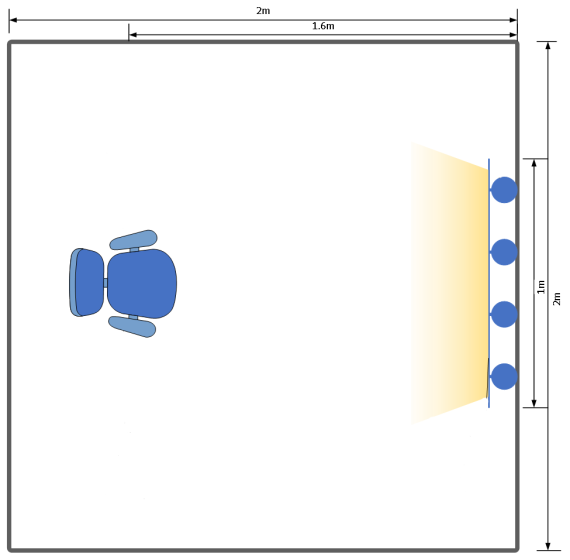
As shown in Figure 1, an experimental area of 2m×2m×3m was built. A subjective experiment was set up to understand the emotional connection between color and music. Twenty volunteers were invited to this test. Some participants have the experience of professional instrument or painting training. The test music pieces are music in major and minor, which all respectively selected from famous musicians. When listening to and appreciating the different works, the audience have totally different feelings. The test light are three mono-color conditions (R, G, B) and two white lights with different color temperature (3000K, 6000K) at eye level of 150lx. After listening to the music or illuminating the light, the test participants were asked to answer a subjective questionnaire to describe their emotions (Table 1) [7]. Emotional valence is a pleasant continuum, including five different types of emotional adjectives. Emotional arousal is an energy continuum, and the degree of arousal ranges from one to five [8].
| Environment Variable | Fear | Sadness | Soothing | Happiness | Heroism |
|---|---|---|---|---|---|
| Major | 1-2-3-4-5 | 1-2-3-4-5 | 1-2-3-4-5 | 1-2-3-4-5 | 1-2-3-4-5 |
| Minor | 1-2-3-4-5 | 1-2-3-4-5 | 1-2-3-4-5 | 1-2-3-4-5 | 1-2-3-4-5 |
| Red | 1-2-3-4-5 | 1-2-3-4-5 | 1-2-3-4-5 | 1-2-3-4-5 | 1-2-3-4-5 |
| Green | 1-2-3-4-5 | 1-2-3-4-5 | 1-2-3-4-5 | 1-2-3-4-5 | 1-2-3-4-5 |
| Blue | 1-2-3-4-5 | 1-2-3-4-5 | 1-2-3-4-5 | 1-2-3-4-5 | 1-2-3-4-5 |
| Warm White | 1-2-3-4-5 | 1-2-3-4-5 | 1-2-3-4-5 | 1-2-3-4-5 | 1-2-3-4-5 |
| Cold White | 1-2-3-4-5 | 1-2-3-4-5 | 1-2-3-4-5 | 1-2-3-4-5 | 1-2-3-4-5 |
Table 1: Screenshot of subjective emotion record sheet.
Results
The results are listed in Figure 2. In terms of valence, major music tends to be positive, while minor music tends to be negative. It showed that the valence of music was obviously affected by the mode. Emotions stimulated by the lights of the three primary colors tended to be negative, and that by the white lights of two different color temperatures tended to be positive. For white light, warm white light with low color temperature makes people more pleasant. For colored light, red light tends to be the most negative valence, which is related to the low illumination level and high saturation of red light set in the experiment. This color was easy to induce negative emotions. The difference of illuminance and saturation of colors directly affects personal psychology and physiology [9]. Blue light makes people sad, while the feeling of soothing is produced in the environment of green light. In terms of arousal, music can awaken people’s emotions, especially major music. For lighting, warm white light is the most emotional light color. In contrast, colored light plays a very weak role in awakening emotions.
Almost all test participants agree that the emotional effects of music and light colors are interactive. Experimental research had found that it can be confirmed that everyone’s response to external stimuli is specific and individual. Participants who have studied music or paintings before will respond more quickly to emotions when they are stimulated by visual or auditory sensations [10]. The results showed that the emotional response to the light and music together was not always higher than response to individual stimuli. Although these pieces of music were not specially created for light, the music shows major effect in the combination of light and sound. The emotional arousal may be enhanced when the music and light are both consistent with the emotional dimensions.
![Figure 2: In terms of valence, major music tends to be positive, while minor music tends to be negative. It showed that the valence of music was obviously affected by the mode. Emotions stimulated by the lights of the three primary colors tended to be negative, and that by the white lights of two different color temperatures tended to be positive. For white light, warm white light with low color temperature makes people more pleasant. For colored light, red light tends to be the most negative valence, which is related to the low illumination level and high saturation of red light set in the experiment. This color was easy to induce negative emotions. The difference of illuminance and saturation of colors directly affects personal psychology and physiology [9]. Blue light makes people sad, while the feeling of soothing is produced in the environment of green light. In terms of arousal, music can awaken people’s emotions, especially major music. For lighting, warm white light is the most emotional light color. In contrast, colored light plays a very weak role in awakening emotions.](/fulltextimages/7968/fig_2.jpeg)
Conclusion
The study reported the subjective emotional ratings of 20 subjects exposed to an auditory or visual environment. Subjective studies have shown that music in major was more positive than music in minor in terms of emotional valence, and white light was more positive than three monochromatic lights in emotional valence. The valence of music in major was close to that of warm-toned light, and the valence of music in minor was close to that of cool-toned light. The emotional effects of major music stimulation and warm white light stimulation are similar. Subjective emotional reactions caused by minor music and colored light are positively correlated.
Synaesthesia can connect different sensation system together and share the information with some unknown principal. It will help to make our sense more vivid and our experience more interesting. Not only for indoor lighting, but also for outdoor lighting, more and more projects will have music and lighting at the same place and same time. The emotional interaction between music and lighting will be an efficient tool for lighting designer. To see the music, to hear the light will give us great fun and fantastic experience.
Acknowledgement
This work was sponsored by Shanghai Gaofeng and the Gaoyuan Project for University Academic Program Development and Shanghai Institute of Technology undergraduate innovation activity plan project (DCX20210223).
References
-
Bugdol MN, Bugdol MD, Smreczak T (2018) The influence of music genres on human emotionality. Innovations in Biomedical Engineering 2018: 107-114.
-
Curwen C (2020) Music-Colour Synaesthesia: A [INLINE_FIGURE:2:1] Sensorimotor Account. Music Sci.
-
Jiang Y, Zhao J (2019) Subjective Evaluation of the Correlation of Pop Music Emotion and Lighting Color. 12th International Congress on Image and Signal Processing, BioMedical Engineering and Informatics (CISP-BMEI), Jiangsu, China.
-
Curwen C (2018) Music-colour synaesthesia: Concept, context and qualia. Conscious Cogn 61: 94-106.
-
Eunyoung LI, Latchoumane CV, Jaeseung J (2017) Arousal Rules: An Empirical Investigation into the Aesthetic Experience of Cross-Modal Perception with Emotional Visual Music. Front Psychol 8: 440.
-
Moon CB, Kim H, Lee DW, Kim BM (2015) Mood lighting system reflecting music mood. Color Res Appl 40(2): 201-212.
-
Hevner K (1935) Expression in music: a discussion of experimental studies and theories. Psychological Review 42(2): 186-204.
-
Whiteford KL, Schloss KB, Helwig NE, Palmer SE (2018) Color, Music, and Emotion: Bach to the Blues. Iperception 9(6): 2041669518808535.
-
Chinazzo G, Chamilothori K, Wienold J, Andersen M (2021) Temperature-Color Interaction: Subjective Indoor Environmental Perception and Physiological Responses in Virtual Reality. Hum Factors 63(3): 474- 502.
-
Wright B, Rainwater L (2014) The Meanings of color. The Journal of General Psychology 67(1): 88-99.
- The Expanding Landscape of Road Rage: A Systematic Review of Conflicts Involving Drivers, Pedestrians, and Micromobility
- Validating Cognitive Models of Royal Navy Performance on Control Systems
- Comparing Standard and State-of-the-art Firefighter Coats on Postural Balance and Gait in a Live Burn Environment
- Investigating the Integration of Telemedicine into Clinicians Workflow: A Review of Methods
- Risk Assessment of Ergonomic Factors in a Textile Firm by RULA, REBA and Fine Kinney Methods
- Impact of Self-Esteem Training on Individuals with Disabilities Aged 17-30