
Performance Test of Arabica Coffee Bean Rating Tool Using Image Sensor Guided
The diversity of coffee bean standards is one of the perspectives of coffee bean quality that is very important to customers. Based on the physical (deffect system) the coffee bean sorting process is divided into two, namely manual sorting and mechanical sorting. The purpose of this study is to study the performance of vibrating table type and conveyor table type rating machines in optimizing time and costs in the process before storage, processing and market to consumers. This research was carried out at the Tanah Toraja Coffee Center, Gandangbatu District, Sillanan District. Tana toraja, the industrial teaching laboratory of the Agroindustry study program, the organolepotic test lab of the Jember research center and the Sukamandi flavcoyur laboratory in the month until March of May 2022. The research method used is linear regression. The best result for the operation of the vibrating table type sorting machine is at a slope of the 8o compartment with a rotating speed of 1,310 rpm with the amount of capacity produced as much as 245 kg per hour and for a rotary table type machine the best result is at a speed of 40 rpm rubber belt speed with a time speed of 30 seconds distance with a distance of 1,800 mm, obtained results on the output hole I ( diameter 7 mm) of 9.2 kg per hour, in the output hole II (diameter 6 mm) of 9 kg per hour, and in the output hole III (diameter 5 mm) of 8.6 kg / hour.
Introduction
According to statistical data from the International Coffee Organization (ICO) in 2015, Indonesia is the fourth largest coffee producing country, after Brazil, Vietnam and Colombia. Coffee is a plantation commodity that is very popular in the world as a beverage that has a distinctive taste and aroma and has a fairly high economic value among other plantation crops.
The diversity of coffee bean standards is one of the most important aspects of coffee bean quality for customers. Ranking of rice grains is one of the stages of the work process which requires a high cost, because all stages of the ranking are done manually [1].
The need for an assessment of coffee products that are acceptable and in demand by the general public is growing along with advances in technology. One of the conditions for coffee beans to be marketed at a reasonable price level is the existence of a clear guarantee of quality, followed by the availability of sufficient quantities and a timely and sustainable supply. Therefore, one of the efforts to improve the quality of coffee production is to rank the quality of Arabica coffee beans by comparing them based on the results of the performance of vibrating table type sorting machines and conveyor tables [2]. In the process of ranking the quality of coffee that must be done, namely by sorting coffee beans and physical testing of coffee to see the best quality based on SNI coffee [3].
To overcome this problem, research on quality ranking of Arabica coffee beans was carried out in order to find out the performance of vibrating table type sorting machines and conveyor table types in optimizing time and costs in the process before storage, processing and marketing to consumers.
Methodology
This research was conducted from March to May 2022 at the Tanah Toraja Coffee Center, Kec. Gandangbatu Sillanan district. Tana Toraja, industrial teaching laboratory for Agro- industry study program [4].
The tools used in this study were vibrating table and conveyor type ranking machines, buckets, digital scales, moisture meter, writing instruments. The materials used in this study were arabica coffee beans originating from Tana Toraja district with a water content of 10 up to 12%.
This study uses a linear regression design which is one of the forecasting or prediction analyzes that is often used on quantitative scale data (intervals or ratios). The purpose of doing linear regression is whether a set or set of independent variables is significant in predicting the dependent variable.
The test parameters carried out were the engine working capacity test, the compartment tilt test, and the engine efficiency test.
Description of the Rating Tool
Description of Vibrating Table Type Rating Machine
The sifting unit, driving force and frame are the three important components of the vibratory table type coffee bean grading machine. The sieve unit is rectangular in shape with a length of 206 cm, a width of 105.5 cm and a thickness of 14 cm for each compartment. The sifting compartment is made of 30 mm thick wood, and each corner is joined with a 30 mm aluminum plate. The rectangular hole is made by threading braided wire in the bottom of the sieve unit compartment.
Wire made of stainless steel is used to make the webbing, which is fixed in each compartment in the form of rectangles of various diameters. The first compartment (above) is made of woven wire mesh, with a wire diameter of 7 mm and is formed into a 7 mm x 7 mm rectangle.
Three outlet holes and one storage chamber for small seeds, seed shell flakes, and other foreign matters are located among the ranking results. The ranking output is in the form of full-bodied seeds with a diameter greater than 5 mm and less than 7 mm. The grading process produces seeds smaller than 4 mm, seeds and bits of skin or other foreign matter in the third outlet (bottom).
Conveyor Table Type Rating Machine Description
A conveyor table type grading machine is a device used to rank green bean coffee according to color and appearance differences which can be done electronically [5]. Conveyor Belt Type Rating Table with imaging sensor with overall dimensions of 2000mm x 1000mm x 1120mm has several systems or parts, namely the frame uses 60mm x 40mm hollow iron box material with frame dimensions of 2000mm x 600mm x 600mm (P X L X T).
The material used is an iron pipe with a diameter of 60 mm, a shaft diameter of 25.4 mm, stainless steel material. The belt support serves as a belt holder for the coffee to pass through, the material used is 2 mm thick 304 stainless steel plate. Hopper Functioning as a container for ingredients / coffee is divided into 3 parts for grade 1, grade 2 and grade 3 coffee containers, the capacity of the hopper for each part is 5 kg for each part. The material used is 304 stainless steel plate 1.5 mm thick with dimensions L x Lx T, 500 mm x 300 mm x 400 mm [6].
Results and Discussion
Working Capacity of Vibrating Table Type Grading Machine
The test results show that at a compartment slope of 8o and a conveyor belt rotational speed of 1,310 rpm, the grading machine can process 245 kg of material per hour. The working capacity of the machine on a slope of 10o is 339 kg per hour at a rotational speed of 1,310 rpm and on a slope of 12o is 428 kg per hour at the same speed (Table 1).
| RPM = 1.310 | Machine Capacity | |
|---|---|---|
| $8^{0}$ | $245 | Kg/hour |
| 10^{0}$ | $339 | Kg/hour |
| 12^{0}$ | $428 | Kg/hour |
Table 1: The results of the capacity of the vibrating table type engine based on the slope and fixed rpm (1,310 rpm).
The high shear force will cause the seeds to slide down faster so that the opportunity to enter and pass through the sieve holes will be shorter [7]. The greater the angle of inclination of the sieve, the coffee beans will have a higher shear ability or shear force compared to those with a higher slope. Therefore, the use of a higher inclination angle of the compartment and the rotational speed of the driving force does not mean that the engine will provide the highest quality of working capacity.
Rating Engine Effectiveness
Rotational speed and tilt of the propulsion sieve compartment are factors that affect the working capacity of the grading machine [7]. The best ranking results do not always follow a high capacity value. The working capacity of the machine which results in minimum variation in the seed size distribution when compared to the seed size distribution achieved by ranking the green bean manually is an ideal condition (Table 2).
| Funnel I ≥ 7 mm | Funnel II 5-6 mm | Funnel III ≤ 5 mm | |
|---|---|---|---|
| 80 | 74.24% | 25.30% | 6.01% |
| 100 | 70.54% | 24.38% | 5.08% |
| 120 | 69.20% | 23.28% | 4.04% |
Table 2: Percentage of Seeds in the separatory funnel based on the slope of the compartment.
High working capacity tends to reduce the effectiveness of the grading machine, therefore it is important to choose the inclination angle of the sieving compartment and the ideal rotational speed of the driving force based on high working capacity and consistent output quality.
The greater the angle of inclination of the sieve, the coffee beans will have a higher shear ability or shear force compared to those with a higher slope. Therefore, the use of a higher inclination angle of the compartment and the rotational speed of the driving force does not mean that the engine will provide the highest quality of working capacity.
Conveyor Table Type Sorting Machine Work Capacity
The conveyor belt rotation speed (rpm) and the amount of material per unit weight (kg/hour) both have a significant impact on the manual grading machine capacity. The rating machine capacity increases with increasing conveyor belt speed, as shown in table 4.3 for various conveyor belt speeds (Table 3).
| RPM | Time | Grade ( Kg/hour) | ||
|---|---|---|---|---|
| I (7 mm) | II (6mm) | III (5mm) | ||
| 30 | 40 seconds | 6,9 | 6,7 | 6,4 |
| 40 | 30 seconds | 9,2 | 9 | 8,6 |
| 50 | 20 seconds | 13,8 | 13,5 | 12,9 |
Table 3: Capacity of the Conveyor Table Type Machine.
The results showed that at a conveyor belt speed of 30 rpm, the sorting work capacity at the output hole I with a hole size of 7 mm was 6.9 kg per hour, the output hole II with a hole size of 6 mm was 6.7 kg per hour, and the hole output III with a hole size of 5 mm obtained 6.4 kg per hour. At a conveyor belt speed of 40 rpm, the sorting work capacity obtained at the output hole I with an output hole size of 7 mm is 9.2 kg per hour, the output hole II with an output hole size of 6 mm is obtained 9 kg per hour, and the output hole III with a size 5 mm hole yields 8.6 kg per hour (Figure 1-3).
At a conveyor belt speed of 50 rpm, the output hole I with a funnel size of 7 mm is 13.8 kg per hour, the output hole II with a hole size of 6 mm is 13.5 kg per hour, and the output hole III with a size 5 mm hole yields 12.9 kg per hour. A high ranking workforce capacity does not guarantee that the best ranking product will be produced, even when a higher value is obtained than using a sorting table.
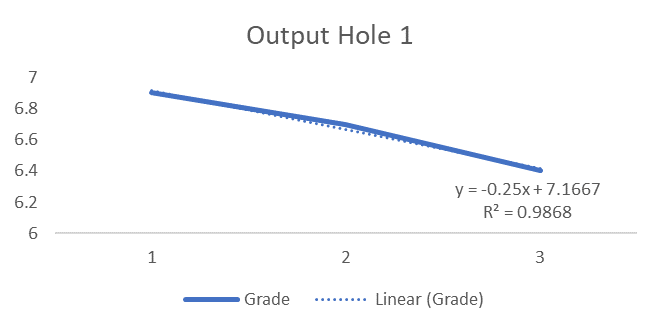
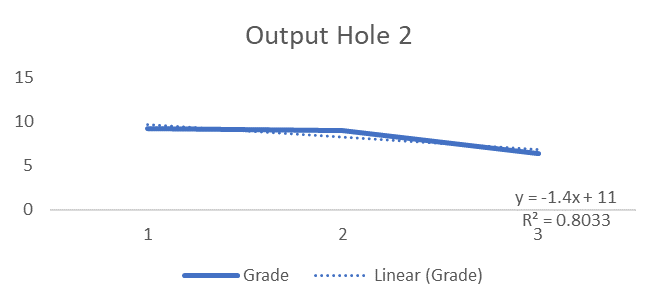
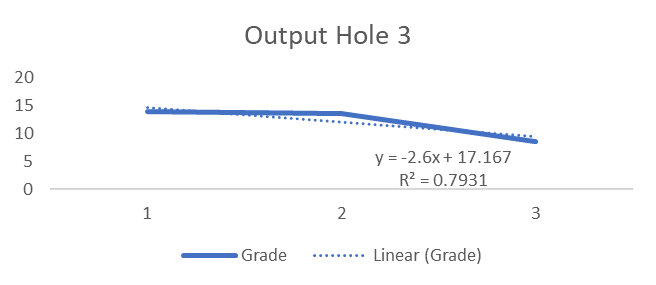
The ability of workers to reduce defects will decrease if the conveyor control speed is increased for a given material density per unit weight. This can be seen at the rotating speed of the conveyor belt of 50 rpm, which shows that when the conveyor belt rotates faster, the level of fatigue of the grading workers increases, and their attention and ability to rank and separate defective coffee beans decreases.
The use of the machine will lower the value of the defective beans resulting from the ranking results so as to produce coffee beans with a grade based on a higher defect value system. When compared to manual ranking activities that use sorting tables made of wood can only reduce errors between 2 and 5, the use of machines will accelerate the decline in the value of the defective beans as a result of sorting so as to produce coffee beans with a quality class based on a higher defect system [7].
Rating Machine Linear Regression Equations
Linear regression is one of the forecasting or prediction analyzes that is often used on quantitative scale data (intervals or ratios). The purpose of doing linear regression is whether a set or set of independent variables is significant in predicting the dependent variable (Tables 4 & 5).
| Regression Linear Line Equation | Correlation Coefficient, R² | |
|---|---|---|
| 30 | Y= -0.25x + 7.1667 | 0.9868 |
| 40 | Y= -1.4x + 11 | 0.8033 |
| 50 | Y= -0.2.6 + 17.167 | 0.7931 |
Table 4: Regression Equation of Working Capacity of Several Treatments of Conveyor Belt Pulley Speed and Material Mass Per Unit W
| Compartment Tilt (o) | Regression linear line equation | Correlation coefficient, R2 |
|---|---|---|
| 8o | Y= -1.005x + 72.327 | 0.9643 |
| 10o | Y= 21.95x + 4.2733 | 0.7343 |
| 12o | Y= -0.985 + 7.0133 | 0.999 |
Table 5: Regression Equation of Working Capacity from Several Slope Treatments. Compartment and Mass of Material per Unit Weigh
Conclusion
Based on the results of the research that has been done, the following conclusions can be drawn: 1. The vibrating table type rating machine operates best at a compartment inclination of 8o, with a driving force rotational speed of 1,310 rpm, and a working capacity of 245 kg/hour. The yield distribution obtained was as follows: 71.24 percent of the seeds were cut off in the first compartment (5-6 mm in diameter), and 6.01 percent of the seeds stopped in the second compartment. The third compartment is at an angle of 8o and a rotational speed of 1,310 rpm (5 mm diameter).
2. The rubber conveyor grading machine works well under optimum conditions, namely at a rotational speed of 40 rpm, a time speed of 30 seconds, a distance of 1,800 mm, 9.2 kg/hour in output hole I (diameter 7 mm), 9 kg/ hour in hole output II (6 mm diameter), and 8.6 kg/h in output port III (5 mm diameter).
Suggestion
In further research to find out the quality of the sorting results using an image control sorting tool, it is recommended to carry out quality testing and cupping to get Arabica coffee bean results according to specifications.
References
-
Widyotomo S, Mulato S, Atmawinata, Yusianto (1998) Performance of single cylinder rotary type cocoa bean sorting machine. Plantation Pelita 14: 197-210.
-
Widyotomo S, Mulato S, Suharyanto E (2006) Optimation of a Table Conveyor Type Grading Machineto Increase the Performance of Green Coffee Manual Sortation. Pelita Perkebunan 22(1): 57-75.
-
National Standard Agency (2008) Biji Kopi. Indonesian National Standard, SNI 01-2907, Jakarta.
-
Reta, Siti, Darmawan, Sahruni T, Sumarlin (2022) Report on Applied Research Results.
-
Reta, Mursalim, Muhiding J, Salengke (2017) Characteristic Flavor of Robusta Coffee from South Sulawesi after Fermentation by Ohmic Technology. Int J Curr Res Biosci Plant Biol 4(7): 33-38.
-
Mulato S (2002) Design and Testing of Cylindrical Type Coffee Bean Roasting Machine. Plantation lamp 18: 31- 45.
-
Widyotomo S, Mulato S (2005) Performance of a Table Vibration Type Coffee Grading Machine. Pelita Perkebunan 21(1): 55-72.
- The Role of Podocyte Apoptosis and the Involvement of SIRT1 in Diabetic Nephropathy
- Dealcoholization of Beer by Osmotic Distillation for the Beverage Industry
- Biopolymer-Based Edible Packaging- Biomaterials, Methods, and Applications in Food Industry: An Updated Review
- Influence of Bioprocessing Methods on 'China Rice' (Gawal R1), and Soyabean Supplementation on the Quality of Complementary Food
- Cassava (Manihot esculenta) Varietal Growth, Yield and Cyanide Content Performance in Three Sites in the South- Eastern Semi Arid Regions of Kenya
- Food Waste Treatment, Recycling, Management and Production of Value-Products-An Update on Methodologies and Current Trends