
Crime Investigating Technique to Development of Invisible Fingerprints on Surfaces using Rock Phosphate Powder
There are several procedures available for the development of invisible fingerprints on different surfaces. This Research Study presents a Rock Phosphate powder are use which is simple for the development of Invisible fingerprints on Porous or nonporous surfaces. Fingerprints get developed on ten different surfaces such as Paper, Plywood, Plastic sheet, Granite Marble, Iron, wood, utensils. The fine dust of Rock Phosphate Powder gets attached with the fatty acid present in the sweat of a fingerprint and invisible fingerprint pattern can be clearly observed on the surface. Research studies shows that it gives good results on most of the surfaces with clear fingerprints pattern and ridges.
Introduction
Fingerprints have major reflected one of the valued categories of physical evidence in the purpose of personal identification. In worldwide, three types of fingerprint evidence that might be establish at a crime scene are visible (or patent) prints, impression (or plastic) prints and invisible prints. Invisible prints are not observable to the naked eye and therefore want some resources of development or improvement for their visualization. New procedures are recognized for invisible fingerprint detection but the traditional fingerprint detection procedure for considering invisible prints is powdering method. When the fingerprint powder is sprinkled over an affected range, the powder adheres to the oil, sweat or other things left in a fingerprint. Powdering technique has been used as a method since the early 1900s. Over this time, various fingerprint powder preparations have been in use, with each powdered connecting of a color or contrast and a sticky material for good adhesion [1]. Several fingerprint powder methods have been established over the years. In universal, there are four methods of fingerprint powders-regular, luminous, metal and thermoplastic [2]. Many of the chemical composition are used in fingerprint powders are as toxic effect of inhale powdered as health hazards effect of human. In instruction to overcome this difficulty to make an effort to use new powders are invent in the invisible fingerprints which are simple, non- toxic, less expensive than the commercially used fingerprint powders [3]. Invisible fingerprints may be found on the surfaces to which a perpetrator may arise in interaction with and traces. These research are communicate has make an effort to develop a using rock phosphate dust, a normally used in the mining area and shown a rock phosphate powder are used to the developed invisible fingerprints. New techniques have been developed for invisible fingerprints are used rock phosphate dust powdering method. Rock Phosphate are used to the colored and contrast on the background on the surface and applied the powder to develop and recognized the fingerprints. This type of work has not been reported previously and can provide useful information to the investigators in cases of scarcity or non-availability of regular conventional fingerprint development powders.
Materials and Methods
Ten Samples are developed and collected to the different i.e. Paper, Plywood, Plastic sheet, Granite Marble, Iron, Aluminum Foil, utensils, Wood, Ceramic, Compact disk (CD) surfaces. These technique used in the development of invisible fingerprint is the used of rock phosphate dusting. Developed the latent fingerprints with the help of rock phosphate powder, few quantity was taken to are obtainable in the mining & mines of rock phosphate in Udaipur District. The dust has very fine particle to put on the suspected area & used camel hair brush o develop the invisible fingerprint sample. Photograph was taken and lift the cellophane tape and put on the different contrast area and fingerprint pattern seen and identified the print &preserved the powder sample. The consuming prints smudges the print, hence the ridge characteristics are not clearly visible. Application of rock phosphate dust to the pattern by using brush is a simple and an informal method then it also has drawbacks that the brush on coming in interaction with the surface consuming the print abolishes the print and hence the ridge characteristics get demolished [4].
Result & Discussion
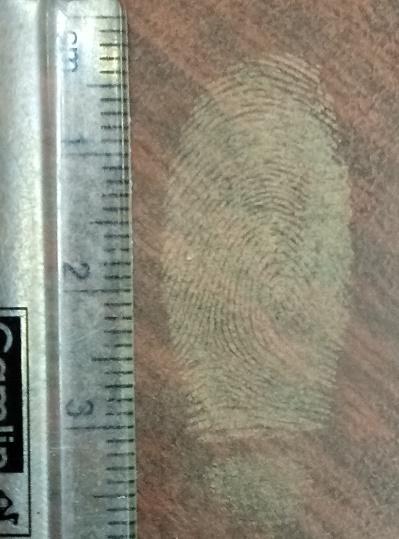
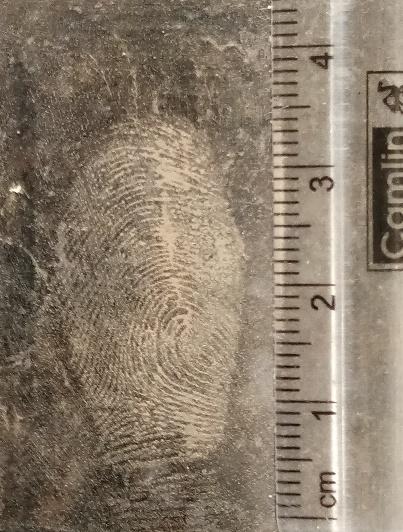
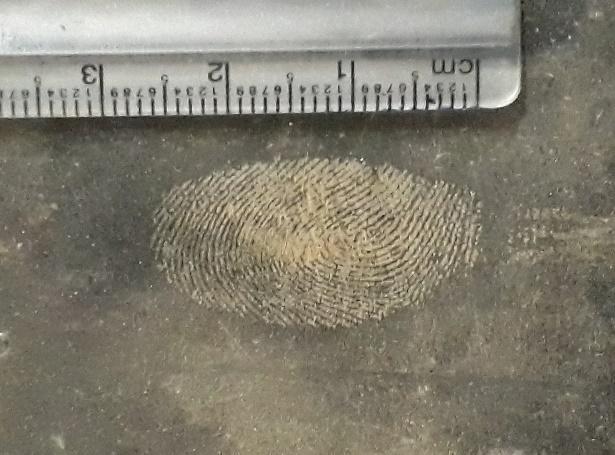
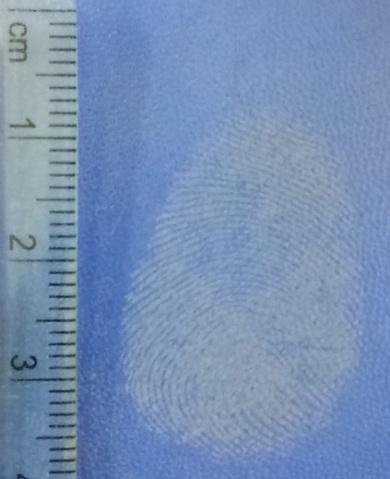
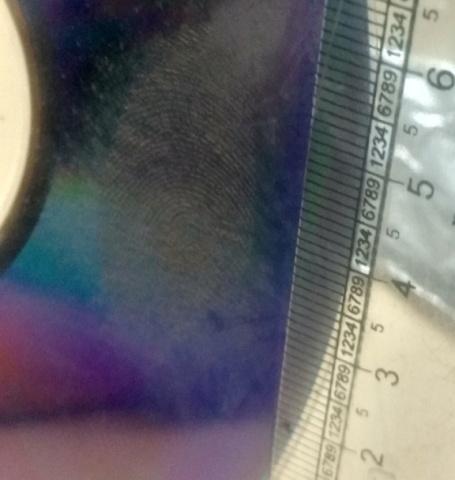
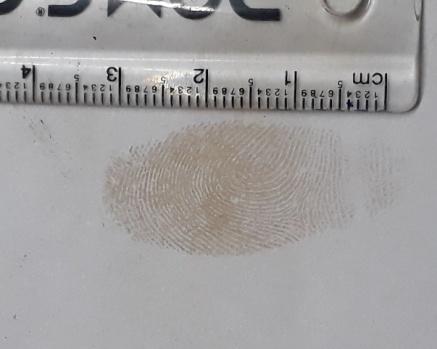
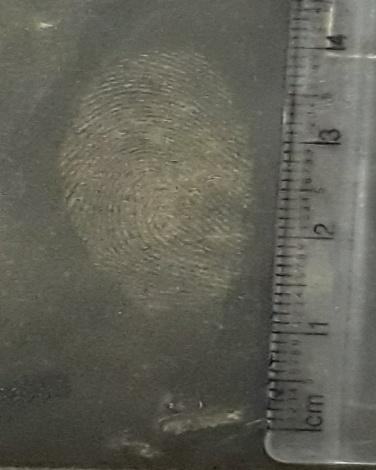
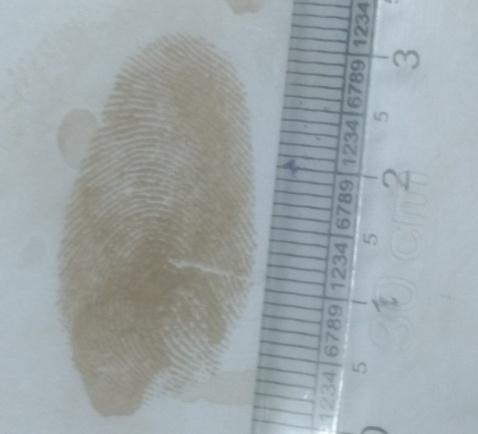
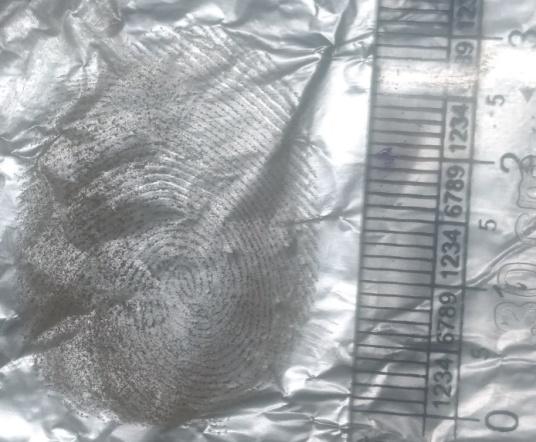
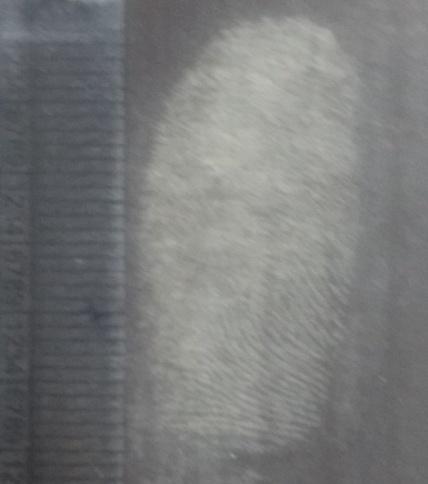
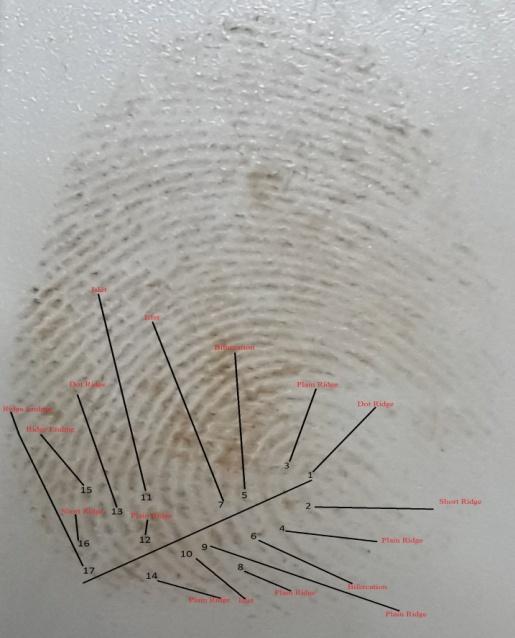
This research study shows ten samples of invisible fingerprints which are positively developed in various porous or nonporous surfaces and are clearly observable and easily identified the fingerprint pattern and their ridge features can be seen in figs. 1-12. Identified & Examination of invisible fingerprints patterns can be positively developed with rock phosphate dust. The relative approximation of different area this rock phosphate dust discloses that it provides well results on contrast surfaces rather than the others powder examine. This research study, based on the invisible fingerprint, is a physical technique based on the adherence of fingerprint powder (dust) attached with fatty acid & oily component present on the sweat are deposit on the fingerprints and ridges. The Developed successful results of these ten samples i.e. Wooden Porous, Aluminum Foil, Plastic sheet, Plywood, Compact Disk (CD), Plastic Porous, Iron, Utensils Nonstick, Paper, Granite Marble, Ceramic are given below.

Conclusion
Using the Rock Phosphate Powder is successfully developed result on various surfaces to identified invisible Fingerprints in crime investigations. The Rock Phosphate dust can provide a good supernumerary powder for fingerprint identification in comparison of commercially available chemical powders. This type of work has not been reported previously and can provide useful information to the investigators in cases of shortage or non-availability of systematic conventional fingerprint development powders.
Acknowledgements
It is a privilege to offer my sincere thanks to Rajasthan State Mines & Minerals Limited (RSMML) Jhamarkotda, Rock phosphate Mines, Udaipur, Rajasthan, India. For giving me this opportunity to work on the development of latent fingerprints samples using rock phosphate powder.
References
-
Champod C, Lennard C, Margot P, Stoilovic M (2004) Fingerprints and other ridge skin impressions. Washington, DC: CRC Press.
-
Lee HC, Gaensslen RE (2001) Advances in fingerprint technology. 2nd ed. Washington, DC: CRC Press.
-
Richa R, Kapoor AK (2014) New Visualizing Agents for Developing Latent Fingerprints on Various Porous and Non-Porous Surfaces Using Different Household Food Items. Asian J Sci Appl Tech 3(2): 33-38.
-
Garg RK, Harish K, Ramanjit K (2011) A new technique for visualization of latent fingerprints on various surfaces using powder from turmeric: A rhizomatous herbaceous plant (Curcuma longa). Egyptian J Forensic Sci 1(1): 53-57.
- Forensic Implications of Adverse Drug Reactions in Schizophrenia A Case Series
- Narcotics and Digital Forensics: Bridging Crimes in the Digital Age
- Ethics in Forensic Psychiatry: Principles, Dilemmas, and Human Rights
- Impact of Acute Stress on Attentional Orienting to Social Cues
- Head Injury and Intracranial Hemorrhage in Western Region of Libya
- A Forensic Study on Handedness: Examination of Handwriting Features in Right and Left Handed Writers