
Using Salt & Sugar Powder to Development Hidden Fingerprint Impressions at the Crime Scene
In the Indian criminal justice system fingerprint is one of the most common and criminal evidence at the crime scene. At the crime scene, various types of print or impressions are found i.e., palm print, footprint, ear print and fingerprint. The fingerprint is unique in every human being, human fingerprint impressions are such unique characteristics of human identity that differ from person to a person, also identical twins don’t have an identical fingerprint. The important part of the fingerprint is its friction ridges impression at the crime scene. In a forensic investigation, latent fingerprint search is an important process. Thus, for the latent or invisible fingerprint impression development, we used salt and sugar powder. The fine particles of salt and sugar powder adhere to the impression and the print is visible to our naked eyes. This method is simple and easily preparable and it’s characterized by being in powder form which is available in different colours, so it can be apply any surfaces to visualization the fingerprint impressions at any crime scene. In this study, we used different surfaces such as plastic, paper, door, glass, CPU, plywood, motorbike painted area, stainless steel, floor background for developing latent or invisible fingerprints impressions. Excellence both type of powders attached to the different surfaces where the fingerprint impression is present. By using these non-destructive techniques to easily develop the hidden fingerprint impression at the scene of a crime.
Introduction
A fingerprint is one of the most crucial pieces of evidence during a criminal investigation and a criminal investigation is part of the criminal justice system. The fingerprints as evidence are important because to own individual characteristics of the fingerprints, which is unique, permanent, universal, inimitable and classable. The above mention characteristics show the unique fingerprint impression in every human being as well as in identical twins [1, 2, 3]. The fingerprint evidence is found on various objects which is present at a crime scene or scene of the crime. A crime scene or scene of the crime is the particular place where the group of persons or individual persons has committed a crime or where the many pieces of evidence thereof are found and the result is they exchange traces with one another and link them to the crime scene, weapon or object. Fingermarks are formed by sweat released from pores which are present on the friction ridge skin of human hands and the study of sweat pores present on the friction ridges of palmer is known as poroscopy [4, 5]. A poroscopy indicate the human finger ridges contain a large number of sweat pores, which is a various shape in male and female finger ridges. The ridges have small pores, which radiate perspiration which is secretion pf the eggrine gland in the skin of the ridge. When the culprit must touch some of the objects or surfaces at the crime scene, the sweat from these pores becomes dropped in form of outlines, which is show the mirror image of the ridge patterns. After the culprit touches the surface, the impressions are formed in that particular place and the impression is known as a latent or invisible impression (due to sweat is colourless in nature and when finger ridges pores deposition on a surface also produce colourless impressions). Latent fingerprint residues consist of secretions of the eccrine or sweat, sebaceous and apocrine glands which is present on the human head, nose and palm and this type of natural substances protected by the surface layer of human skin. Sweat contains 98% water, 0.5% minerals, and 0.5% organic compounds also organic and inorganic substances are secreted [6, 7, 8, 9]. The word “Latent Impressions” defines that these prints that are presented on the crime scene or scene of the crime are tough to picturize with the naked eye or available on the particular place in a very less amount to be easily identified by the forensic experts or crime scene investigators and law enforcement officers. Latent fingerprint impression is found at the crime scene in many places i.e., porous (paper, cardboard and other forms of cellulose), non-porous (plastics, glass, metal, painted wood and rubber) and semi-porous surfaces (glossy cardboard and some finished wood).
A latent fingerprint impression based on the following two types of factors which are associated with the donor, so first one is deposition factors which include age, sex, climate condition and temperature etc, and the second factor is the surface of the deposition of the fingerprint impressions pattern that includes the porous, non-porous, semi-porous surfaces that willingly takes up the finger ridges print. Since there are various traditional methods are used to analysed latent fingerprint impressions at the crime scene such as the physical developer’s method, chemical method, powder methods, laser method and usage of the various light source methods. Here, we have proposed a new powder method which is a different application comparing to the prevailing powder methods. In the present study, sugar and various types of salt powders are used as a powder to develop the latent fingerprint impressions at the scene of crime or crime scene [10, 11, 12, 13].
Materials and Methods
Latent fingerprints were collected from different surfaces such as plastic, paper, door, glass, CPU, plywood, iron, motorbike painted area, stainless steel, water bottle, floor background. This type of following porous and non- porous surfaces is used to develop the latent fingerprints impressions. In this method, we used powder dusting, for the development or visualization of hidden fingerprints that are latent or invisible imprints at the scene of crime or crime scene [14, 15]. To develop the latent fingerprints or invisible fingerprints impression with the help of one sugar powder and three types salt powder i.e.
- The 100 gm of granulated sugar which is formed the white colour powder.
- The 100 gm of table salt which is formed the white colour powder.
- The 100 gm of smoked grey salt which is formed the white grey colour powder.
- The 100 gm of rock salt which is formed the white colour powder.
The above mention total four types of sugar and salt powder are used in the development of invisible or latent fingerprint impressions. The excellence of fine particles powder was spread over the questioned surface and excess amount of the powder was removed by brush or tapping to get a clear print and we apply the most common method to development fingerprints impression that is “powder dusting method”. On the based powder dusting method, we used salt and sugar powders and the powders attached to the oils and other constituents of the sweat left in a fingerprint. After the development of fingerprints impressions, images were taken with the help of a DSLR camera and this photo session in forensic science known as forensic photography. Due to fine particles of salt and sugar powders, the prints are easily identified also ridges are clearly visible.
Result and Discussion
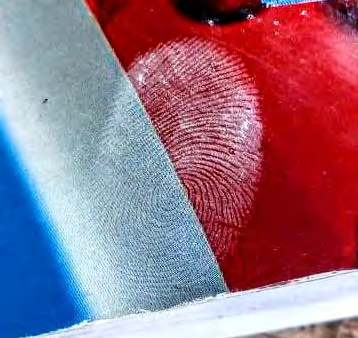
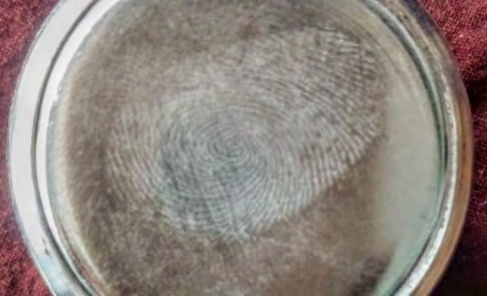
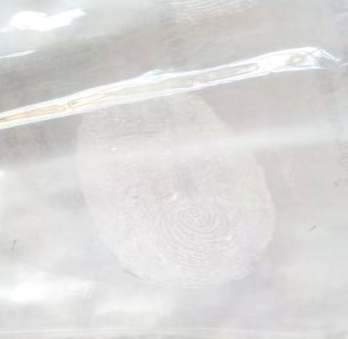
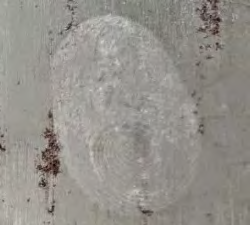
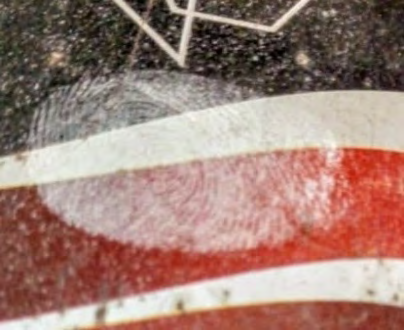
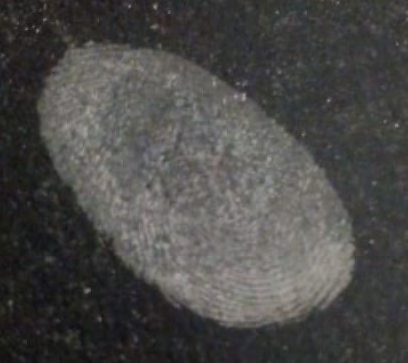
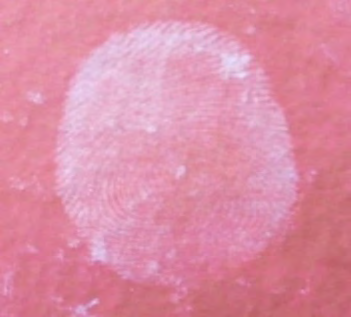
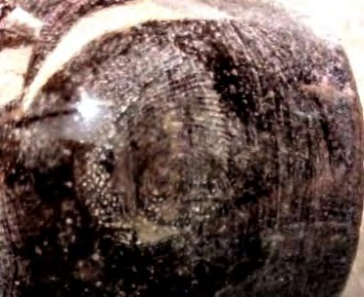
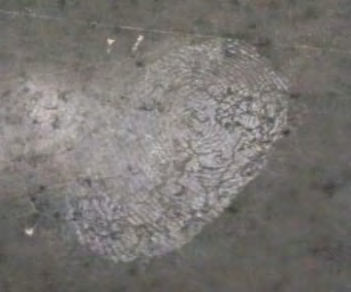
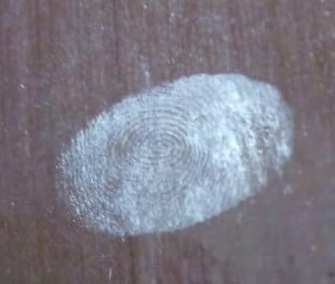
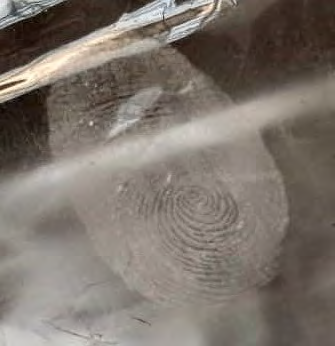
The results of the current study showed the latent of invisible fingerprints were developed on porous and non- porous surfaces using various salt and sugar powder colour for comparative assessment and powders exposes that it gives better results on contrast surfaces. The development of the latent or invisible fingerprints impressions presents on surfaces i.e., plastic, paper, door, glass, CPU, plywood, iron, motorbike painted area, stainless steel, water bottle, floor background, could be successfully done and their ridges features can be seen in figure 01 to 11. Thus, powders are an excellent medium to develop the latent or invisible prints on surfaces and the powders of all shades and verities have been used that’s why all salt and sugar powder are used base on the different surfaces such as for white surfaces we can be used dark colour powders and black surfaces we can be used light colour powders, then the result shows excellent in nature. These results advise that various salt and sugar powders can be successfully employed as a new powder method on most of the surfaces except cotton surfaces to the development of latent or invisible fingerprints. The latent fingerprints impressions or invisible fingerprint impressions identified and proper examination is positively done with the salt and sugar powders. The current study is showing the better technique in a way to identify clean observation of fingerprint impressions and ridges characteristics, the ridgeline is clearly shown in the following mention images and it is clear because fine particles of powder adjoining with fatty acid and oily components which is present on the sweat are deposit on the fingerprints and ridges. After developing the impression of the latent or invisible fingerprint, it is visible up to 3 to 4 days.
Conclusion
In the current of this research paper, different forms of salt and sugar are present everywhere, basically, it’s a household product, which is easily available and simple. If any crime has occurred and investigation officers reached the crime scene and they do not have any fingerprint development powders, then they have easily used these household powders to develop fingerprint impressions. By using the salt and sugar powder is the result is developed on various surfaces during crime scene investigation and it can be utilized at the crime scene or scene of the crime for the development of latent fingerprints. This type of research work is very beneficial to our criminal justice system to solve any crime.
References
-
Herschel WJ (1880) Skin furrows of the hand. Nature 23: 76.
-
Jones NE, Davies LM, Charlotte Russell AL, Brennan JS, Bramble Sk (2001) A Systematic approach to latent fingerprint of sample preparation for comparative chemical studies. Journal of Forensic Identification 51(5): 504-551.
-
Castello A, Frances F, Verdu F (2013) Solving underwater crimes: Development of latent prints made on submerged objects. Science and Justice 53(3): 328-331.
-
Champod C, Lennard C, Margot P, Stoilovic M (2004) Fingerprints and Other Ridge Skin Impressions 1st (Edn.), CRC Press LLC.
-
Maslanka DS (2016) Latent fingerprints on a nonporous surface exposed to everyday liquids. Journal of Forensic Identification 66(2): 137-154.
-
Sodhi GS, Kaur J (2012) A novel fluorescent small particle reagent for detecting latent fingerprints on wet non-porous items. Egypt J Forensic Sci 2(2): 45-47.
-
Sodhi GS, Kaur J, Garg RK, Kobilinsky L (2003) A Fingerprint powder formulation based on Rhodamine B dye. J For Ident 53: 551-555.
-
Gaskell C, Bleay SM, Ramadani J (2013) Natural yellow 3: a novel fluorescent reagent for use on grease- contaminated fingermarks on nonporous dark surfaces. J For Ident 63(3): 274-285.
-
Garg RK, Kumari H, Kaur R (2011) A new technique for visualization of latent fingerprints on various surfaces using powder from turmeric: a rhizomatous herbaceous plant (Curcuma longa). Egypt J Forensic Sci 1(1): 53-57.
-
Sodhi GS, Kaur J (2001) Powder Method for detecting latent fingerprints: a review; Forensic Science International 120(3): 172-176.
-
Friesen JB (2015) Forensic Chemistry: The Revelation of Latent Fingerprints. J Chem Educ 92(3): 497-504.
-
Liappis N, Kelderbacher SD, Kesseler K, Bantzer P (1979) Quantitative study of free amino acids in human eccrine sweat excreted from the forearms of healthy trained and untrained men during exercise. Eur J Appl Physiol 42(4): 227-234.
-
Labows JN, Preti G, Hoelzle E, Leyden J, Kligman A (1979) Steroid analyzes of human apocrine secretion. Steroids 34(3): 249-258.
-
Dhunna A, Anand S, Aggarwal A, Agarwal A, Verma P, et al. (2018) New visualization agents to reveal the hidden secrets of latent fingerprints. Egypt. J Forensic Sci 8: 32.
-
Kapoor S, Sodhi G, Sanjiv K (2015) Visualization of Latent Fingermarks using Rhodamine B: a new method. Int J Forensic Sci Pathol 3(11): 199-201.
- Forensic Implications of Adverse Drug Reactions in Schizophrenia A Case Series
- Narcotics and Digital Forensics: Bridging Crimes in the Digital Age
- Ethics in Forensic Psychiatry: Principles, Dilemmas, and Human Rights
- Impact of Acute Stress on Attentional Orienting to Social Cues
- Head Injury and Intracranial Hemorrhage in Western Region of Libya
- A Forensic Study on Handedness: Examination of Handwriting Features in Right and Left Handed Writers