
Planktic Foraminiferal Biostratigraphy of the Cretaceous Oceanic Red Beds in Gyangze, Tibet
A set of CORBs developed in the Northern Tethys Himalayan Subzone, southern Tibet, China. The CORB, which is called as the Chuangde Formation, in Gyangze area is mainly composed of micofossil-bearing red limestone and shale intercalated with siliceous rock (chert). This study focuses on the planktic foraminiferal biostratigraphy of the CORB in Gyangze area, Southern Tibet, China. the important elements of the planktic foraminiferal assemblage include Archaeoglobigerina bowi, Globigerilloides ultramicra, G.prairiehillensis, Globotruncana linneiana, G. lapparenti, G. arca, G.ventricosa, G. falsostuarti, Globotruncanella havanensis, Globotruncanita elevata, G. stuartiformis, G. stuarti, Hedbergella holmdelensis, Heterohelix globulosa, H. striata, Radotruncana calcarata, R. subspinosa, and Rugoglobigerina rugosa etc. Four planktonic foraminiferal biozones were recognized (in ascending order) G. elevata, G. ventricosa, R. calcarata and G. havanensis zones, which provided the Chuangde Formation (CORB) with an age of Late Cretaceous Campanian.
Introduction
Oceanic/marine red beds are widely distributed in the global oceans during the entire Phanerozoic period, usually after oceanic anoxic events. They represent a typical oxygen- rich sedimentary environment and play a important role in marine scientific research. Marine red beds of Cretaceous age, also termed the Cretaceous oceanic red beds (CORBs) have been reported from various palaeogeographical settings and in different time intervals worldwide, which usually comprise reddish to pinkish to brownish sedimentary rocks deposited in pelagic-hemipelagic marine environments and generally comprised of limestone, marl, shale, and/or chert, span the Aptian-Maastrichtian interval of Late Cretaceous, and have been reported worldwide [1, 2, 3, 4, 5, 6, 7, 8, 9]. Cretaceous Oceanic Red Bed (CORB) deposition is of great significance to paleoceanography evolution and is one of the most attractive topics in Cretaceous research in the world.
A set of CORBs developed in the Northern Tethys Himalayan Subzone, southern Tibet, China. The CORB, which is called as the Chuangde Formation, in Gyangze area is mainly composed of micofossil-bearing red limestone and shale intercalated with siliceous rock (chert). This study focuses on the planktic foraminiferal biostratigraphy of the CORB in Gyangze area, Southern Tibet, China.
Material and Methods
A detailed geologic survey was carried out on the Upper Cretaceous, especially the CORBs, in the Gyangze area, southern Tibet (Figure 1). Samples mainly of limestone and shale were collected from the Chuangde Formation (CORBs) mainly to uncover planktic foraminiferal fossils.
Samples were processed in various ways according to different lithology and hardness as follows: For relatively soft samples such as shale, about 100 g from each sample were soaked with a 10% Na2SO4 solution, washed over a 50 μm mesh sieve and dried and sieved into fractions greater than 250μm, 80 μm and 50 μm, respectively. About 50 g of washed residue was then examined. For hard samples, such as limestone, numerous thin-sections (especially axial sections of foraminifera) were prepared for taxonomic analysis and were cut in different orientations after visual observations. All rock samples, fossils and thin sections are housed at the Fossil Identification Center, the China University of Geosciences (Beijing).
Planktic Foraminiferal Biostratigraphy
With few exceptions, the well-preserved foraminifera from the the CORBs of the Gyangze area fossils can be identified to genus or species level. Established Cretaceous planktic foraminiferal biostratigraphy was applied to this study using age assignments for planktic zones of Caron [10] and Nederbragt [11].
The foraminiferal assemblages are dominated by such genera as (Figure 1): Archaeoglobigerina, Contusotruncana, Dicarinella, Hedbergella, Heterohelix, Globotruncana, Globotruncanita, Globigerineloides, Marginotruncana, Radotruncana, and Rugoglobigerina. The important elements of the planktic foraminiferal assemblage include Archaeoglobigerina bowi, Globigerilloides ultramicra, G.prairiehillensis, Globotruncana linneiana, G. lapparenti, G. arca, G.ventricosa, G. falsostuarti, Globotruncanella havanensis, Globotruncanita elevata, G. stuartiformis, G. stuarti, Hedbergella holmdelensis, Heterohelix globulosa, H. striata, Radotruncana calcarata, and R. subspinosa etc. Four planktonic foraminiferal biozones were recognized (in ascending order) G. elevata, G. ventricosa, R. calcarata and G. havanensis zones, which provided the Chuangde Formation (CORB) with an age of Late Cretaceous Campanian.
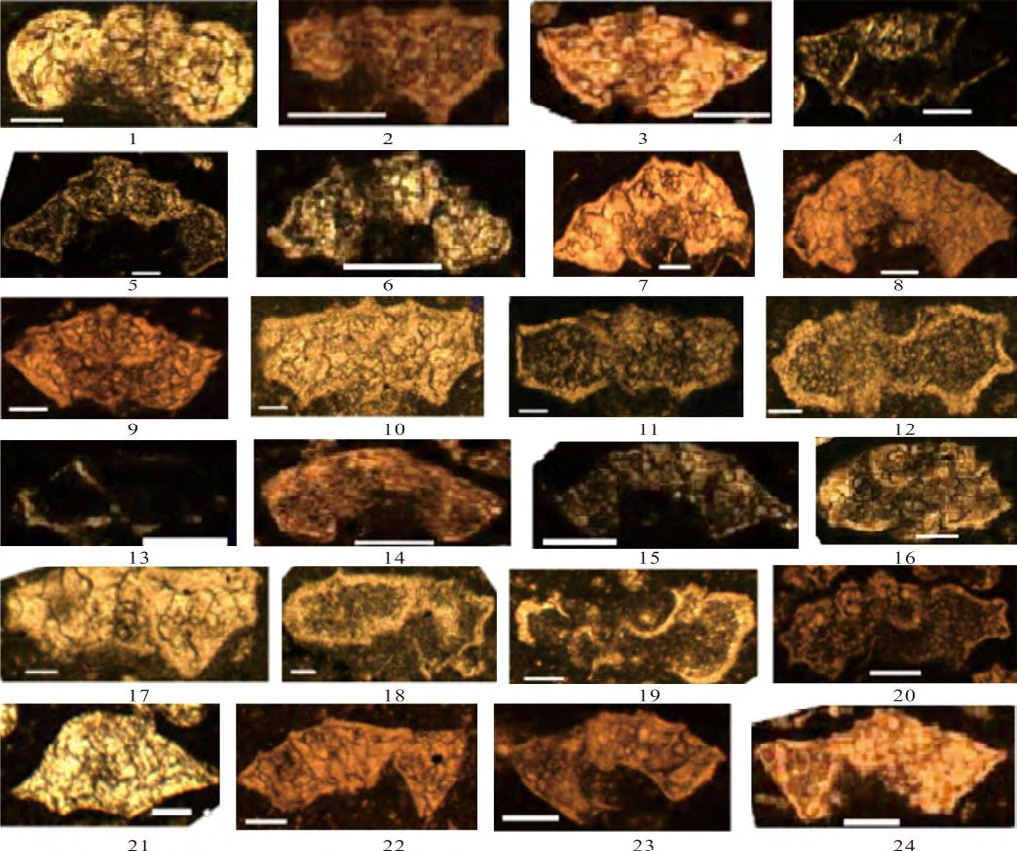
Figure 1: The representative elements of the planktic foraminiferal assemblage from the Chuangde Formation (CORB) in Gyangze area, Tibet. 1. Archaeoglobigerina blowi (Pessagno, 1967)(CW100-40); 2. Archaeoglobigerina cretacea (d’Orbigny, 1840)(CW74-31); 3,4,9. Globotruncanita stuarti (De Lapparent, 1951)(3.CW100-124; 4.CW102-12b; 9. CW74-66); 5. Contusotruncana fornicata (Plummer,1931)(5. CW74-222; 6. CW90-74;7.CW74-238 ; 8.CW81-45); 9. Globotruncanita stuatiformis (Dalbiez, 1955)(CW74- 25); 10,11. Globotruncana linneiana (d’Orbigny, 1839) (10. CW85-118; 11. CW85-153); 12, 13. Globotruncana bulloides (Vogler, 1941)(12.CW85-136; 13. CW102-14); 14-16. Globotruncana arca (Cushman, 1926)(14.CW83-50;15.CW102-29; 16.CW37- 36); 17,18. Globotruncana ventricosa (White,1928) (17.CW31-21; 18. CW31-26); 19. Globotruncanita elevata (Brotzen, 1934) (CW30-71); 20. Globotruncana lapparenti (Brotzen, 1936) (CW98-40); 21. Rodotruncana calcarata (Cushman, 1927) (CW102- 1); 22-24. Globotruncanita stuatiformis (Dalbiez, 1955) (22. CW81-63; 23. CW74-58; 24.CW74-25).
Globotruncanita elevata zone
The Globigerinelloides elevata Zone is a partial range zone (PRZ) after Postuma [12], and it spans the interval from the LO of D. asymetrica to the FO of G. ventricosa. In Gyangze area, The key species of this zone ranges include: Archeoglobigerina blowi, Globigerinelloides prairiehillensis, G. ultramicra, Globotruncana arca, G. bulloides, G. carinata, G. lapparenti, G. linneiana, Globotruncanita elevata, G. stuartiformis, Heterohelix carinata, H. cordites, H. globulosa, H. planata, H. reussi, H. striata, Laeviheterohelix pulchara, Marginotruncana coronata, M. marginata, Planoglobulina ornatissima. The age of this zone is early Campanian.
Globotruncana ventricosa zone
The Globotruncana ventricosa Zone is a partial range zone (PRZ) defined by Dalbiez [13], and is marked by the FOs of G. ventricosa and R. calcarata at its base and top, respectively. In Gyangze, this zone is defined by the FO of G. ventricosa at its base and by the FO of R. calcarata at its top. Key elements include: Globigerinelloides prairiehillensis, Globotruncana arca, G. bulloides, G. carinata, G. falsostuarti, G. lapparenti, G. linneiana, G. rosseta, G. ventricosa, Globotruncanita stuarti, G. stuartiformis, Hedbergella holmdelensis, Heterohelix americana, H. carinata, H. cordites, H. grabrans, H. globulosa, H. reussi, H. striata, Pseudotextularia nuttalli, Rugoglobigerina rugosa, and Schackoina multispinata. This zone is dated as early Campanian to middle Campanian in age.
Radotruncana calcarata zone
The Radotruncana calcarata Zone is a total range zone (TRZ) described by Herm [14], which spans the total range of R. calcarata. In Gyangze, the base and top of this zone are marked respectively by the FO and LO of R. calcarata. Important elements include planktic species: Archaeoglobigerina blowi, A, cretacea, Contusotruncana sp., Globigerineloides prairillensis, Globotruncana aegyptiaca, G. arca, G. carinata, G. bulloides, G. globigerilloides, G. linneiana, G. mariei, G. rosseta, G. ventricosa, Globotruncanella havanensis, Globotruncanita stuarti, G. stuartiformis, Heterohelix carinata, H. cordatus, H. globulosa, H. reussi, H. striata, Laeviheterohelix dentata, L. pulchara, L. turgita, Pseudotextularia nuttalli, Radotruncana calcarata, R. subspinosa, Rugoglobigerina rugosa, and Schackoina multispinata. The age of this zone is inferred as middle Campanian.
Globotruncanella havanensis zone
The Globotruncanella havanensis Zone is a partial range zone (PRZ) defined by Caron [15], with Globotruncanella havanensis, from LO of R. calcarata to the FO of Globotruncana aegyptiaca. In Gyangze, the base of this zone is defined by the FO of R. calcarata. Representative elements of this zone include Globotruncanella havanensis, Globotruncana bulloides, G. linneiana, G. ventricosa, Globigerinelloides prairiehillensis, Archaeoglobigerina blowi, A. cretacea, Heterohelix sp., H. striata and Contusatruncana fornicata. The age of this zone is inferred as late Campanian.
Discussion
Age assignment
This paper mainly adopts the Cretaceous planktic foraminiferal zonal schemes of Caron (1985). Globotruncana ventricosa, which defines the G. ventricosa Zone, is Campanian to Maastrichtian in age. G. stuarti ranges from the late Campanian to the end of Maastrichtian, i.e., from the middle of G. havanensis Zone to the top of A. mayaroensis Zone. G. stuartiformis is restricted to the latest Santonian to Late Maastrichtian, i.e., from the top of D. asymmetric Zone to the lower A. mayaroensis Zone. Heterohelix globulosa ranges from the earliest Campanian to Middle Maastrichtian. Contusatruncana fornicata ranges from Middle Santonian to Middle Maastrichitian. Radotruncana calcarata defines the R. calcarata Zone, which is limited to middle Campanian. Globotruncanella havanensis, which defines the G. havanesis Zone, is late Campanian to the end of Maastrichtian in age.
Palaeogeographic distribution of CORBs
Cretaceous strata in Tethyan Himalaya of southern Tibet have been considered as deposits from the northern Indian passive margin. In general, Upper Cretaceous strata from the southern Tethyan Himalaya record shallow to deep shelf environments, while time-equivalent units from the northern Tethyan Himalaya document continental slope to basinal environments [3, 4, 5, 6, 8, 16, 17, 18, 19, 20, 21].
The “Cretaceous Oceanic Red Beds (CORBs)” associated with “Oceanic Oxic Events” have become a hot topic for geologists from around the world. In southern Tibet, Upper Cretaceous oceanic red beds (CORBs) are widely distributed in the northern Tethyan Himalayas [3, 4, 5, 6, 8, 9, 20, 21] (Figure 2). These CORBs are composed of pink limestone, marl, shale, siltstone, and radiolariants (siliceous rocks, usually assigned to the Chuangde Formation. The origin of these CORBs remains uncertain, but most authors believe that they are related to change in ocean circulation patterns and low deposition rates [8, 20, 21].
![Figure 2: Distribution and stratigraphic correlation of the CORBs in the Tethyan Himalayan area (modified from Li, et al, [3]; Li, et al. [22]; Gansser [23]).](/fulltextimages/8051/fig_2.png)
Paleogeographic reconstruction [3, 4] shows that the CORBs represented by the Chuangde Formation and its time- equivalent units are confined to the deep water environments and are completely absent in the shelf environments including shelf margin. Given the similar stratigraphic thickness of shelf and slope/basin sections, it is unlikely that the Tethy-Himalayan CORBs were formed by terrigenous iron transport to a sediment-deficient ocean.
Recently, our field geological survey [22] found a shallow-marine purple limestone layer with the thickbess of 5 m, equivalent to the CORB, in the Cretaceous Zongshan Formation of the Gyabukeqing section of Yadong, southern Tethyan Himalayas, which is the first report of the shallow- marine CORB in a shelf setting.
Conclusion
The study on the planktic foraminiferal biostratigraphy of the CORBs developed in Gyangze area, northern Tethyan Himalayas, southern Tibet were carried out. Four planktonic foraminiferal biozones were recognized (in ascending order) G. elevata, G. ventricosa, R. calcarata and G. havanensis zones, which provided the Chuangde Formation (CORB) with an age of Late Cretaceous Campanian.
Acknowledgments
This work is granted by the National Natural Science Foundation of China (Grant No. 41272030), the IGCP679, and the National Basic Research Program of China (Grant No. 2012CB822001).
References
-
Bak K (2006) Sedimentological, geochemical and microfaunal responses to environmental changes around the Cenomanian/Turonian boundary in the Outer Carpathian Basin a record from the Subsilesian Nappe, Poland. Palaeogeogra Palaeoclimatol Palaeoecol 237(2-4): 335-358.
-
Eren M, Kadir S (1999) Colour origin of upper cretaceous pelagic red sediments within the Eastern Pontides, northeast Turkey. International Journal of Earth Sciences 88: 359-595.
-
Li GB, Jiang GQ, Hu XM, Wan XQ (2009) New biostratigraphic data from the Cretaceous Bolinxiala Formation in Zanda, southwestern Tibet of China and their paleogeographic and paleoceanographic implications. Cretaceous Research 30(4): 1005-1018.
-
Li GB, Jiang GQ, Wan XQ (2011) The age of the Chuangde Formation in Kangmar, southern Tibet of China: implications for the origin of Cretaceous Oceanic Red Beds (CORBs) in the Northern Tethyan Himalaya. Sedimentary Geology 235(1-2): 111-121.
-
Li GB, Wan XQ, Jiang GQ, Hu XM, Goudemand N, et al. (2007) Late Cretaceous foraminiferal faunas from the Saiqu “mélange” in southern Tibet. Acta Geologica Sinica 81(6): 917-924.
-
Li, GB, Wan XQ, Pan M (2011) Planktic foraminiferal biostratigraphy of the Cretaceous oceanic red beds in Kangmar, southern Tibet, China. Acta Geologica Sinica 85(6): 1238-1253.
-
Mansour A, Wagreich M, Gentzis T, Ocubalidet S, Tahoun SS, et al. (2020) Depositional and organic carbon- controlled regimes during the Coniacian-Santonian event: First results from the southern Tethys (Egypt). Marine and Petroleum Geology 115: 104285.
-
Wan XQ, Lamoldab MA, Si JL, Li GB (2005) Foraminiferal stratigraphy of Late Cretaceous red beds in southern Tibet. Cretaceous Research 26(1): 43-48.
-
Wang CS, Hu XM (2005) Cretaceous world and oceanic red beds. Earth Science Frontiers 12(2): 11-21.
-
Caron M (1985) Cretaceous planktic foraminifera. In: Bolli HM, Saunders JB, Perch Nielsen K (Eds.), Plankton Stratigraphy, Cambridge University Press, Cambridge, pp: 17-86.
-
Nederbragt AJ (1991) Late Cretaceous biostratigraphy and development of Heterohelicidae (planktic foraminifera). Micropaleontology 37(4): 329-372.
-
Postuma J (1971) Manual of Planktonic Foraminifera. Elsevier Publishing Co., Amsterdam, pp: 1-420.
-
Dalbiez F (1955) The genus Globotruncana in Tunisia. Micropaleontology 1(2): 161-170.
-
Herm D (1962) Stratigraphische und miktopaläontologische Untersuchungen der Oberkreide im Lattengebirge und im Nierental. Verl D Bavarian Akad D, pp: 1-119.
-
Caron M (1978) Cretaceous planktic Foraminifers from DSDP Leg 40, Southeastern Atlantic Ocean. Initial Rep Deep Sea drill Proj 40: 651-678.
-
Yu GM, Wang CS (1990) Sedimentary geology of the Xizang (Tibet) Tethys, Geological Memoir, Series 3, 12. Geological Publishing House, pp: 187.
-
Colpaert CPA-M, Li G (2021) Uppermost Jurassic to Lower Cretaceous benthic foraminiferal faunas of the Weimei and the Bandingsi localities of northern and southern parts of South Tibet – A preliminary analysis. Cretaceous Research 124: 104785.
-
Li G, Holbourn A, Kuhnt W, Fang PY, Yao JX, et al. (2020) Occurrence of benthic foraminifers across the Jurassic/ Cretaceous transition in Gyangze, southern Xizang (Tibet), China. Cretaceous Research 105: 103931.
-
Li GB, Wan XQ, Yu C (2003) Sequence stratigraphy of the Cretaceous strata in the Tethyan Himalayas. Sedimentary Geology and Tethyan Geology 23(3): 21-34.
-
Chen X, Wang CS, Hu XM, Huang YJ, Wang PK, et al. (2007) Cretaceous oceanic red beds, distribution, lithostratigraphy and paleoenvironments. Acta Geologica Sinica 81(6): 1070-1086.
-
Hu XM, Luba J, Wang C, Sarti M, Bak K, et al. (2005) Upper Cretaceous oceanic red beds (CORBs) in the Tethys, occurrences,lithofacies, age, and environments. Cretaceous Research 26(1): 3-20.
-
Li YW, Wang CS, Li GB, Xu X, Han ZC, et al. (2020) Shallow- marine Cretaceous oceanic red beds from the southern Tethyan Himalaya, Tibet, western China: biostratigraphy, microfacies analysis, and global correlations. Geological Journal.
-
Gansser A (1964) Geology of the Himalayas. Wiley Interscience, pp: 289.
- Evolution and Extinction of Dinosaurs
- Ferromanganese Crust: Is a Type of Cenozoic Black Stromatolite in Seabed? The Case of the Rio Grande Rise, South Atlantic Ocean
- The Saint Loup of the Col Du Fam, A Smilodon Caught in a Lava Bubble
- Proving that Dinosaurs are Distant Ancestors of Humans – The East Asian Locus of Evolution that disproves definitively the “Out of Africa" Theory
- The Current State of Foraminiferal Research and Future Goals
- The Importance of Benthic Macroinvertebrates to Unravel Biotic Responses to Climate Change in Deep-Time