
Application of Platelet-Rich Plasma in Nasal Tip Reconstruction with Medpor Prosthesis
Objective: To observe the effect of platelet-rich plasma (PRP) on reducing ear cartilage absorption and nasal tip complications after nasal tip plasty with medpor prosthesis. Methods: During the conventional medpor rhinoplasty, PRP was injected locally around the tip and columella of the nose with medpor material. The morphology of the nasal tip cartilage and the shape of the nasal tip were observed at least 1 year after the surgery, and the status of cartilage absorption was judged. The statistical differences between the control group and the experimental group were analyzed by χ²-test. Results: After observation for 1 year, a total of 71 cases underwent conventional medpor rhinoplasty, of which 21 cases had cartilage resorption, and 10 cases had a prominent shape of the nasal tip prosthesis that required repair; In the platelet-rich plasma treatment group, there were 18 cases, 1 case of cartilage absorption, and 0 case requiring repair. There are significant statistical differences in clinical practice. Conclusion: PRP can significantly reduce the absorption of ear cartilage, maintain the appearance of the nasal tip, and improve the satisfaction of patients with medpor prosthesis rhinoplasty.
Background
Adequate cartilage materials are very important for shaping the nasal tip in rhinoplasty [1, 2] but the insufficient sources of cartilage materials and postoperative cartilage absorption [3] are the problems we faced. The use of medpor material in combination with ear cartilage greatly saves the amount of cartilage used, and the medpor material will not be absorbed and softened in the later stage, providing a lasting support effect [4]. However, it has been found that there have also been some complications with the use of medpor materials in clinical work, especially the Clinical Note appearance of the nasal tip medpor material after ear cartilage absorption, manifested as narrow and small nasal tip, thin skin, no expression points, and the appearance of the prosthesis. Autologous platelet-rich plasma can stimulate collagen proliferation and reduce cartilage absorption [5, 6] and is widely used in other clinical departments [7, 8]. From January 2021 to March 2022, we used PRP injection locally on the tip and columella of the nose during rhinoplasty in a total of 24 patients. No significant absorption of ear cartilage and no significant change in the shape of the tip of the nose were found after a follow-up of 1 year or more, and the effect was good. The patient’s satisfaction was high.
Methods
PRP was prepared by filtering autologous blood [9]. Take a unilateral ear nail cavity ear cartilage with a size of approximately 1.5cm * 1.5cm from the incision behind the ear for future use. Using a flying swallow shaped nasal columella incision, the alar cartilage, nasal septum cartilage, and nasal dorsal tunnel were separated; Use a 0.7mm medpor sheet material to trim to a size of 5 * 30mm, trim the periphery of the material without sharp edges, fix it on both sides of the nasal septum cartilage, maintain the nasolabial angle of 90 ° - 95 °, then suture and fix the medpor material and the nasal septum cartilage. When the fixation is completed, wrap and suture the upper end of the medpor material with ear cartilage sheets on both sides; Fix the medial feet of bilateral alar cartilage symmetrically to the top of the medpor material, and adjust the height of the medpor material appropriately according to the tension; Implantation of nasal dorsal prosthesis material, suture fixation and shaping; Trim ear cartilage size to match nasal tip shape and fix the trimmed ear cartilage at the tip of the nose to cover the medpor in a shield like manner and form a nasal tip presentation point; After suturing, the prepared PRP was injected evenly into the nasal columella and tip, and the back of the nose was fixed with a nasal splint. The suture was removed one week after surgery.
Before January 2021 and between January 2021 and March 2022, all cases of medpor material combined with ear cartilage rhinoplasty, cases of cartilage absorption, and cases of nasal tip complications requiring repair were statistically analyzed using chi-square test. SPSS 22.0 (IBM Corp., Chicago, IL, USA) was used for statistical analysis.
Results
Observation was conducted for 1 year after nasal tip plasty. A total of 71 cases underwent conventional medpor rhinoplasty before January 2021, of which 21 cases had cartilage resorption, and 10 cases had significant shape of the nasal tip prosthesis that required repair; A total of 18 patients (including 10 cases of repair) in the platelet-rich plasma treatment group experienced cartilage resorption in 1 patient and needed repair in 0 patients from January 2021 to March 2022. There were significant differences in cartilage absorption between the two groups at 1 year or more post-operation (χ²=4.4529 8, P=0.0348). There were no differences in requiring repair due to cartilage absorption between the two groups at 1 year or more post- operation(χ²=2.8561, P=0.0910).
The combination of medpor material and ear cartilage rhinoplasty can achieve the desired nasal tip shaping effect, and the amount of ear cartilage used can be significantly reduced. The medpor material can fuse well with the nasal septum cartilage, and the shape of the nasal tip can be maintained for a long time; Injection of PRP around the tip and columella of the nose can reduce the absorption of ear cartilage, increase the survival of ear cartilage, and better maintain the shape of the tip of the nose. During a follow-up period of 1 year or more, the nasal tip was in good shape, and no complications such as cartilage absorption and prosthesis appearance were found. The complications in the PRP local injection group were significantly lower than those in the conventional surgery group.
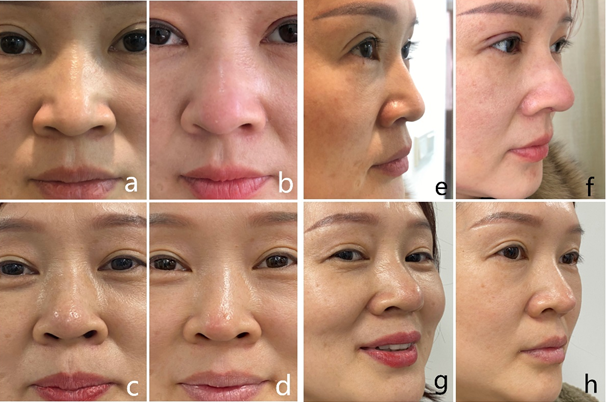
Figure 1: A 35-year-old woman who underwent nasal tip plasty with medpor prosthesis and ear cartilage, facial front and side appearance. (a,e) Preoperative view. (b,f) 6 months post-operation, patient is satisfied with the shape. (c,g) 1 year post- operation, narrow and small nasal tip, no expression points, and the appearance of the prosthesis were found. (d,h) 1 year after combined PRP plasty of nasal tip with medpor prosthesis and ear cartilage.
| Total number of cases of cartilage absorption | Total number of cases requiring repair due to cartilage absorption | Total number of cases | |
|---|---|---|---|
| traditional group | 21 | 10 | 71 |
| PRP usage group | 1 | 0 | 18 |
Table 1: Cases of cartilage absorption and surgical repair in the PRP use group and the conventional surgery group. Cartilage abs
Discussion
During the repair operation, we found that the pressure bearing part in the middle of the nasal tip ear cartilage piece was partially absorbed, and the ear cartilage on both sides was less absorbed. Although the ear cartilage was intact, the supporting part of the medpor softened, and the cartilage on both sides was pendulous; The fusion between medpor and surrounding tissues is relatively close; It is suggested that the medpor material has good histocompatibility, closely adheres to the nasal septum cartilage, and has a higher strength than the ear cartilage. However, at the tip of the nose, the tension at the location where the medpor material contacts the ear cartilage is high, and partial absorption may occur when the ear cartilage undergoes early nutritional disorders. The main function of PRP is to provide sufficient nutritional support in the early stage [10], so that free cartilage can have nutritional support in the early stage [11, 12] and it can stimulate the growth of cartilage and connective tissue, collagen tissue proliferation, and provide sufficient support for cartilage.
Conclusion
Adequate hypotension and the use of local PRP during surgery can effectively increase cartilage survival and reduce cartilage absorption. The application of PRP and medpor can not only improve surgical efficiency, but also improve the satisfaction of recipients.
Acknowledgements
This study is supported by Zhenjiang Key R&D Plan (Social Development): SH2021039.
Ethical Approval
The study was approved by the Yangzhong People’s Hospital Institutional Review Board (202141).
References
-
Ryu JY, Lee JH, Lee JS, Lee JW, Choi KY, et al. (2022) Correction of a Secondary Bilateral Cleft Lip Nasal Deformity in Adults Using Repositioning of Both Lower Lateral Cartilages and Nasal Tip Plasty Through an Open Bilateral Reverse-U Incision. J Craniofac Surg 33(2): 506- 511.
-
Cho BC, Lee JW, Lee JS, Lee JH, Ryu JY, et al. (2021) Correction of secondary unilateral cleft lip nasal deformity in adults using lower lateral cartilage repositioning, columellar strut, and onlay cartilage graft on the nasal tip with open rhinoplasty combined with reverse-U incision. J Plast Reconstr Aesthet Surg 74(5): 1077-1086.
-
Sun Y, Wu G, Jiang Z, Cao W, Li S, et al. (2023) Novel method for correcting cephalic rotation in Asian nasal tip plasty. J Plast Reconstr Aesthet Surg 76: 315-321.
-
Scopelliti D, Amodeo G (2016) J Nasal Dorsum Reconstruction With Alloplastic Material. Craniofac Surg 27(7): e676-e678.
-
Yildirim U, Kemal O, Aksoy A, Karaca E, Terzi O, et al. (2020) Effects of submucosal PRP injection on wound healing in endonasal surgeries: an experimental study. Eur Arch Otorhinolaryngol 277(6): 1681-1689.
-
Wang H, Wang J, Guo T, Ding X, Yu W, et al. (2019) The endoscopically assisted transcrestal sinus floor elevation with platelet-rich fibrin at an immediate implantation of periapical lesion site: A case report. Medicine (Baltimore) 98(27): e16251.
-
Bennell KL, Paterson KL, Metcalf BR, Duong V, Eyles J, et al. (2021) Effect of Intra-articular Platelet-Rich Plasma vs Placebo Injection on Pain and Medial Tibial Cartilage Volume in Patients With Knee Osteoarthritis: The RESTORE Randomized Clinical Trial. JAMA 326(20): 2021-2030.
-
Xu J, Gou L, Zhang P, Li H, Qiu S (2020) Platelet-rich plasma and regenerative dentistry. Aust Dent J 65(2): 131-142.
-
Derwich M, Mitus-Kenig M, Pawlowska E (2021) Mechanisms of Action and Efficacy of Hyaluronic Acid, Corticosteroids and Platelet-Rich Plasma in the Treatment of Temporomandibular Joint Osteoarthritis-A Systematic Review. Int J Mol Sci 22(14): 7405.
-
Li Z, Weng X (2022) Platelet-rich plasma use in meniscus repair treatment: a systematic review and meta-analysis of clinical studies. J Orthop Surg Res 17(1): 446.
-
Später T, Menger MD, Laschke MW (2021) Vascularization Strategies for Porous Polyethylene Implants. Tissue Eng Part B Rev 27(1): 29-38.
-
Lee SG, Yang JW, Park SG, Yang YI (2010) Effect of stem cells and fibrin concentration on the vascularization of the Medpor orbital implant. Clin Exp Ophthalmol 38(9): 885-891.
- Management of Chronic Insertional Achilles Tendinopathy Using Flexor Hallucis Longus Tendon Transfer in Patients Over 50 Years of Age: A Four-Case Series Following the CARE Guidelines
- Application of Induced Pluripotent Stem Cells in Bone Tissue Engineering: Current Status and Prospects
- Surgical Management of Upper Thoracic Esophageal Squamous Cell Carcinoma with Concomitant Hypersplenism: Integration of Chai's Supra-Thoracic Apex Technique with Laparoscopic Splenectomy - A Technical Innovation Case Study with Systematic Review
- Evaluation of Masticatory Functional Efficiency of Stomatognathic System in Patients Undergoing Open Reduction Internal Fixation for Treatment of Pan-Facial Trauma: A Prospective Study
- Hepatic Abscess Secondary to Appendiceal Phlegmon an Unusual Complication of Appendiceal Phlegmon
- Report of Lumboperitoneal (LP) Shunt Procedure in Over Decades Experiences, Systematic Narrative Review