
Prevalence of ABO and Rh Blood Groups Among Blood Donors in Jiblah University Hospital in Ibb Province Yemen
Background: The ABO and Rhesus (Rh) blood group system are the most important blood group systems in Transfusion Medicine, genetic studies and in legal medicine study. The distribution of the ABO and Rhesus blood groups is vital for the effective operation and planning of blood banks and secure blood transfusion services. Objective: To determine the prevalence of ABO Rh blood groups among blood donors in Jiblah University Hospital in Ibb province, Yemen. Methods: A retrospective study was conducted at Blood bank of Jiblah university hospital in Ibb city, Yemen from January 2021 to August 2023. Blood groups typing of 4853 blood donors was carried out using Slide Agglutination (antigen-antibody) method with antisera anti-A, anti-B, and anti-D. Age and sex of participants were considered. SPSS version 20 was used for data analysis. Results: The most common blood group was O (55.54%) and AB was the least common (1.71%). The prevalence of Rhpositive and Rh-negative was 80% and 20% respectively. There were statistically significant association between ABO blood groups and Rh blood group (P = 0.000). Conclusion: The overall phenotypic frequencies of ABO blood groups were O>A>B>AB and O+>A+>O->B+>A->AB+>B->ABwas found to be the order of blood group frequency in the current study. There was a statistical association between ABO blood group system and Rh system.
Introduction
Blood groups are antigenic determinants located mainly on the surface of the human red blood cells (RBC) which are defined by antibodies, usually alloantibodies produced by individuals who lack the corresponding antigen. Blood group antigens are inherited biological characteristics that do not change throughout the life and appear to be very important for transfusion safety and clinical practice as well as markers for various human diseases. The study of blood grouping is also useful in population genetic studies, researching population migration patterns as well as resolving certain medico legal issues, particularly of deciding forensics and disputed paternity cases and in blood transfusion practice as it will help a lot in reducing the morbidity and mortality rate. The frequency and distribution of these blood groups vary worldwide. The International Society of Blood Transfusion (ISBT) acknowledged 43 blood group systems with 360 known antigens that are clinically significant and associated hemolytic transfusion reactions (HTR) and hemolytic disease in fetuses and newborns Haemolytic Disease of Foetus and New-born (HDFN).
The ABO and Rhesus (Rh) blood group systems are the most important among these systems. The ABO blood group system was the first human blood group system discovered by Karl Landsteiner in 1900 and is used to characterize the ABO blood groups by the presence of A, B or AB antigens in which, there are four types of antigens: A, B, AB and O. In 1941, Rh blood group system is discovered and reported as a second most significant blood group system due to hemolytic disease of newborn and its importance in Rh negative individuals in subsequent transfusions once they develop Rh antibodies. There are only two Rh phenotypes such as Rh positive and Rh negative, depending on whether Rh antigen is present on the red cell or not. This Rh antibody agglutinated 85% of human red cells tested and was nonreactive with 15%. The distribution of Rh positive and Rh negative groups vary between countries globally, where, for example, in Britain and USA the frequency of Rh negative group is relatively higher than other regions. Since it was discovered by Karl Landsteiner, the ABO blood group and RH systems are the most important blood group system in Transfusion Medicine.
Safe blood transfusion is not realized only by testing of blood for transfusion transmittable infections but also thorough protection from hemolytic transfusion reaction and resulting from Alloimmunization against red cell antigens which commonly occurs following a transfusion or in pregnancy. For effective management of blood banks and safe blood transfusion services, therefore, knowing the distribution of ABO and Rh blood groups within communities is important. The prevalence of ABO blood groups varies from race to race and region to region. The frequency of A and O phenotypes in white populations is 45% and 40%, respectively. Blood groups B and AB are in the next position with respective frequency of 11% and 4%. In the studies conducted in USA, southwest Saudi Arabia, Kenya, Mauritania, southwest Nigeria, Egypt and Jordan, the O blood group was the most prevalent and AB the least prevalent blood group and study conducted in Bangkok, Thailand reported the distribution of blood group systems in Thailand blood donors determined by gel test, group O is the most common 40.5% followed by group B 30.5%, group A 20.5% and group AB 8.5%. In another study conducted in India, the B and AB blood groups had the highest and lowest frequency, respectively. In a study in Turkey, the A blood group was the most prevalent and AB the least prevalent blood group.
Yemen as developing country with limited resources and heavy patient load, there is limited data regarding describing the distribution of ABO and Rh blood group systems in the practice of transfusion medicine in Yemen. Jiblah university hospital was called American Baptist Hospital and was opened in 1965 by the American Baptist Association and is located in Jiblah town in Ibb governorate that located in south-western Yemen. Jiblah university hospital provides medical and health services for patients from Ibb and neighboring governorates especially that related to surgery and childhood and motherhood. Therefore, this study aims to determine the distribution of blood groups and the demographic background of blood donors in Universal hospital in Jiblah university for medical and health sciences.
Material and Methods
Subjects
A retrospective study was carried out on 4853 blood donors who were attending Blood Bank Department of Jiblah University Hospital in Ibb province, Yemen, from January 2021 to August 2023, to determine the prevalence of the ABO and Rh blood groups. All participants belonged to age group between 18-60 years [1, 2, 3, 4, 5].
Determination of Blood Groups
The Blood samples were obtained by standard procedures of venipuncture and emptied into tubes containing ethylene diamine tetra acetic acid (EDTA) as an anticoagulant [6]. Blood groups of the blood donors were determined by commercially available standard monoclonal antisera (anti A, anti B and anti D sera) (Lorne, UK) by slide agglutination test (or test tube agglutination techniques) [7]. In doubtful cases, the prepared samples were observed microscopically [8]. In the case of the Rh negative result, the indirect test was performed to confirm the result. Donor’s age and sex were taken.
Statistical Analysis
All statistical analyses were performed using SPSS version 22. Chi-squared test was used for comparing the distribution of qualitative variables in blood groups. A _P-_value of < 0.05 was considered statistically significant [9].
Results
A total of 4853 blood donor samples were analyzed to determine the prevalence of blood groups among study population [10]. From Table 1, the majority 94.3% (4575) samples were males and 5.7 % (278) were females and their ages are between 18 to 60 years. The mean age of the donors was 33.46 years [11].
| Variable | ABO Blood Group | TotalL | *P Value | Rh blood group | Total | ||||||
|---|---|---|---|---|---|---|---|---|---|---|---|
| A | B | O | AB | No. | Rh+ve | Rh-ve | No. | *P Value | |||
| Age (years) | No. (%) | No. (%) | No. (%) | No. (%) | (%) | 0 | No. (%) | No. (%) | (%) | 0.397 | |
| 18-24 | 213 (35.7) | 56 (9.4) | 320 (53.6) | 8 (1.3) | 597 (12.3) | 467 (78.2) | 130 (21.8) | 597 (12.30) | |||
| 25-31 | 568 (35.5) | 126 (7.9) | 886 (55.4) | 19 (1.2) | 1599 (32.9) | 1290 (80.7) | 309 (19.3) | 1599 (32.95) | |||
| 32-38 | 506 (34.1) | 119 (8) | 829 (55.9) | 1483 (30.6) | 1483 | 1169 (78.8) | 314 (21.2) | 1483 (30.56) | |||
| -30.6 | |||||||||||
| 39-45 | 252 (33.6) | 65 (8.7) | 414 (55.1) | 20 (2.7) | 751 (15.5) | 609 (81.1) | 142 (18.9) | 751 (15.47) | |||
| 46-52 | 115 (35.2) | 22 (6.7) | 183 (56) | 7 (2.1) | 327 (6.7) | 271 (82.9) | 56 (17.1) | 327 (6.74) | |||
| ≥ 53 | 16 (16.7) | 21 (21.9) | 59 (61.5) | 0 (0.0) | 96 (2) | 77 (80.2) | 19 (19.8) | 96 (1.98) | |||
| TOTAL | 1670 (34.41) | 409 (8.43) | 2691 (55.45) | 83 (1.71) | 4853 (100) | 3883 (80) | 970 (20) | 4853 (100) | |||
| Gender | 0.069 | 0.251 | |||||||||
| Male | 1569 (34.3) | 392 (8.6) | 2532 | 82 (1.79) | 4575 (94.3) | 3668 (80.17) | 907 (19.83) | 4575 (100) | |||
| -55.34 | |||||||||||
| Female | 101 (36.33) | 17 (6.12) | 159 (57.19) | 1 (0.36) | 278 (5.7) | 215 (77.34) | 63 (22.66) | 278 (100) |
Table 1: Frequency of ABO and Rh blood groups according to age and gender (n = 4853).
*A P-value of < 0.05 was considered statistically significant.
The most common age group among the donors was 25-31 years 32.9% (1599), followed by 32-38 years 30.6% (1483) and the least common age group was more than or equal 53 years 2% (96). The blood group O has the highest frequency 55.45% (2691), followed by A 34.41% (1670), B 8.43% (409) and AB 1.71% (83) [12, 13, 14, 15]. The overall blood groups frequencies of ABO blood group were O>A>B>AB (Figure 1).
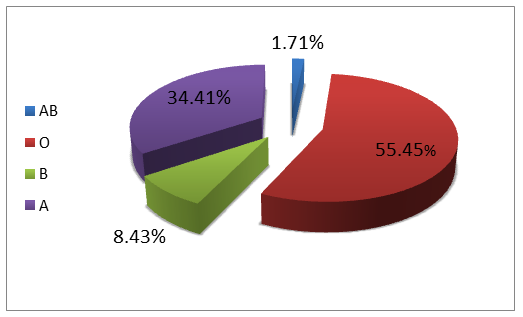
In male donors subjects, the most dominant blood group was found to be O 55.34% (2691) and the least common AB 1.79% (82). However in female samples, the most dominant blood group was found to be O 57.19% (159) and the least common AB 0.36% [1]. Overall ABO blood groups frequencies in both male and female samples were O>B>A>AB. Regarding to RH blood group, the Rh+ve blood group was the most predominant 80% (3883) and the rest 20% (970) were Rh- ve. This study stated that there is strong association between ABO blood group and RH blood group (P> 0.000). Males Rh +ve represented 80.17% (3668) while females represented 77.34% (215) were RH +ve (Table 2).
| ABO Blood Group | Rh Blood Group | Total | *P Value | |
|---|---|---|---|---|
| Rh+ve | Rh-ve | No. (%) | 0 | |
| No. (%) | No. (%) | |||
| A | 1484 | 186 | 1670 | |
| -30.57 | -3.83 | -34.41 | ||
| B | 380 | 29 | 409 | |
| -7.83 | -0.6 | -8.43 | ||
| 0 | 1939 | 752 | 2691 | |
| -39.95 | -15.5 | -55.45 | ||
| AB | 80 | 3 | 83 | |
| -1.65 | -0.062 | -1.71 | ||
| Total | 3883 | 970 | 4853 | |
| No. (%) | -80 | -20 | -100 |
Discussion
Knowledge of blood group distribution in any given population has been always helpful in preparation of database for the blood bank that assists in the management of blood bank, transfusion and organ transplantation services as well as in providing data about availability of blood group in the area of the study especially in case of health emergencies and natural disasters in addition to predicting the prevalence of ABO and Rh HDFN. Health planners need for database of blood group in the community to face health challenges and to improve from blood bank services. The present study is helpful in the preparation of database for blood bank in the study area and to the best of our knowledge, this study is the first study to be done in Jiblah University Hospital, not to mention the largest sample size, so our work is genuine and helpful in the field of transfusion. In the current study, the predominant ABO blood group was type O blood group 55.45% (2691) and the least common was AB blood group AB 1.71% (83). The overall blood groups frequencies of ABO blood groups were O>A>B>AB. This is consistent with studies conducted in different Yemeni cities like Sana’a and Dhamar which also showed the predominant group to be O and least common to be AB [16, 17].
In comparison of the finding of the present study with other studies carried out in different parts of the Arab world like, Libya [8, 13], Oman [18], Saudi Arabia [19, 20], Mauritania [21], as well as, in comparison with other studies in different parts of the world such as that studies conducted in Ethiopia (3), Iran (5,14) and USA (15). Blood type O is the most frequent and the overall blood groups frequencies of ABO blood groups were O>A>B>AB in all of these studies, which are similar to the finding of this study. However in Karachi, Pakistan, the overall blood groups frequencies of ABO blood groups were O>B>A>AB [7]. In studies carried out in Turkey [22], Egypt [23], China [24] and Switzerland [25] revealed that Blood type A is the most common and the overall blood groups frequencies of ABO blood groups were A>O>B>AB, whereas in Thailand, the overall blood groups frequencies of ABO blood groups were A>B>O>AB [15]. In India and Lahore, Pakistan, the blood groups distribution was B> O> A>AB [11, 12]. Globally, blood group O had the highest frequency 49.10% followed by A 28.28%, B 18.56% and AB 4.05% [26]. This difference in the distribution of the ABO blood group might be due to ethnic differences, genetic variations in the study groups as well as geographic and regional differences.
In the present study, the most common Rh blood group was Rh+ve 80% (3883) and the least common Rh blood group was Rh-ve 20% (970). The results of this study were consistent with results of studies conducted in Ethiopia, Iran, Egypt, Pakistan, India, Oman and Libya which indicated that Rh positive blood group was the most prevalent with 94.8%, 92.38%, 91.7%, 91.1%, and 90.99%, 89.3% and 84.6% respectively (3,14,23,7,1,18,13). The majority of participants of donors to be male donors 94.3% (4575), whereas female donors represented 5.7% (278). This finding is consistent with the other studies for instance; studies done in India, Tanzania, Saudi Arabia and in other parts of the Arabian Peninsula [1, 6, 9, 19]. In Yemen, The predominance of male donors is observed might be because female donors are more likely to be exclude due to cultural practice, social taboo and medical backgrounds. In contrast, studies conducted in Iran, Australia, Turkey and Ethiopia revealed that predominance of female over male donors [3, 14, 22, 27]. The most dominant blood group was found to be O blood group among male participants 55.34% (2532) and the least common AB blood group 1.79% (82).
However in female samples, the most dominant blood group was found to be O blood group 57.19% (129) and the least common AB blood group 0.36% (1). Overall ABO blood groups frequencies in both male and female samples were O>B>A>AB. ABO. ABO blood groups were not significantly different between male and female donors (P = 0.067). These findings were similar to studies finding carried out in Australia, Ethiopia and Pakistan [3, 7, 21, 27]. Out of 4853 blood donors, age of population study was between 18-60 years and the age group 25–31 years was the most common blood donors, contributing about 32.9% (1599) of the total blood donations, this might be due to the younger population may have better awareness, good physical health, easy understanding and be easily convinced group. Donors aged 53 years old or more represented 2% (96), which is the least group. Age significantly influence ABO prevalence blood donors (P= 0.000), whereas did not significantly influence Rh blood group prevalence (P= 0.397) which is similar to the studies conducted in India, Australia, Ethiopia and Pakistan [1, 3, 9, 11, 27].
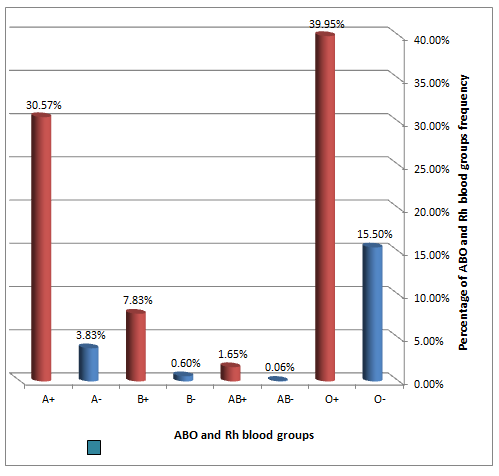
This association between Age and ABO blood groups could be by chance and not true association. Dissimilar finding was noted in study conducted in Tenzania that revealed age group 18-29 years was the commonest. Regarding to distribution of ABO blood group and RH blood group, the present study demonstrated that, the most prevalent ABO/ RhD blood group in population study was blood group O+ has the highest frequency 39.51% (1939) followed by A+ 30.75% (1484), O negative 15.5% (752), B+ 7.83% (380), AB+ 1.65% (80), A negative 3.83% (186), B negative 0.6% (29) and AB negative 0.062% (3). The overall blood groups frequencies of ABO and RH blood groups were O+>A+>O- >B+>A->AB+>B->AB.
The distribution of the RH blood group ABO blood group was significant different (P = 0.00). There is similarity to some extent if the results of the current study are compared with other studies, such as studies conducted in Saudi which showed that the ABO/RhD blood group distribution was O+>A+>B+>AB+>O->A->B->AB-.(20, 28) and in Libyia was O+>A+ >B+ >O->A->AB+>B-> AB- (13) and also in Thailand and Australia, in which frequency was O+>B+>A+>AB+>O->B- >A->AB- and O+>A+>B+>O->A->AB+>B->AB- respectively [15, 27]. In other side, study carried out in Switzerland which stated that ABO/RhD blood group distribution was A+>O+>B+>A->O->AB+>B->AB- (25). As well as study in India revealed that frequency of ABO/RhD blood group was B+>A+ O+ >AB+ >A- >AB-> O-> B- (6).
Conclusions
This study highlights the distribution of blood group in study area which is very helpful in the effective management of the blood bank inventory and improves blood transfusion practice. It will help transfusion services planning for future health challenge [28].
Acknowledgements
Authors would like to thank Dr. Mohammed Khoshfah, Miss Ahalam Alsaber and Wheeb Alshikh for their appreciated participation.
Conflicts of Interest
The authors declare no conflicts of interest regarding the publication of this work.
References
-
Sharma DS, Sharma DDC, Rai DS, Arya DA, Jain DR, et al. (2020) Prevalence of ABO RhD and other clinically significant Blood Group Antigens among blood donors at tertiary care center Gwalior. Bali Medical Journal 9(2): 437-443.
-
Suresh B, Sreedhar BP, Chandra MP, Arun R, Jothibai DS (2015) Distribution of ABO and rhesus D blood group antigens among blood donors at a tertiary care teaching hospital blood bank in south India. J Clin Sci Res 4: 129- 135.
-
Debele GJ, Fita FU, Tibebu M (2023) Prevalence of ABO and Rh Blood Group Among Volunteer Blood Donors at the Blood and Tissue Bank Service in Addis Ababa Ethiopia. J Blood Med 14: 19-24.
-
Belali TM (2022) Distribution of ABO and Rhesus Types in the Northern Asir Region in Saudi Arabia. J Blood Med 13: 643-648.
-
Andalibi M, Dehnavi Z, Afshari A, Tayefi M, Esmaeili H, et al. (2020) Prevalence of ABO and Rh blood groups and their association with demographic and anthropometric factors in an Iranian population Mashad study. East Mediterr Health J 26(8): 916-922.
-
Puri PL, Kochhar AK (2016) Distribution of ABO Blood Groups and RH D factor in Haryana**.** Int J Med Res Rev 4(6): 982-986.
-
Ahmed M, Memon A, Iqbal K (2019) Distribution pattern of ABO and Rhesus blood groups among different ethnic population of Karachi. J Pak Med Assoc 69(10): 1474- 1478.
-
Vuhahula EAM, Yahaya J, Morgan ED, Othieno E, Mollel E, et al. (2023) Frequency and distribution of ABO and Rh blood group systems among blood donors at the Northern Zone Blood Transfusion Center in Kilimanjaro Tanzania a retrospective cross sectional study. BMJ Open 13(2): e068984.
-
Sakal IDA, Emberesh RA, Alhamoudi AA, Habhab ST, Waddan MA (2019) Prevalence and Distribution of ABO and Rh D Factor among Blood Donors in Sabratha Libya. The Saudi Journal of Life Sciences 4(9): 283-286.
-
Chandra T, Gupta A (2012) Prevalence of ABO and Rhesus Blood Groups in Northern India. J Blood Disorders Transf 3: 132.
-
Umer K, Muhammad WB, Raima R, Rizwan AK (2014) Frequency of ABO And Rh D Blood Groups Among Blood Donors In Lahore Pakistan. Int J Adv Biol Biom Res 2(3): 597-600.
-
Raja KA, Dobariya GH, Unagar CA, Pandya AN, Patel JN, et al. (2016) Frequency and distribution of ABO and Rh blood groups among blood donors in tertiary care hospital of South Gujarat India. Int J Res Med Sci 4(12): 5377-5381.
-
Othman MS, Alfalos AM, Jaber ZM, Alasga AM, Alati R (2023) Prevalence of ABO and RhD Blood Groups in Almergeb Provence Libya. Journal of Survey in Fisheries Sciences 10(3S): 2555-2559.
-
Maatoghi JT, Paridar M, Shoushtari MM, Kiani B, Nori B, et al. (2016) Distribution of ABO blood groups and rhesus factor in a Large Scale Study of different cities and ethnicities in Khuzestan province, Iran. The Egyptian Journal of Medical Human Genetics 17(1): 105-109.
-
Anuphun T, Srichai S, Sudwilia Y, Jenwitheesuk K, Phunikhom K (2018) ABO and Rhesus Blood Group Distribution in Blood Donors, Blood Transfusion Centre Faculty of Medicine Khon Kaen University Thailand. Srinagarind Med J 33(5).
-
Nahari AA (2017) Genetic Variation of ABO and RhD Blood Groups Polymorphism among Marginalized People and Tribesmen in Sana’a Capital of Yemen. Hebron University Research Journal A Natural Sciences 7(1): 1-15.
-
Samer B, Al HM, Al MA, Al SM, Othman A, et al. (2023) The association between ABO/RH blood groups and type 2 diabetes mellitus in Dhamar Governorate Yemen. Rom J Diabetes Nutr Metab Dis 30(2): 182-187.
-
Al RAZ, Ali AM, Saif AH, Sabah AM, Michael S, et al. (2019) Prevalence of Red Blood Cell Major Blood Blood Group Antigens and Phenotypes among Omani Blood Donors. Oman Medical Journal 34(6): 496-503 .
-
Tareg MB (2022) Distribution of ABO and Rhesus Types in the Northern Asir Region in Saudi Arabia. Journal of Blood Medicine 13: 643-648.
-
Bashawri LA, Al MAA, Ahmad MS, Ahmed MA (2001) Frequency of ABO blood groups in the Eastern region of Saudi Arabia. Saudi Med J 22 (11): 1008-1012.
-
Ola J, Jeremia JP, Ernest ON, Alex M, Elichilia RS (2017) ABO and Rhesus blood group distribution and frequency among blood donors at Kilimanjaro Christian Medical Center Moshi Tanzania. BMC Res Notes 10(1): 738.
-
Esref A, Ihsan S, Serhat S (2019) ABO and Rh blood groups frequency in men women and neonates in Diyarbakir province. Annals of Medical Research 26(12): 2876-2880.
-
Abdelmonem M, Fyala A, Boraik A, Shedid M, Mohamed AH, et al. (2019) Distribution of Blood Types and ABO Gene Frequencies in Egypt. Am J Clin Pathol 152(1): 151- 155.
-
Jue L, Shikun Z, Qiaomei W, Haiping S, Yiping Z, et al. (2017) Frequencies and ethnic distribution of ABO and RhD blood groups in China a population based cross sectional study. BMJ Open 7: e018476.
-
Volken T, Crawford RJ, Amar S, Mosimann E, Tschaggelar A, et al. (2017) Blood Group Distribution in Switzerland a Historical Comparison. Transfus Med Hemother 44(4): 210-216.
-
Hamed CT, Bollahi MA, Abdelhamid I, Mahmoud MM, Habti N, et al. (2012) Frequencies and Ethnic Distribution of ABO and Rh(D) Blood Groups in Mauritania Results of First Nationwide Study. International Journal of Immunogenetics 39(2): 151-154.
-
Rena H, Natalie W, David OI (2022) The distribution of ABO RhD blood groups in Australia based on blood donor and blood sample pathology data. Med J Aust 216(6): 291-295.
-
Alateeq FA, Aldugieman TZ, Al RYDA, Alsogair ARAA, Alharbi SH, et al. (2018) The Patterns of Blood Groups and Its Association with Blood Donation in Saudi Arabia. Open Journal of Preventive Medicine 8: 291-300.
- Potential Medicinal Herbs and Secondary Metabolites in Combating Corona Virus
- Monkeypox and its Clinical Implications in Pregnancy
- Pharmacognostical Analysis of the Leaves of Important Nervine Medicinal Plant: Strychnos Nux-Vomica L
- Assessment of Antibacterial Activity of Various Solvent Extracts of Dictyota Dichotoma Against Multidrug Resistant Bacterial Strain
- An Insights of Bioactive Elements on Malignancy: Mechanistic Avenues
- Advances and Future Directions in Pharmacognosy and Chinese Medicine