
Levels Consumption of Sea Rabbit (Dolabella auricularia) Extract Microcapsule Mixed Feed in Goldfish (Carassius auratus)
This research aimed to determine the level of sea rabbit (Dolabella auricularia) extract microcapsule-mixed feed on consumption in goldfish (Carassius auratus). The extraction process was done by maceration method using a single solvent, namely ethyl acetate, while in making microcapsules, 1% of sodium alginate was used as a coating. The animals tested which used were goldfish with their size 7.56 ± 0.3 g and they were kept for 30 days. These animals tested were divided into two groups; the fish group that was fed with 7.7% sea rabbit extract and the control fish group or without sea rabbit extract microcapsules. The foods given was as much as 3% of fish body biomass in the morning and evening with protein ranging from 42-44%. The results showed that the highest absolute growth rate in feeding which had been mixed with sea rabbit extract microcapsules had a value of 3.16 g, food consumption rate was 62.84 g, the efficiency of feeding was as much as 29.49% while the value of conversion ratio of feeding was 3.39. From those results of this research, it can be concluded that the use of feed which had been mixed with sea rabbit extract microcapsules could increase the absolute growth, feed consumption level, the efficiency of feeding so that it was potential to be developed as a supplement in fish feed.
Introduction
Goldfish (Carassius auratus) are from China with their English name as goldfish. Goldfish is one of the most popular ornamental fish and has many fans among ornamental fish cultivators in the world [1]. Disease prevention can be done through quarantine, vaccination and disinfection. Medical treatment is often given using antibiotics. The use of this material has some weakness. Vaccines are only effective against one type of disease, not widely available and the price is quite expensive. The use of antibiotics continuously and inappropriate doses can cause resistance of pathogenic organisms [2]. Environmentally friendly immunostimulants can be used as alternative way of vaccines. Immunostimulants are used in terms of protection against disease. This protection is in the form of an increase defense system in non-specific body. An alternative way that is often used is the use of sea rabbit extract. Sea rabbit extract (Dolabella
auricularia) is antibacterial because it can inhibit the growth of bacterial and can increase immunity in fish [3].
The administration of active ingredients can be given to fish in various methods, one of which is through oral. However, the response and preference of fish is different towards the feed. Some factors that attract fish towards the food provided include color, taste, and nutritional content in the feed.
One of the drawbacks of giving supplements through fish feed is that the active ingredients in it are damaged during the feed manufacturing process and can be washed out in the water. Therefore, feeding requires an active ingredient preparation method that can maintain its content against environmental factors. Microcapsule is one method to overcome this challenge. Microcapsules can shield substances from environmental influences, reduce toxicity, and change the nature or performance of substances [4]. Based on the idea that sea rabbit extract is beneficial for fish health and how to make its preparation in feed acceptable to fish, then this study aims to determine the level of consumption of feed mixed with sea rabbit extract microcapsules in goldfish.
Materials and Methods
Container Preparation
There are 6 aquariums with a size of 35 x 30 x 35 cm which equipped with aerators, hoses and aeration stones. Before using them, those aquariums were washed and cleaned with soap and dried. The cleaned aquarium was then filled with water, then it was aerated for 48 hours.
Tested Fish Adaptation
There were 36 goldfish (C. auratus) with their size 8-12 cm and a weight of ± 8 - 9.37 g/fish. These tested fish were obtained from the Fish Seed Center of Kendari, Southeast Sulawesi, Indonesia. First, the tested fish were acclimatized for 1 week in a fiber bath, which was filled with water in half of the height of the tub. During this acclimatization period, the fish were fed with a frequency of 2 times a day, namely in the morning at 08.00 am and in the afternoon at 16.00 pm, as much as 5% of biomass of the fish body.
Tested Feed Making
In making the tested feed which used in this study was formulated feed. The type of feed formulation was based on the addition of microcapsules of sea rabbit extract in the feed. The food used in this study was the formulation for goldfish (Table 1). The microcapsules of sea rabbit extract were weighed first as much as 7.7 g before they were mixed into 100 g of feed. The feed of goldfish was then mixed with microcapsules of sea rabbit extract and stirred until evenly smooth. The ingredients, namely fish meal, shrimp head flour, soybean flour, wheat flour, corn flour, soft bran flour, sago flour, fish oil, corn oil, and top mix were mixed and stired for 5 minutes (until evenly smooth). The feed was then dried (Figure 1).
| Materials | Tested Feed (% sea rabbit extract) | |
|---|---|---|
| A | B | |
| Microcapsules of sea rabbit extract | 0 | 7.7 |
| Fish Meal | 20 | 20 |
| Prawn Head Flour | 20 | 20 |
| Soy Flour | 22 | 22 |
| Cornstarch | 20 | 14 |
| Fine Bran Flour | 13.5 | 11.8 |
| Sago Flour | 3 | 3 |
| Fish Oil | 0.5 | 0.5 |
| Corn Oil | 0.5 | 0.5 |
| Top Mix | 0.5 | 0.5 |
| Total | 100 | 100 |
Table 1: The Formulation of Raw Materials of Tested Feed in This Research.
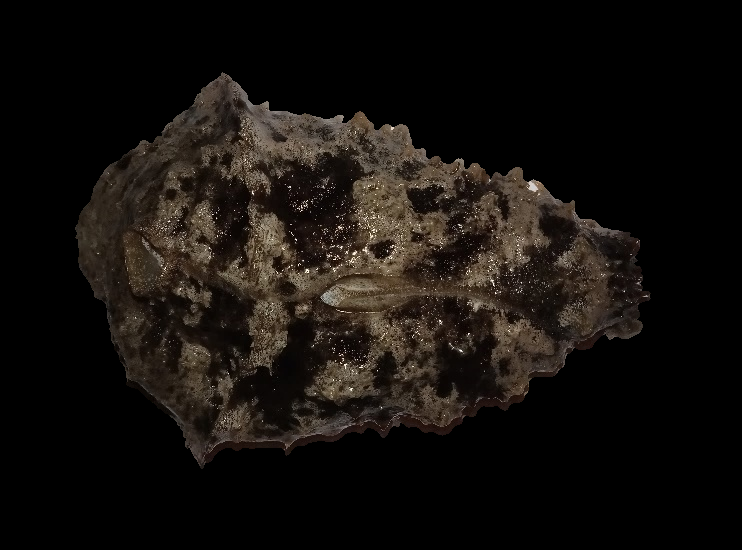
5 cm Figure 1: Morphology of Dolabella auricularia.
Observed Parameters
Average weight growth (g) = final weight - initial weight; Feed intake or feed consumption (g) = Amount of initial feed - Amount of leftover feed; Feed conversion ratio (FCR) = (Amount of feed given/final weight - initial weight); Feed efficiency (%) = (1/FCR) x 100%
Data Analysis
Some data about absolute weight growth, food consumption rate, food conversion ratio and feed utilization efficiency of goldfish were tabulated with the SPSS program through normality test, homogeneity test and then T test to compare the data in the two groups.
Results
Absolute Growth
The data on goldfish showed that feeding which mixed with microcapsules of sea rabbit extract for 30 days gave a significantly different effect (P < 0.05) on the growth of goldfish. The results of the study of the growth value of goldfish were presented in Figure 2 below:
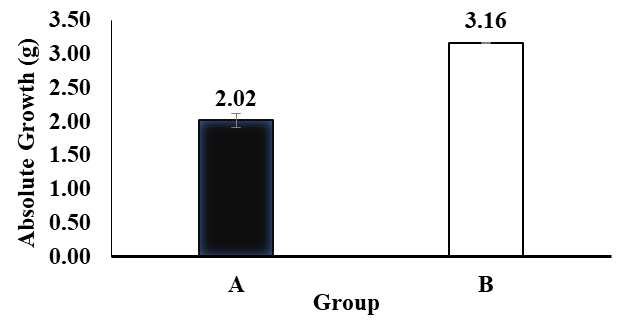
Figure 2 above shows that the highest average value of absolute growth in the feeding treatment with the addition of sea rabbit extract microcapsules was 3.16 g, and the lowest one in the feeding treatment without the addition of sea rabbit extract microcapsules was 2.02 g.
Feed Consumption Rate
The results of the study of the feed consumption rate value of goldfish were presented in Figure 3 below:
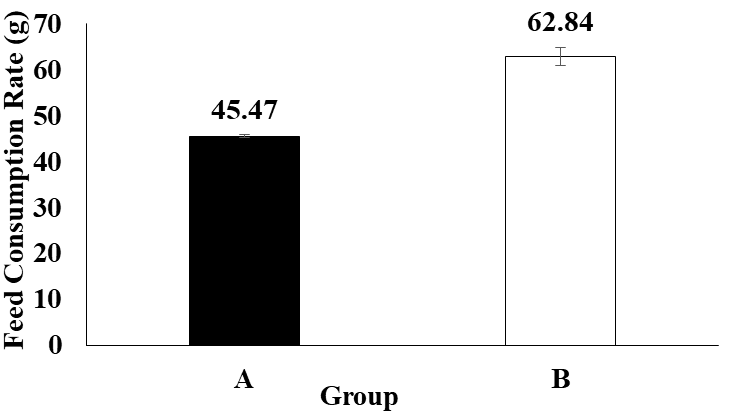
Based on Figure 3 above, it shows that the average value of the highest food consumption in the feeding treatment with the addition of sea rabbit extract microcapsules was 62.84 g while the lowest one in the feeding treatment without the addition of sea rabbit extract microcapsules was 45.47 g. Based on the results of the T test, it showed that the feeding treatment with the addition of microcapsules of sea rabbit extract gave a significantly different effect (P <0.05) on the level of food consumption of goldfish.
Feed Conversion Rate (FCR)
The results of the study of the feed conversion rate value of goldfish were presented in Figure 4 below:
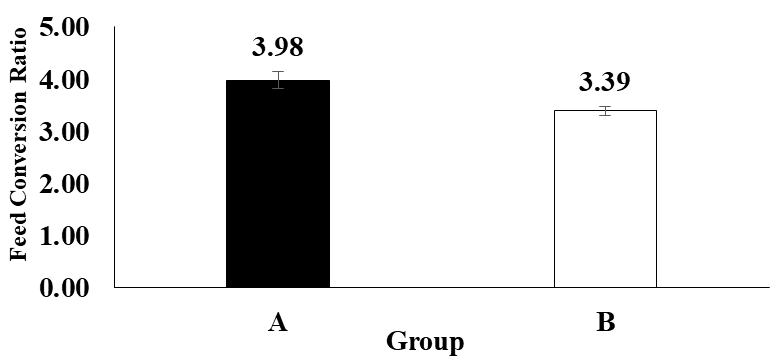
Based on Figure 4 above, it showed that the average value of the highest feed conversion ratio of goldfish in the feeding treatment without the addition of sea rabbit extract microcapsules was 3.98, while the lowest one in the feeding treatment with the addition of sea rabbit extract microcapsules was 3.39. Based on the results of the T test, it showed that the feeding treatment without the addition of microcapsules of sea rabbit extract had a significantly different effect (P<0.05) on the food conversion ratio of goldfish.
Feed Conversion Efficiency
The results of the study of the feed conversion efficiency value of goldfish were presented in Figure 5 below:
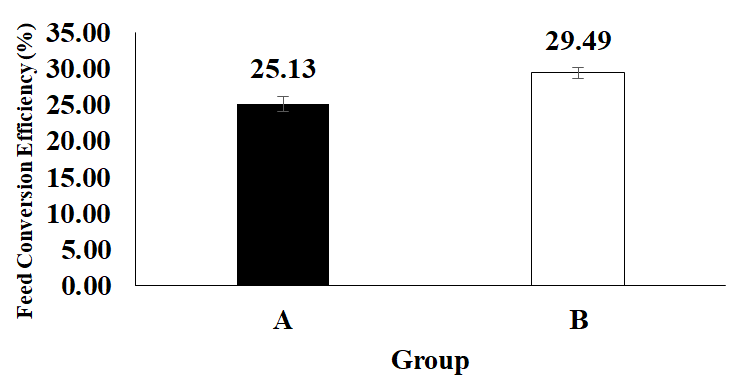
Based on Figure 5 above, it showed that the highest average value of food efficiency in the feeding treatment with the addition of microcapsules which mixed by sea rabbit extract was 29.49%, while the lowest one in the feeding treatment without the addition of microcapsules with sea rabbit extract was 25.13%. Based on the results of the T
test, it showed that the feeding treatment with the addition of microcapsules of sea rabbit extract gave a significantly different effect (P <0.05) on the food efficiency of goldfish.
Discussion
The results of this study especially about the absolute growth on goldfish showed that the administration of microcapsules of sea rabbit extract in the feed gave a significantly different effect between those two treatments. Based on this, it was indicated that the administration of sea rabbit extract microcapsules in the feed could increase the absolute growth of goldfish. The value of absolute growth was predicted to be influenced by the content of sea rabbits. According to the statement of Manullang [5], that sea rabbit extract contained 12.49% protein, essential amino acid, such as arginine 1.61%, leucine 0.90%, valine 0.54%, threonine 0.50%, I-leucine 0.46%, phenylalanine 0.44%, lysine 0.34%, methionine 0.20%, histidine 0.07%, and contains non-essential amino acid, such as glycine 3.02%, glutamic acid 2.78%, aspartate 1.59%, alanine 1.11%, serine 0.95%, tyrosine 0.41%. The amount of protein in the feed was influenced by the amino acid. As a comparison, the addition of local feed with 5% sweet potato leaves powder of feed could provide a specific growth rate of 0.0370 %d for 60 days of rearing goldfish [6].
Meanwhile, giving 2.1% of Spirulina flour, the weight growth of goldfish was 4.33 g which given for 30 days [7]. According to Cowey CB [8], several types of amino acid such as methionine, phenylalanine, threonine (essential amino acid), and tyrosine (non-essential amino acid) are amino acid which needed for the growth and maintenance of fish. Based on the growth rate of sea rabbit extract microcapsules treatment in feeding, it was the better treatment compared to the treatment with given without sea rabbit microcapsules.
Based on the results of observations which had been conducted, it showed that the amount of feed consumption was significantly different between treatments. It was predicted that the quality of feed from the addition of microcapsules of sea rabbit extract had influence towards the protein in order to achieve efficiency and effectiveness of feed utilization. As Suprayudi, et al. [9] stated that palatability or response towards feed was influenced by feed performance condition which included some aspects, like physical properties in the form of shape, color, texture, and size, as well as chemicals that form taste and aroma. According to Håkan Olsén, et al. [10], during feeding, many fish rely on both their olfactory and gustatory senses. It is needed the stimulus included attractants and stimulants in fish feed. An attractant was the attraction of an object (food) so that fish came to and got the food, while stimulants were related to flavors that could stimulate appetite so that fish received it, swallow it, and consumed it.
The high level of feed consumption in the treatment using sea rabbit extract microcapsules was predicted to be influenced by attractant feed factors which stimulated fish by their senses, namely taste, smell, and texture of the feed. The low level of palatability is indicated by how slowly the fish respond to feed. This is in accordance with the statement of Shankar, et al. [11] that the attractants contained in the feed were as a signal to aquatic animals, so that fish could recognize pellets as a food source. According to Manullang B [5] stated that sea rabbit extract contained nine kinds of essential amino acid and 6 kinds of non-essential amino acid, which generally contained relatively high arginine and glycine. The amino acid, such as glycine, proline, taurine and valine provided a more sensitive feeding response in carnivorous fish [12].
The feed conversion ratio in the feed treatment with microcapsules which had been mixed by sea rabbit extract was lower than the treatment without those which were no sea rabbit extract, this indicated good level of feed quality. According to Gumus E, et al. [13] that feeding goldfish the diet including yeast replaced 35% of the fish meal were better FCR than those of fish fed the other diets which has different portion of yeast. The high feed conversion ratio was due to the fact that the nutrients in the feed were not maximally absorbed by the fish’s body and were only wasted through feces so that the growth rate which obtained was relatively low. Management practices, environmental conditions, feed quality, inherent genetic factors, and fish physiological condition all influenced high feed intake in aquaculture [14]. Feed with poor quality means feed with low nutrition and that is easily destroyed or the smell of feed which do not stimulate them, it caused the fish did not want to eat it.
The efficiency results of the feed utilization showed a significantly different effect between those treatments. One of the factors that influenced the value of high feed efficiency was due to the microcapsules content which was with sea rabbit extract in the feed. In addition, the quality and nutritional content of feed containing microcapsules of sea rabbit extract could affect the growth of goldfish. In the research of Souto, et al. [15] it was concluded that in general, fish fed diets containing 3,200 kcal/kg significantly outperformed fish fed 3,600 kcal/kg (P<0.01), indicating higher feed efficiency. A diet of 3,200 kcal/kg appears to be the optimal efficiency level for meeting goldfish requirements for maximum weight gain.
According to Subramanian S [16], the quality of feed and feeding management is important economic criteria for fish farmers. It is critical to feed fish according to their feed consumption level in order to maximize growth rate. The
level of efficiency in the use of food in fish was determined by the growth and amount of feed given. The efficiency of the use of food showed the value of food which could change the increase of weight of fish body. The best efficiency level of food which used was obtained in the treatment with good feed quality, good feed quality brought good results in giving more energy being for their growth so that through giving less feed, it was expected that the growth rate could increase. Most of the energy which was from food actually used for maintenance, the rest was used for activity, growth and reproduction. Improving feed efficiency is critical to lowering aquaculture production costs and achieving aquaculture sustainability [17].
Conclusion
Feeding with the addition of microcapsules with sea rabbit extract gave higher results in their absolute growth (3.16 g), feed consumption level (62.84 g), feed efficiency (29.49%) in goldfish compared to feeding without the addition of microcapsules with sea rabbit extract. Meanwhile, the feed conversion ratio in feeding with the addition of microcapsules of sea rabbit extract was lower (3.39) compared to their feeding without the addition of microcapsules of sea rabbit extract.
Acknowledgment
Thanks to the staffs of Laboratory of Fisheries and Marine Science, Halu Oleo University and Laboratory of Pharmacy, Halu Oleo University, Indonesia for their technical assistance. We also want to thank the reviewers and journal editors for comments and suggestions to improve the manuscript for publication.
References
-
Hossain I, Mohsin A (2021) Native and non-native ornamental aquarium fishes of Bangladesh. IJOTA Indonesian Journal of Tropical Aquatic 4(1): 1-13.
-
Nur I, Fitriani A, Asnani (2009) The Potential of Extract of Leaves and Flowers of Lantana Camara Linn. as an Antibacterial for Catfish (Clarias gariepinus) Infected by Aeromonas hydrophila. Indonesian Aquaculture Journal 4(1): 41-45.
-
Nurhalisa, Nur I, Suryani (2021) Potential extracts of wedge sea hare (Dolabella auricularia) as immunostimulators in Comet Fish (Carassius auratus auratus). Biodiversitas 23(4): 1884-1893.
-
Tomaro-Duchesneau C, Saha S, Malhotra M, Kahouli I, Prakash S (2013) Microencapsulation for the Therapeutic Delivery of Drugs, Live Mammalian and Bacterial Cells, and Other Biopharmaceutics: Current Status and Future Directions. J Pharm (Cairo) 2013: 19.
-
Manullang B (2016) Sea Rabbit Extract Activity (Dolabella auricularia) as Glucosidase inhibitor, Red Blood Cell Stabilizer, Antibacterial and Antioxidant. Graduate School, IPB University, Indonesia.
-
Gurung S, Bohara K, Adhikari R, Bista A, Singh S (2018) Growth Performance and Feeding Efficiency of Goldfish (Carassius auratus) and Red Cap Oranda Fish (Carassius auratus auratus) by Using Different Locally Prepared Feed Mixed with Different Plant Extracts at Paklihawa, Nepal. Journal of the Institute of Agriculture and Animal Science 35(1): 277-284.
-
Mbarep MR, Anggraini IY, Mutiara D (2019) Level of Growth and Brightness Comet (Carassius auratus) Color with Additional Concentration Flour Spirulina sp on Feed. Jurnal Ilmu-ilmu Perikanan dan Budidaya Perairan 14(1): 37-44.
-
Cowey CB (1999) Amino acid requirements of fish: a critical appraisal of present values. Aquaculture 124(1- 4): 1-11.
-
Suprayudi MA, Inara C, Ekasari J, Priyoutomo N, Haga Y, et al. (2014) Preliminary nutritional evaluation of rubber seed and defatted rubber seed meals as plant protein sources for common carp Cyprinus carpio L. juvenile diet. Aquaculture Research 2014: 1-10.
-
Hakan Olsen K, Lundh T (2016) Feeding stimulants in an omnivorous species, crucian carp Carassius carassius (Linnaeus 1758). Aquaculture Reports 4: 66-73.
-
Shankar R, Murthy S, Pavadi P, Thanuja K (2008) Effect of Betaine as a Feed Attractant on Growth, Survival, and Feed Utilization in Fingerlings of the Indian Major Carp Labeo rohita. The Israeli Journal of Aquaculture 60: 95- 99.
-
NRC (2011) Nutrient requirement of fish and shrimp. National Academic Press, Washington DC, USA, pp: 392.
-
Gumus E, Aydin B, Kanyilmaz M (2016) Growth and feed utilization of goldfish (Carassius auratus) fed graded levels of brewers yeast (Saccharomyces cerevisiae). Iranian Journal of Fisheries Sciences 15(3): 1124-1133.
-
Eriegha, OJ, Ekotutu, PA (2017) Factors affecting feed intake in cultured fish species: A review. Animal Research International 14(2): 2697-2709.
-
Souto C, Vinicius, M, De Lemos A (2013) Protein to energy ratios in goldfish (Carassius auratus) diets. Ciência e Agrotecnologia 37(6): 550-558.
-
Subramanian S (2013) Feed intake and oxygen consumption in fish. Thesis. Wageningen University pp: 1-165.
-
Verdal H, Komen H, Quillet E (2017) Improving feed efficiency in fish using selective breeding: A review. Reviews in Aquaculture 10(4): 833-851.
- California Red-Legged Frog and Non-Listed Amphibians Response to Non-Native Fish Removal
- Industrial Standardization of the Bio-OS: Algorithmic Codification of Resilience Engineering Guidelines and Version V8 Architecture
- Climate Variability and the Sustainability of Snail Farming in Nigeria: Past Trends, Present Challenges and Potential Outlook
- The Evaluation of the Surveillance System of Anthrax in Gilgit-Baltistan, Pakistan, 2018
- Natural Decline to Extinction of A New Zealand Rabbit Population
- Mitochondrial Bio-Logistics: Steering Co-Enzyme Q10 and Lycopene Synergies within the Science 4.0 Bio-OS Framework