
From SET Theory to Science 4.0: An AI-Driven Framework for Epigenetic Integrity and Biological Flow Control
The transition to Science 4.0 represents a fundamental paradigm shift: moving from passive observation to the proactive navigation of biological flows. Building upon the Strategic Energy Transfer (SET) Theory and the identification of epigenetic bottlenecks specifically the locking mechanism of the NR3C1 gene this paper demonstrates how Artificial Intelligence (AI) enables the steering of genomic integrity. By modeling living organisms as complex logistical systems, Science 4.0 provides predictive maintenance tools to prevent systemic exhaustion and optimize biological resilience in high-pressure environments
Introduction
Traditional biological science has long been limited to a descriptive approach to pathology. However, as established in previous research (Boblique J., Medwin IZAB-16000667, 2026), biology must be understood as the management of energetic and informational flows.
Chronic stress is not merely a psychological state, but a logistical bottleneck. The locking of the NR3C1 receptor constitutes a critical congestion point that impedes homeostatic regulation. Science 4.0 emerges as the technological response to this crisis, integrating AI to restore system fluidity through strategic piloting.
Methodology: The Pillars of Science 4.0
Science 4.0 employs a multi-layered algorithmic approach to manage biological integrity:
- Bottleneck Identification: Utilization of Deep Learning architectures (CNN/RNN) to detect “weak signals” Perspective preceding epigenetic locking.
- Predictive Genomic Maintenance: Inspired by Industry 4.0, the model calculates the “wear curve” of biological resilience.
- Flow Control: The scientist acts as a Strategic Pilot, adjusting environmental and nutritional variables to maintain SET stability (Strategic, Evolutionary, Tactical).
Mathematical Modeling of Biological Flows
To quantify the Science 4.0 framework, we define the Biological Flow Efficiency (E) as the ratio between useful metabolic energy and the incoming informational load:
out E= in+C Φ Φ
Where Φ represents the flow of energy/information and C is the Congestion Coefficient. In Science 4.0, C is a dynamic stochastic function integrating the state of the NR3C1 gene:
( ) ( ) ( ) 0 C . T t f S k L dt = ∫
- f(S): Environmental stress function (input signal).
- k(L): DNA methylation rate (degree of NR3C1 locking).
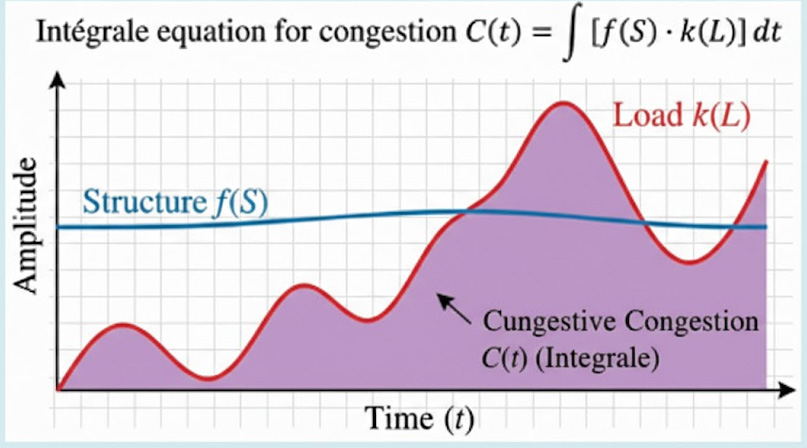
As illustrated in Figure 1 (Biological Resilience Congestion Model), cumulative congestion C(t) represents the area under the curve resulting from the dynamic interaction between the stress structure f(S) and the methylation load k(L). AI intervention aims to minimize C by identifying “reversibility windows” where adjusting in Φ can force the unlocking of L(t), thereby restoring systemic efficiency. The control mechanism for this efficiency, based on bottleneck detection and correction, is represented in the flow model in Figure 2.
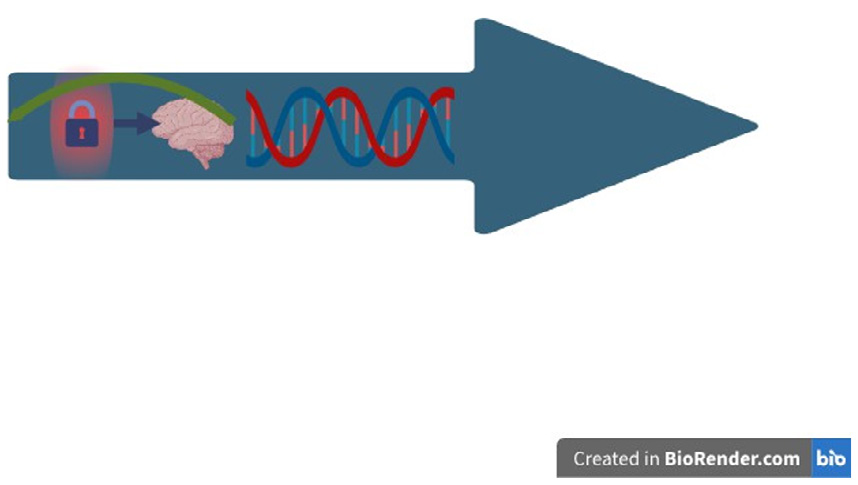
• Flow( ) Φ : Represents the trajectory of energy and information through the biological system. • Lock & Red Zone: Symbolize the logistical bottleneck caused by the locking of the NR3C1 gene. • Feedback Loop (Green): Illustrates the AI intervention acting as a Strategic Pilot to restore system fluidity. • Brain & DNA: Represent the integration of informational flows and genomic integrity at the heart of Human Logistics.
Discussion: Human Logistics
Science 4.0 proposes a new “Human Logistics” where the goal is no longer to cure, but to pilot. • Reversibility: Unlike traditional models, we focus on identifying the exact moment for epigenetic unlocking. • Performance and Ethics: This framework protects individual integrity while maximizing adaptive capacity in complex social environments. • Predictive Nature: Transition from reactive medicine to proactive biological navigation. Conclusion Science 4.0 is the only viable vehicle for navigating the complexity of the 21st century. By transforming SET Theory into an AI-assisted operational model, we open the door to precision biology where uncertainty is reduced through strategic calculation and real-time flow management. Declarations Data Availability: Mathematical models and Phase I simulation parameters are available upon request. Conflict of Interest: None declared. Acknowledgments: Special thanks to the editorial team for their continuous support of disruptive theoretical science and the “Science 4.0” paradigm.
- Industrial Standardization of the Bio-OS: Algorithmic Codification of Resilience Engineering Guidelines and Version V8 Architecture
- Climate Variability and the Sustainability of Snail Farming in Nigeria: Past Trends, Present Challenges and Potential Outlook
- The Evaluation of the Surveillance System of Anthrax in Gilgit-Baltistan, Pakistan, 2018
- Natural Decline to Extinction of A New Zealand Rabbit Population
- Mitochondrial Bio-Logistics: Steering Co-Enzyme Q10 and Lycopene Synergies within the Science 4.0 Bio-OS Framework
- Hymenoptera Specimens from the Caño Negro Wetland, of the National Museum Collection, Costa Rica