
First Records of the Caspian Tern Hydroprogne caspia in Lebanon 2021
Caspian Tern Hydroprogne caspia is a monotypic, cosmopolitan species occurring in North America, North Europe, Africa, Madagascar, Asia, Australia, and New Zealand. There are only three European populations of approximately 4,500 breeding pairs along the coasts of the Caspian, Black, and Baltic Seas. It’s the largest of the terns, with a wingspan averaging. It has a body length of 48 - 56 cm, a weight of 570-780 gram and a wing span of 127-140 cm. Its size, stout red bill, and lack of a deeply forked tail distinguishes it from other white terns found in the state. Its black cap, large red bill, and tern-like habit of flying slowly with its bill pointed downward separates it from the gulls. The low harsh call of the Caspian tern sounds similar to karrr or kraa-ah and is given frequently while in flight. The orange feet of immature birds distinguish them from fall-plumaged adults which have black feet. Recently it was recorded for the first time in Lebanon in 15th of September 2021 at Cheikh Zennad, Akkar District, North Lebanon by Michel Sawan.
Mini Review
Caspian Tern Hydroprogne caspia is a monotypic, cosmopolitan species occurring in North America, North Europe, Africa, Madagascar, Asia, Australia, and New Zealand [1, 2]. There are only three European populations of approximately 4,500 breeding pairs along the coasts of the Caspian, Black, and Baltic Seas [3, 4]. It’s the largest of the terns, with a wingspan averaging. It has a body length of 48 - 56 cm, a weight of 570-780 gram and a wing span of 127- 140 cm. Its size, stout red bill, and lack of a deeply forked tail distinguishes it from other white terns found in the state. Its black cap, large red bill, and tern-like habit of flying slowly with its bill pointed downward separates it from the gulls. The low harsh call of the Caspian tern sounds similar to karrr or kraa-ah and is given frequently while in flight. The orange feet of immature birds distinguish them from fall-plumaged adults which have black feet [5].
This species has an extremely large range, and hence does not approach the thresholds for Vulnerable under the range size criterion (extent of occurrence <20,000 km2 combined with a declining or fluctuating range size, habitat extent/quality, or population size and a small number of locations or severe fragmentation). The population trend appears to be increasing, and hence the species does not approach the thresholds for Vulnerable under the population trend criterion (>30% decline over ten years or three generations). The population size is very large, and hence does not approach the thresholds for Vulnerable under the population size criterion (<10,000 mature individuals with a continuing decline estimated to be >10% in ten years or three generations, or with a specified population structure). For these reasons the species is evaluated as Least Concern [6].
Breeding almost worldwide in geographically isolated populations, in Europe Caspian Terns also have distinctly disjunct breeding areas. The larger breeding colonies are concentrated in the north Caspian (the Volga Delta, 3000- 5500 pairs in 1984-1988) and 250-800 pairs along the northern coast of the Black Sea (Heath et al. 2000. Apart from 2-3 small colonies in Turkey (totalling about 300 pairs; [4]), the only other population of importance in Europe
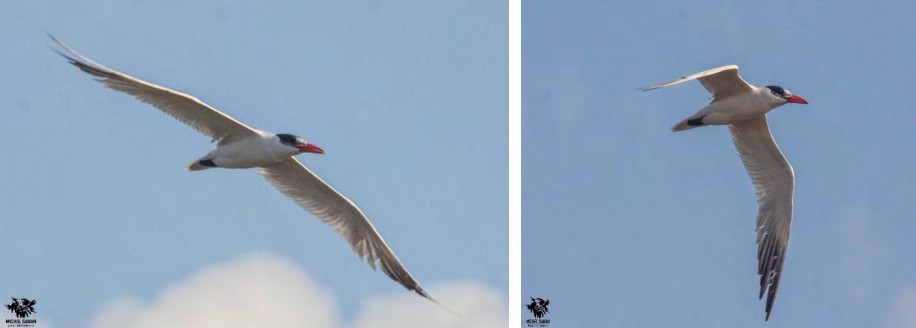
On the 15th of September 2021, and during a birdwatching trip in Cheikh Zennad, Akkar District in North Lebanon, I spotted 2 Terns coming from the north over the sea and passed through the land heading south during the Fall migration. They were flying on a very low altitude and their sound grabbed my attention. I was able to take 12 shots and go back home later to identify the bird. It was reported and confirmed immediately as Caspian Terns, and according to the Lebanese Birds National Checklist, it was a first record for the country. It was announced in the Ornithological Society of the Middle East but not published yet in a paper.
References
-
Del Hoyo J, Collar NJ (2014) HBW and BirdLife International Illustrated Checklist of the Birds of the World, 1. Barcelona, Spain: Lynx Edicions.
-
Gochfeld M, Burger J (1996) Family Sternidae (Terns). In: Del Hoyo J, Elliot A, et al. (Eds.), Handbook of the Birds of the World. Hoatzin to Auks, Barcelona, Spain: Lynx Edicions 3: 624-667. breeds in the Baltic. In Finland, Sweden and Estonia, some 1500-1600 pairs were present in the 1990s and early 2000s. Contrary to most other tern species, Caspian Terns routinely fly overland in Europe and in Africa on their way to and from their wintering quarters. When foraging flies high over water, hovers, then plunges to catch fish below surface. Less often flies low, dips down to catch prey at water’s surface (Figure 1). May steal food from other birds. Its diet consists predominantly of fish 5-25 cm in length also including the eggs and young of other birds, carrion, aquatic invertebrates (e.g. crayfish), flying insects and [7]. [INLINE_FIGURE:1:1]
-
Svensson S, Svensson M, Tjernberg M (1999) Svensk Fågelatlas. Vår Fågelvärld, Sveriges Ornitologiska Förening, Halmstad, pp: 31.
-
Birdlife International (2019). Hydroprogne caspia. The IUCN Red List of Threatened Species 2019: e.T22694524A155509311.
-
Evers DC (1994) Endangered and Threatened Wildlife of Michigan. The Univ. of Mich. Press, Ann Arbor, MI. pp: 160-166.
-
IUCN (2019) The IUCN Red List of Threatened Species. Version 2019-3.
-
Shuford WD, Craig DP (2002) Status Assessment and Conservation Recommendations for the Caspian Tern (Sterna caspia) in North America_._ U.S. Department of the Interior, Fish and Wildlife Service, Portland, OR.
-
Brisson-Curadeau E, Patterson A, Whelan S, Lazarus T, Elliott KH (2017) Tracking cairns: biologging improves the use of seabirds as sentinels of the sea. Frontiers in Marine Science 4: 1-7.
- California Red-Legged Frog and Non-Listed Amphibians Response to Non-Native Fish Removal
- Industrial Standardization of the Bio-OS: Algorithmic Codification of Resilience Engineering Guidelines and Version V8 Architecture
- Climate Variability and the Sustainability of Snail Farming in Nigeria: Past Trends, Present Challenges and Potential Outlook
- The Evaluation of the Surveillance System of Anthrax in Gilgit-Baltistan, Pakistan, 2018
- Natural Decline to Extinction of A New Zealand Rabbit Population
- Mitochondrial Bio-Logistics: Steering Co-Enzyme Q10 and Lycopene Synergies within the Science 4.0 Bio-OS Framework