
Creating the Next Generation Human 2n=44 from Embryonic Stem Cells
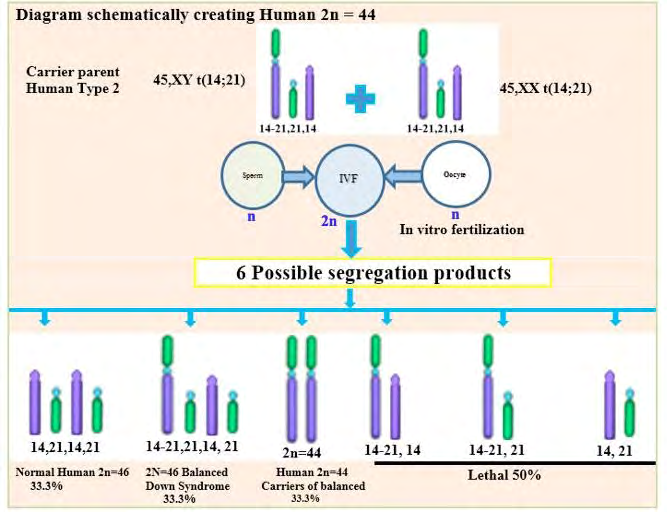
A robertsonian translocation does not always produce harmful results. In fact, many mutations are impartial, and some even reach useful traits. For instance, if balanced carriers are parents 13/21 or 14 /21 or 15/21. This is the start of the new generation of human 2n=44 using In vitro fertilization (IVF). In the chromosomes balanced human 14/21 is relatively prevalent. With the proliferation of the cells, 3-type offspring create Second Human Species as follows: Carriers of balanced parents: 45, XY t (13 /21) X 45 XX t (13/21) → Type 1 - human 2n=44. Carriers of balanced parents: 45, XY t (14 /21) X 45 XX t (14/21) → Type 2 - human 2n=44. Carriers of balanced parents: 45, XY t (15 /21) X 45 XX t (15/21) → Type 3 - human 2n=44. Our study suggested that chromosomal evolution is from a chromosomal fusion, playing a significant role in decreasing the ancestral diploid number to the range of values currently seen.
Introduction
Robertsonian rearrangements between rod chromosomes to produce metacentric & submetacentric biarmed chromosomes are a common mechanism of karyotype evolution and occur spontaneously at an appreciable frequency in mammalian tissue culture [1]. We find important clues to the evolution of species from one generation to the next, of the long-term cell culture. The objective of this study is to achieve the evolution of mammals, and predict the emergence of new species.
Methods
In vitro fertilization is a process of fertilization where an egg is combined with sperm outside the body. The process of IVF involves monitoring and stimulating a woman’s ovulation process, removing an ovum from the woman’s ovaries and letting sperm fertilize them after (Retrieved) in a liquid environment in a laboratory.
After the fertilized egg (zygote) undergoes embryo culture for 3-7 days, it is implanted in the same or another woman’s uterus, with the intention of establishing a successful pregnancy [2, 3].
Using this method helps to achieve the evolution of mammals and reach the origin, and predict the emergence of new species. The evolution of humans and all species first begins with the fusion of two acrocentric chromosomes, and the carriers of balanced parents create changes in other species. Centric fusion of two acrocentric chromosomes results in Robertsonian translocation. Comparison of karyotypes was analyzed in 785 primates, species which are indicates that the species began “by the above method” One of the attached documents, for details see Table 1, therefore in my observation shows similar result.
Result
This method is useful for parents carrier of balanced, because they can create two types normal of children, 2n=46 and 2n=44. “By isolating” a new generation of humans can be obtained. In the past, when there was many of births and no information like today, there were exceptions Human has occurred. May by the genius human of history were 2n=44 chromosomes from one of the 3 types created. Human 2n=46 each cell typically contains 5 pairs Acrocentric chromosomes. Human 2n=44 each cell typically contains 3 pairs Acrocentric chromosomes. It is two acrocentric pairs from 2n=46 are fusioned. Create a Second Human Species.
Comparison of karyotypes performed analysis of 785 species of mammals. With many observe that one of the attached documents in confirms the accuracy of our research in the Table 1 & Figure 1.
| NFa | Lepilemur | Species | author’s descriptions | 2N | A | MS | SY | Ref. |
|---|---|---|---|---|---|---|---|---|
| 38 | The ancestor of the group | Lepilemur septentrionalis | The ancestor of the group | |||||
| andrafiamenensis 1 | 38 | 34 | 2 | MA | -2 | |||
| 38 | Start change Species | one acrocentric pairs | ||||||
| L. septentrionalis 2 | from 2n=38 are fusioned | 37 | 32 | 3 | MA | -2 | ||
| 38 | Carrier parents of balanced Second | |||||||
| Tribe 1 | L. s. ankaranensis 3 | species from 2n=36 | 36 | 30 | 4 | MA | -2 | |
| 38 | Start change Species | one acrocentric pairs from 2n=36 are fusioned | ||||||
| L. septentrionalis 4 | 35 | 28 | 5 | MA | -2 | |||
| 38 | Carrier parents of balanced Second species from 2n=36 | |||||||
| Tribe 2 | L. s. septentrionalis 5 | 34 | 26 | 6 | MA | -2 |
Table 1: Mechanisms of chromosomal changes Species in this group 2n=38 to 2n=34.
NFa = Fundamental arm autosomes; A = Acrocentric chromosomes; MS = metacentric & submetacentric; M = metacentric; S = submetacentric; XY = Sex chromosome. Table 1: Mechanisms of chromosomal changes Species in this group 2n=38 to 2n=34.
References
-
Kamalidehghan F, Kamalidehghan B (2008) Centric Fusions from Primary Cell Culture of Calf Kidney Applied Chromosomal Evolution, Conservation and Speciation in the Bovidae Family pp: 838-846.
-
Kolnicki RL (2012) Mammalian species origin and geographical dispersal patterns correlate with changes in chromosome structure, exemplified in lemurs (Madagascar) and bats (worldwide). pp: 1-165.
-
(2016) Human Genetics.
- Research Progress of Induced Pluripotent Stem Cells and Their Clinical Application Prospects
- Nishan Al-Kamal is the Starting Point of A Feminist Scientist
- Current Concepts and Future Perspectives of Stem Cell Therapy in Peripheral Arterial Disease
- Stem Cell and Oxidative Stress-Inflammation Cycle
- Adipose Derived Mesenchymal Stem Cells Origin, Characteristics and Promises
- Mitochondria Targeted Antioxidants can Improve In Vitro Embryo Production in Buffalo