
Physicochemical and Thermal Characterization of the Consciousness Energy Healing Treated Folic acid
Folic acid is a water-soluble vitamin that acts as a co-factor for DNA replication and required for various intracellular reactions. The scientific study was performed to determine the power of the Trivedi Effect®-Consciousness Energy Healing Treatment with respect to the physicochemical and thermal properties of folic acid by using sophisticated analytical techniques. In this experiment, the test sample folic acid was divided into two parts. One part so-called control sample did not get the Biofield Energy Treatment; while the other part was termed as the Biofield Energy Treated sample received the Consciousness Energy Healing Treatment remotely by a well-known Biofield Energy Healer, Alice Branton. The analysis revealed the increase in particle size values in the treated sample by 2.86% (d10), 6.34% (d50), 17.22% (d90), and 11.30% {D(4,3)}, respectively, along with 4.55% reduction in the specific surface area, compared to the control sample. The PXRD peak intensities and crystallite size the treated folic acid showed significant alteration ranging from - 11.57% to 394.74% and -81.93% to 4.06%, respectively, compared to the control sample. Besides, the treated folic acid showed 32.95% reduction in the average crystallite size than the control sample. The total weight loss of the treated folic acid was significantly reduced by 12.96%, while the residual amount was increased significantly by 111.84%, as compared to the untreated folic acid. The maximum thermal degradation temperature corresponding to 1st, 2nd, 3rd, and 4th peaks were altered by -7.10%, -2.95%, 0.36%, and 3.57%, respectively as compared to the control sample. Besides, the treated sample revealed 9.59% reduction in the melting point along with 24.17% increase in the latent heat of fusion. Moreover, the decomposition temperature and latent heat of decomposition of the treated sample were found to be increased by 3.86% and 42.56%, respectively, as compared to the control sample. The Consciousness Energy Healing Treatment (Trivedi Effect®) might have created some polymorphic form of folic acid that ensure its better appearance, flowability, and thermal stability than the untreated sample. Thus, the use of the Biofield Energy Treated folic acid might be more advantageous for designing the nutraceutical/pharmaceutical formulations.
Introduction
Vitamin B9 (folate) denotes the group of folate, whose structure is derived from folic acid. It is a water-soluble vitamin present in fortified foods and supplements and can be synthetically-produced [1]. The daily requirement of folate would be overcome using plants, such as the dark green leafy vegetables because it is not synthesized de novo by humans. Thus, folic acid requirement meets the dietary intake of foods rich in folic acid or supplements [2]. Folate, as a cofactor is required for DNA replication, various intracellular reactions, and as a substrate for a range of enzymatic reactions included in vitamin metabolism and amino acid synthesis. Besides, folic acid is majorly involved in the synthesis and repair of DNA and RNA, aiding rapid cell division and growth, enhancing the overall brain health, and in age-related hearing loss [3]. Folic acid also plays important role in normal blood formation, homocysteine levels, normal metabolism of the immune system, cell division, maintain normal maternal tissue growth during pregnancy, normal amino acid synthesis, control various psychological functions, reduction of tiredness, and fatigue. Folate deficiency might lead to multiple common health problems and is one of the common vitamin deficiencies, which might result from inadequate intake, poor absorption, abnormal metabolism or increased requirements during pregnant or breastfeeding [4]. In addition, anemia and congenital deformities are very common abnormalities, along with higher risk of developing clinical depression, embryonic defects, altered memory, and brain function, megaloblastic anemia, leuco- and thrombocytopenia, cardiovascular disease, in particular neural tube defects, and malignancies, depression, higher risk of potentially developing allergic diseases, and long-term risk of lower bone density [5]. The daily amount of folate recommended for adults is 400 micrograms (mcg), while women in pregnancy advised to take 400 to 800 mcg of folic acid a day [6]. Various natural sources rich in folic acid are asparagus, baker's yeast, broccoli, Brussels sprouts, cabbage, cauliflower, egg yolk, lentils, lettuce, many fruits such as papaya and kiwi, milk, and many more [7, 8].
Nowadays, the Biofield Energy Treatment is known worldwide due to its significant impact on the physicochemical and thermal properties of various compounds. The subject of Biofield science and healing therapies is considered a frontier in the field of Complementary and Alternative medicine (CAM). It is widely accepted as an alternative integrative approach to promote the wellness and quality of life along with rectifying the root cause of diseases [9, 10, 11]. It is also considered that a human has the ability to harness energy from the universe and can transmit it to any living organisms or non-living objects. The object or recipient always receives energy and responds in a useful way. This process is known as the Biofield Energy Healing Treatment (Trivedi Effect®) [12, 13]. The Consciousness Energy Healing Treatment has been widely reported in scientific literature due to its significant impact on the properties of various organic compounds, pharmaceuticals, metals and ceramics, crops, antimicrobial activity, bone health, and skin health [14, 15, 16, 17, 18, 19, 20, 21, 22, 23, 24, 25, 26, 27, 28, 29]. Thus, this study was also aimed to analyze the impact of the Biofield Energy Healing Treatment (Trivedi Effect®) on the physicochemical properties of folic acid by using sophisticated analytical techniques such as, particle size analysis (PSA), powder X-ray diffraction (PXRD), thermogravimetric analysis (TGA)/ differential thermogravimetric analysis (DTG), and differential scanning calorimetry (DSC).
Materials and Methods
Chemicals and Reagents
The test sample folic acid was purchased from Alfa Aesar along with other chemicals for the experiments were of analytical grade and available in India.
Consciousness Energy Healing Treatment Strategies
The test sample folic acid was divided into two equal parts. One part so-called the control sample did not receive the Biofield Energy Treatment. But, the control sample was treated with a “sham” healer for comparison purpose. The “sham” healer did not have any knowledge about the Biofield Energy Treatment. However, the other part of the sample was termed as the Biofield Energy Treated folic acid received the Biofield Energy Healing Treatment remotely under standard laboratory conditions for 3 minutes by a well-known Biofield Energy Healer, Alice Branton (USA). After all, the Biofield Energy Treated and control folic acid samples were kept in sealed conditions and characterized using sophisticated analytical techniques.
Characterization
The spectrometric and calorimetric analysis of folic acid was performed. The PSA was performed by the Malvern Mastersizer 2000 (UK) using the wet method [30, 31]. The PXRD analysis of folic acid powder sample was performed with the help of Rigaku MiniFlex-II Desktop X-ray diffractometer (Japan) [32, 33]. The
average size of crystallites was calculated from PXRD data using the Scherrer’s formula (1) G = kλ/βcosθ (1) Where k is the equipment constant, G is the crystallite size in nm, β is the full-width at half maximum, λ is the radiation wavelength, and θ is the Bragg angle [34]. Similarly, the DSC analysis of folic acid was performed with the help of DSC Q200, TA instruments. The TGA/DTG thermograms of folic acid were obtained with the help of TGA Q50 TA instruments [35]. The % change in particle size, specific surface area, crystallite size, peak intensity, melting point, latent heat, the maximum thermal degradation temperature, and weight loss of the Biofield Energy Treated folic acid was calculated compared with the control folic acid using the following equation 2:
The particle size analysis of both the sample of folic acid samples were presented in Table 1. The analysis showed that the particle size distribution of the control sample was observed at d10 = 1.75 μm, d50 = 4.10 μm, d90 = 12.31 μm, and D(4, 3) = 5.75 μm. However, a significant change was observed in the particle size distribution of the Biofield Energy Treated sample as it was found at d10 = 1.80 μm, d50 = 4.36 μm, d90 = 14.43 μm, and D(4, 3) = 6.40 μm. Thus, the analysis revealed that the particle size values at d10, d50, d90, and D(4, 3) in the treated sample were significantly increased by 2.86%, 6.34%, 17.22%, and 11.30%, respectively, compared to the control sample. Parameter d10 (µm) d50 (µm) d90 (µm) D(4,3) (µm) SSA (m2/g) Control 1.75 4.1 12.31 5.75 1.76 Biofield Energy Treated 1.8 4.36 14.43 6.4 1.68 Percent change (%) 2.86 6.34 17.22 11.3 -4.55 [ ]
(2)
Results and Discussion
Particle Size Analysis (PSA)
Powder X-ray Diffraction (PXRD) Analysis
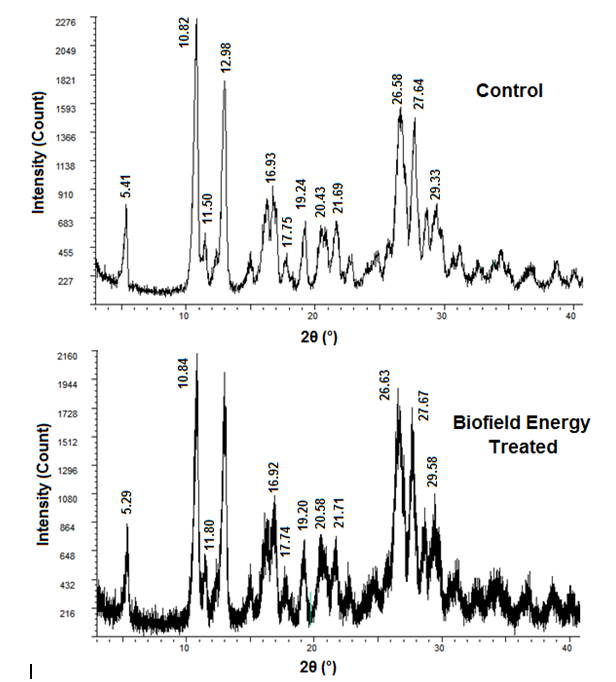
The PXRD diffractograms of the control and treated folic acid samples are shown in Figure 1. Both the samples showed sharp and intense peaks in their diffractograms, which indicated their crystalline nature. The calculation of the crystallite sizes was done using Scherer equation (Table 2) for both the samples across various planes.
| Bragg angle (°2) | Intensity (cps) | Crystallite size (G, nm) | ||||||||||||||||||||||||
|---|---|---|---|---|---|---|---|---|---|---|---|---|---|---|---|---|---|---|---|---|---|---|---|---|---|---|
| Entry No. | ||||||||||||||||||||||||||
| Control | Treated | Control | Treated | % change | Control | Treated | % change | |||||||||||||||||||
| 1 | 5.41 | 5.29 | 141 | 342 | 142.55 | 249 | 45 | -81.93 | ||||||||||||||||||
| 2 | 10.82 | 10.84 | 553 | 489 | -11.57 | 214 | 199 | -7.01 | ||||||||||||||||||
| 3 | 11.50 | 11.80 | 147 | 262 | 78.23 | 139 | 34 | -75.54 | ||||||||||||||||||
| 4 | 16.93 | 16.92 | 289 | 470 | 62.63 | 140 | 84 | -40.00 | ||||||||||||||||||
| 5 | 17.75 | 17.74 | 30 | 59 | 96.67 | 325 | 194 | -40.31 | ||||||||||||||||||
| 6 | 19.24 | 19.20 | 100 | 117 | 17.00 | 274 | 229 | -16.42 | ||||||||||||||||||
| 7 | 20.43 | 20.58 | 230 | 228 | -0.87 | 124 | 116 | -6.45 | ||||||||||||||||||
| 8 | 21.69 | 21.71 | 149 | 136 | -8.72 | 211 | 187 | -11.37 | ||||||||||||||||||
| 9 | 26.58 | 26.63 | 603 | 820 | 35.99 | 118 | 111 | -5.93 | ||||||||||||||||||
| 10 | 27.64 | 27.67 | 315 | 352 | 11.75 | 197 | 205 | 4.06 | ||||||||||||||||||
| 11 | 29.33 | 29.58 | 133 | 658 | 394.74 | 176 | 49 | -72.16 |
Table 1: PXRD Data for the Control and Treated Folic Acid.
The analysis showed that the Bragg’s angles of the characteristic peaks of the Biofield Energy Treated folic acid sample were significantly altered as compared to the control sample. Moreover, the peak intensities corresponding to various characteristic peaks of the Biofield Energy Treated sample also showed significant changes ranging from -11.57% to 394.74% in comparison to the control sample. Similarly, the crystallite sizes of the Biofield Energy Treated folic acid sample corresponding to most of the peaks were found to be decreased ranging from 5.93% to 81.93%; however, the crystallite size corresponding to 2θ = 27.6º was increased by 4.06%, as compared to the control sample. On the other hand, the average crystallite size of the Biofield Energy Treated sample (197.0 nm) was also observed to be significantly reduced by 32.95% as compared to the control sample (132.09 nm). Several kinds of literature reported that it might be possible to alter the crystalline structure and crystal morphology of the compounds with the help of the Biofield Energy Treatment, which through the process of altering the peak intensities and crystallite sizes, might form a new polymorph of the compound [38, 39]. Hence, the overall analysis indicated that the significant alterations in the peak intensities and crystallite size of the Biofield Energy Treated folic acid may occur due to the formation of a new polymorph of the compound, which may help in improving its drug profile as compared to the untreated sample.
Thermal Gravimetric Analysis (TGA)/ Differential Thermogravimetric Analysis (DTG)
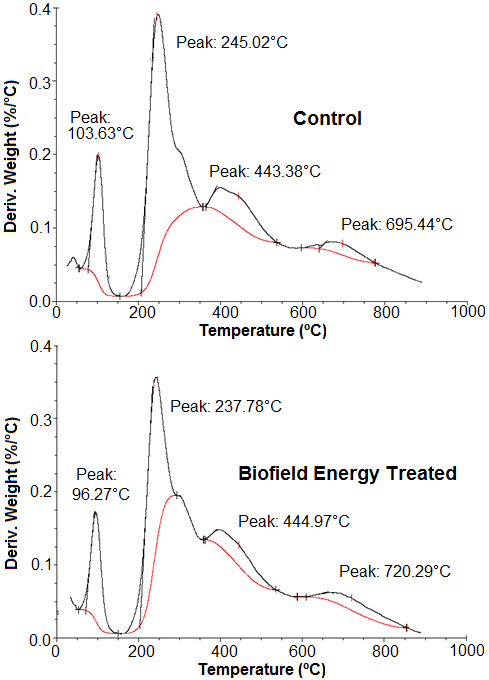
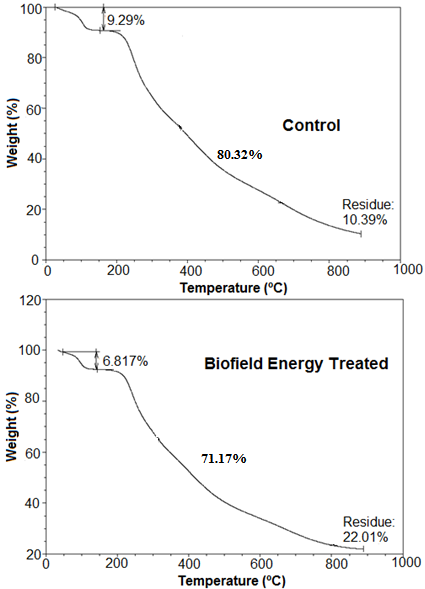
The thermal stability profile of the control and treated folic acid samples were analysed with the help of the TGA/DTG technique. The literature reported the thermal behaviour of the folic acid, according to which, at around 180°C, the “Glu” moiety first broke away. Further, following the heating process, the pterin and PABA degradation takes place in an overlapping manner. Later on, the compound started losing the amide and acid functionalities at 195°C, and as the temperature reached above 200°C, the degradation converted the crystalline form of folic acid into the amorphous one [40]. The TGA thermograms of both the samples, i.e., control and Biofield Energy Treated folic acid (Figure 2) revealed that the thermal degradation took place in two steps and the degradation temperature corresponding to those steps were similar as reported in the literature. The further analysis showed that the weight loss of the Biofield Energy Treated folic acid in the 1st step of degradation was reduced by 26.62% as compared to the control sample. Although the 2nd step showed a slight increase (11.39%) in weight loss, however, the total weight loss of the treated sample during the sample degradation was also observed to be reduced by 12.96% as compared to the untreated sample. Besides, the residue amount of the treated sample was significantly increased by 111.84% (Table 3) as compared to the control sample. It indicated that the thermal degradation of the Biofield Energy Treated folic acid sample was significantly reduced as compared to the control sample.
Besides, the DTG thermograms of both the control and Biofield Energy Treated samples (Figure 3) showed four peaks. The maximum degradation temperature (Tmax) corresponding to 1st and the 2nd peak was observed to be reduced by 7.10% and 2.95%, respectively in the treated sample as compared to the control sample. However, the Tmax corresponding to 3rd and the 4th peak of the treated sample was found to be increased by 0.36% and 3.57%, respectively, as compared to the control sample. It indicated that the thermal degradation temperature of the treated sample was improved at a higher temperature range. Overall, the TGA/DTG studies showed that the thermal stability profile of the Biofield Energy Treated folic acid sample was improved as compared with the untreated sample.
| TGA; Weight loss (%) | DTG; T (°C) max | |||||||||||||||||||||||||
|---|---|---|---|---|---|---|---|---|---|---|---|---|---|---|---|---|---|---|---|---|---|---|---|---|---|---|
| Sample | ||||||||||||||||||||||||||
| 1st step | 2nd step | Total | Residue % | Peak 1 | Peak 2 | Peak 3 | Peak 4 | |||||||||||||||||||
| Control | 9.29 | 80.32 | 89.61 | 10.39 | 103.63 | 245.02 | 443.38 | 695.44 | ||||||||||||||||||
| Biofield Energy Treated | 6.817 | 71.17 | 77.99 | 22.01 | 96.27 | 237.78 | 444.97 | 720.29 | ||||||||||||||||||
| % Change | -26.62 | 11.39 | -12.96 | 111.84 | -7.10 | -2.95 | 0.36 | 3.57 |
Table 2: TGA/DTG Data of the Control and Treated Samples of Folic Acid. Tmax = the temperature at which maximum weight loss takes
Differential Scanning Calorimetry (DSC) Analysis
The DSC technique was used to study the thermal behaviour such as melting, crystallization temperature, etc_._ of the compound [41].
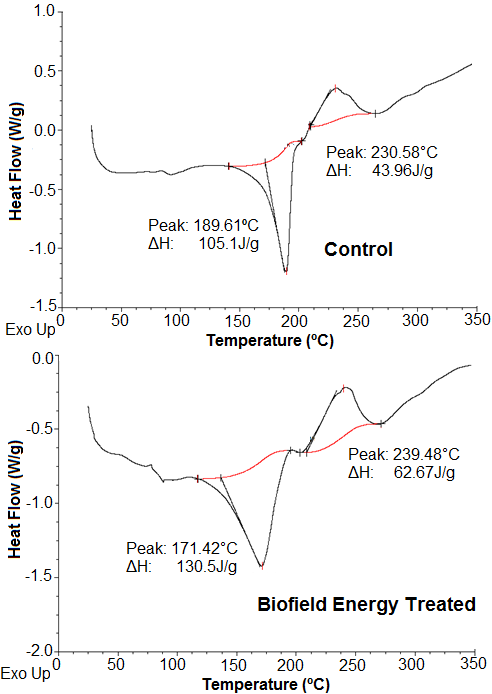
The DSC thermograms of both the samples showed two peaks (Figure 4) and the analysis corresponding to those peaks was given in Table 4. The first peak observed in the thermograms of both the samples was an endothermic peak, which was observed at 189.61°C in the control sample; whereas at 171.42°C in the Biofield Energy Treated sample. Thus, the analysis revealed a significant reduction (9.59%) in the peak temperature of the Biofield Energy Treated sample compared to the control sample (Table 4). Moreover, the latent heat of fusion (ΔHfusion) of the Biofield Energy Treated sample was found to be 130.50 J/g, which was significantly increased by 24.17% compared with the ΔH of the control sample (105.10J/g).
| Peak | Description | Melting Point (°C | ) | ΔH(J/g | ) | ||||||
|---|---|---|---|---|---|---|---|---|---|---|---|
| Peak 1 | Control sample | 189.61 | 105.1 | ||||||||
| Biofield Treated sample | 171.42 | 130.5 | |||||||||
| % Change | -9.59 | 24.17 | |||||||||
| Peak 2 | Control sample | 230.58 | 43.96 | ||||||||
| Biofield Treated sample | 239.48 | 62.67 | |||||||||
| % Change | 3.86 | 42.56 |
Table 3: Comparison of DSC Data between the Control and Biofield Energy Treated Folic Acid. ΔH: Latent heat of fusion/decompositi
The DSC thermograms of both the samples of folic acid also exhibited a broad exothermic inflection at 230.58ºC and 239.48ºC, respectively. Furthermore, the ∆H corresponding to this peak in the control and Biofield Energy Treated sample was observed as 43.96 and 62.67 J/g, respectively. The further analysis suggested that the Biofield Energy Treated sample showed a significant increase in this temperature (3.86%) as well as ∆Hdecomposition (42.56%) as compared to the control sample. The analysis indicated that the Biofield Energy treatment might be responsible for such alterations in the melting temperature and ∆H as it might cause some alterations in the crystallization structure and molecular chains of the treated folic acid as compared to the untreated sample [42].
Conclusions
The overall analysis indicated that the Trivedi Effect®- Consciousness Energy Healing Treatment has a significant effect on the physicochemical properties such as particle size, surface area, Bragg’s angle, crystallite size, peak intensities, and the thermal properties of the folic acid sample. The study revealed an increase in the particle size values in the Biofield Energy Treated sample by 2.86%, 6.34%, 17.22%, and 11.30% at d10, d50, d90, and D(4,3), respectively as compared to the control sample. In addition, the specific surface area of the Biofield Energy Treated folic acid was significantly decreased by 4.55% as compared to the untreated sample. The PXRD peak intensities of the Biofield Energy Treated folic acid showed alteration in the ranging from -11.57% to 394.74% compared to the control sample. Besides, the crystallite sizes corresponding to those peaks of the treated sample were altered ranging from -81.93% to 4.06%, when compared to the untreated sample. Also, the Biofield Energy Treated folic acid sample showed 32.95% reduction in the average crystallite size compared with the control sample. The TGA thermogram showed two- step degradation of both the samples in which, the treated sample showed 26.62% reduction in weight loss in the 1st step; while it was slightly increased by 11.39% in the 2nd step as compared to the control sample. However, the total weight loss of the Biofield Energy Treated sample was reduced by 12.96%; whereas, the residual amount was significantly increased by 111.84% in comparison with the control folic acid sample. It shows that the thermal stability of the treated sample was improved when compared with the untreated folic acid sample. The DTG study of both the samples revealed four peaks in the thermograms. The Tmax corresponding to 1st, 2nd, 3rd, and 4th peaks of the Biofield Energy Treated sample was altered by -7.10%, -2.95%, 0.36%, and 3.57%, respectively as compared to the control sample. Besides, the DSC data of the treated sample revealed 9.59% reduction in the melting point along with 24.17% increase in ΔHfusion. Moreover, the decomposition temperature and ΔHdecomposition of the treated sample were found to be increased by 3.86% and 42.56%, respectively, as compared to the control sample. The overall results concluded that the Trivedi Effect®-Consciousness Energy Healing Treatment imparts significant impact on the crystallite properties of the treated folic acid sample and might create a new polymorphic form of a sample with better appearance, flowability and storage properties along with improved thermal stability compared with the untreated folic acid sample. Hence, the Biofield Energy Treated folic acid may be considered as more suitable for prevention and treatment of various diseases such as embryonic defects, clinical depression, altered memory, and brain function, leuco- and thrombocytopenia, megaloblastic anemia, cardiovascular disease, malignancies, neural tube defects, depression, allergic diseases, and lower bone density, etc.
Acknowledgements
The authors are grateful to Central Leather Research Institute, SIPRA Lab. Ltd., Trivedi Science, Trivedi Global, Inc., Trivedi Testimonials, and Trivedi Master Wellness for their assistance and support during this work.
References
-
Carmel R (2005) Folic Acid, Modern Nutrition in Health and Disease. In: Shils M, et al. (Ed.) Lippincott Williams & Wilkins, Baltimore.
-
Guilland JC, Aimone-Gastin I (2013) Vitamin B9. Rev Prat 63: 1079: 1081-1084.
-
Fenech M (2012) Folate (vitamin B9) and vitamin B12 and their function in the maintenance of nuclear and mitochondrial genome integrity. Mutat Res 733(1-2): 21-33.
-
Greenberg JA, Bell SJ, Guan Y, Yu Y (2011) Folic acid supplementation and pregnancy: More than just neural tube defect prevention. Rev Obstet Gynecol 4(2): 52-59.
-
Allen LH (2008) Causes of vitamin B12 and folate deficiency. Food Nutr Bull 29: S20-34.
-
Scholl TO, Johnson WG (2000) Folic acid: influence on the outcome of pregnancy. Am J Clin Nutr 71(5): 1295S-1303S.
-
Pobocik RS, Richer JJ (2002) Estimated intake and food sources of vitamin A, folate, vitamin C, vitamin E, calcium, iron, and zinc for Guamanian children aged 9 to 12. Pac Health Dialog 9(2): 193-202.
-
Whittaker P, Tufaro PR, Rader JI (2001) Iron and folate in fortified cereals. J Am Coll Nutr 20(3): 247- 254.
-
Warber SL, Cornelio D, Straughn J, Kile G (2004) Biofield energy healing from the inside. J Altern Complement Med 10(6): 1107-1113.
-
Hammerschlag R, Levin M, McCraty R, Bat N, Ives JA, et al. (2015) Biofield physiology: A framework for an emerging discipline. Glob Adv Health Med 4: 35-41.
-
Koithan M (2009) Introducing complementary and alternative therapies. J Nurse Pract 5(1): 18-20.
-
Trivedi MK, Tallapragada RM, Branton A, Trivedi D, Nayak G, et al. (2015) Spectral and thermal properties of biofield energy treated cotton. American Journal of Energy Engineering. 3(6): 86-92.
-
Trivedi MK, Patil S, Shettigar H, Bairwa K, Jana S (2015) Effect of biofield treatment on spectral properties of paracetamol and piroxicam. Chem Sci J 6: 98.
-
Trivedi MK, Branton A, Trivedi D, Nayak G, Singh R, et al. (2015) Characterization of physical, spectral and thermal properties of biofield treated resorcinol. Organic Chem Curr Res 4:146.
-
Trivedi MK, Branton A, Trivedi D, Nayak G, Panda P, et al. (2016) Evaluation of the isotopic abundance ratio in biofield energy treated resorcinol using gas chromatography-mass spectrometry technique. Pharm Anal Acta 7: 481.
-
Trivedi MK, Branton A, Trivedi D, Nayak G, Sethi KK, et al. (2016) Isotopic abundance ratio analysis of biofield energy treated indole using gas chromatography-mass spectrometry. Science Journal of Chemistry 4: 41-48.
-
Trivedi MK, Branton A, Trivedi D, Nayak G, Bairwa K, et al. (2015) Spectroscopic characterization of disodium hydrogen orthophosphate and sodium nitrate after biofield treatment. J Chromatogr Sep Tech 6: 282.
-
Trivedi MK, Branton A, Trivedi D, Shettigar H, Bairwa K, et al. (2015) Fourier transform infrared and ultraviolet-visible spectroscopic characterization of biofield treated salicylic acid and sparfloxacin. Nat Prod Chem Res 3: 186.
-
Trivedi MK, Tallapragada RM, Branton A, Trivedi D, Nayak G, et al. (2015) The potential impact of biofield energy treatment on the atomic and physical properties of antimony tin oxide nanopowder. American Journal of Optics and Photonics 3(6): 123- 128.
-
Trivedi MK, Patil S, Tallapragada RM (2013) Effect of biofield treatment on the physical and thermal characteristics of vanadium pentoxide powders. J Material Sci Eng S 11: 001.
-
Trivedi MK, Branton A, Trivedi D, Nayak G, Gangwar M, et al. (2016) Molecular analysis of biofield treated eggplant and watermelon crops. Adv Crop Sci Tech 4(1): 208.
-
Trivedi MK, Branton A, Trivedi D, Nayak G, Mondal SC, et al. (2015) Evaluation of biochemical marker - glutathione and DNA fingerprinting of biofield energy treated Oryza sativa. American Journal of BioScience 3(6): 243-248.
-
Trivedi MK, Patil S, Shettigar H, Mondal SC, Jana S (2015) Evaluation of biofield modality on viral load of Hepatitis B and C viruses. J Antivir Antiretrovir 7(3): 083-088.
-
Trivedi MK, Branton A, Trivedi D, Nayak G, Charan S, et al. (2015) Phenotyping and 16S rDNA analysis after biofield treatment on _Citrobacter braakii_: A urinary pathogen. J Clin Med Genom 3: 129.
-
Trivedi MK, Patil S, Shettigar H, Mondal SC, Jana S (2015) An impact of biofield treatment: Antimycobacterial susceptibility potential using BACTEC 460/MGIT-TB System. Mycobact Dis 5: 189.
-
Koster DA, Trivedi MK, Branton A, Trivedi D, Nayak G, et al. (2018) Evaluation of biofield energy treated vitamin D3 on bone health parameters in human bone osteosarcoma cells (MG-63). Biochemistry and Molecular Biology 3: 6-14.
-
Ansari SA, Trivedi MK, Branton A, Trivedi D, Nayak G, et al. (2018) _In vitro_ effects of biofield energy treated vitamin D3 supplementation on bone formation by osteoblasts cells. Biomedical Sciences 4: 10-17.
-
Smith DM, Trivedi MK, Branton A, Trivedi D, Nayak G, et al. (2017) Skin protective activity of consciousness energy healing treatment based herbomineral formulation. Journal of Food and Nutrition Sciences 5(3): 86-95.
-
Dodon J, Trivedi MK, Branton A, Trivedi D, Nayak G, et al. (2017) The study of biofield energy treatment based herbomineral formulation in skin health and function. American Journal of BioScience. 5: 42-53.
-
Trivedi MK, Sethi KK, Panda P, Jana S (2017) Physicochemical, thermal and spectroscopic characterization of sodium selenate using XRD, PSD, DSC, TGA/DTG, UV-vis, and FT-IR. Marmara Pharmaceutical Journal 21(2): 311-318.
-
Trivedi MK, Sethi KK, Panda P, Jana S (2017) A comprehensive physicochemical, thermal, and spectroscopic characterization of zinc (II) chloride using X‑ ray diffraction, particle size distribution, differential scanning calorimetry, thermo gravimetric analysis/differential thermo gravimetric analysis, ultraviolet‑ visible, and Fourier transform‑ infrared spectroscopy. International Journal of Pharmaceutical Investigation 7(1): 33-40.
-
Zhang T, Paluch K, Scalabrino G, Frankish N, Healy AM, et al. (2015) Molecular structure studies of (1S,2S)-2-benzyl-2,3-dihydro-2-(1Hinden-2-yl)-1H- inden-1-ol. J Mol Struct 1083: 286-299.
-
(1997)Desktop X-ray Diffractometer “MiniFlex+”. The Rigaku Journal 14: 29-36.
-
Langford JI, Wilson AJC (1978) Scherrer after sixty years: A survey and some new results in the determination of crystallite size. J Appl Cryst 11: 102- 113.
-
Trivedi MK, Branton A, Trivedi D, Nayak G, Plikerd WD, et al. (2017) A systematic study of the biofield energy healing treatment on physicochemical, thermal, structural, and behavioral properties of iron sulphate. International Journal of Bioorganic Chemistry. 2(3): 135-145.
-
Hlinak AJ, Kuriyan K, Morris KR, Reklaitis GW, Basu PK (2006) Understanding critical material properties for solid dosage form design. J Pharm Innov 1(1): 12- 17.
-
Morin G, Briens L (2013) The Effect of Lubricants on Powder Flowability for harmaceutical Application. AAPS Pharm Sci Tech 14(3): 1158-1168.
-
Trivedi MK, Branton A, Trivedi D, Nayak G, Plikerd WD, et al. (2017) Evaluation of the physicochemical, spectral, thermal and behavioral properties of sodium selenate: influence of the energy of consciousness healing treatment. American Journal of Quantum Chemistry and Molecular Spectroscopy 1(1): 31-40.
-
Trivedi MK, Branton A, Trivedi D, Nayak G, Lee AC, et al. (2017) Evaluation of the impact of biofield energy healing treatment (the Trivedi Effect®) on the physicochemical, thermal, structural, and behavioural properties of magnesium gluconate. International Journal of Nutrition and Food Sciences. 6(2): 71-82.
-
Gazzali AM, Lobry M, Colombeau L, Acherar S, Azaïs H, et al. (2016) Stability of folic acid under several parameters. Eur J Pharm Sci 93: 419-430.
-
Gill P, Moghadam TT, Ranjbar B (2010) Differential Scanning Calorimetry Techniques: Applications in Biology and Nanoscience. J Biomol Tech 21: 167-193.
-
Zhao Z, Xie M, Li Y, Chen A, Li G, et al. (2015) Formation of curcumin nanoparticles _via_ solution enhanced dispersion by supercritical CO2. Int J Nanomedicine 10: 3171-3181.
- Management of Ear Keloid with Ksharsutra: A Case Study
- Yoga and Global Sustainability: A Holistic Path to One Earth, One Health
- Autoimmune Diseases in Ayurveda: A Narrative Review with Classical and Modern Perspectives
- Management of Cluster Headache Associated with Pituitary Apophysitis by CERT (Chakrasiddh Energy Release Technique): A Case Report on Energy Rebalancing
- Zygophyllum Geslini Coss : Biochemicals and Antioxidant Activity
- Observations of a Beginner Vaidya