
Knowledge and Practice of Nurses on Healthcare Associated Infection
Background: Healthcare associated infections (HCAI) are among the major complications of modern medical therapy. While outbreaks often capture the attention of the media and the public, endemic HCAI represents the majority of infections encountered in healthcare and are associated with significant morbidity, mortality and healthcare costs. Objectives: The objectives of this study were to assess the nurses' level of knowledge on Healthcare Associated Infection, assess the nurses' practice on Healthcare Associated Infection and assess the association between nurses' level of knowledge and their practice on the Healthcare Associated Infection. Method: A cross sectional design study was carried out at King Fahad Hospital of the University in Kingdom of Saudi Arabia including all nurses working in medical, surgical, and emergency department units. Using a self-administered questionnaire for healthcare associated infection designed by (Yunfang Zhou, et al.), engaged the ANOVA test and pearson correlation analysis. Results: According to the results, knowledge and practice of nurses were found to be low; the overall score of HCAI knowledge was 40.20 ± 11.79 while the overall score of HCAI practice was 45.51 ± 11.04. Statistical significance differences were found for studied participants who undergone training programs on infection control their knowledge found to be high. In analyzing the categorical knowledge, it was noticed that nurses scored well in the knowledge of hand hygiene (80.5%) and healthcare workers safety (77%), and the lowest score was in HCAI pathogen identification (36.9%). On the other hand, analysis of categorical practice revealed that nurses were scored well in the HCAI pathogens (86%) and hand hygiene (70.6%), and the lowest score was obtained in sources of HCAI (38%). The Pearson correlation analysis demonstrated a positive relationship between the total knowledge and practice scores, i.e, r = 0.481, which is statistical significant (p <0.001).
Review of Literatures
Infection was traditionally classified to either hospital or community acquired infection depending on where it occurs, this classification is still in used to help in treatment decisions [1, 2]. However, the shift of many healthcare services from traditional inpatient services and hospitals towards different outpatient settings over the last decade was the reason for a new classification of a new group of infection which is healthcare associated infection (HCAI) [2, 3].
Healthcare associated infection defined as a localized or systemic condition resulting from adverse reaction to the presence of infectious agent or its toxins acquired from health care settings that was not incubating or symptomatic at the time of admission to the healthcare facility. It also includes infection acquired by patients in the hospital or facility but appearing after discharge, and occupational infection among staff. Nurses play a vital role in transmitting healthcare associated infection, and their compliance with infection control measures seems to be necessary for preventing and controlling healthcare associated infection.
Nurses' knowledge and practice can contribute to the prevention of healthcare associated infection. Many studies discussed knowledge and practice of nurses on healthcare associated infection by using different methodologies in which some studies found the knowledge and practices of nurses as good and in some studies it was reported as poor. To this end there have been limited studies assessed the knowledge and practice of nurses within the Kingdom of Saudi Arabia therefore the objectives of this study were to assess the nurses' level of knowledge and their practice on healthcare associated infection and the association between them within the Kingdom of Saudi Arabia.
Methodology
The data was analyzed for socio-demographic characteristics of the studied participants, explored the percentage distribution of the knowledge score and total knowledge score, and studied the relationship of total knowledge scores with that of socio demographic variables. Similarly carried out for the studied participants’ practice scores and total practice scores to explore its relationship with the socio-demographic variables. Finally, total scores for the sub-scales were included.
A descriptive cross-sectional design was used in this study. Including all nurses working in the medical and surgical wards and the emergency department of the King Fahad Hospital of the University in the Eastern region of Kingdom of Saudi Arabia. Data was collected using a self- administered questionnaire for healthcare associated infection (HCAI) designed after the United States Centers For Disease Control (USCDC)‘s HCAI concept and precautions [4].
The overall purpose of the questionnaire is to assess knowledge and self-reported practice of nurses. It included 9 questions related to socio-demographic characteristics of nurses, 16 questions covered the knowledge section and 11 questions addressed the practice, in the form of closed-ended (yes or no), multiple- choice single correct answer, multiple-choice multiple correct answers, and matrix questions. The correct answers were taken from the USCDC guideline for isolation precautions 2007. The researcher had modified the questionnaire in which all physicians' related questions, in addition to other six questions were not related to the studies objectives were excluded.
A total of 130 questionnaires were distributed among nurses and collected after 30 minutes by the researcher, but most of the questionnaires were collected the following days from the distribution due to nurses' busy shifts. One questionnaire was excluded due to non- completeness, others either nurses didn‘t return it back to the researcher or were in leave, while the completed ones were 100 questionnaires which is the required sample in the current study. The results were manually entered into an SPSS database (Statistical Package for the Social Sciences) version 22.
Results
| Characteristics | No n= (100) | (%) |
| Age in yrs. | ||
|---|---|---|
| 20< | 45 | 45 |
| 30< | 32 | 32 |
| 40< | 20 | 20 |
| 50 and above | 3 | 3 |
| Mean ± SD = 32±8.1 | ||
| Gender | ||
| Male | 25 | 25 |
| Female | 75 | 75 |
| Nationality | ||
| Saudi | 40 | 40 |
| Non-Saudi | 60 | 60 |
| Type of the ward | ||
| Medical | 16 | 16 |
| Surgical | 32 | 32 |
| ER | 28 | 28 |
| Medical & Surgical | 24 | 24 |
| Educational qualification | ||
|---|---|---|
| Diploma | 6 | 6 |
| Bachelor | 89 | 89 |
| Master | 5 | 5 |
| History of previous infection control training program | ||
| Attended training | 77 | 77 |
| Didn't attend | 23 | 23 |
| 17 | 17 | |
| 24 | 24 | |
| 24 | 24 | |
| 14 | 14 | |
| 21 | 21 | |
Table 2: Distribution of the studied participants according to their socio-demographic characteristics & work-related Table 1: Di
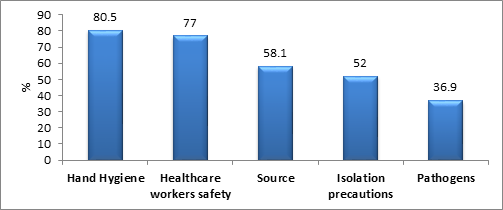
hand hygiene, personal protective equipment and healthcare workers’ safety as shown in Figure 1.
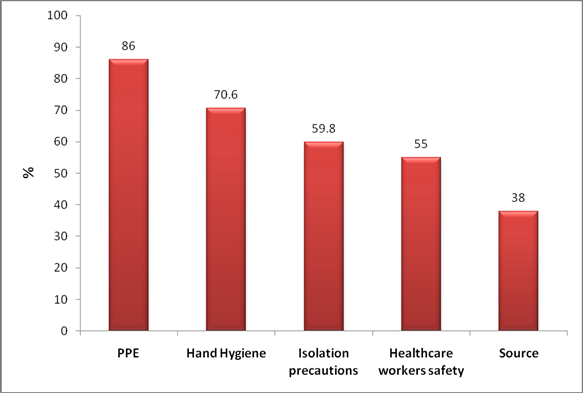
The practice section of the self-administered questionnaire collected self-reported practices on hand hygiene, use of PPE, isolation precautions and healthcare workers safety together with self-practices that control source of infection as shown in Figure 2.
| Test Statistics | |
|---|---|
| Pearson Correlation | 0.481** |
| P value | <0.001 |
| N | 100 |
Table 3: Simple Correlation analysis between total knowledge and practice score of the studied participants.
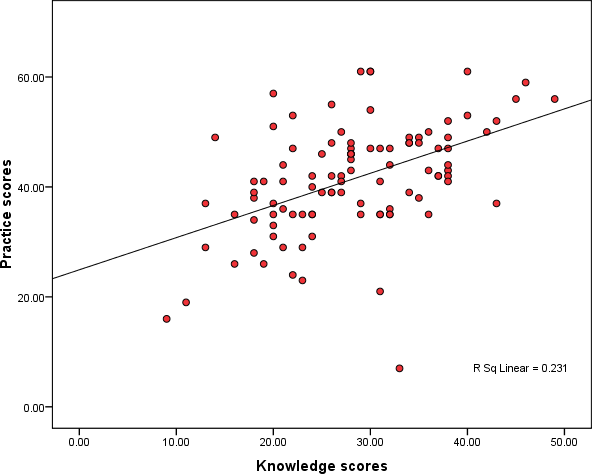
Table 2: Simple Correlation analysis between total knowledge and practice score of the studied participants. **Statistically significant difference In Figure 3 and Table 2, Pearson correlation analysis was carried out, which demonstrated a positive relationship between the total knowledge and practice scores of studied participants(r =0.481, which is statistical significant p=<0.001). It indicates that practices of the studied participants were totally depended on their knowledge, but the level of correlation is only moderate (r2=0.231). So, we conclude that if the knowledge of studied participants improves then the level of practice will also improve automatically.
Discussion
In this present study, a questionnaire was utilized to collect information from a sample of nurses regarding their knowledge and self-reported practices in healthcare associated infection. Despite increased awareness and tighter hospital infection control measures in recent years, our study instrument enabled us to identify obvious safety concerns for patients and healthcare providers attributable to the shortcomings in the studied participants knowledge and practices concerning HCAI.
Results of the present study showed a relatively low overall mean scores in the knowledge as well as overall scores in the practice as shown in Figures 1 & 2. Similar results found in a study carried by Zhou, et al. [4] on nurses, physicians and medical students in which the mean knowledge scores of the clinicians were unexpectedly lower than that of the students(43.48±9.9 for nurses and 40.89±11.4 for physicians vs.52.54±0.45 for students) using the same questionnaire of our study. This is in contrast to the results from an Italian study in which the participants' knowledge concerning the various aspects of HCAI was generally high and consistent with current scientific evidence [5]. This data is in line with the reviewed literatures of Taffurelli, et al. [6] in which the high score obtained by the participants shows a high awareness of good practice in HCAI management, and Kulkarni, et al. where the participants’ knowledge concerning awareness about hand hygiene, CDC guidelines and HCAI was high (Average 95%) and also regarding infections transmitted and acquired to and from the patients.
In breaking them into categories the followings were noted; exhibited patchy knowledge found as an evident from their high scores in some categorical items, such as hand hygiene and healthcare worker safety but very low scores in knowledge about HCAI pathogens as shown in Figure 1. This result is consistent with those obtained by Zhou, et al. where the participants received high scores in HCWs safety, but very low scores in knowledge about HCAI pathogens.
A finding from a study by Abdraboh, et al. [7] conducted in Jeddah-Kingdom of Saudi Arabia indicated the need for an effective educational intervention and setting the hand hygiene as a priority for patient safety among health care workers as evidenced by the dramatic improvement in hand hygiene knowledge among health care workers immediately following a hospital-wide educational intervention.
A finding by Jose, et al. has shown the knowledge of hand hygiene seemed to be good with 63.3% of 190 healthcare workers having more than 75% score when compared to a similar Indian study where in 74% of the study population, the knowledge was between 50% and 75% of total score [8]. Opposite to results by Sreejith, et al. from nursing and medical students which showed both study groups had moderate knowledge on hand hygiene which considered a positive finding.
The present study revealed a high acceptance practice score by the studied participants on PPE and hand hygiene as indicated by their high scores but less acceptance score in the sources of HCAI as shown in Figure 2. This is in accordance with most studies such as Huang, et al. who noted encouragingly high levels of self- reported hand hygiene practice. The results of a study by Nasirudeen, et al. on the practice of students in Singapore showed that 66.3% of them had a have good practice about hand hygiene.
Kalantarzadehet, et al. who noted the performance of the investigated units was intermediation 75.8% of the nurses regarding hospital infections control. But opposite to Karim, 2012 who reported a poor practice (27.7%) of universal precautions among the participants, and findings from a study by Sarani, et al. showed that most nurses had an average practice (42%) about HAI control. Considering the third objective of the current study in investigating the association between the studied participants’ knowledge and their practices, the correlation analysis showed a positive moderate relationship but statistically significance, in which their practices were totally depended on their knowledge as shown in Figure 3 and Table 2.
The correlation between awareness of good practices and knowledge of the infectious risk was significant. Professionals who have good awareness of hygiene practices also have higher knowledge as shown in Figures 1,3 & 5. This data is in line with the literature in saying that high levels of knowledge predispose higher effectiveness in HCAI prevention [9, 10].
Conclusion
Nurses can prevent infection transferring among the patients of a hospital or other healthcare setting with proper disinfecting the skin, wearing gloves and masks, changing infusion sets, applying prudential measures, proper isolation, using the principles of standard cautions, observing hand hygiene, preventing accidental contact of hand with needle-stick and avoiding the infected respiratory discharges.
Based in the present study findings, it’s concluded that the overall score of HCAI knowledge was 40.20 ± 11.79 while the overall score of HCAI practice was 45.51 ± 11.04 which considered to be low, statistically significant differences found where the studied participants aged 50 and above have scored less knowledge as compared to other age groups, and the knowledge score was observed to be higher for the studied participants who had undergone training programs on infection control, additionally, non-Saudis received high knowledge score than Saudis.
Recommendations
The researcher strongly recommended a periodic infection control program with emphasizing all nurses in all hospital's units to attend. Future studies are recommended to explore the relationship between hand hygiene compliance and its long-term success on decreasing healthcare associated infection rate in different healthcare settings. Staff from different disciplines as well as patient engagement ''as it’s the next step in infection prevention'' and positive role modeling is expressive interventions to support and enhance hand hygiene compliance.
References
-
Cardoso T, Almeida M, Friedman ND, Aragão I, Costa- Pereira A, et al. (2014) Classification of healthcare- associated infection: a systematic review 10 years after the first proposal. BMC Med 12: 40.
-
Vallés J, Alvarez-Lerma F, Palomar M, Blanco A, Escoresca A, Study Group of Infectious Diseases of the Spanish Society of Critical Care Medicine, et al. (2011) Health-care-associated bloodstream infections at admission to the ICU. Chest 139(4): 810-815.
-
Grenier C, Pepin J, Nault V, Howson J, Fournier X, et al. (2011) Impact of guideline-consistent therapy on outcome of patients with healthcare-associated and community-acquired pneumonia. J Antimicrob Chemother 66: 1617-1624.
-
Zhou Y, Zhang D, Chen Y, Zhou S, Pan S, et al. (2014) Healthcare-Associated Infections and Shanghai Clinicians: A Multicenter Cross-Sectional Study 9(8): e105838.
-
Parmeggiani C, Abbate R, Marinelli P, Angelillo IF (2010) Healthcare workers and health care-associated infections: knowledge, attitudes, and behavior in emergency departments in Italy 10: 35.
-
Taffurelli C, Sollami A, Camera C, Federa F, Grandi A, et al. (2017) Healthcare associated infection: good practices, knowledge and the locus of control in healthcare professionals. Acta Biomed 88(3S): 31-36.
-
Abdraboh SM, Milaat W, Ramadan IK, Al- Sayes FM, Bahy KM (2016) Hand Hygiene and Health Care Associated Infection: An Intervention Study, American Journal of Medicine and Medical Sciences 6(1): 7- 15.
- Teaching Cognitive Behavioral Therapy to Graduate Psychiatric Mental Health Nurse Practitioner Students: Utilizing A Mixed Methods Course Evaluation
- The Role of Pharmacogenetic Testing in Clinical Practice: A Path toward more Effective, Personalized and Cost-effective Care
- Implementing Screening with the GAD-7 in an Outpatient Mental Health Setting: A Quality Improvement Project
- Social Media and Health Promotion
- Impact of Covid-19 Pandemic on the Academic Performance and Attitude of Nursing Students towards E-Learning
- A Study to Assess the Knowledge Regarding Ill Effects of Tobacco Consumption on Health among Adolescents in Selected Higher Secondary School in Nadiad City