
Thermal Stability of SR8100/nTiO2 PMNC
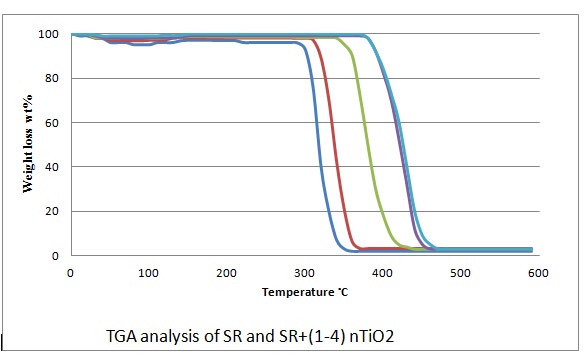
(1-4) weight percent of Nano titania (nTiO2) was dispersed through a SR8100 membrane ultrasonically at 300°C. Morphology of the resulted PMNCs were detected by SEM, which shows a high dispersion for nTiO2 through the SR membranes. TGA of SR8100 /n TiO2 show that thermal stability of SR was also affected, thermal stability of SR has been reach to 400°C when nTiO2 reach (4%).
Introduction
Silicone Rubber (SR) is a robust and highly-resistant elastomer combine silicone polymer and other molecule such as carbon, oxygen and hydrogen. Its construction consistently contains siloxane spine (silicon-oxygen chain) and an organic moiety engaged to the silicon [1]. Thus, the features of silicone rubber can change enormously relying upon the organic groups (methyl, vinyl, phenyl, trifluoropropyl or other group), and chemical compound structure [2]. When contrasted with organic rubber, silicone rubber contain Si-O bond in its synthesis, and consequently, it has an efficient heat resistance, electrical insulation, chemical stability, resistance of abrasion, Weather tolerance and also Ozone reluctance [3]. Silicone rubber able combat strength temperatures from -50°C to 350°C [4, 5, 6, 7]. Yet several researchers work to enhance flammability, and fire retardency of SR, in 2006 an original “room-temperature-vulcanized silicone rubber (RTV-SR)/ organic montmorillonite (OMMT) nanocomposites” were promised by a solution interpolation process [8]. In 2007 Shoulin Fang, et al. [9] product a halogen-free flame resistant SR composites, utilizing “Magnesium Hydroxide Sulfate Hydrate (MHSH)” bristles as flame resistant have been performed by a two-roll mill.
It is obtained which MHSH bristles could successfully ameliorate the flame ret ardency of SR composites. Because of the endothermic retrogression of MHSH bristles escort together with the liberation of water vapor, and the arrangement of fibrous magnesia elaborating as a barrier layer [8, 9]. Since then several research groups have been used several types of ceramic fillers to reinforce mechanical, electrical, and thermal features of (SR). Clay, bentonite, zirconia, and several other ceramic materials were used to enhance mechanical properties, and thermal stability of different types of traditional polymers, among these are silicon rubber [10]. Polymer matrix nano composite based on SR8100, and nano titania shows an outstanding physical and electrical properties [11, 12], main goal of this work were to study the impact of ultrasonically dispersed nano titania on thermal stability of SR8100.
Experimental Part
SR memberane was prepared using “γ-piperazinylpropyl heptamethylcyclotetrasiloxane (D3DPyP)”, was incorporated to deliver high-molecular-weight “poly [(piperazinylpropyl) methylsiloxane-co-dimethylsiloxane] (PyP-PDMS)” by a base “equilibration response with octamethylcyclotetrasiloxane (D4)”. At that point, SR was gotten with “PyP-PDMS” as the gum, “oligo[(acryloxypropyl)methylsiloxane-co- dimethylsiloxane] (AP-PDMS)” as the crosslinker, and silica as the filler as in the procedures in (Figure 1) [13]. Nano titania was ultrasonically dispersed through the SR membrane by hot dispersion technique under evacuated and at 300°C.
![Figure 1: Two steps Silicon rubber preparation [13].](/fulltextimages/6018/fig_1.jpeg)
Results and Discussion
Polymer matrix composite based on silicon rubber play a major role in several serious applications. Main disadvantage of silicon rubber (SR) is the lake of its thermal properties comparing to metals, and ceramic materials to solve this problem several additives are used. Ceramic nano fillers is the most important among these fillers due to their high thermal properties, and high chemical resistance to UV radiation. In this research nano titania was added to silicon rubber membrane by ultrasonically dispersion under vacuum at, (Figure 2) shows morphology of the SR-nTiO2 PMNC by SEM. While (Figure 3) shows the embedded nano titania particles in the SR membrane.
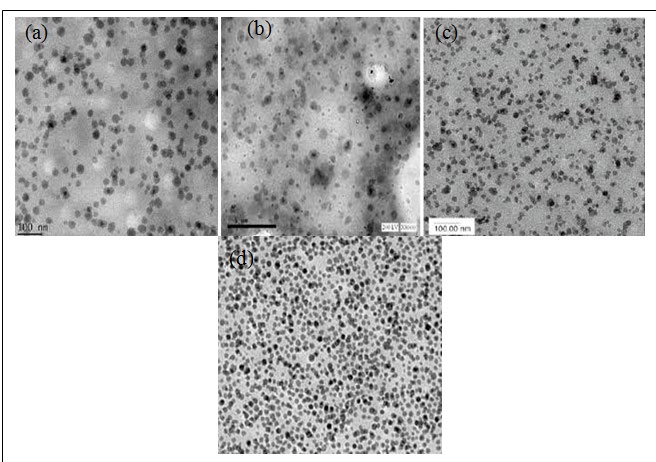
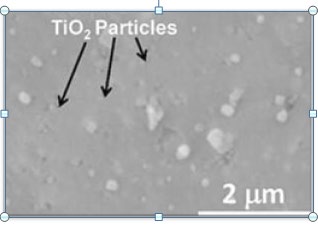
Among everyone the ceramic oxide nano fillers nTiO2 record the most elevated impact on the PMNCs particularly on the electrical features. This amelioration in electrical features watched for nTiO2. Filled polymers may be because of one and / or additionally for the accompanying factors:-
- The huge surface area of nano particles which makes a enormous interaction zone or region of adjusted polymer conduct.
- Alteration in the polymer morphology because of the surfaces of nano particles.
- A decrease in the inward field brought about by the reduction in the size of the particles.
- Alteration in the space charge allocation.
- Scattering mechanism [12].
According to this fact we may understand the effect of nano titania on thermal stability of silicon rubber which are illustrated in (Figure 4). Thermal stability of (4%nTiO2) is up to (400°C). TGA results showed enhancement in thermal stability due to the protection of underlying matrix by the low surface energy associated with the Si–O–Si and the Si-O-Ti present in SR-nTiO2 PMNC. This exceptional thermal stability enhancement is due to the fact that unlike all the other ceramic nano fillers, nTiO2 has two spin quantum dots with energy values very close to the energy of HOMO band, with values -4.21eV, and -7.41eV respectively. These values enable nTiO2 to form very strong bonds with polymers raising their different properties. Thermal stability of SR-nTiO2 PMNC makes it suitable for high-performance aerospace structures.
References
-
Vivek TR, Jayanth SK, Anjana J (2017) Polymer and ceramic nanocomposites for aerospace applications, Applied Nanoscience 7: 519-548.
-
Wang JC, Chen YH, Jin QQ (2006) High Perform Polym 18:325
-
Eung SK, Eun JK, Jea HS (2008) Thermal stability and ablation properties of silicone rubber composites. 110(2): 1263-1270.
-
Jie Zhang, Shengyu Feng, Qingyu Ma (2003) Kinetics of the thermal degradation and thermal stability of conductive silicone rubber filled with conductive carbon black. J Applied Polymer Science 89(6): 1548-1554.
-
Wen‐Ying Zhou, Shu‐Hua Qi, Hong‐Zhen Zhao, Nai‐ Liang Liu (2007) Thermally conductive silicone rubber reinforced with boron nitride particle. Polymer Composites 28(1): 23-28.
-
Ruijie Han, Zhilong Wang, Yinghe Zhang, Kangmin Niu (2019) Thermal stability of CeO2/graphene/phenyl silicone rubber composites. Polymer Testing 75: 277- 283.
-
Lainéa E, Grandidiera JC, Benoita G, Omnèsb B, Destaing F (2019) Effects of sorption and desorption of CO2 on the thermomechanical experimental behavior of HNBR and FKM O-rings - Influence of nanofiller-reinforced rubber. Polymer Testing 75: 298-311.
-
Jincheng W, Yuehui C, Qiqi J (2006) Preparation and Characteristics of a Novel Silicone Rubber Nanocomposite Based on Organophilic Montmorillonite. High Performance Polymers 18(3): 325-340.
-
Shoulin F, Yuan H, Lei S, Jing Z, Qingliang H (2008) Mechanical properties, fire performance and thermal stability of magnesium hydroxide sulfate hydrate whiskers flame retardant silicone rubber, Journal of Materials Science 43: 1057-1062.
-
Sabah Mohammed Mlkat Al-Mutoki, BAK Al-Ghzawi, Ali Abdulabbas Abdullah, Ammar IR AlAmmar, Emad A Jaffar Al-Mulla (2015) Synthesis and characterization of new epoxy/titanium dioxide nanocomposite. Nano Biomed Eng 7(4): 135-138.
-
Sabah Mohammed Mlkat Al-Mutoki, Ahmad Ghanim Wadday, Ali Abdulabbas Abdullah, Baydaa Abdul-Hassan Khalaf Al-Ghzawi, Emad A Jaffar Al-Mulla (2016) Effect of nanoTiO2 dopant on electrical properties of SR8100/ nanoTiO2 PMNC. Results Physics 6: 551-553.
-
Sabah Mohammed Mlkat Al Mutoki, Baydaa Abdul- Hassan Khalaf Al-Ghzawi, Abdul Amohsin, M Samir, Emad A Jaffar Al-Mulla (2017) Raman shift of silicon rubber-nano titania PMNC. Journal Silicate Based & Composite Materials 69(1): 20-23.
-
Linglong F, Lin Z, Shengyu F (2016) Preparation and characterization of silicone rubber cured via catalyst- free aza-Michael reaction. RSC Advances 113: 111648- 111656.
- Solution-Processed Chiral Perovskites for Biomedical Applications
- Nanotechnology in Health Chemistry and Medicine: Current Challenges and Future Directions
- Human Exposure to Micro- and Nanoplastics: Pathways, Toxicity, and Intervention Strategies
- Exosome Nanomedicine for Cancer Therapy
- Micro and Nanoplastics–Plastisphere, Biotoxicity, Impact on Human Health, and Mitigation Strategies
- Process Validation of Cefixime Powder for Suspension Dosage Form, 50 mL