
Theory of Space Quantization (Tsq) Driven Version of the Conventional Theories of Physics, Relativity and Gravitation-A Concise Report
The global scientific community at the moment is awaiting passionately for a ‘Theory of Everything’ (TOE) and the level of expectation of the said community is, i) the Theory has to be very robust and versatile ii) the theory should be in a position to fully explain and connect all the happenings and aspects of the universe and iii) the said TOE has to be a multi block compatibilizing one (is in harmony with the existing theories of physics) and as well has to establish the fact that the theories of physics proposed so far, though have been presented in many different forms but they are inherently being identical by their origins or routes. In this small article it is being reported that the recently discovered ‘ Topological Theory of Quantum gravity (TTQG) or the ‘ Theory of Space Quantization’ (TSQ) has already unified the theories of ‘Newtonian physics or classical physics’, ‘thermodynamics’, ‘quantum mechanics’, ‘cosmological theories’ and the ‘theories of relativities’ under a single umbrella and revealed the dimensionalities of ‘time’ , ‘mass’, ‘space expansion-space inversion’ of the universe , geometries of ‘gravitation’ the ‘singularity’ and the dimensionality of the universe itself and as well presented an ‘Universal Graviton Cycle’ to explain most of the cosmic/astronomical phenomena of the universe in a single frame. It is a first foot step of TSQ or TTQG to ultimately converge to the ‘Theory of Everything’.
Bhattacharya C¹*, Nishant S² and Roy N³
¹Austin Paints & Chemicals Private Limited, India ²CITAP, University of North Carolina, USA ³Biosetup Lifesciences, India to ultimately converge to the ‘Theory of Everything’.
Abbreviations
TSQ: Theory of Space Quantization; TOE: Theory of Everything; TTQG: Topological Theory of Quantum Gravity; TSQ: Theory of Space Quantization; STR: Special Theory of Relativity; E: Energy Quantum; SPD: Spectral Power Radiance.
Introduction
The recently discovered theory of space Quantization, TSQ, also called as Topological Theory of Quantum Gravity (TTQG) has opened up an altogether new horizon in the fields of General physics, General physical chemistry, Cosmology, Astronomy, Quantum Thermodynamics, Quantum mechanics and other streams of science [1, 2, 3, 4, 5, 6, 7, 8, 9]. The conventional Newtonian Physics, the Newton’s Laws of Gravitation, the relativity theories (special and general relativities) all suffer from the problems of ‘incompleteness’ since in all the said theories, no attempt had been made to embody principally the two physical variables ‘time’ and ‘mass’ [10, 11, 12, 13, 14, 15, 16, 17, 18]. Retaining their states of ‘abstractness’ of the said physical variables, the following important propositions have been made:
- A physical variable ‘acceleration’ has been introduced in the Newtonian Physics with its unit or dimension as, distance per second per second. Another physical variable introduced as the product of mass and acceleration, which is force. Although force is very realizable but the dimensionalities of the said of all the said physical variables (time, mass, force and acceleration) were never presented to the readers, students and the researchers.
- Newton’s 3rd law of motion has claimed the ‘action and reactions’ for any occurrence of the universe are equal and opposite to each other. However, although this is a practical reality which we realize from our day to day life experience, the underlying physics of the said day to day life experience or the said physical reality of the universe remained latent forever.
- Newton’s proposition of ‘conservation of momentum’ was a hypothesis too and the physical significance of the said proposition in relation to the quantized ‘space-time’ of the universe were never being explored.
- All the three laws of motion of Newton were presented intuitively but all the three laws are very much ‘disintegrated’ in the sense that the impact of a moving body (being any celestial object of the universe) on the vast space surrounding it and the exchange of ‘space quantum’ between the two (the moving body and the ‘space-time’) was never thought off and hence the said laws are not the ‘integrated’ versions.
- The very famous law of Gravitation of Sir Isaac Newton, which from the day of its proposition and till today is considered to be a one of the wake-up propositions in science, however, the said law was an empirical one and tangibly it was an ‘incomplete’ one too since the dimensionalities or the topologies of the above said physical variables were never disclosed or evaluated till the inception of the theory of space quantization.
- The special theory of relativity (STR) of Sir Albert Einstein proposed a relation between Energy (E) and mass (m), E = mC2, where C is the velocity of light (which was considered to be a constant for any frame of the universe). In the said equation, the biggest disharmony to the ‘time-space’ constitution of the universe is, as per the mathematics of the equation is being concerned, when mass tends to zero energy also tends to be zero. On the contrary, when mass would be tending to infinity, energy too will be infinity. The merging of energy and mass simultaneously towards zero or infinity is fully contradictory to the physical reality of the ‘space-time’ of the universe. The said reality of the ‘space-time’ of the universe is just the opposite. While in a ‘Black-Hole’ the mass is enormous and energy is tiny, in a ‘plasma state’ energy is too high and mass is tiny. As is discussed recently in TSQ at several occasions in the literature, that this is the main ambiguity in the equation , E = mC2 , and when the proper dimension of the physical variables as discovered in TSQ (of time, velocity and mass) is considered , the said equation is transformed to an equation of ‘energy density constancy of the space-time of the universe’ (which is one of the proposed equations of TSQ) and that is, E=3V or (E/V) = 3.0, (where E and V represents each of a space quantum of ‘energy’ and ‘volume’ respectively of TSQ [19, 20, 21, 22, 23, 24, 25, 26, 27, 28, 29, 30].
- The GTR or General Theory of Relativity very intuitively proposed that ‘Gravitation’ is a phenomenon of acceleration (not a force) and there is somewhere existing in the universe a point of ‘Singularity’ and from the said ‘singularity’ only everything of the universe has evolved indeed. While the said propositions are quite different than that of the prediction of TSQ, since the geometries or topologies of neither of the ‘gravitation’, the ‘space- time’, the ‘singularity’ nor their dimensionalities could be presented in the right way in GTR but which TSQ has very success fully revealed.
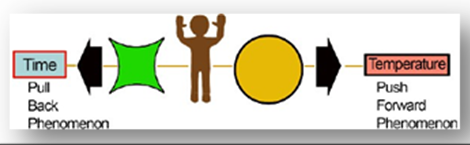
- The consideration of an equilibrium in the universe existing between the ‘Direct Space’ and the ‘Reciprocal Space’ is the main key of TSQ to search out the cosmic mysteries of the universe and one of the prime findings that the ‘time’ (t) is a ‘pull back force’ or an ‘attractive force’ which is always trying to hold back the universe and the ‘ force or temperature’ (T) is a ‘push forward force’ or a ‘dispersive force’ which is trying to always to take ahead the universe. At the state of equilibrium, the above said forces are just balancing each other and becoming the multiplicative inverse to each other such that Tt = 1
- The parameters those had always been kept abstract in science is ‘time’ and ‘temperature’ and TSQ embodies these parameters by straight forward definitions, i) the extent to which energy is pulling back entropy, is ‘time’ and ii) the extent to which energy is pushing forward entropy is ‘force or temperature’. Time = (entropy/ Energy) Force or Temperature = (Energy / entropy)
- The entire global scientific is saluting and will go on saluting forever Sir Isaac Newton and Sir Albert Einstein for their super brains and the highest level of intuitions. However, both of the super great personalities adhered to mathematics to a large extent but kept away the subjects of ‘thermodynamics’ and ‘space quantization’ from the scope of their novel work. As a result of that, the curtain of the cosmological mystery of the universe were definitively stretched to a certain extent but the said curtain could not be fully exposed.
- In this mini article the principal salient points of the new discovery in science in the name of TSQ or TTQG is being presented
Methodology
In this research article the dimensional expressions of the TTQG [31, 32, 33, 34, 35, 36, 37, 38, 39, 40, 41, 42, 43, 44] for the various physical variables like pressure, energy, time, temperature, acceleration, mass, force, etc. have been put in the equations of conventional Newtonian physics, Quantum physics and the theories of relativities and the outcome of the said fitting have been explained by the logic and the philosophies of the Theory of Space Quantization (TSQ) or the Topological Theory of Quantum Gravity (TTQG). The phenomenon of ‘gravitation’ have been newly defined interlinking the same to the ‘molecular attractive forces’ and an overlapping of two numbers of ‘inverse acceleration’ fields.
Results and Discussions
Changing Newtonian Physics
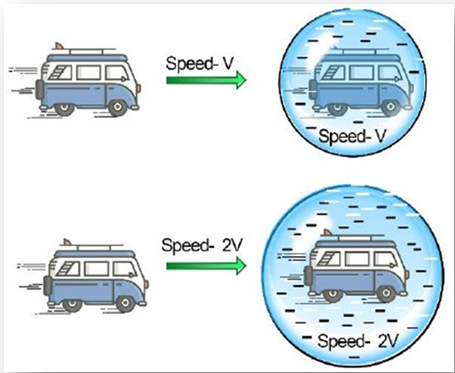
The physical variable, velocity v, of Newtonian Physics converges to a concept of volume [1] (V) in TSQ since distance being a length (L) divided by time [which is being a of inverse force or area (dimension = 1/ L2]. Velocity = v = (Distance/time) = (L/(1/ L2) = L3 = volume = V The topological presentation is given in Figure 1 below:
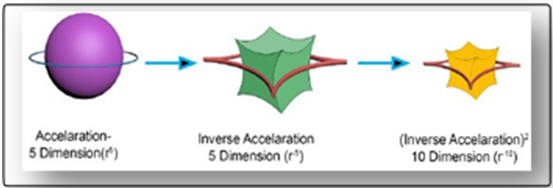
‘Acceleration’ of Newton for the very obvious reasons transforms to a concept of ‘changing volume of the space’ or ‘space expansion’ [1, 2, 3, 4, 5, 6, 7, 8, 9] phenomena and becomes very visible to us in the form of 5- dimensional Cosmic phenomena as is being shown below in Figure 2.
Newton’s laws of motion were totally silent about the dimensionalities of the physical variables like ‘Force’ and ‘mass’ too. TSQ embodies those and the first topological or geometrical proof in the history of science [31, 32, 33, 34, 35, 36, 37, 38, 39, 40, 41, 42, 43, 44] of the Newton’s Second law of motion is given by TSQ is shown in Figure 3 below:
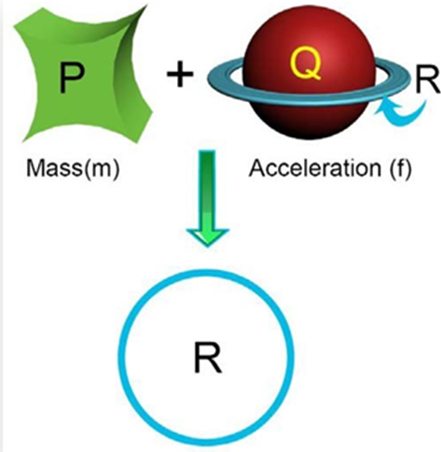
The point to note that the Newton’s 2nd law mathematical formula of expressing ‘Force’ as the hybrid of ‘mass’ and ‘acceleration’ is only a single representation of force out of many to many relations involving the other physical variables of the universe can be fabricated through TSQ or TTQG and which is the foundation of the 1st law of thermodynamics to be shown later in this article. iii) Newton’s 3rd law of motion in the form of ‘To every action there does exist an equal and opposite reaction’ could not depict the reason for the same. However TSQ not only depicted it but the law has been modified in TSQ as ‘To every push forward space quantum of the universe there does exist an inverse (not opposite) pull back space quantum and they are the conjugate pairs only (Table 1) and being multiplicative inverse to each other’ [1, 2, 3, 4, 5, 6, 7, 8, 9]. The most striking example of the existence of such equilibrium of the direct space to the reciprocal space of the universe is Tt = 1.0 as shown below in Figure 4 below and for that only the universe is existing in a state of equilibrium and otherwise which the universe would have busted out or would have disintegrated.
| SI. No. | Type of Anti Graviton | Type of Graviton | |
|---|---|---|---|
| I | Distance Collapsing Graviton or Order Graviton (r-1) | ⇋ | Entropy Graviton, Index of Randomness Volt- age/Potential Difference(r1) |
| 2 | Time Graviton, Viscosity. Magnetic Potential (r-2) | ⇋ | Force, Temperature Charge(r2) |
| 3 | Mass Graviton(r-3) | ⇋ | Energy Graviton, Intensity, Volume(r3) |
| 4 | Inverse Magnetic Field(r-4) | ⇋ | Em Wave Graviton/So Called Photons(r4) |
| 5 | Space Inversion, Inductance, Mass Localisation, Color Gravi- ton of Object in Mass Form (r-5)* | ⇋ | Space Expansioin, Delocalisation Of Mass, Color Graviton in Em Wave Form(r5) |
| 6 | Condensed State Mass Graviton or Second Degree Mass Graviton(r-6) | ⇋ | 2nd Degree Energy Graviton, Photo- Electricity(r6) |
| 7 | Nuclear Fusion Graviton(r-7) | ⇋ | Nuclear Fission Graviton(r7) |
| 8 | Gravitational Collapse Graviton(r-8) | ⇋ | X-Ray, Gamma Ray Graviton(r8) |
| 9 | Black Hole Graviton(r-9) | ⇋ | 3RD Order Energy. Plasma State Graviton(r-9) |
| 10 | Superentropic/Singularity Graviton(r-10) | ⇋ | Anti-Gravity or Supernova(r-10) |
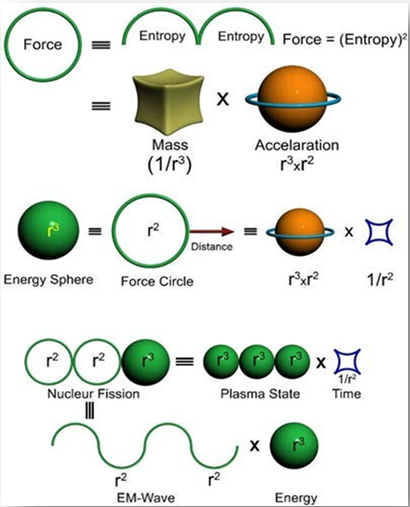
In Newtonian Physics the 3 principal Physical variables of the universe (L, M & T) were considered non-quantized and independent to each other. If this be so, the universe would have attained infinite numbers of shapes arising out of the innumerable combinations of L, M & T (mathematically expressed as Lx My Tz where x, y and z are variables). It is TTQG only which has very firmly established the fact that the said 3 variables are interwoven to each other as [7]: MT-2 = L This is the reason the universe is not taking up any shape of desire. Newly Defining the Thermodynamic Laws and their Geometrical Proof i) The 1st law of thermodynamics is restated as ‘Any Space quantum of the universe can be represented through permutations and combinations in many forms with the other space quantum of the universe keeping the magnitude of the space quantum constant’. The geometrical or topological proof (5) is given below in Figure 5.
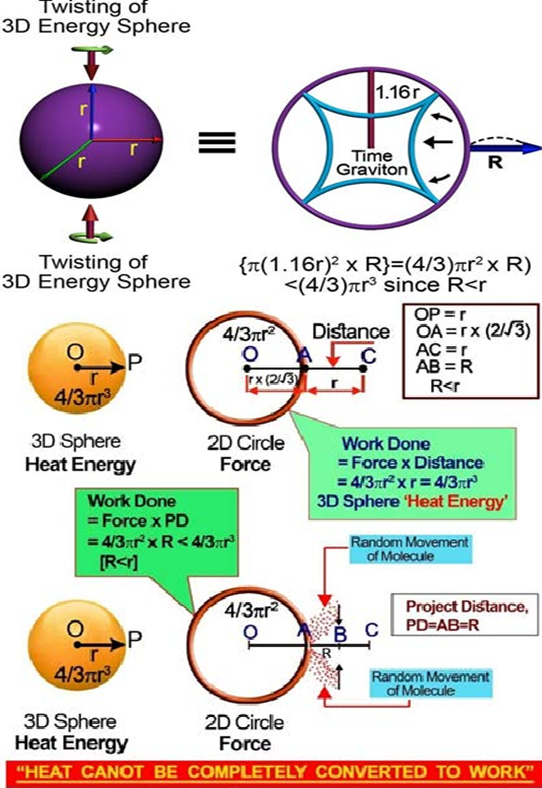
The 2nd law of thermodynamics is restated as ‘The heat or energy is a 3D sphere and which is the integrated form and it passes out to the differential form in the form of Force and entropy (or distance) while generating work but the time attractive force (t) does not allow the entropy to fully emerge out and as result of that Heat cannot be completely converted to work.’ This is being shown diagrammatically in Figure 6, which is being self-explanatory [45, 46, 47, 48, 49, 50].
iii) The 3rd law of thermodynamics is restated as ‘In the domain when the time attractive force quantum (t) overcomes the energy quantum (E), the direct space passes on to a reciprocal space and the ordered phases are formed’. The topological presentation of the 3rd law of thermodynamics is given below: To the end the TTQG sums up as below regarding the three laws of thermodynamics [5]: a. The 1st law of thermodynamics is applicable to any domain of E and t. b. The 2nd law of thermodynamics is meant for the domain when E > t. c. The 3rd law of thermodynamics is operative in the domain t > E
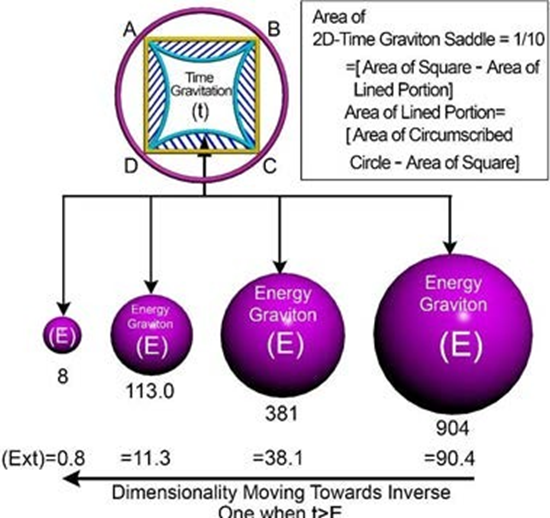
Figure 6a: Quantum Gravity theory driven geometrical presentation of 3rd law of thermodynamics.
Embodying the Quantum Physics of Planck and Einstein
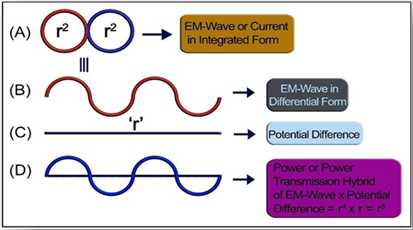
The concept of ‘photon’ of Einstein has been superseded in TTQG by the concept of ‘EM-wave gravitons’ or ‘EM- wave space quantum’ and the underlying physics, mathematics and topology has been presented in TTQG. In the Figure 7 below, the integrated, semi-integrated and full differential form of ‘ EM-wave space quantum’ is being shown [51, 52, 53, 54, 55, 56, 57, 58, 59, 60, 61, 62, 63, 64, 65, 66, 67, 68, 69, 70, 71, 72, 73, 74, 75, 76, 77, 78, 79].
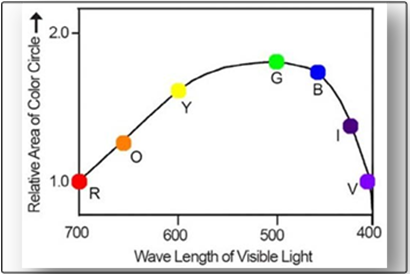
Max Planck had to adhere to some stiff mathematics to explain the ‘Black Body Radiation phenomena or curves’ since he could not embody the ‘spectral power radiance’ (SPD) physical variable but TTQG by evaluating the proper dimension of SPD could explain [1, 2, 3, 4, 5, 6, 7, 8, 9] the SPD’s of Black Body Radiation at ease. This is being shown below in Figure 8.
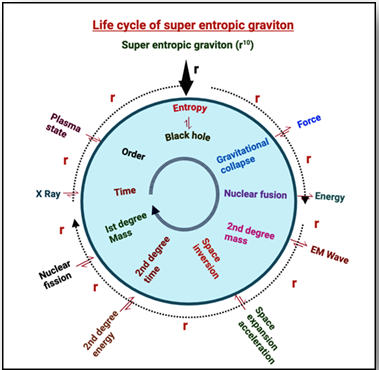
iii) The ‘particle -wave’ duality concept in physics is basically being an equilibrium phenomenon of the universe between the masses and the EM-wave gravitons (or the space Quantum). It is being shown in TTQG that a ‘singularity’ space quantum of the reciprocal space (termed as super- entropic graviton) in the form of inverse 10 dimensionality through different stages by emitting ‘entropy space quantum’ gives rise to all the ‘Cosmic Phenomena’ of the universe. This has been represented by a ‘UNIVERSAL GRAVITON CYCLE’ UGC) in TTQG. The UGC is shown in Figure 9 [80, 81, 82, 83, 84, 85, 86, 87, 88, 89, 90].
New Shapes of the Theory of Relativities
As per the logic and philosophy of TSQ or TTQG is considered, there is no need of adhering to any theory of ‘relativity’ to explore the cosmic mysteries of the universe [91, 92, 93, 94, 95, 96, 97, 98, 99] due to the following reasons:
i) The Energy density of the space of the universe is constant and hence there cannot exist different inertial frames of the universe. The universe is isotropic and homogeneous and all the cosmic phenomena of the universe are arising out of the ‘exchange of quantum forces. The length, area and volumes of the ‘space gravitons or space quantum’ and their geometries and dimensions are the real operating keys . Velocities of the celestial bodies are important but ultimately, they generate volumes. For any celestial body to move has to overcome some or the other attractive forces and then only it covers some distance. The hybrid effect of the two as shown at the very beginning of this article gives rise to the generation of a volume. So the special theory of relativity considerations of ‘length contraction’, ‘time dilation’, ‘volume contraction’ are all the effects of ‘distortion of space quantum’ and which is topological and not ‘relativistic’ ones. The shapes of the space quantum (curved line, circle, sphere) do vary in the space due to different stress – strain situations and a result of that a curved entropy line might be straightened, a force circle may be longitudinally more stretched than the lateral one, a 3D energy sphere can attain homogeneous or inhomogeneous shape of ellipsoids, a 2D time saddle might be more squeezed or get enlarged…like so. All the said distortions are geometric or topological leaving no chance of being relativistic. The famous equation of Einstein of special theory of relativity simply merges to a different form when the light of TTQG is being showered on it as shown below:
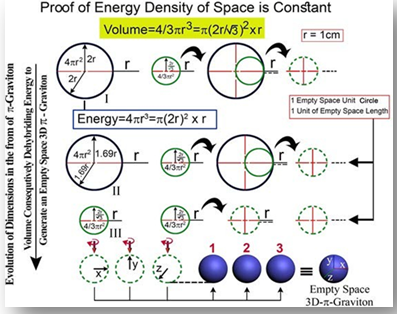
E= mC2, where m is mass, E being energy and C is the velocity of light. In TTQG velocity is volume and so it can be written as E = mV2 (V =volume). Now in TTQG the momentum is the product of mass and velocity and it has been proved in TTQG that mV = 3 (conserved or constant) and then the said equation converges to E = 3V or (E/V) =3, or the energy density of the space is constant. So, the ‘relativistic’ equation of Einstein is being transformed to a topological equation. The topologically (E/V) = 3 signifies that when a quantum of ‘energy’ is been divided by a quantum of volume, 3 numbers of empty pi gravitons [88, 89, 90, 91, 92, 93, 94, 95, 96, 97, 98, 99]. This is being shown in Figure 10.
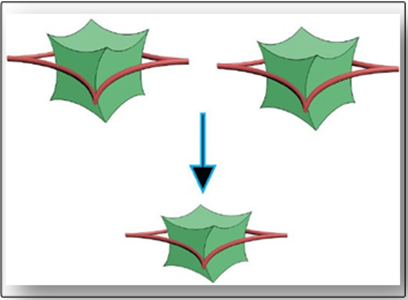
ii) The GTR has claimed that the physical variable mass is the warp of the space time of the universe. However, this is a very qualitative one since it could not be split into the concepts of physics, mathematics and topology. The next proposition was that ‘Gravitation’ is a phenomenon of ‘acceleration’ (not a force) and again could not show in black and white in papers what this could be? However, the TSQ findings are a. Mass is a 3D saddle or a 3D inverted sphere, squeezing type by its nature and is a physical variable of the reciprocal space of the universe. b. Gravitation is not a phenomenon of ‘acceleration’ in the true sense. It is indeed an overlapping of two numbers of ‘inverse acceleration fields’ and which is the ‘singularity’ in the form of inverse 10 dimension. c. The phenomenon of Gravitation or the ‘Gravitation function’ has been represented as ‘G’ (which is not the constant of gravitation of Newton) in TSQ and is represented as: (overlapping of 2 inverse acceleration fields.
G = (9/16π2 r5) x (9/16π2 r5) = (81/256 π4 r10) Where the term, (9/16π2 r5) stands for the ‘inverse acceleration’ and the G converges to a state or a point of ‘singularity’ of inverse 10 dimensions.
The topological presentation of the phenomenon of gravitation is shown in Figure 11.
Symmetry Breaking of the Universe and Origin of Mass
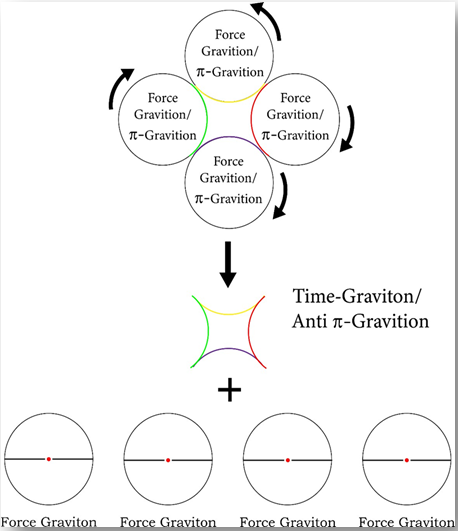
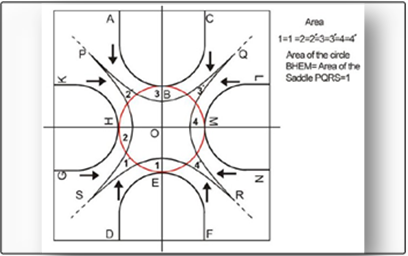
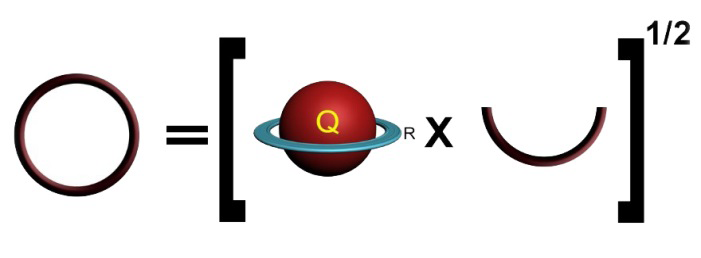
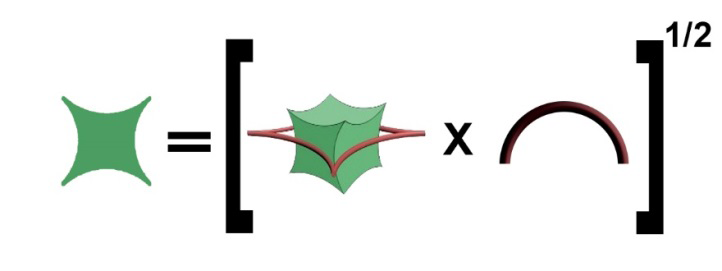
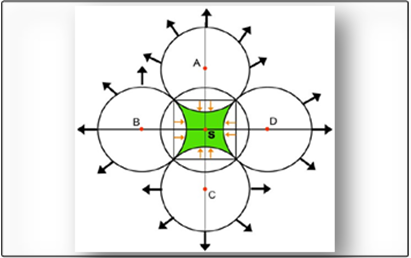
This ‘symmetry breaking’ phenomena [101] are much discussed subject of the current ‘standard model of physics’ for quite some time. It is being proposed that the mass of the universe has originated from the symmetry breaking of somewhere or the other in the universe. Many research articles have published but no one could put up a concrete scientific argument to establish this phenomenon. This phenomena as the TSQ analyzed is very true and has arisen out of quantized ‘space-time ‘constitution of the universe [1, 2, 3, 4, 5, 6, 7, 8, 9]. In a tripartite fashion TSQ has proved this phenomenon being true (from the angle of physics, mathematics and geometry) and the occurrence of inter convertibility or interchange of the space quantum among themselves is fully responsible for this. The said occurrence is being shown in the following Figures 12-15.
Conclusion
The conclusions are
i) The basic text books of physics need to be written out in an entirely different fashion in terms of the quantized ‘space-time’ constitution of the universe of TSQ. ii) The specialized branches of Physics like thermodynamics, Cosmology, Astronomy, super- conductivity, Fluid mechanics all are required to be rebuilt in the light of TSQ. iii) The postulates or the findings of TSQ are to be applied in Biological science especially in fields like protein folding, genome sequence and the outcome to be observed and verified through experiments.
References
-
Bhattacharya C (2020) Novel Quantum Gravity Interpretation of Chemical Equilibrium, Free Energy, Dark Energy and Dark Matter of the Universe. Advances in Theoretical & computational Physics 3(3): 86-95.
-
Bhattacharya C (2020) Novel Quantum Gravity Approach To Evaluate The Dimensionalities And The Geometrical Profiles Of The Chemical Reactions. International Journal of Scientific & Engineering Research 11(4): 373-391.
-
Bhattacharya C (2020) Cosmology and Unified Quantum Gravity Theory of the Universe. Advances in Theoretical & Computational Physics 3(3): 114-211.
-
Bhattacharya C (2020) Unified Quantum Gravity Theory Driven Concepts of the Classical Laws of Physics, the Dark Energy, the General Theory of Relativity and the ‘Zero-Energy Universe’. Advances in Theoretical & Computational Physics 3(4): 265-286.
-
Bhattacharya C (2021) Novel Quantum Gravity Model of the Physics of Operability of Galvanic Cells and Electrical Power Generation. Advances in Theoretical & Computational Physics 4(1): 7-13.
-
Bhattacharya C (2023) TTQG (Topological Theory of Quantum Gravity) Driven New Theory of Color Physics. Advances in Theoretical & Computational Physics 6(1): 1-9.
-
Bhattacharya C (2023) Reformulating the Basics of Conventional Newtonian Physics, Quantum Physics and the Einstein Theories of Relativities Based on the newly discovered Topological Theory of Quantum Gravity (TTQG). Phys Sci & Biophys J 7(1): 1-23.
-
Bhattacharya C (2023) The Newly Discovered Topological Theory of Quantum Gravity (TTQG) ‐ A Multiblock Compatibilizer Cum Modifier of the Existing Theories of Physics, Cosmology, Quantum Mechanics and Quantum Computing. Global Journal of Science Frontier Research 23(A4): 13-58.
-
Baker D (2010) Symmetry and the Metaphysics of Physics. Philosophy Compass 5(12): 157-1166.
-
Jones JE (1924) On the determination of molecular fields. Proceedings of the Royal Society of London 106(738): 463-477.
-
Lim TC (2003) The relationship between Lennard-Jones (12-6) and Morse potential Functions. Zeitschrift für Naturforschung A 58(11): 615-617.
-
Zhang L (2013) The Van der Waals force and gravitation force in matter. ArXiv, 1303.3579.
-
Bonneville R (2016) An alternative model of particle physics in a 10-dimension (pseudo) Euclidian space- time. arXiv.
-
Menon KK, Quarashi T (2017) Wave-particle duality in asymmetric beam interference. Physical Review A 98: 022130.
-
Zslavski OB (2005) Ultimate gravitational mass defect. Gen Rel Grav 38(5): 945-951.
-
Bolotin YUL, Yanoksky VV (2017) Modified Planck units. arXiv.
-
Paul GH (2009) Maxwell’s equation. In: 1st (Edn.), Wiley- IEEE Press.
-
Jackson JD (1998) Classical electrodynamics. In: 3rd (Edn.), Wiley.
-
(2022) Fundamental physical constants - Extensive listing. NIST.
-
Halliday D, Resnick R (1974) Fundamentals of physics. Feynman Lecture on Physics.
-
Loudon R (2000) The quantum theory of light. In: 3rd (Edn.), Oxford University Press.
-
Duffin W (1990) Electricity and magnetism. In: 4th (Edn.), McGraw-Hill Education.
-
Serway RA, Jewett JW, Wilson K, Wilson A, Rowlands W (2016) Physics for global scientists and engineers. In: 2nd (Edn.), Cengage, 2.
-
Rybicki GB, Lightman AP (1979) Radiative processes in astrophysics. John Wiley & Sons.
-
McQuarrie DA, Simon JD (1979) Physical chemistry: A molecular approach. In: 1st (Edn.), University Science Books.
-
Michael B (2013) Physics for engineering and science. In: 2nd (Edn.), McGraw-Hill Education.
-
Rybicki GB, Lightman AP (1979) Fundamentals of radiative transfer. In: Radiative processes in astrophysics (Edn.), John Wiley & Sons, pp: 20-28.
-
Purcell ME, David J (2013) Electrical energy in a crystal lattice. In: Electricity and magnetism, 3rd (Edn.), Cambridge University Press, pp: 14-20.
-
Maxwell JC (1873) A treatise on electricity and magnetism. Clarendon Press 2: 500.
-
Nobel Prize in Physics (1921).
-
Arore MG, Singh M (1994) Nuclear chemistry. Anmol Publications, pp: 1-11.
-
Goldston RJ, Rutherford PH (1995) Introduction to plasma physics. Institute of Physics Publishing.
-
Sharma KS (2008) Atomic and nuclear physics. Pearson Education India.
-
Verdenne G, Attetia JL (2009) Gamma-ray bursts: The brightest explosions in the universe. In: 1st (Edn.), Springer.
-
Schrödinger E (1926) An undulatory theory of the mechanics of atoms and molecules. Physical Review 28(6): 1049-1070.
-
Griffiths DJ (2004) Introduction to quantum mechanics. In: 2nd (Edn.), Prentice Hall.
-
Atkins PW (1977) Molecular quantum mechanics parts I and II: An introduction to quantum chemistry. Oxford University Press.
-
Atkins PW (1974) Quanta: A handbook of concepts. Oxford University Press.
-
Einstein A (1916) The foundation of the general theory of relativity. Annalen der Physik 354(7): 769-822.
-
Grøn O, Hervik S (2007) Einstein’s general theory of relativity: With modern applications in cosmology. In: 1st (Edn.), Springer.
-
Lemkhl D (2018) General relativity as a hybrid theory: The genesis of Einstein’s work on the problem of motion. General Relativity and Quantum Cosmology 67: 176-190.
-
Hess PO (2016) The black hole merger event GW150914 within a modified theory of general relativity. Monthly Notices of the Royal Astronomical Society 462(3): 3026- 3030.
-
Chrimes AA, Levan AJ, Stanway ER, Lyman JD, Fruchter AS, et al. (2019) Chandra and Hubble Space Telescope observation of dark gamma-ray bursts and their host galaxies. Monthly Notices of the Royal Astronomical Society 486(3): 3105-3117.
-
Bergh SVD (2011) The curious case of Lemaitre’s equation no. 24. Journal of the Royal Astronomical Society of Canada 105(4): 151.
-
Nussbaumer H, Bieri L (2011) Who discovered the expanding universe. The Observatory 131(6): 394-398.
-
Way MJ (2013) Dismantling Hubble’s legacy. American Astronomical Society 471: 97-132.
-
Wald RM (1984) General relativity. The University of Chicago Press.
-
Wald RM (1999) Gravitational collapse and cosmic censorship. In: Iyer BR (Eds.), Black holes gravitational radiation and the universe, Springer 100: 69-86.
-
Overbye D (2015) Black hole hunters. NASA.
-
Montgomery C, Orchiston W, Whittingham I (2009) Michell, Laplace, and the origin of the black-hole concept. Journal of Astronomical History and Heritage 12(2): 90- 96.
-
Abbott BP, Abbott R, Abbott TD, Abernathy MR, Acernese F, et al. (2016) Observation of gravitational waves from a binary black hole merger. Physical Review Letters 116(6): 061102.
-
Event Horizon Telescope Collaboration, Kazunori A, Antxon A, Walter A, Keiichi A, et al. (2019) First M87 Event Horizon Telescope results. I. The shadow of the supermassive black hole. The Astrophysical Journal 875(1): 1-17.
-
Shapiro SL, Teukolsky SA (1983) Black holes, white dwarfs, and neutron stars: The physics of compact objects. John Wiley & Sons.
-
(2017) Introduction to black holes.
-
Singh J (1995) Space-time waltz. 1st (Edn.), Wiley Eastern Ltd.
-
Penrose R (2002) Gravitational collapse: The role of general relativity. General Relativity and Gravitation, 34(7): 1141-1165.
-
Rose C (2013) A conversation with Dr. Stephen Hawking and Lucy Hawking.
-
Srikanta P (2017) Recent developments in intelligent nature-inspired computing. Advances in Computational Intelligence and Robotics Waterstones, pp: 264.
-
Giddings SB, Thomas S (2002) High-energy colliders as black hole factories: The end of short-distance physics. Physical Review D 65(5): 056010.
-
Belgiorno F, Cacciatori SL, Clerici M, Gorini V, Ortenzi G, et al. (2010) Hawking radiation from ultrashort laser pulse filaments. Physical Review Letters 105(20): 203901.
-
Grossman L (2010) Ultrafast laser pulse makes desktop black hole glow, New york.
-
Kumar KNP, Kiranagi BS, Bagewadi CS (2012) Hawking radiation: An augmentation attrition model International Journal of Scientific and Research Publications 2: 6.
-
Kumar KNP, Kiranagi BS, Bagewadi CS (2012) Advances in Natural Science Journal of Modern Physics 5(2): 14- 33.
-
Wilt BSD (1980) Quantum gravity: The new synthesis. In: Hawking S (Ed.), General relativity; an Einstein centenary (Edn.), Cambridge University Press, UK, pp: 696.
-
Jacob DB (2008) Bekenstein bound. Scholarpedia 3(10): 7374.
-
Hawking SW, Ellis GFR (1973) The large-scale structure of space-time. Cambridge University Press, UK.
-
Charles M, Thorne KS, Wheeler J (1973) Gravitation. In: WH Freeman and Company (Edn.), Princeton University Press, New Jersey.
-
Peacock JA (1999) Cosmological physics. Cambridge University Press, UK.
-
Dieter B (2012) Black-hole horizons and how they begin. The Astronomical Review 7(1): 25-35.
-
Chen Y, Shu J, Xue X, Yuan, Q, Zhao Y (2019) Probing axions with event horizon telescope polarimetric measurements. Physical Review Letters 124: 06.
-
Giddings SB (2019) Searching for quantum black- hole structure with event horizon telescope. General Relativity and Quantum Cosmology 5: 9.
-
Kunter ML (2003) Astronomy: A physical perspective. Cambridge University Press, UK.
-
Schwarzschild K (1916) On the gravitational field of a mass point according to Einstein’s theory. Mathematical Physics pp: 189-196.
-
Robert W (1984) General relativity. The University of Chicago Press, USA, pp: 152-153.
-
Simon S (1979) John Mitchell and Black Holes. Journal of the History of Astronomy 10(1): 42-43.
-
Dimitar V (2012) Consequence from conservation of total density of the universe during the expansion. Aerospace Research in Bulgaria 24: 60-66.
-
McCornell NJ, Ma CP, Gebhardt K, Wright SA, Murphy JD, et al. (2011) Two ten billion solar mass black holes at the center of giant elliptical galaxies. Nature 480(7376): 215-218.
-
Sandesses RH (2013) Revealing the heart of the Galaxy. In: Sandesses (Ed.), The Milky Way and its Black Hole. (Edn.), R. H. Cambridge University Press, Cambridge, UK, pp: 36.
-
Carol SM (2004) Space-time and Geometry. In: Carol (Ed.), An Introduction to General Relativity. (Edn.), M Cambridge University Press, Cambridge, UK.
-
Penrose R (1965) Gravitational collapse and space-time singularities. Physical Review Letters 14(3): 57-59.
-
Kerr RP (1963) Gravitational Field of a spinning mass as an example of Algebraically Special Metrics. Physical Review Letters 11(5): 237-238.
-
Newman ET, Janis AI (1965) Note on the Kerr-Spinning Particle Metric. Journal of Mathematical Physics 6(6): 915.
-
NASA (2018) Black Holes. Science Mission Directorate.
-
IAU (2018) IAU members vote to recommend renaming Hubble law as Hubble-Lemaitre law.
-
Haranas I, Gkigkitzis I (2014) The Mass Graviton and its relation to the number of information according to the Holographic principle. International Scholarly Research Notices.
-
Benincasa P (2018) From the Flat Space S-matrix to the wave function of the universe. High Energy Physics- Theory, arXiv.
-
Modestino G (2016) Explanation of the Special Theory of Relativity by Analytical Geometry and Reformulation of the inverse square law. General Physics, arXiv.
-
Corichi A, Diag-Polo J, Borza EF (2007) Loop quantum gravity and Planck-size Black Hole entropy. J Phys Conf Ser 68: 012031.
-
Bojowald M (2007) Singularities and quantum Gravity. AIP Conference Proceedings 910: 294-733.
-
Ashtekar A (2007) An introduction to Loop Quantum Gravity through cosmology. Nuovo Cim B 122: 135-155.
-
Fan YZ, Wei DM, Xu D (2007) Gamma-ray Burst UV/ optical afterglow polarimetry as a probe of quantum gravity. Monthly Notices of the Royal Astronomical Society 376(2007): 1857-1860.
-
Bojowald M (2007) Quantum gravity and cosmological observations. AIP Conference Proceedings 917: 130- 137.
-
Hansson J (2010) Newtonian Quantum Gravity. Phys Essays 23: 53.
-
Ward BFL (2008) Resummed Quantum Gravity. International Journal of Modern Physics 17: 627-633.
-
Wang CHT (2006) New ‘Phase’ of quantum gravity. Philosophical Transactions of the Royal Society of London A 364(1849): 3375-3388.
-
Demir DA, Tanyildizi SH (2006) Higher curvature Quantum gravity and Large extra Dimensions. Phys Lett 633: 368-374.
-
Kiefer C (2005) Quantum: General Introduction and Recent Developments. Annalen der Physik 15: 129-148.
-
Bhattacharya C (2020) Cosmology and unified quantum gravity theory of the universe. Advances in Theoretical and Computational Physics 3(3): 1-98.
-
Bhattacharya C (2020) Novel quantum gravity approach to evaluate the dimensionalities and the geometrical profiles of the chemical reactions. International Journal of Scientific & Engineering Research 11(4): 373-391.
- Asymmetry Irreversible Heterogeneity Quantum Cosmology Grand Mathematical PHYSICS
- Early Universe: Hadronic Crystals Coherent Micro Gravitational Wave Emitters PHYSICS Part II
- The Solar System Constraint Maze: A Scientific Dead-End Revealing the Interuniversal Machine
- Assessment of Radiofrequency Radiation from 2G and 3G Mobile Phone Handsets
- Early Universe Magneto-Gravitational Coupling Genesis Physics: Part I
- Falsifiability of the Classical Law of Gravitation and Unveiling the Time-temperature Entanglement of the Universe