
The World Views of the Universe Since the Beginning of Civilization over the last 10,000 Years Since the Last Ice Age Current
This paper investigates the evolving World View of our Universe from geo-centric to helio-centric to primary-centric Worldview. In the Copernican Framework, Kepler’s Third Law places no restriction on the orbit of a secondary. In Primary Centric Framework there are two Clarke’s Orbits which are non-dissipative and equilibrium orbits called inner and outer Clarke’s Orbit equivalent to geo-synchronous orbit in Earth-Moon System. Outer Clarke’s Orbit is permissible as a stable orbit if the mass ratio of secondary to primary is greater than 0.2, Inner Clarke’s Orbit is permissible if mass ratio is less than 10-4. If the mass ratio is between 10-4 to 0.1 then secondary spirals-out from inner Clarke’s Orbit to outer Clarke’s Orbit in super-synchronous condition and spirals-in if it is in sub-synchronous orbit destined to be destroyed by the primary or if the secondary is not stiff enough it gets tidally pulverized within Roche’s limit of the primary into a ring around the primary. The Author conjecture states that every cosmological sub-system has a characteristic Primary Component anchoring the given sub-system and this primary decides the stable equilibrium orbits of the secondary/secondaries. Planet-Satellite has a planet as the primary, Solar System and exo-Solar Systems have a planet hosting star (PHS) as the primary, Galaxy has a Supermassive Black Hole (SMBH) as the primary, Cluster has a cD galaxy (central dominant Galaxy) which is also known as Brightest Cluster Galaxy (BCG) as the primary, Super-Cluster has a massive Cluster hosting a QUASAR/Blazer as the primary. This goes ad-infinitum until a Cosmic Web is woven with Cosmic filaments. This conjecture gains a definite credence after the recent discoveries of the over-massive Black Holes in Galaxies namely Messier 87 in Virgo Cluster, NGC 3842 in Leo Cluster, NGC 4889 in Coma Cluster and NGC 1277 in Perseus Cluster. In 2011, a group of floating planets were discovered. This is a transitory event and is an exception to this conjecture.
Abbreviations
STR: Special Theory of Relativity; QUASER: Quasi-Stellar Radio Source; GTR: General Theory of Relativity; GPS: Global Positioning System; PHS: Planet Hosting Star.
Introduction
Objective of the Paper
Progression of Cosmological Models of Universe:
The earliest World View was completely based on folk-lore and Mythology. The earliest human society imagined Earth resting on the back of turtles. By the Greek times this world view progressed to the view that Earth was at the centre of the Universe supported by nothing but equidistant from all the celestial bodies surrounding the Earth. Hence Earth was held in balance. This advanced to the Geo-centric Model of Ptolemy where all planets orbited Earth. This advanced to the Heliocentric model of Copernicus which was based on reason and observations. In modern times this has further progressed to Primary-centric model --World View where every celestial system or subsystem is governed by a Monarch. In a planet-satellite system Planet is the Monarch. In a solar system or exo-solar system Planet Hosting Star (PHS) is the Monarch as Sun is the Monarch in our Solar System. In a Galaxy Super Massive Black Hole (SMBH) is the Monarch. Every Galaxy is invariably anchored by a SMBH which gives stability as well as it regulates the star formation in the given Galaxy. A Cluster of Galaxies is anchored by cD Galaxy (compact disc Galaxy). This gives the stability as well as its Galaxies rotation dynamics about the cD Galaxy. A Super Cluster is anchored by the most massive cluster. This most massive cluster becomes QUASER (quasi-stellar radio source). A Hyper-Cluster is anchored by the most massive Super Cluster. This goes on ad-infinitum. The enigma of Dark Matter and Dark Energy continues to puzzle the community of Astrophysicists and Astronomers.
Importance
The significance of understanding the evolution of Cosmological Model: Special Theory of Relativity (STR) and General Theory of Relativity (GTR) propounded by Einstein in 1915 CE are indispensable for Global Positioning System (GPS) and for landing the Curiosity Rover on Mars.
Newton law fails to predict the trajectories of motion of particles at atomic scale (Quantum Mechanics is needed for these atomic trajectories) and at Cosmic Level (STR and GTR comes to our help). GPS is built on Einsteinium interpretation of Gravity. A fleet of 24 satellites in low Earth Orbit help us determine our bearing in real time. Each satellite carries an Atomic Clock with ultimate precision. A GPS receiver on Earth receives radio signal from the nearest satellite and four other satellites and through triangulation it determines the correct bearing in terms of longitude and latitude of the GPS receiver. This bearing is accurate within 1m or less of the correct bearing. GPS receiver computes the precise position by incorporating the corrections provided by STR and GTR. Moving Clocks suffer time dilation as predicted by STR. Hence Atomic Clock on the satellite moves slower. Earth is immersed in the gravitational field of a rotating, massive body like Sun. According to GTR this rotating Sun results in a Faster Clock. These two corrections result in a slightly faster clock on the satellite. The net effect results in 40 microsecond per day faster clock. If this correction is not incorporated in the computation of bearing of GPS receiver, then a navigator aiming to reach New Jersey would land in Manhattan an error of 600 Km.
Within our Solar System GTR computation deviates from Newtonian computation by 1 in million parts.
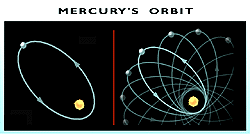
Because of the Frame Dragging effect by Sun, Mercury experiences apisidal precession. Perihelion point on Mercury’s orbit shifts forward by 44.3 arcsecond per century. Newtonian Mechanics predicts 22 arcseconds per century.
Methodology
Historical Analysis and Comparative Studies
Entire Theories are not usually discarded easily. New Observations that do not fit an existing paradigm more often than not lead to amendments of the currently accepted World View rather than supplant it with a new World View of Universe. This is the course of science as pointed by Kuhn T [1].
Sir. William Herschel (1738-1822) and the discovery of Uranus: An English Astronomer who discovered Uranus with his homemade Telescope on March 31,1781. The discovery of this seventh planet had pushed the edge of our Solar System beyond the six classical planets. At first, he saw a faint object slowly moving across the sky which he mistook for a comet.
- Then he built an advanced, high quality, large aperture, reflecting type telescope.
- Systematic Sky Survey of night sky was carried out. He identified it as a planet which had not been recorded before by the astronomers.
- He initially thought it to be a Comet. But a periodic Comet takes a highly elliptical orbit when it comes in the inner Solar System. And if it is coming for the first time from the Oort’s cloud (giant spherical shell of icy objects surrounding our Solar System and extending from 5000AU to 100,000AU) into the inner Solar System it takes a hyperbolic path and it lasts for very long periods. But the object he had detected was in a circular path. So he was convinced that it was the seventh planet, and it was named Uranus, Greek god of the sky.
- Collaboration with other scientists and mathematicians was crucial in validating a discovery.
Discovery of Neptune: In 1846, Uranus completed a complete orbit around Sun. While tracking the orbit there were discrepancies in the orbit based on Newtonian Mechanics. French Astronomer Urbain-Jean-Joseph Le Verrier (1811-1877) calculated the existence of an 8th planet. Independent English Astronomer John C. Adams also calculated the size and position of this eighth planet and passed this information to German Astronomer Johann G. Galle to look for the 8th Planet. On September 23, 1846, within one hour of searching the night sky Neptune was located within 1 degree of the position calculated by Verrier. For this remarkable discovery Verrier was awarded Copley Medal and full membership of Royal Society of London.
The anomaly in Mercury’s orbit: Certain anomaly was observed in Mercury’s orbit. The perihelion of the orbit was seen to advance by 43 arcseconds per century forward in the direction of orbiting Mercury. Verrier who was studying this anomaly, suggested the existence of a Planet Vulcan just within Mercury’s orbit. No such planet was found. Eventually in 1915 Einstein proposed the General Theory of Relativity and he explained that near the Sun because of the strong gravitational field a planet does not orbit in a repetitive elliptical orbit as suggested by Newton. Rather the curvature in Space-Time fabric causes the advance of perihelion by 45 arc second per century. This is known as apsidal precession. So, the theory had to be amended to explain the anomaly.
The evidence for Expanding Universe: First clue of expanding Universe came from Slipher’s measurement of speeding Nebulae which he measured using a 24-inch Telescope at Lowell Observatory, Arizona, in 1912. This was further supported by Hubble and Humason measurements in 1929 at Mount Wilson 100-inch Telescope which gave Hubble Law.
From Conception to Acceptance: Theories are conceived but are not accepted until they are confirmed by data and rigorously tested by several astronomers or groups of astronomers. Only when they have withstood the test of time that these new theories can supplant the old theories. In case of Uranus and Neptune Newton’s theory was suspected but it led to the discovery of Uranus and Neptune. But in case of Mercury’s anomaly Einstein’s General Theory of Relativity enunciated in 1915 came to our rescue. Thus, it is evidence, reasoning and the consensus of several researchers which leads to the acceptance of a new theory.
Ancient Worldviews. Geo-centric
Early Cosmology: *Mythological and Religious explanations of natural events (Paleolithic Age; Mesolithic Age; Neolithic Age; Bronze Age; Iron Age; Babylonian interpretations; Egyptian interpretations; Indian and Chinese interpretations; • World View of Cosmos has evolved as human society evolved. Paleolithic Age (2.5 Million years to 10,000BCE): The society was nature cantered and practised Animism. Spiritual essence was added to animals, plants and natural phenomena. Living soul was attributed to all animated and inanimate objects. There was a free will.
Shamanism was practised. Shamans or Spiritual leaders mediated between the human world and spiritual world.
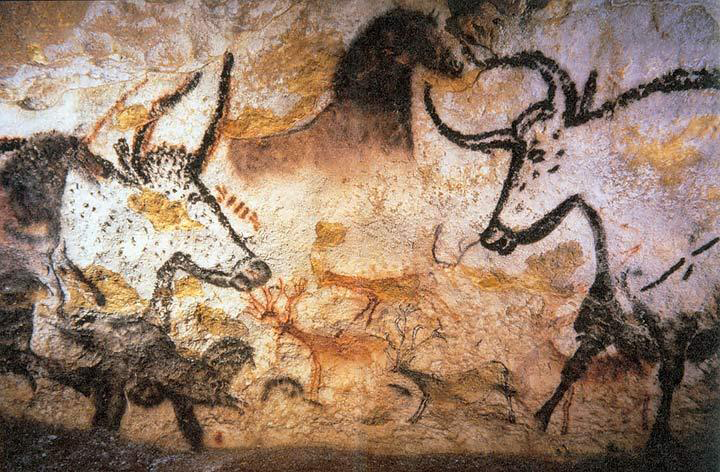
Arts and Symbolism played a major role. Cave paintings at Lascaux (southern France) shown in Figure 2. are a testimony to this. These cave paintings are repositories of empirical knowledge for posterity.
Figurines of Venus of Willendorf were found at Willendorf, Austria. It belongs to the time of 22,000 to 24,000BCE belonging to the Upper Palaeolithic era.
Mesolithic Age (10,000 to 8,000 BCE): This age saw the shift from hunting to herdsman ship. Their World View was centered around understanding seasonal change, animal migration and plant cycles to secure food. They were nature centric. Animism was still prevalent Their World View was closely tied to egalitarianism, community resources, decisions based on group consensus. This period saw the rise of earth mother deities. Stone tool making and domestication entered their livelihood. Observation of celestial patterns (phases of moon and solistices) laid the foundation for early calendars and agricultural planning. Their world view emphasized respect for and adaptations to nature’s rhythm. This set the stage for transition to the rise of Civilization.
Neolithic Age (8,000 to 3,000BCE): This period was centred around land, seasons, and cycles of planting and harvesting There was emergence of Deity Worship becoming structured. Private property and private ownership replaced community ownership. Master - slave relationship was born. The victors enslaved their vanquished. Megalithic Monuments such as Stonehenge was built. Early governance and leaders emerged- State was born.
Bronze Age (3000 to 1200 BCE): Urbanization and Cities as trading centres were built. There was a trade network through trading routes such as Silk Routes connecting China to South Asia to European trade centres. The art of writing was developed. Cuneiform in Mesopotamia and Hieroglyphics in Egypt and Pictorial language in China. Polytheism was widely practised. Monumental Architectures were developed in form of Worship places and Palaces. Trade and exchange were extensively developed. There was myth and order. The epic of Gilgamesh was written in cuneiform on clay tablets and it is the oldest known epic poem.
The first documented images of the night sky (2000 to 1600 BCE): When the ancient looked at the heavens they wanted to use the night sky for guidance in day to day living as well as they wanted to make accurate predictions for agricultural and for migration in search of food. So the World View evolved with the evolution of human Society They documented the night sky and made maps. Between 2000 and 1600 BCE first recorded images of the sky has been excavated. It is a “hammered copper and gold plate” prepared in the Bronze Age belonging to Unetice Culture shown in Figure 3.
The “hammered copper and gold plate” is illustrated in Figure 3. Nine hundred years later Babylonians (modern Iraq) were sophisticated recorders of astronomical information. Layard AH [2] a British explorer, excavated thousands of cuneiform tablets at the Assyrian site, Nineveh, in 1850. These tablets were prepared during the reign of King Ammisaduqa’s reign (1646-1626 BCE) fourth rule after Hummurabi (1792-1750 BCE). One of the tablets is on Planet Venus known as Venus Tablet. Venus tablet gives the following observation: On 15th of November month Venus disappeared. On 18th of November Venus reappeared in the eastern sky. Venus disappearance for three days corresponded to Solar conjunction when Venus passes close to the Sun and is obscured by the brightness of the Sun.
Venus reappearance in the eastern sky indicates it has moved from being evening star to morning star. Venus Tablet notes: spring flows, rain falling and floods. This reflects the renewal and fertility which Venus symbolized. Ancient Mesopotamians blended astronomy, mythology and practical life using celestial observations to predict and explain natural events. Babylonians could distinguish between twinkling stars and steady spots of light corresponding to Planets as wanderers. They had seen five wandering planets moving separately from the twinkling stars. They noted that one spot moved West to East but every two years it reversed its motion for 90 days and then switched back to West to East motion. This is the retrograde motion of Planet Mars and this can be explained by looking at the orbital motion of Earth and Mars around Sun. Comets were seen as harbinger of doom, bad omens and portending disasters on Earth. Map of the ancients connected the terrestrial to the celestial [3, 4, 5]. The ancient tradition centered around taking data from the night sky, how we are on Earth and what is our location in the Cosmos. Babylonians did not understand the science of wandering orb, but their observations had agricultural and religious utilities. Patterns in the sky were related to the agricultural cycles on the ground. Babylonians interpreted celestial events as divine messages affecting weather, agriculture and property. The shift in World View rooted in logic, data and evidence had to wait for the ancient Greeks. From the position of the constellations in the sky, ancients developed astrology which even today plays a vital role in India, for travel, for marriages and for agricultural practices. Every Planet had a significance in astrology as shown in Table 1.
Iron age (1,200 BCE to 500 CE): In this period the world view of human society was as follows: Earth rested on Turtles. This was symbolic cosmology rooted in the spiritual and ecological understanding of man-kind.
Creation myths have striking similarity across the world cultures. These supernatural explanations evoke belief in an invisible energy which drives the physical World and the human society. These supernatural forces have a creator, sustainer and annihilator. These ancient civilizations envisioned entities that were not present but felt real. For example:
- Enki- Sumerian god of water whose wrath unleashed floods;
- Indra- God of rain and thunderstorm- Rainbow was his bow stretched across the sky and with a lightning bolt on his arrow.
In all ages Science has been a human endeavour so it cannot be an unbiased inquiry by purely objective researchers engaged in deriving fixed truths of nature. Such endeavour has always been interlaced with subjectivity, punctuated by controversies and disagreements.
From ancient times Science has helped us chart our relationship with the natural world and it pointed the way forward.
In ancient times we had our eyes only to observe the Cosmos. So how did we interpret these observations: through folklore, mythology, and through supernatural and metaphysics. They created maps.
![Figure 3: The “hammered copper and gold plate” is illustrated in Figure 3. Nine hundred years later Babylonians (modern Iraq) were sophisticated recorders of astronomical information. Layard AH [2] a British explorer, excavated thousands of cuneiform tablets at the Assyrian site, Nineveh, in 1850. These tablets were prepared during the reign of King Ammisaduqa’s reign (1646-1626 BCE) fourth rule after Hummurabi (1792-1750 BCE). One of the tablets is on Planet Venus known as Venus Tablet. Venus tablet gives the following observation: On 15th of November month Venus disappeared. On 18th of November Venus reappeared in the eastern sky. Venus disappearance for three days corresponded to Solar conjunction when Venus passes close to the Sun and is obscured by the brightness of the Sun.](/fulltextimages/13961/fig_3.png)
Figure 3: Nebra Sky Disk with representations of moon, sun and stars. The disk was excavated in 1999 in Saxony Anhalt, Germany, belonging to Unetice Culture (Early Bronze Age 1600 BCE). It is a unique illustration of the astronomical knowledge of prehistoric inhabitants of Central Europe as well as an excellent example of the connection between bronze metallurgy and trade. (Courtesy: Photo by Deichmann 2006).
| Planets | Ancient culture | Associated Gods | Temperaments | Comments |
|---|---|---|---|---|
| Mercury | Mesopotamian (Babylonian) | With Nabu | Literary skill | Innermost planet, has rapid movement across the night sky. |
| Greece/Roman | Hermes (the messenger of god) | Communication, commerce, travel | ||
| Venus | Mesopotamian | Ishtar | Love, fertility & War | Sister planet of Earth, brightest after Sun and Moon. Seen as evening and morning star. |
| Greece/Roman | Aphrodite | Love and beauty | ||
| Mars | Mesopotamian | Nergal | War, deaths & pestilence | Just adjacent to earth on outer orbit. Its reddish hue made it stand out. |
| Greece/Roman | Ares, the god of war | War & aggression | ||
| Jupiter | Mesopotamian | Marduk, king of gods | Protector of order | Largest and most prominent Planet in the solar system |
| Greece/Roman | Zeus, the king of gods | Justice and moral obligation | ||
| Saturn | Mesopotamian | Ninurta | God of agriculture and boundaries | Known for slow movement |
| Greece/Roman | Cronus, the father of Zeus. | God of time, agriculture and seasons; | ||
| Sun | Mesopotamian | Mes | Shamash , god of justice and truth | Primary center of Solar system; |
| Greece/Roman | Helios/Apollo | Light, reason & vitality; | ||
| Moon | Mesopotamian | Sin/(Nanno) | Goddess of time | Natural satellite of Earth |
| Greece/Roman | Artemis/Diana | Goddess of Hunt; | Here Hunt implies wilderness, nature & child care; | |
| Selene/Luna | Goddess of Moon; | |||
| Uranus | Mesopotamian | Linked to innovation, rebellion, and sudden change; | Slow movement across the night sky, Later discovery but associated retrospectively | |
| Greece/Roman | ||||
| Neptune | Mesopotamian | Linked to Posiedon; | God of sea and mystery; | Outermost planet;Later discovery but retrospectively associated; |
| Greece/Roman | ||||
| Pluto | Mesopotamian | Hades | God of underworld | It is no more a planet but a Kuiper Belt Object; |
| Greece/Roman |
Table 1: The planets, their gods and their temperaments.
- The classical planets are fixed patches of light and moved relative to stars.
- Therefore they were wanderers and later they were named planets.
Role of celestial bodies in early civilization
Classical Geocentric Model: Emerging Greek World consisted of several independent city states: autonomous but fragmented. They were open to questions and debates. They remade their Pantheon that ruled the heavens. Gods were refashioned and more power was transferred to humans. In 610 BCE Anaximander was born on the Ionian coast in Miletus, modern day Turkey. Till 600 BCE the prevalent the world-view was of Earth resting on the back of the turtles. This was symbolic cosmology rooted in spiritual and ecological understanding. In 600 BCE a pivotal change occurred in the Civilized World. Anaximander marked a paradigm shift towards rational, naturalistic explanation of the Universe. In his cosmogony Anaximander held that everything originated from APERION (the boundless or the infinite, unlimited and indefinite)- a primordial, boundless cause from which everything emanated and to which everything would return. His teacher Thales held WATER as the originator of everything. Anaximander postulated eternal motion along with Aperion as the originating cause of Universe. Rotary motion causes the separation of opposites: hot and cold to be separated from one another as the World came into being. However, the World is not eternal. It will be destroyed back into APERION and from which new Worlds will be created. Thus all existing things must pay penalty and retribution to one another for their injustices according to the disposition of the time. In Anaximander World- view of Universe Earth was a cylinder with its top flat face inhabited. It is held aloft at the center of Universe supported by nothing. Because it is equidistant from all surrounding celestial objects hence it is held in balance. It was surrounded by concentric rings of fire. These rings of fire created the Sun, Moon and the stars. He held that the Sun and Moon are hollow rings filled with fire. Their disks are vents in the ring through which the fire shines.
The phases of the Moon and the solar and lunar eclipses are due to closing of these vents. He held an evolutionary view of life. He discussed the causes of meteorological phenomena such as wind, rain and lightning. Anaximander set up a gnomon (a shadow casting rod) in Sparta and used it to demonstrate the equinoxes and solstices and perhaps the hour of the day. He drew the map of the known world corrected by fellow Milesian Hecataeus. This was a profound change in World View of Universe -incredible leap that was emblematic of his entire take on COSMOS. He started the tradition of searching for knowledge that was grounded in questions and he challenged the prevailing WorldView - fixed and certain. This marked the birth of Western Science and modern Cosmology.
Anaximander laid the foundation of Greek Philosophy. Plato, Aristotle and Stoics were deeply influenced by his World View. His teacher Thales had dispensed with divine explanations but he did not write a book on his philosophy. Anaximander wrote extensively on astronomy , geography and a unified account of the nature of things. Anaximander primitive astronomy was soon superseded by Ptolemaic Astronomy but his efforts to provide a rational explanation of the World has a lasting influence on the future civilizations. This was a turning point in history- questioning, scrutiny and continuous reformulation [6, 7, 8].
In 624 BCE Thales of Miletus was born. Miletus was a thriving city state of Ionia (Modern day Turkey). It was a center of Commerce and Cultural Exchange influenced by different civilizations including Egyptian and Babylonian Civilizations. Thales laid the foundation of Geometry;
- Laid the foundation of measurement and calculation;
- Predicted the Solar Eclipse in 585 BCE;
Gave rational explanations for Natural Phenomena: laid the foundation of Scientific Thinking of seeking truth from empirical facts. He laid the seeds of Rationalism but Rationalism as the formalized philosophical doctrines emerged much later after Plato and Pythagoras came on the World Stage. Thales founded a tradition of critical thinking and intellectual inquiry. In sum he laid the foundation of Western Culture as we know it today.
- By 500 BCE Greeks had accepted Earth to be a sphere. The solar and lunar eclipses corroborated the spherical shape of Earth and Moon. Sailors on the high sea strengthened the spherical shape of Earth and Moon.
- 450 BCE- Leucippus of Abdera had an ABSOLUTIST view of the Universe. Space exists independent of matter. He was the first of Greek ATOMISTS. He believed in ‘emptiness between atoms’. He later followed Epicureanism- an ancient philosophy which taught moderation, simplicity, friendship and community.
- 428 to 347 BCE Archytas. He was the earliest philosopher to have an absolutist world view. He was a pythagorean philosopher (a disciple of Pythagoras).
- Pythagoras 520-490 BCE who gave the Pythagorean Theorem; in the right-angle triangle Hypotenuse square = sum of perpendicular square and base square). In his world view space existed.
- 344 to 262 BCE Hellenistic Philosopher Zeno of Citium, Cyprus. He taught Stoic School of Philosophy. Zeno had a relational view of Space. In his World -View empty space could not exist. Space and Time are unreal. They cannot act upon matter, and they cannot be acted upon by matter. Zeno considered Space Time to be united.
Aristotle (384 BC-322 BCE): Aristotle was an ancient Greek Philosopher and polymath. Aristotle world view reigned supreme except for free thinkers such as John Philoponus (490-570 BCE). Aristotle said, “Place is not an adjacent part of the surrounding body. It is a given interval measurable in three dimensions, it is distinct from the bodies in it and by its very nature incorporeal. In in other words it is DIMENSIONS alone devoid of anybody.” Aristotle regarded fire, air, water and earth as the basic constituents of the Universe. The Aristotelian World view was: Throughout all past times, through the records handed down from generation to generation we found no trace of change either in the whole of the outermost heaven or in any one of the parts. Right from classical antiquity to the present the astronomers and philosophers divided the night sky into two categories: first category of fixed stars which rise and fall with regularity, but their relative arrangement remains unchanged over time; the second category of wandering stars that include planets namely Mercury, Venus, Mars, Jupiter and Saturn and celestial objects Sun and Moon. In the Aristotelian World view the eternal backdrop of order reiterated “a preordained divine origin of COSMOS”.
Late Antiquity to Middle Ages
Aristarchus of Samos in 300 BCE determined the size of Earth [7, 8]: Aristarchus of Samos was an ancient Greek astronomer, mathematician and the first heliocentrist. He was the last Ionian Scientist. The history of measurements in Astronomy goes back to Aristarchus [9]. He presented the first known model of Sun at the center of Universe with Earth revolving around the Sun in one year and Earth spinning on its axis in one day.
The Astronomy founded by Greeks dominated the World View until the 17th Century. Greek Philosopher Cleanthes, a stoic, declared that Aristarchus must be indicted for his impiety for putting the hearth of the Universe in motion. Here hearth refers to Earth which was being put in orbit around Sun by Aristarchus- in eyes of a stoic this was a scientific challenge and a metaphysical and theological affront to the prevailing World View. From the Solar and Lunar eclipses he determined the relative sizes of Sun, Earth and Moon as well as the inter-distances among Sun, Earth and Moon. He had three premises.
Premise 1, From Lunar Eclipse he concluded that diameter of Earth’s shadow is twice the diameter of Moon.
![Figure 4: Moon, Earth and Sun diagrammed in Aristarchus’s - On the sizes and distances of the Sun and Moon. From top to bottom Moon, Earth and Sun in a 1572 edition of Aristarchus of Samos’s “on the sizes and distances of the Sun and Moon” [Credit:1572 edition of Aristarchus of Samos’s “on the sizes and distances of the Sun and Moon”].](/fulltextimages/13961/fig_4.png)
Figure 4: Moon, Earth and Sun diagrammed in Aristarchus’s - On the sizes and distances of the Sun and Moon. From top to bottom Moon, Earth and Sun in a 1572 edition of Aristarchus of Samos’s “on the sizes and distances of the Sun and Moon” [Credit:1572 edition of Aristarchus of Samos’s “on the sizes and distances of the Sun and Moon”].
![Figure 5: During Full non-central Lunar eclipse, the long shadow of Earth falling on Moon. [Credit: Author]](/fulltextimages/13961/fig_5.png)
In Figure 5 the Diameter of Moon is D_M and Diameter of the shadow of Earth at Moon is D_shadow. By the time it takes Moon to pass through the conical shadow of Earth, Aristarchus estimated that the shadow of Earth is twice the diameter of the Moon.
- That is Dshadow= 2 ×DM (relation 1)
- Distance of Moon from Earth = X (relation 2)
- The length of the shadow extended by Earth during full non-central eclipse
- encompassing Moon =2.4X (relation 3) [10]
- Inspecting Figure 5 through elementary geometry we arrive at at the following results:
- Diameter of Sun is 9 times the Diameter of Earth;
- Diameter of Moon is (1/3.4) times the Diameter of Earth;
Premise 2: Sun and Moon each are 2 degrees in angular diameter as seen from Earth.
![Figure 6: Angular diameter of Sun and Moon as seen from Earth {Credit: Author]](/fulltextimages/13961/fig_6.png)
From Premise 3 we get the Sun to be 19.1 times as distant from Earth as Moon is from Earth.
o 2 2 Tan 1 19.1
M D Ds X X = = ; Therefore DS = 19.1DM (relation 4).
Hence ( )
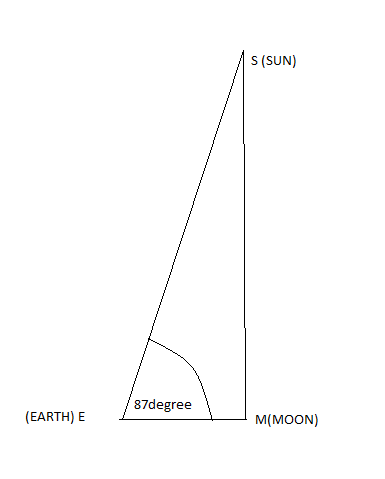
Premise 3: At the time of the half Moon (first or last quarter) the angle between Sun and Earth as seen from Earth is 87°.
• Inspecting the Figure F we get: ( ) o SideEM Cos 87 SideES =
- Therefore Distance of Sun from Earth = SideEM SideES 19.1timesEM Cos87degree = = (relation 5)
- Therefore Distance of Sun from Earth = 19.1 times the Distance of Moon from Earth-relation 5
- The relation 5 is a large under estimation because of lack of accuracy in the measurement of the angle subtended by Sun and Moon on Earth during the first quarter or last quarter of half Moon.
- The Modern value is 90° - 9 arc minute;
- Now 9 arc minute is 0.15°
- Therefore Cos (90°- 0.15°) = 2.618×10(-3); From relation 5, Distance of Sun from Earth = reciprocal of 2.618×10(-3) = 382 times the distance of Moon from Earth (relation 6) In 1672 CE, a more accurate value was determined by Jean Richer and Giovanni Domenico Cassini. According to their observations and computation Earth-Sun distance was 134 million Km, about10% less than the modern value of 150 million Km. The Sun-Earth distance is 390 times Moon- Earth distance. Aristarchus had underestimated the values because of erroneous observations but he did prove that Sun was far bigger than Earth and Moon and exceedingly far off.
In Table 2 all the results determined by Aristarchus through simple observations and elementary geometry are tabulated.
| Sun- Earth | Moon- Earth | Comments | |
|---|---|---|---|
| Aristarchus results of spacing | 19.1X | X | Grossly underestimated |
| Modern corresponding results | 390X | X | |
| Aristarchus results of size | Ds=(9) DE | D = (1/3 M to 1/4) D E | Sun diameter is under- estimated |
| Modern corresponding results. | Ds=(109) DE | D = M (1/3.67) D E |
Table 2: summarizes the findings of Aristarchus and compares them with modern values.
• • Table 2: summarizes the findings of Aristarchus and compares them with modern values.
Eratosthenes of Syrene (the modern day Shahhat in Libya)
Eratosthenes measured the circumference of Earth in 240 BCE. On Summer Solstice Eratosthenes measured the shadows of vertical poles at midday in Alexandria and Syria and from this information he calculated the circumference of Earth.to be 39,375Km which is very near the modern day measurement of 40,096Km.
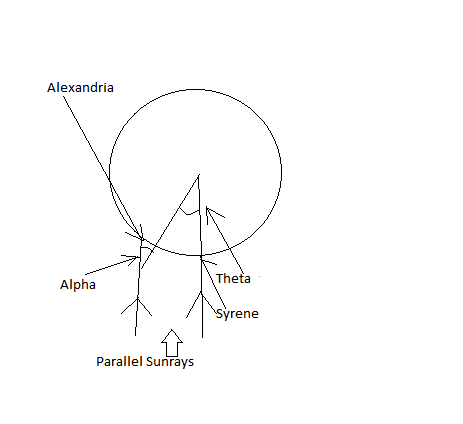
- At summer solstice no shadow is cast at midday at Syrene. The shadow of a vertical pole was measured at two places namely Cyrene and Alexandria. The two places lie on the same longitude.
- The distance between the two places is X =5000 stadia.
- The angle subtended by the arc length X on the center of the Earth= θ = 7.2°
- The angle made by Sun rays in Alexandria is = α;
- And because the Sun rays are parallel hence α = θ = 7.2° Length of theshadow in Alexandria Tan Height of thepolein Alexandria α = ;
1 o Length of theshadow in Alexandria Alpha Tan 7.2 Height of thepolein Alexandria − = = = o 360 X circumference θ = where θ=α= 7.2°
- Therefore, circumference of Earth= 250,000 stadia and 1 stadia =157.5m;
- Therefore, the circumference of Earth = 39,375Km which is very near to the modern value of 40,075 Km. (see subsection 8.6) o
- Therefore Hipparchus (190-120 BCE): Hipparchus was a Greek Astronomer. Geographer and mathematician. He founded Trigonometry. He discovered the precession (axial precession-- gravity induced slow and continuous change in the orientation of the astronomical body) of equinoxes [10]. He was the greatest Astronomer of Antiquity. He developed a reliable method of predicting solar eclipse. He compiled a comprehensive star catalogue. He invented astrolabe. He developed Armillary Sphere different from Celestial globe. This Sphere centered around Earth or Sun and he gave celestial longitudes and latitudes. Jean Baptista Joseph Delambre (1817). He considered him the true father of Astronomy. He compiled the Trigonometric Tables.
Posidonius (135 BCE to 51 BCE): Poseidonius, the Athlete, was a native of Apamea, Syria. He was the pupil of a stoic Philosopher named Pancetius. Poseidonius was the most learned person of Stoic School. Stoicism was the dominant school of thought during the Hellenistic period in Classical Antiquity. The goal of all inquiry should be to provide a mode of conduct characterized by tranquility and certainty of moral worth. He widely travelled and did scientific research. Finally, he settled as a teacher in Rhodes, his adopted Greek city. He was one person who did the most to spread stoicism. He was eclectic- a combination of old Stoics and Plato, Aristotle. He tried to calculate the diameter of Earth, he studied the influence of Moon on tides in oceans. He measured the distance and magnitude of luminosity of the Sun. Between 146 to 88 BCE he wrote 52 Volumes on the history of this period. He was a noted dialectician; a noted Observer and he prepared travel reports. He had ironic humour He practised Stoic Doctrine.
(99-55 BCE) Epicurean Philosopher Lucretius: Lucretius had a relational WorldView of time. In his book titled The
Nature of the Universe he writes “Time by itself does not exist. It must not be claimed that anyone can sense time by itself apart from the movement of things.
Claudius Ptolemy (90 CE -168 CE): Claudius Ptolemy propounded a geocentric world view as testified in his Almagest (2nd century mathematics and astronomical treatise on the apparent motion of stars and planetary paths written by Claudius Ptolemy written in Koine Greek) still held sway in the scientific community. In Almagest he writes, “The first cause of the first motion of the Universe, if one considers simply, can be thought as an invisible and motionless deity.” Ptolemy anticipated Newton, who would refer to absolute space many centuries later (in the Optiks) as the sensorium of God (the place where God could move bodies in the Universe). One of the earliest documents to deal with stars and constellations is a catalog found in the Latin astrological compendium called Liber Hermetis [11].
Liber Hermetis (130 BCE) [11]: Liber Hermetis (130 BCE) predates Ptolemy (150CE). Ptolemy lists 1020 new fixed stars in addition to those in Liber Hermetis. These 1020 stars became important to the Hellenistic Traditions. In classical antiquity, Hellenistic Period is Mediterranean history covering the time between the death of Alexander, the Great, (323 BCE) to the time of death of Cleopatra VII in 30 BCE. followed by the ascendancy of the Roman Empire (Battle of Actium 31 BCE) and Roman conquest of Ptolemaic Egypt by 30 BCE. The last major Hellenistic Kingdom was eliminated. Greek culture reached its peak in the Mediterranean and beyond. Attic based Greek dialect became the lingua franca throughout the ancient worlds.
Euclid (300 BCE): Greek culture was characterized by the work of Mathematician Euclid (prominent mathematician of Greco-Roman antiquity in 300 BCE and wrote the book on geometry in five parts titled “The Elements”).
• The polymath Archimedes (287 BCE to 212/211 BCE) from Syracuse, Sicily and mathematician and inventor. He was famous for his hydrostatic Archimedes Principle). Hellenistic Culture was characterized by grand monuments and ornate decorations exemplified by Pergamon Altar. The end of Hellenistic culture is marked by 146 BCE conquest by Romans of the Greek heartland following the Achaean war. The final defeat of the Ptolemaic kingdom was at the battle of Actium in 31 BCE. In 138CE Greek rule of Hadrian came to an end and Roman Emperor King Constantine moved the capital of the Roman Empire from Rome to Constantinople (modern day Istanbul in Turkey) in 330 CE. Deep seated belief in fixed stars and static Universe led Einstein to introduce cosmological constant in his General Theory of Relativity Equation in 1915 CE.
• Saint Augustine (354 - 430 CE): He gave a theological twist to Lucreteus’ argument for the relational nature of time in his “Confessions”, emphasizing that God created the World with time and not in time. Time comes with matter just as in Big Bang with the birth of Singularity Big Bang occurs giving birth to time. There is no yesterday in Big Bang Theory. • Chinese contribution to Geodesy (1940 CE): Chinese developed the science of navigation in 1940 CE. This was Geodesy. They developed magnetic compass needles. This helped in maritime navigation and for military purposes. At nighttime stars helped in navigation hence star maps were prepared. • In 1054 CE Chinese Astronomy: Chinese astronomers recorded in 1054 CE the appearance of a Guest Star in the constellation Taurus. It remained visible in the daytime for almost 23 days. This came as a rude shock for the Aristotelian World View. The night sky was unchanging but here we are visited by a Guest Star. Later it was realized that it was a supernova explosion at the end of a the life cycle of a massive star which has a mass between 1.44MΘ to 3MΘ. Crab Nebula seen in the night sky is the remnant of that Guest Star. Today we know that it had an apparent magnitude of 8.4 in 1054 CE and was located at 6400 ly in the constellation Taurus. In modern times a Neutron Star/pulsar spinning at 30 revolutions per second has been discovered in the middle of the Crab Nebula and it is pulsing at the same rate.
Transition to heliocentrism: the Medieval to early Modern Shift
Seeds of change in the Islamic Golden Age-the bridge from Classical Greek Astronomy to Modern Astronomy;
* Contribution of Nasir-Din-al Tusi (1201-1274 CE) and Ibn-al-Shatir (1304-1375CE); • Nasir-Din-al Tusi (1201-1274 CE) [12]: Nasir-Din- al Tusi developed the “Tusi Couple”. The Tusi Couple generated linear motion from the combination of two circular motions. The Ptolemaic System had complicated epi-cycles for planetary motions Tusi couple helped replace these epicycles as well as the Equant point in the Ptolemaic System. Equants were used by Ptolemy to explain the observed speed changes in different stages of planetary orbital motion. Tusi Couple was adopted by Copernicus to develop heliocentric model. Al-Tusi directed the MARAGHA OBSERVATORY in Persia, one of the most advanced observatories of the times. Star Charts astronomical tables (Zij-i-ilkhani) prepared by al=Tusi refined the Ptolemaic Model and improved planetary position prediction. He was a strong critique Ptolemaic Astronomy and questioned Ptolemaic System.
• Ibn al-Shakir (1304-1375 CE): Ibn al-Shatir proposed new geometric models which eliminated the equant points to improve Ptolemaic Models and made accurate predictions of planetary positions. He proposed modifications to lunar and planetary orbits which resembled Copernican models. He designed Sundials which were used in Mosques extensively. He worked in geo-centric framework but his mathematical models influenced Copernican Models transition to heliocentric framework.
Both these Islamic Scholars Nasir-Din-al Tusi and Ibn- al-Shakir created the bridge from Classical Greek Astronomy to Modern Astronomy resulting in a paradigm shift from the Ptolemaic Model to a more sophisticated and observational accurate system.
The Scientific Revolution (the Renaissance Awakening)
Disorienting discoveries in the Medieval times:
- In 1543, Nicolaus Copernicus (1473-1545 CE) shifted the pivot of the Universe from Earth to Sun- geocentric world-view was changed to heliocentric world-view. He noted at the beginning of the De Revolutionibus, “Nothing prevents the earth from moving…. for it is not the center of revolution.” Though COSMOS was kinematically centered around Sun, Copernicus did not attach space dynamically to the rest frame of the sun or any other body but followed Aristotle in associating it metaphysically with the sphere of fixed stars which contain itself and everything and is therefore immovable. It is unquestionably the place of the Universe, to which the motion and position of all other heavenly bodies are compared. Fifty years later astronomical observations could no longer be reconciled with the notion of rigid planetary spheres leading Johannes Kepler (1571-1630 CE) to declare , “From henceforth the planets follow their planetary paths through the ether like the birds in the air. We must therefore philosophize about these things differently.” Thoughts such as these led Kepler to the radical idea of attaching the rest frame of space to the physical bodies rather than to the metaphysical reconstruct. (Kepler conceived of forces extending outward from the Sun and sweeping the planets along in the orbits). The law of planetary motion that he derived subsequently has been characterized by Julian Barbour in the Discovery of Dynamics (1989) as the triumph of pre-Machian ideas of Mach’s principle. 1. Heliocentric world-view permanently changed our place in the Solar System; 2. Unfixing the stars led to greater changes in the model of Universe;
- 1548-1600 Giordano Bruno- an Italian monk, Renaissance Philosopher, cosmologist and mathematician. Roman Catholic believed in closed, finite Universe but he preached an infinite earths and infinite suns and he summed up his views in the book published in 1584, “The infinite Universe and Worlds”. This heretical text led to his excommunication from the Dominican Order and eventually his trial by Catholic Inquisition.in Venice. On 17th February 1600, he was burnt at stake in the marketplace (Campo de’ Fiori) of Rome. The same marketplace today has a giant size statue of G. Bruno installed.
• 16th Century Danish Astronomer Tycho Brahe -He continuously built and refined astronomical instruments, and he improved the accuracy of observation. He launched specific campaigns and efficiently collected data when the planets were in interesting geometric configurations such as in conjunctions or in oppositions. He was the last of the naked eye astronomers He observed the comets in detail, and he dismantled the popular Aristotelian world view of a perfect, fixed and unchanging Universe beyond Moon’s orbit. Even as he challenged the old paradigm, he was not comfortable with the heliocentric model. He crafted an alternative model where all planets orbited Sun, but Sun orbited Earth with all the planets in tow. Figure 9 {Andreas Cellarius (1708) gives Harmonic macrocosmica (cosmic harmony) which conveys Tycho Brahe’s compromised Model [Courtesy: Stephen S. Clark Library University of Michigan Library]}. The Aristotelian Model of Universe was well entrenched in the minds of the Scientific Community Hence it could not be dislodged from its supremacy in the World View of Universe. A slow and steady accumulation of solid supporting evidence finally led to the paradigm shift.
• Following are the observations which brought the titanic shift: 1. Galileo (1609-1610) discovery of Galilean moons of Jupiter and the phases of Venus like Moon when observing through a Telescope and while not transiting across the Sun. Moon goes through its different phases namely beginning from a thin crescent it waxes to a full disk and then wanes to thin crescent before disappearing altogether after which the cycle repeats. This supported the Venus orbit around the Sun.
2. Kepler’s three laws also supported the heliocentric model;
3. Isaac Newton law of universal gravitation and three laws motion directly resulted in an elliptical path of planets as already stated by Kepler earlier. This was the final death knell in Ptolemaic Model;
![Figure 9: The Sun is spiraling around Earth but all the other planets are orbiting the Sun. [Courtesy: Stephen S. Clark Library University of Michigan Library].](/fulltextimages/13961/fig_9.png)
• Tycho Brahe’s student appears on the scene namely Johannes Kepler (1571-1630). Kitty Ferguson of N.Y. Walker 2002 commented, “Tycho and Kepler the unlikely partnership that forever changed our understanding of the Heavens” Kepler, after the death of Tycho Brahe, inherited the custodianship of all the observational data of Tycho Brahe. Kepler after studying the vast compendium of data especially his data on Mars helped him conclude the following three laws: 1. Orbits of Planets within our Solar System are ellipses; 2. In an elliptical planetary orbit, with Sun at one of the foci of the ellipse, a line segment joining the planet with Sun sweeps equal area in equal interval of time;
3. The square of orbital period of a planet is proportional to the cubic power of planetary semi-major axis; The mathematics of the planetary paths were understood but the physics was not understood. Even Kepler did not understand why planets are orbiting the Sun. In ancient times Ptolemy believed in a Prime Mover that spurred the celestial spheres. Kepler failed to arrive at the concept of INERTIA and invoked the rotation of the Sun as the continued and dynamic source of energy that holds the Solar System aloft. More accurate data from Brahe provided the adjustment to Earth’s orbit and this was crucial to Kepler’s inference of elliptical planetary orbit. Allowing the correct placement of Earth’s orbit and the formulation of Kepler’s law came the solution to the Mars puzzle. Earth and Venus are orbiting in nearly circular orbit. Mars has much higher eccentricity. Kepler could not settle the issue on planetary motion which was decisively solved by Newton. Newton made the boldest leap in imagination by uniting the terrestrial and Celestial. Henceforth no distinction will be made between heaven and earth. In the 1600s the scientific method of investigation started . In last 17th century French Master engraver Bernard Picart reveals the concept of plurality throughout the cosmos-
- multiplicity of stars like our sun;
- these stars harbour their own planetary systems which are mirror image of our solar system;
- beyond the solar system there a large entity which needs to be mapped;
Copernican heliocentric arrangement of the heavens coupled with Kepler’s law finally accounted for the retrograde motion of Mars;
![Figure 10: Viewed from the vantage point of Earth, in its orbit around Sun, Mars appears to travel backward periodically in the sky, only to resume its forward motion. Copernican heliocentric arrangement of the heavens coupled with Kepler’s law finally accounted for the retrograde motion of Mars; [Courtesy; NASA-Earth Observatory]](/fulltextimages/13961/fig_10.png)
The Dawn of Telescopic Astronomy [14] 400 years ago telescopes began to open the wonders of the Universe to humanity. The science of optics - light rays reflecting and refracting - began around 1000 CE studied by one of the scholars of Iraq, named Ibn-al-Haythem (called by Europeans- Albazen). Roger Bacon, the Franciscan Monk, first suggested lenses for weak eyes Making eyeglasses in frame began in 1300 in Italy and spread across Europe. Girolamo Fracassaro of Vienna (who studied in Padua along with Copernicus) suggested in 1538 that if you look through two spectacle lenses one on top of the other then you will get a magnified image. Middleburg, capital of South West Dutch
province Zeeland, had a glass factory and several spectacle makers called Hans Lipperslay, Hans Janssen and his son Zacharias in 1590 made the first microscope. By 1660 microscopes started being used when Leeuwenhoek made a more powerful one-lens kind. Two decades have passed. Lippershey thought of holding different lenses farther apart to give long distance magnification.
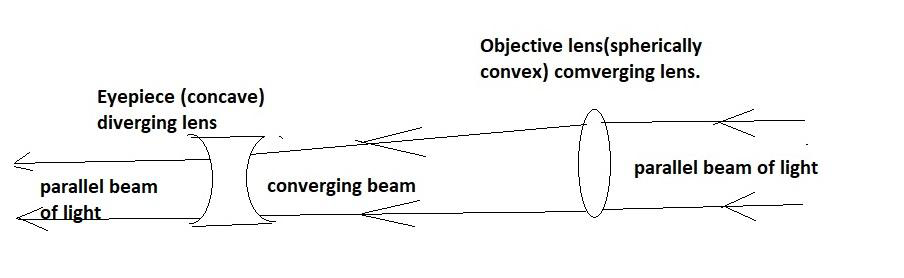
Figure 11: A prototype Telescope. (credit:Author) In September 1608 Lippershey applied for a patent of Telescope but it was refused on the ground that it was very easy to duplicate. Other spectacle makers across the shops and markets all over Europe were making the telescope. In March 1609 this news reached a great scholar in Venice named Paulo Sarpi. He wrote the detailed diagram of this to Jacques Badovere in Paris. In May 1609 Sarpi received a reply. Galileo was a teacher of Badovere and friend of Sarpi.
Galileo visited him at that time and examined the diagram of the Telescope. At that time Galileo was a Professor of Mathematics in Padua, the oldest University in the Republic of Venice. After returning from Venice he made the first telescope. It was magnified 3 times using ordinary spectacle lenses. He set the lenses in a lead tube. As shown in Figure 11 the convex lens was set on one end of the lead tube and the concave lens on the other.
| Italian | spy glasses | Ochiale or visioro |
|---|---|---|
| Latin | Perspicillum | “little things for looking through” |
| Greek | Telescopio and telescope | “far seeing” |
Table 3: Name of telescope in Italian, Greek and Latin.
This telescope was not sharply focussed. Galileo had pushed Science a long way from verbal towards the mathematical and experimental. He taught himself to grind and polish lenses. He developed a technique for checking the curvature of the lenses. By August 1609 he achieved a magnification of 8 or 9 times. He placed his invention before the Senate of Venice. The military application of this instrument was obvious. He presented it to the Republic. By November 1609 he achieved a magnification of 20. He turned his telescope towards the Moon. He began the rush of astronomical observations that overthrew 2000 years of what had been considered as knowledge. Throughout the past centuries the World View of Universe was as prescribed by Aristotle in 300 BCE or by Ptolemy in 100CE. This World View was accepted by the Church as well as by the scripture. Nicolaus Copernicus authored de Revolutionibus orbium coelestium libri vi (Six Books concerning the Revolution of Heavenly Orbs) published in 1543. This book was supported by Galileo which resulted in his persecution. Galilee entered into argument with the Church in his own name in the book Il saggiatore (The Assayer) published in 1628.
Foreseeing trouble, Lutheran Theologian Andreas Osianden had inserted an unsigned preface stating that heliocentric had been inserted only for simplifying the celestial calculations. It is not a description of reality.
The dominant WorldView till 1609 was: Earth was at the center of the created and unchanging COSMOS, a heavy unmoving home of corruption : around it was Moon, the Sun and five other planets as wanderers namely Mercury, Venus , Mars, Jupiter and Saturn, perfect sphere moving in perfect circles since there can be no imperfections in heavens, beyond Saturn was the rotating sphere of stars. Natural philosophy was the interpretations of the pronouncements of earlier authorities. Griodano Bruno was jailed for 7 years (naked and gagged) and then burnt at stake in 1600. Tycho Brahe retreated to compromise. He definitely was the greatest recorder of naked eye measurements. But because of his deeply entrenched biases, his World View consisted of Sun being at the center of Mercury, Venus, Mars, Jupiter and Saturn but the Sun in turn is orbiting Earth with five planets in tow as shown in Figure 9. In 1601 Kepler succeeded Tycho Brahe as the Mathematician to the Holy Roman Empire at Prague. Kepler’s Astronomia Nova (New Astronomy - New Astronomy based upon Causes or Celestial physics treated by means of commentaries on the motion of the Star Mars from the observations of Tych Brahe, Gent) was published in 1609. The 2009 International Year of Astronomy is dedicated to the 400th Anniversary of telescopic Astronomy invented in 1609 [14]. This 400th Anniversary is dedicated to:
- Kepler’s the Astronomia Nova; and
- to the discoveries of Galileo as described in Sidereus Nuncius or Sidereal Messengers; Kepler and Galileo disrupted the century-old Aristotelian and Ptolemaic Paradigm, advanced the Copernican Revolution, and set the stage for Modern Science. Galileo’s 1609 invention of Telescope represents a moment when technology and human curiosity combined to transform our World View so radically that it makes the event of 1609 a watershed in the history of Astronomy. Astronomical Observations became the engine of discoveries providing evidence for various Cosmic Phenomena.
Galileo Galilei (1564-1642) A pioneer of Modern Science. He firmly believed that the book of nature is written in the language of mathematics. Rather than identify the fixed stars with the rest frame of space in the abstract sense he asserted (in the Dialogue) that they are physically at rest in space. “The fixed stars (which are so many suns) agree with our sun in enjoying perpetual rest in space. Galileo adopted an absolutist view of space. In fact he was the first to use the actual term of “absolute motion” in his theory of tides.
His major contributions:
- Performed the Leaning Tower of Pisa experiment to disprove the Aristotelian erroneous conclusions about falling bodies. Aristotle made no measurement and came to erroneous conclusions namely:(a) The speed of a falling body is in proportion to its weight. 10Kg mass will fall ten times faster than a 1Kg mass. (b) The speed of a falling body is inverse proportion to the resistance of the medium through which it is falling. Hence a body falling through Vacuum will fall with infinite speed because Vacuum has zero resistance. Galileo proved these two conclusions to be wrong by performing the experiment from the Leaning tower of Pisa. He dropped two lead balls of different weights from the Tower and the two hit the ground at the same time disproving century old Aristotelian view on the falling bodies. The same experiment was carried out on the Moon during Apollo 15 Mission 1971 [15]. Mission Commander and Astronaut David Scott dropped a Aluminum Geological Hammer 1.32Kg and Eagle Feather 0.00032Kg from a height of 1.6m and the two reached the Moon surface simultaneously [16]. This established “The Universality of Free Fall” or “The Equivalence Principal” which is the cornerstone of Modern Physics.
- Between 1589 to 1592 wrote a book on motion titled “de Motu”.
- Invention of Telescope;
- Discovery of four moons of Jupiter now known as four Galilean moons- Io, Europa, Ganymede and Callisto;
- He discovered the sunspots. To establish this as a irrefutable fact Galileo wrote Istoria e dimostrazioni intorno alle macchie solari e loro accidenti (“History and Demonstrations Concerning Sunspots and Their Properties,” or “Letters on Sunspots”), which appeared in 1613.
- He discovered the phases of Venus; By the use of Telescope we can see the waxing and waning of Venus just as we see the Moon waxing from thin crescent to full moon and full Moon waning to thin crescent. Only at the transit of Venus across the face of the Sun , which is a very rare event, do we see it as a black dot moving across the face of the Sun as shown in the Figure 12 below.
![Figure 12: Transit of Venus across the face of the Sun on 5th June 2012.Sequence of images of transit composited to show the path of Venus as black dots across the face of Sun. The event lasted for 6 hours. [Courtesy: NASA/Goddard Space Flight Center/ SDO].](/fulltextimages/13961/fig_12.png)
This event occurs in pairs of 8 years apart. It occurred in 2004 and then in 2012. Next pair will occur 105 years or 121 years later. The next pair will occur in 2117 and 2025 Edmond Halley of Halley’s Comet fame suggested using the transit of Venus for measuring Sun-Earth distance. In 1761 and 1769 the transit occurred and by parallax method Venus to Earth distance was measured in an identical manner as Cassini did in 1672 while measuring the distance between Earth and Sun (see Subsection 8.6) had measured the distance from Earth to Mars during Mars opposition in 1621 CE. By Kepler’s law the relative distance of all the planets can be determined. Venus distance is known to be 0.72AU this can be converted to distance in Km and from there all the planetary distances are deduced. In the Modern World Radar and Spacecrafts have made this method obsolete but it remains of historical importance in Astronomy.
- He discovered the surface of the Moon which is mountainous, and crater marked just as rugged as the surface of Earth.
- Aristotle taught that Moon was a smooth sphere;
- He advanced the notion of Celestial Physics;
In 1592 he replaced the Aristotelian notion with Archemedian notions. Because of this his contract (Chair of Mathematics at Pisa University) was not renewed. But he obtained the Chair of Mathematics at Padua University where he stayed from 1592 to 1610. In 1609 while describing the trajectory of projectiles as a parabola, he stated the vertical displacement as s= (1/2) gt2 where g = the acceleration due to gravity. In 1610 he summarized his findings in Sidereus Nuncius (Sidereal Messenger). He dedicated the moons of Jupiter to the Duke of Tuscany and called them Medician Stars which are now called Galilean moons. While in Padua he discovered the Rings of Saturn and while in Florence he discovered the phases of Venus just like the phases in the Moon. After these momentous observations Galilee became a committed Copernican. At this time a debate started about the nature of sunspot. With Christopher Scheimer (a German Jesuit and a Professor of Mathematics). Galilee believed these spots to be a contiguous part of the Sun where the Jesuit regarded these spots as satellites of the Sun. He wrote a letter titled History and Demonstration Concerning Sun Spots. It was published in 1613. In the same year he wrote a letter to his student Benedetto Castelli to reconcile the Church with his discoveries which testified to the Copernican model. In 1613 his letter was sent to the Inquisition in Rome where Dominican Fathers of Florence lodged a complaint against Galileo in Rome. Before travelling to Rome Galileo wrote a letter to the mother of Grand Duke, the dowager Christinia. The Inquisition Consultant pronounced Copernican theory heretical. Kepler’s Epitome of Copernican Astronomy was banned. Nicolaus Copernicus authored de Revolutionibus orbium coelestium libri vi (Six Books concerning the Revolution of Heavenly Orbs) published in 1543 was suspended with corrections. Robert Cardinal Bellarmine admonished Galilee. At this time Galilee entered into a controversy about the Comets (3 Comets had appeared in 1618). Galilee entered into argument with his adversaries. He wrote a book in his own name titled Ilsaggiatory (The Assayer) published in 1623. It was a brilliant polemic on physical reality and about the New Scientific Method. - a discourse on the emerging Science.
Philosophy is written in this open book, the Universe, which stands continuously open to our gaze. But the Book cannot be understood unless one first learns to comprehend the language and read the letters. It is written in the language of Mathematics, and its characters are triangles, circles and geometric figures without which it is humanly impossible to understand a single word.
Ilsaggiatory (The Assayer) came at an auspicious time, for maffeo Cardinal Barberini (1568-1644), a friend, admirer, and a patron of Galileo for a decade was named Pope Urban VIII as the book went to press. The book was dedicated to the new Pope. In 1624 Galileo went to Rome and had 6 interviews with the Pope. Urban VIII. Galileo told about his theory of tides due to the Moon and Sun as a proof of annual and diurnal motion of Earth. The Pope gave the permission on the condition that the Copernican Model must be hypothetical. Galileo concluded his scientific investigation by The book, Dialogo sopra i due massimi sistemi del mondo, tolemaico e copernicano (Dialogue Concerning the Two Chief World Systems, Ptolemaic & Copernican), written in the period 1624 to 1632, Galileo had obtained the permission to write the above book from the Pope but he had to maintain neutrality. In this book he concluded that we cannot presume to know which model the Omnipotent Creator chose to use. It was academically acclaimed but was condemned by the Church. Jesuit Cardinal Roberto Ballarmine (raised to Sainthood from 1630 and one of the judges who condemned Giordono Bruno to death) had declared the Copernican view as heretical and his book had been placed on the index of prohibited books. The Pope had personally instructed Galileo to not teach the Copernican Model. This enabled persecution to level the charges of heresy against Galileo. In February 1632 Galileo had to travel to Rome at the advanced age of 69 years. On June 21, 1632, he was found guilty of having held and taught heliocentric dogma and ordered to recant, reciting that he abjures, curses and detests the belief that Earth moves. But on his way out he murmured “that it does move”. He spent his last 7 years under house arrest. Till 1634, his daughter Sister Maria Celeste looked after him. After his daughter passed away he was working on his book named Discourses on Two New Sciences. The manuscript was smuggled out to Leiden, the Netherlands, where it was published in 1638. After this he became blind and he was assisted by his young student, Vincenzo Viviani, and he worked on Pendulums and intended to develop a pendulum clock. He breathed his last on 8th January 1648.
Rene Descarte (1596-1650 CE): He believed implicitly in absolute space and uses the concept to arrive at something very similar to those of Newton’s eventual first law.of motion. After learning of Galileo’s trial by Inquisition he puts off publishing his results by more than a decade and even then he prefaced his publication (in the Principia Philosophe) with the disclaimer stating that all motions after all are relative. He may have been the first to hold both absolutist and relational views.
English Physicist Isaac Newton (1642-1726) appears on the scene. He gave the Universal Law of Gravitation namely:
Force of Gravity between two bodies m1 and m2 is:
1 2 2 m m G r × = = Inverse square Law where m1 and m2 are the masses, r is the distance between the two objects and G is the gravitational constant.
In 1687 The Magnum Opus Philosophiae Naturalis Principia Mathematica was published. In that he stated, “Absolute, true and mathematical time, of itself and from its own nature, flows equally without relation to anytime external…. absolute space in its nature, flows without relation to anything external remains always similar and immovable.” Without Kepler’s Law, Principia would have been inconceivable. Newton made the boldest leap, thus far, uniting the terrestrial and celestial with an universal of gravitation. The radical transformation in World View - heralded by Copernicus and supported by telescopic observation of Kepler, Galileo and many others revived another ancient speculation about the structure of COSMOS - plurality of worlds that could exist throughout the Universe- a multiplicity of other stars which could harbour their own planetary systems. In 1686 French polymath Bernard Le Bovier de Fontenelle published “Conversations on the Plurality of Worlds”. In that book he describes the new order of COSMOS - the Copernican World View - with clarity and simplicity. Two centuries later astronomer Camille Flammarion published his book in 1862 “Plurality of inhabited World”. He boldly asserted the possibility of life as we know to exist elsewhere.
Today we model using computers instead of astrolabes - but we are still explorers. We draw and redraw our cosmological maps with the help of increasingly sophisticated instruments.
Newton stressed that absolute space could be demarcated by hanging a bucket of water from a rope and spinning it. As shown in the figure the water level becomes concave.
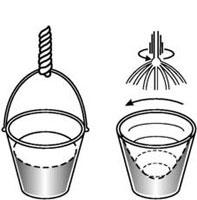
The concave shape of water showed that water had a frame of reference. German Mathematician and Philosopher Gottfried Wilhelm Leibniz (1646-1716 CE) retorted in a debate with Newton’s disciple Samuel Clarke. “Space is nothing but an order of existence of things, observed as existed together, and therefore the fiction of a material finite Universe moving forward in an infinite empty space cannot be admitted. Such an action would be without any design in it: it would be working without doing anything. There would be no change which could be observed by anyone whatsoever.” An even more explicit statement of the relational view came from philosopher “Father of Idealism” Bishop George Berkeley (1685-1753 CE) who wrote in his book De Motu that in empty space it would not be possible to conceive of two globes orbiting around a common center and an observer, moving along with a globe, would see nothing changing. But suppose the sky of fixed stars are created then the movement will be conceived. Newton had an absolutist view. Newton united the terrestrial with celestial. In 1600 the methodological program of Science was started in earnest.
- In February 1848 Edgar Allen Poe (an American Editor and literary critic) gave a lecture titled “On the cosmography of the Universe”. He described the Universe as restless and evolving in contrast to the Ancient view of the Static Universe. It needed support from data which came in 1929. Hubble and Humason found an incredible correlation: The farther was given a Galaxy faster it was receding from us. This was as radical a shift as the one in 1543 proposed by Copernicus. COSMIC MAP got a 20th century make-over.
- In 1887, American Physicist Albert A.Michelson and Edward W.Morley experimentally proved that there is no all pervading luminiferous aether present in the Universe for propagation of light [17]. The light wave is electro-magnetic wave travelling through the vacuum as a transverse electromagnetic wave.
- James Clerk Maxwell (1831-1879) used Gauss Law, Faraday law and Ampere’s Law to give the 4 underlying equations of Elctro-magnetic waves and in vacuum these EM waves self-propagate with the velocity of light ‘c’ = 1/√εoμo where μo = absolute permeability and εo = absolute permittivity.
- Hendrik A, Lorentz (1853-1928) in 1878 introduced Lorentz Transformation for cases where the frame of reference is moving at a velocity near the velocity of Light. This was a generalized form of Galilean Transformation in classical Mechanics. Lorentz and Fitzgerald proposed for the first time that in a frame of reference moving at near velocity of light experiences length contraction and time dilation. This laid the groundwork for Special Theory of Relativity by Einstein in 1905. In a series of lecture by Scott A. Hughes of Massachusetts Institute of Technology shows that by introducing Time Dilation, Length Contraction and Mass enhancement velocity of light becomes invariant of frame of reference [18]. The Lorentz Transformation is as follows:
If in rest Frame mass, length and time interval are m0, L0 and t0 then in a moving Frame moving with velocity v mass, length and time interval are: 0γ m and 0 γ L where
1 γ = − v c
1 2 This results in mass enhancement, length contraction and time dilation. This ensures invariance of velocity of light c = 2.99792458×10⁸m/sec in all frames of references.
Ernest Mach (1838-1916 CE) He had a relational view In Science of Mechanics (1883) he revisits the spinning bucket of water. He gives a thought experiment in which the side of bucket is increased in thickness as well as in mass.
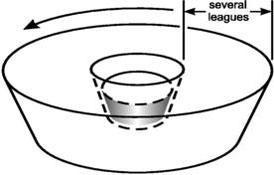
Mach’s observation was that water level will remain flat. But it was difficult to verify this conclusion experimentally.
Gravity Probe-B (GP-B) the modern day realization of Newton’s spinning bucket experiment: In 1894 Immanuel Friedlander (1871-1948) tried to carry out this experiment but he got no definite results. August Foppl (1854-1948) tried to align the spin axis of Earth and that of a pair of heavy flywheels when the axis of rotation was aligned with longitude and next with latitude. He too found no definitive answers. Gravity Probe- B (GP-B) is the modern day realization of Newton’s spinning bucket experiment. Earth Planet is the rotating bucket and water level is simulated by precision ‘gyroscope.
GP-B is a NASA Physics mission to verify two predictions of General Theory of Relativity: Geodetic Effect and Frame Dragging Effect. According to Einstein, the presence of mass and energy causes warping of Space-Time Fabric which is the Geodetic Effect and rotation of a massive body causes the Frame-Dragging effect. The precession of the spin axis of the four gyros around the polar axis of the orbital plane of the satellite was measured as 6.6 arcseconds per year (measured value was 6,602±18 mas and predicted value was 6,606mas in the orbital plane). This is Geodetic Effect. Gyros precess perpendicular to the orbital plane of the satellite and advance 40 milliarcsecond per year (measured value was 37.2±7.2 mas and predicted value was 39mas).This is Frame- Dragging Effect [19].
The findings of GP-B probe regarding the hypothetical Mach’s Bucket experiment- In General Relativity, space- time curvature and frame-dragging effects are calculated based on the distribution of mass energy. A bucket as massive as Earth would significantly warp spacetime locally, creating non-Newtonian effects that could influence water’s behaviour. In this hypothetical scenario, whether the water forms a concave surface depends on the balance between: a. The distant universe’s contribution to defining the inertial frame; b. The massive bucket’s ability to locally dominate the spacetime geometry through frame-dragging. If the massive bucket sufficiently alters the local spacetime and inertial frame, the water may not form a concave surface as it would in Newton’s original experiment. However this remains speculative and would require advanced relativistic calculations to determine the exact outcome.
The Greek ancient World View transits to the Modern World View: The ancient world view; The stars are fixed and Sun, Moon and Planets rise and fall periodically. **
- The year 1718:** Edmund Halley (1656-1742) a Londoner gave evidences contrary to the fixed star model. He was the second astronomer Royal. He found that stars Sirius, Arcturus and Aldebaran had strayed from their positions as chronicled by ancient Greek astronomer Hipparchus about 2000 years ago. These stars had moved southward by > 30’ in 2000 years. This was the Proper Motion of stars due to the orbital motion around the galactic center in 225 million years. He authored “A Synopsis of The Astronomy of Comets.” In this he studied 24 Comets which appeared in the period 1337 to 1698. Among these comets the ones visiting Earth in the years 1531,1607 and 1682 were the same comet of short period of orbital period 75 years approximately. Halley pointed out that they were the same comet visiting earth at a period of 75 years subsequently it was named after him as Halley Comet. It appeared in 1986 in recent times and it is expected to revisit us in 2061. In 1678 he prepared a Star Catalog of Southern Stars. In 1678 he became the fellow of the Royal Society of London. By the study of Venus transit in 1761 and 1769 utilizing Solar Parallax method (see Subsection 4.2.1.). He calculated the distance between Sun and Earth. In 1720 he succeeded Flamsteed as the Astronomer Royal of Greenwich. He played a critical role in getting Newton’s Principia published in 1687.
- 1920, Hubble and Humason discovered that the nebulae beyond our Milky Way were independent galaxies in their own right. That is, the Milky Way is just one among the many galaxies. The duo were using the Cepheid variable as the scale for distance measurements. The distance to Andromeda Galaxy was measured to be 1,000,000ly from Earth. 300,000ly is the size of our Galaxy. NGC 6822 is 700,000ly distant from us.
- 1920 saw the emergence of the model of expanding Universe;
- Today we are recording light from the infancy of our Universe;
- Newton’s Philosophiae Naturalis the Principia Mathematica established that the Solar System works as a clockwork governed by natural laws. Newton regarded universe to be stable and steady;
- Copernican Revolution discovered the helio-centric Universe but the concept of fixed universe was retained in Copernicus world-view. Only the focal point was reorganized;
The scientific discipline that has transformed our conception of our Universe and our place in it is COSMOLOGY. Cosmology is the science of the origin and development of the Universe. Before 1914 we clung to the ancient Greek world view that Universe is static and non-changing and Milky Way was the entire Universe - alone, stagnant and small. After 1914 with the discovery of expanding Universe made by Hubble and Humason at Mount Wilson Observatory, Hawaii, our Universe became dynamic place expanding at an accelerating rate whose principal constituent materials are dark matter and dark energy which cannot be seen but we can only feel it because of its gravity. Dark Matter gravitates but do not interact with ordinary matter. Hence we cannot take its image. All the elements in the Periodic Table which constitute us and the stars are mere 4% of the total inventory of our entire Universe. Hubble Frontline Initiative [20, 21] was taken up to peer into the distant Universe and to map the dark matter more accurately then ever before - the dark matter is the gravitational scaffolding on which the entire visible Universe is built and that attracts most of the cosmos normal matter.
Detection of Dark Matter: In 1970, US astronomer Vera Rubin confirmed the existence of dark matter - dark matter exists as a vast web-like structure that winds through the whole Universe- a gravitational scaffolding that attracts normal matter. Figure 15 gives the distribution of Baryonic Matter throughout the universe and figure 16 gives the distribution of Dark Matter throughout the Universe.
![Figure 15: Large Scale Distribution of Baryonic Matter. The bright spot is the location of our Milky Way. [Courtesy- Large Numerical Simulation for Dark Matter Surveys@ Marenostrum Supercomputer]](/fulltextimages/13961/fig_15.png)
![Figure 16: Large Scale Distribution of Dark Matter. The bright spot is the location of our Milky Way [Courtesy- Large Numerical Simulation for Dark Matter Surveys@ Marenostrum Supercomputer].](/fulltextimages/13961/fig_16.png)
Cosmology emerges as a scientific discipline
The powerful confluence of new ideas and new instruments bring a qualitative leap in our World-View of Universe.
Spectrographs which analyze the chemical composition of distant stars: Joseph von Fraunhofer (1787-1826)- The light emitted by an object is akin to the fingerprints of the constituent chemical elements contained in the object. Every element has its own characteristic spectrum. Hence any object light spectrum will reveal the chemical elements it is constituted of. Fraunhofer made a major breakthrough in optical astronomical telescope lenses in 1814.A prism disperses different frequencies of light emitted or absorbed by an element. Red light is dispersed the least and violet light is dispersed the most thus generating a rain-bow spectrum. While measuring sunlight spectrum he detected 600 dark lines now known as Fraunhofer lines. These lines reveal the atomic composition of Sun.In 1859 Chemist Robert Bunsen and Physicist Gustav Kirchoff, both German, showed that each chemical element emits and absorbs its own characteristic set of wavelengths, producing its unique fingerprint of spectral lines. William Huggins, a Londoner, in 1854, studied the lunar, planetary, cometary, stellar and galaxies light and found the same set of spectral lines establishing that they are all constituted of same kind of materials. Fraunhofer set in motion the technique and technology that refined spectrograph, the key instrument for precision measurement of speeding nebulae which led to the inference of dark matter 120 years later.
- Fraunhofer Lines and Atomic Composition (1814- 1815)- There are 600 dark lines interrupting the rainbow-coloured spectrum of sunlight. Specefic wavelengths were being absorbed by distinct elements present in Sun atmosphere. Unique pattern of dark lines identified the elements present. This marked beginning of Astrophysical Spectrograph.
- Refinement of Spectrograph- By the late 19th century and early 20th century Doppler Shift was measured for ascertaining the speed of nebulae (receding or approaching).
- Spectroscopy was being used to establish the theory of Expanding Universe.
Table 4 gives Fraunhofer Dark lines, their corresponding wavelength and the element causing the absorption dark line.
| Element | Colour & Wavelength in nm | Colour & Wavelength in nm | Colour & Wavelength in nm | Colour & Wavelength in nm | Comments |
|---|---|---|---|---|---|
| H | H-alpha 656.3 (RED) | H-beta 486.1(CYN- BLUE-GREEN) | H-gamma 434(VIOLET) | H-delta 410.2(VIOLET) | Balmer Series. |
| Ca | H line 396.8(VIOLET) | K line 393.4(VIOLET) | These lines are prominent in Sun’s Spectrum | ||
| Fe | 526.9(GREEN) | 495.8(CYN) | Multiple Absorption Lines across the spectrum | ||
| Na | Na D1 589.6(YELLOW) | Na D2 589(YELLOW) | |||
| Mg | Mg b line 516,7; 517.3;518; (GREEN) | Triplet | |||
| O | Near 687; 760; (RED) | Molecular Oxygen line | |||
| He | 587.6; 760; (RED) | Less prominent in Solar spectrum but visible in chromospheric spectrum | |||
| C | Found in UV & IR | ||||
| N | Primarily in UV | Molecular Nitrogen Bond. | |||
| Other metals | Ti | Ni | Cr | ||
| 450-500 (BLUE- GREEN) | GREEN & YELLOW | 520(GREEN) | |||
| RED | ORANGE &YELLOW | GREEN | BLUE | VIOLET | |
| H-alpha; Oxygen molecular Band | Na D line | Mg TRIPLET; Fe line | H-beta; Fe | Ca H-line; K line; H-gamma; H-delta |
Table 4: Various Fraunhofer Dark Lines, their wavelength and the element causing it.
Element Colour & Wavelength in nm Colour & Wavelength in nm Colour & Wavelength in nm Colour & Wavelength in nm Comments
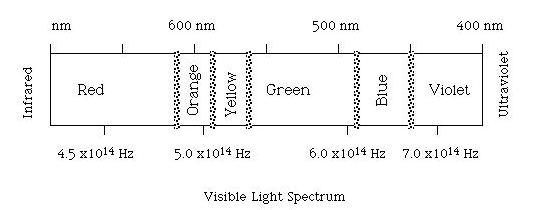
These lines are studied in Solar and Stellar Spectroscopy to determine the composition, temperature, motion of stars and galaxies.
Use of Spectrograph for Velocity Measurement of Nebulae Faint Object Spectrograph: A spectrograph disperses the light gathered by a telescope so that it can be analyzed to determine such properties of celestial objects as chemical composition and abundances, temperature, radial velocity, rotational velocity, and magnetic fields. The Faint Object Spectrograph (FOS) examines fainter objects than the HRS (High Resolution Spectrometer), and can study these objects across a much wider spectral range -- from the UV (1150 Angstroms) through the visible red and the near-IR (8000 Angstroms).
The FOS uses two 512-element Digicon sensors (light intensifiers) to detect light. The “blue” tube is sensitive from 1150 to 5500 Angstroms (UV to yellow). The “red” tube is sensitive from 1800 to 8000 Angstroms (longer UV through red). Light can enter the FOS through any of 11 different apertures from 0.1 to about 1.0 arc-seconds in diameter. There are also two occulting devices to block out light from the center of an object while allowing the light from just outside the center to pass on through. This could allow analysis of the shells of gas around red giant stars of the faint galaxies around a quasar.
The FOS has two modes of operation PP low resolution and high resolution. At low resolution, it can reach 26th magnitude in one hour with a resolving power of 250. At high resolution, the FOS can reach only 22nd magnitude in an hour (before S/N becomes a problem), but the resolving power is increased to 1300.
Goddard High Resolution Spectrograph: The High- Resolution Spectrograph also separates incoming light into its spectral components so that the composition, temperature, motion, and other chemical and physical properties of the objects can be analyzed. The HRS contrasts with the FOS in that it concentrates entirely on UV spectroscopy and trades the extremely faint objects for the ability to analyze very fine spectral detail. Like the FOS, the HRS uses two 521- channel Digicon electronic light detectors, but the detectors of the HRS are deliberately blind to visible light. One tube is sensitive from 1050 to 1700 Angstroms; while the other is sensitive from 1150 to 3200 Angstroms.
The HRS also has three resolution modes: low, medium, and high. “Low resolution” for the HRS is 2000 -- higher than the best resolution available on the FOS. Examining a feature at 1200 Angstroms, the HRS can resolve detail of 0.6 Angstroms and can examine objects down to 19th magnitude. At medium resolution of 20,000; that same spectral feature at 1200 Angstroms can be seen in detail down to 0.06 Angstroms, but the object must be brighter than 16th magnitude to be studied. High resolution for the HRS is 100,000; allowing a spectral line at 1200 Angstroms to be resolved down to 0.012 Angstroms. However, “high Hence red-shifts are 𝜟z/z rest = 0.1055299539, 0.1055338408, 0.1055919549 for 434 nm, 486.1nm, 656.3nm respectively.
resolution” can be applied only to objects of 14th magnitude or brighter. The HRS can also discriminate between variation in light from objects as rapid as 100 milliseconds apart.
Measurement of RED SHIFT of an object to determine its distance and its velocity of recession/ velocity of approach:
- In BLUE SHIFT, the spectral lines will shift to the bluer part of the spectrum and in REDSHIFT the spectral lines shift towards the redder part of the spectrum/ The case we are studying is experiencing a RED SHIFT hence there is a velocity of recession at a given distance,
- Rest Wavelengths for Hα lines are: 434 nm, 486.1nm and 656.3nm.
- For a particular Galaxy the red-shifted lines are: 479.8nm, 537.4nm and 725.6nm respectively.
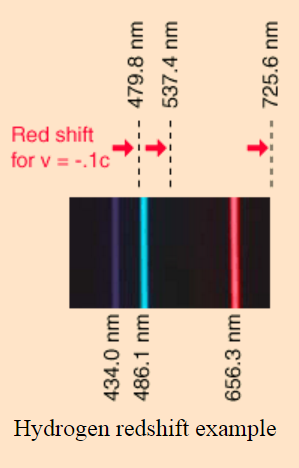
Due to the transition from Principal Quantum Number n=3 to n = 2 the H-alpha line seen all over the universe.
In this example: the red-shift (z) are 0.1055299539, 0.1055338408, 0.1055919549 for 434 nm, 486.1nm, 656.3nm respectively.
Hubble’s Law:
0 recession v d H = × (relation 1) where d=distance of the receding object and
3 67.164 10 m s Mpc × (relation 2)
H0=Hubble Constant =
1 source Z λ β λ β ∆ = = − =red shift parameter and rec v c β =
(relation 3) Under non-relativistic condition that is at low velocity β << 1 and (relation 3) becomes modified:
receding v z c = (relation 4)
1 0.105 10 z = =
The average redshift is
Substituting the magnitude of z in relation 4: Velocity of recession is:
The velocity of recession is = 10 c zc = (relation 5) From relation 1: Distance
8
| m 67.164 ×10³ | s |
|---|
| m 10 ×67.164 ×103 | s |
|---|
But 1pc = 3.26156 ly; Therefore, distance of the red shifted QUASER is d = 1.4568 bly; and it is receding at (1/10)c.
The use of Photographic Plates for recording the spectrographic images with large aperture time: The first clue of expanding Universe came from Slipher’s measurement of the red shift of receding galaxies made with 24 inch Telescope at the Lowell Observatory, Arizona, made in 1912. By the early 1900s , astronomers regularly attached cameras and spectrographs for detailed study of lights emitted in the night sky. Lights were collected at long exposure time so that the position and brightness could be studied and recorded. Till 1990s photographic plates were the main workhorse in Astronomy. Only after 1950 Charge Coupled Devices and Digital Cameras came into picture. In 1900 Edwad Pickering, the Director of the Harvard College Observatory, employed Henrietta Swan Leavitt under whom a team of women researchers did the cataloging and measurement of the brightness and colour of every star in the night sky. In 1950s Watson Computing Lab at Columbia University in collaboration with IBM pioneered a new and automated way to study the astronomical plates. Automating the plate measurement process helped extract data from generations of large area sky surveys thereafter. This started the data driven revolution. Invisible became visible, ephemeral was made concrete and fleeting became permanent. Astronomical observations became the engine of discovery providing evidence for Cosmic Phenomena.
Powerful Telescope and sensitive cameras that produce incredibly high resolution image;
- Hubble Space Telescope with optical cameras:
- IRAS (InfraRed Astronomical Satellite);
- Spitzer Space Telescope
- William Herschel Telescope: It is a European Space Mission with NASA participation. It studies the Universe in Far IR and sub-mm portion of spectrum.
- Chandra X-Ray Telescope Satellite:
- ROSAT: The Roentgan Satellite ,ROSAT, Germany/US/UK Collaboration. Launched on June 1, 1990 and operated for 9 years. It carried out all sky survey in Soft X-Ray Band.
- Einstein Telescope:
- ASCA (Astronomical Satellite for Cosmology and Astrophysics:
- XMM Newton- XRay Muti-Mirror Mission:
- High Through-put X-Ray Telescope mission:
Computers that can store and process vast amount of data The use of Digital Image Processing for calibrating SNe1a as standard candle: As Hubble peered into remote past Cepheid variables could not be used as distance marker. SNe1a had to be used as the standard candle. To calibrate and use SNe1a as standard candle, the shape of the light curve and the brightness at the peak- both are needed. The technique of Digital Image Processing was introduced after 1960 at Jet Propulsion Lab, Pasadena. It revolutionized the technique of using SNe1a as a standard candle. It became possible to swiftly prepare and rapidly compare large sweeping images of the night sky and shifting out the flashing SNe1a, storing the data, following up and computing light curves. This radically transformed SNe1a cosmology. This pushed the boundary beyond the point where Hubble and Humason had reached. Photographic plates had played an important role in Hubble ‘s investigation. As computer became faster and could handle more complex algorithmic instruction dedicated software for real time processing of astronomical images became possible. This technique developed in leaps and bounds.
Sophisticated satellites and detectors have enabled us to go to the very beginning of time that is to the point of Big Bang The New World View (20th and 21st century)
- The disruptive cosmological discoveries:
- Expanding Universe by Hubble and Humason;
- Dark matter by Zwisky and Vera Rubin;
- Black Holes by Stephen Hawking;
- Big Bang Model by George Gamow and Robert Wilson and Arno Panzias;
- Accelerating expansion of Universe by two teams-, Saul Perlmutter, Brian P. Schmidt and Adam G. Reiss;
- Discovery of exo-planetary systems. First exo-planet discovered was 51 Peg-b in 1995 by Michael Mayor and Didier Queloz. It is a hot-Jupiter giant gas planet orbiting the Planet Hosting Star(PHS) 51Peg at a distance of 5.1light years and the planet is orbiting PHS in 4 days. Till date 5500 exoplanets have been discovered. Transiting Exo-planet Survey Satellite (TESS) system. It is a space observatory which looks at the transit of the exo-planet across the PHS and from the transit data all the parameters of the transiting exoplanet is analyzed.
In modern times there has been a shift in the scale of Research endeavour from individual work to group coordinated endeavour giving rise to Big Science. Following are the examples of Big Sciences.
Sloan Digital Sky Survey (SDSS).
- 3D map of one-third of the entire sky was recorded;
- A team of several hundred scientists worked on this project;
- These scientists were drawn from 40 Research Institutes around the Globe;
- Big Science and Big Data: Cosmology has led to big data revolution.
Some of extraordinary individual endeavours of the Ancient Times and Middle Ages (the Renaissance)
- In 240 BCE Greek Astronomer Eratosthenes measured the circumference of Earth. It was 16% off the mark of the modern times namely 40,000Km;
- 1543 Nicolaus Copernicus wrote De revolutionibus orbium coelestiam (on the revolution of the heavenly spheres). In this work Earth was moved from the center of the Ptolemaic Cosmos and was replaced by Sun.
- 1548-1600 Giordano Bruno- an Italian monk, Renaissance Philosopher, cosmologist and mathematician. Roman Catholic believed in closed, finite Universe but he preached an infinite earths and infinite suns and he summed up his views in the book published in 1584, “The infinite Universe and Worlds”. This heretical text led to his excommunication from the Dominican Order and eventually his trial by Catholic Inquisition.in Venice. On 17th February. February 1600 he was burnt at stake in the market place (Campo de’ Fiori) of Rome. The same marketplace today has a `giant size statue of D. Bruno installed.
- In 16th Century Danish Astronomer Tycho Brahe -He continuously built and refined astronomical instruments and he improved the accuracy of observation. He was the last of the naked eye astronomers He observed the comets in detail and he dismantled the popular Aristotelian world view of a perfect, fixed and and unchanging Universe beyond Moon’s orbit.
- Johannes Kepler (1571-1630)- Tycho Brahe’s student appears on the scene: Kitty Ferguson of N.Y. Walker 2002 commented, “Tycho and Kepler the unlikely partnership that forever changed our understanding of the Heavens” Kepler , after the death of Tycho Brahe, inherited the custodianship of all the observational data of Tycho Brahe. Kepler after studying the vast compendium of data concluded the following three laws: 1. Orbits of Planets within our Solar System are ellipses; 2. In an elliptical planetary orbit, with Sun at one of the foci of the ellipse, a line segment joining the planet with Sun sweeps equal area in equal interval of time; 3. The square of orbital period of a planet is proportional to the cubic power of planetary semi-major axis;
The mathematics of the planetary paths were understood but the physics was not understood. Even Kepler did not understand why planets are orbiting the Sun. In ancient times Ptolemy believed in a Prime Mover that spurred the celestial spheres. • Giovanni Domenico Cassini (1625-1712) - King Louis XIV appointed Cassini as the director of Paris observatory. Cassini founded a dynasty of five successive generations of Astronomers who dominated French Astronomy for a century. In 1621 CE Sun, Earth and Mars were aligned and Earth and Mars were at their minimum distance apart. This is known as Mars Opposition. Cassini took this opportunity to measure the distance between Earth and Sun. .He sent his co-partner Jean Richer to Cayenne, French Guiana, where he would measure the angular position of Mars against the distant stars through parallax measurement. Cassini would carry out an identical exercise from Paris. The distance between Paris and Cayenne is 6,800Km.. Using Trigonometry and the angular positions of Mars from these two places Cassini determined the distance of Mars from Earth. From Kepler’s 3rd Law, Cassini determined the distance of Earth from Sun. This distance came out to be 133,590,000Km which was only 10% less than the correct value 150,000,000Km.
Cassini used the Triangulation Method as shown in Figure 19.
Baseline = b = 6,800Km; Altitude of the Triangle = d (distance of Mars from Earth in Mars Opposition) (relation 1) Half Angular Parallax in observing Mars against the distant stars from the two Places on Earth Earth =θ/2 (relation 2) Base line = b; (relation 3) è è Tan 2 2 since parallax angle is negligibly small (relation 4) Therefore;
= b/2d (relation 5)
è è Tan 2 2
From relation 5 one obtains è b 2 2d = or θ (in radians) = b d (relation 6)
- From relation 6 Distance of Mars from Earth= d ;
- Let the distance from Earth to Sun be X;
- Therefore Mars is (X+d) distant from Sun;
- Using Kepler’s Harmonic Law or 3rd Law:
- If semi-major axes of Mars and Earth are a_2 and a_1and orbital period of Mars and Earth are T_2 and T_1 where T_2 = 687 days per orbit and T_1=365 days per orbit;(Orbital Orbits had been known from Greek Astronomy;
According to Kepler’s 3rd Law (also known as Harmonic Law):
3 2 = = (relation 7)
- Cubic root 0f 3.54 = 1.524 (relation 8)
- Let the distance of Earth from Sun = X;
a T 3.54 a T
2 2
1 1 • Then the ratio of two semi major axes is= d X 1.524 X + =
(relation 9) From relation 5:
b d ; or b d ; è = (relation 10) Cassini team had measured θ =20 arc second = 9.691×10(- θ (in radians) =
5) radians (relation 11) From relation 6; 5 b 6800 d 70.168 è 9.691 10− = = = ×
million Km (relation 12)
Combining relation 9 and relation 12:
70.168million Km X 134 0.524 = = million Km; The modern value of X is 150 million Km. So the value calculated by Cassini in 1621 CE is only 10% less which is remarkable considering the stage of maturity in astronomical measurements in 1621 CE.
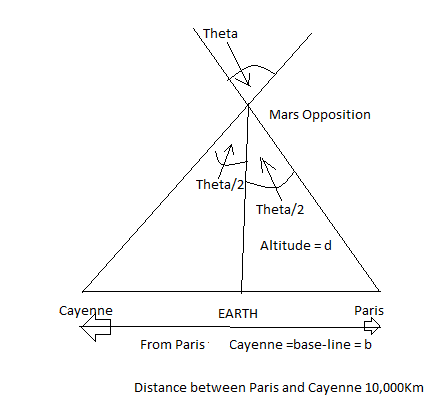
Cassini discovered the four satellites of Saturn namely Iapetus, Rhea (1671,1672), Tethys, Dione (1684). He noted the division in the rings around Saturn. And it was named after him as the Cassini Division [22]. Cassini Space the probe to Saturn was named after him. It was fourth to visit Saturn and first to orbit around Saturn. He created the first scientific map of the Moon. He recorded the observations of Zodiacal Light (it is a band of light in the night sky thought to be reflected sunlight from the cometary dust concentrated in the plane of ecliptic or plane of zodiac). It is cosmic light not meteorological light. In 1665 in collaboration with Robert Hooke he discovered the great Red Spot on Jupiter. He was the first to discover the differential rotation within Jupiter’s atmosphere. He made the successful measurement of longitudes by the method suggested by Galileo. using Galilean satellites as a clock. He introduced Indian Astronomy to Europe [23]. In 1652 he prepared a treatise on Comets.
English Physicist Isaac Newton (1642-1726) appears on the scene. He gave the Universal Law of Gravitation namely:
Force of Gravity between two bodies m1 and m2 is:
1 2 2 m m G r
× = Inverse square Law where m1 and m2 are the masses, r is the distance between the two objects and G is the gravitational constant.
- In 1687 The Magnum Opus Philosophiae Naturalis Principia Mathematica was published. Newton united the terrestrial with celestial.
- In 1600 the methodological program of science was started in earnest.
- Galileo Galilei (1642-1726) A pioneer of Modern Science. He firmly believed that the book of nature is written in the language of mathematics. His major contributions: 1. Invention of Telescope; 2. Discovery of four moons of Jupiter now known as four Galilean moons; 3. He discovered the sunspots. To establish this as a irrefutable fact Galileo wrote Istoria e dimostrazioni intorno alle macchie solari e loro accidenti (“History and Demonstrations Concerning Sunspots and Their Properties,” or “Letters on Sunspots”), which appeared in 1613. 4. He discovered the phases of Venus; 5. He discovered the surfaces of Moon which is mountainous and crater marked; 6. He advanced the notion of Celestial Physics; 7. He replaced the Aristotelian notion with Archemedian notions; 8. Galileo concluded his scientific investigation by The book, Dialogo sopra i due massimi sistemi del mondo, tolemaico e copernicano (Dialogue Concerning the Two Chief World Systems, Ptolemaic & Copernican), in 1630.
1735-1738; French Scientific Expedition [24]: Bouquet and La Canasmine noticed that in the vicinity of a mountain a plumb Bob is deflected towards the mountain. In 1774 English Scientist Meskelezyne made a careful measurement of the deviation of a plumb bob. On both sides of mountain ridge Schiehallion in Perthshire, Scotland, bob direction differed by 24 arcseconds that is mountain deflected the bob by 12 arcseconds. This was fifty years after Newton’s discovery of Universal Law of Gravitation.
The year 1798 the Henry Cavendish Experiment to determine Gravitational Constant [24]: Henry Cavendish used a torsion balance to measure the Gravitational Constant enunciated by Isaac Newton.
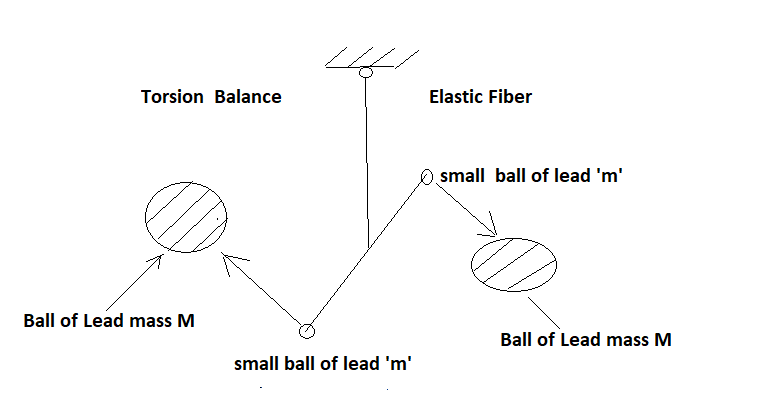
Figure 20 gives the experimental set up of Henry Cavendish used for making quantitative measurement of Gravitational Constant ‘G’ theoretically defined by Newton earlier in 1687.The set up is a torsion balance which consists of elastic fiber with a known Torsional constant.
The horizontal rod is freely hung from a support. It has two small lead balls each of mass ‘m’. There are two large lead balls each of mass ‘M’.
Small balls are attracted by the larger ball creating a torsional twist Torque;
Torque = F.d (relation 1) where F=force between the balls and ‘d’ is the half length of the horizontal rod;
By Newton’s Universal Gravitation law:
2 Mm F G r = inverse square law of Newton (relation 2)
Gravitational force:
Here ‘r’ is the distance between the heavy ball and light ball;
The Torsional Balance comes to an equilibrium position after experiencing an opposing Torque.
Let the angle of twist be = θ degree; Let the the torsional constant of elastic fiber be N.m k radian ; Therefore Opposing Torque exerted by the elastic fiber = κ×θ = F.d (relation 3)
Combining relation 2 and relation 3 we obtain: G = (Fr2)/Mm (relation 4) The numerical values of the set up as given by wikipedia: Length of the rod = 2d =1.83m; Therefore; d =0.915m; r is given as 0.225m; Torsional Constant κ determines the oscillation period = P = 7.5 minutes…. (relation 5) Mass of the big lead ball = M = 12.03 Kg (relation 6) The formula for oscillation period (from Simple harmonic motion):
1 2 P k π = (relation 7) Where I = moment of inertia of the torsional balance = md2+md2 = 2md2 (relation 8) Torsional Constant of the elastic fiber is determined from relation 7 and relation 8:
2 4 I K p π = (relation 9) Combining relation 3 and relation 4 we get Gravitational Constant ;
2 Torsional Constant
2 2 11 2 . 6.67 10 r k N m G Mm d kg θ − = × = × (relation 10) Once ‘G’ was determined the mass of Earth was determined:
Acceleration due to gravity on the surface of Earth = g=
2 m 9.8 s (relation 11)
Therefore, force due to gravity on a given mass m is given as follows;
2 GMm mg R = (relation 12) where R = radius of Earth =6371 Km known from the work of Eratosthenes in 300 BCE Therefore, mass of Earth =5.96 ×1024 Kg; An alternative method was adopted by studying the orbital period of Moon:
Because of orbital motion of Moon, The centrifugal force = centripetal force due to force of gravity;
2
2 mí GMm D D = (relation 13)
where D =384,400Km distance between the center of Earth and the center of Moon was already kd known determined known by Aristarchus of Samos in 400 BCE; From relation 13 we get M =6×1024 Kg; Edgar Allen poe: In February 1848 Edgar Allen Poe (an American Editor and literary critic) gave a lecture titled “On the cosmography of the Universe”. He described the Universe as restless and evolving in contrast to the ancient view of the Static Universe. It needed support from data which came in 1929.
Hubble and Humason found an incredible correlation: The farther was given a Galaxy faster it was receding from us. This was as radical a shift as the one in1543 CE proposed by Copernicus. Our COSMIC MAP got a 20th century make-over.
Albert Einstein: Another February day in 1931 at a seminar in the Library of Mount Wilson Observatory, Hubble and Humason were presenting their results of EXPANDING UNIVERSE. At the end of the lecture Einstein admitted that he had made a mistake in introducing cosmological constant to make the Universe static. A gasp of astonishment swept through the Seminar Hall. This gasp is emblematic (a visible symbol of something abstract) of the human dimension of Scientific discovery. It was a watershed in the Scientific World.
- In 1905, Einstein published his special theory of relativity: two postulates are put forward namely the Law of Physics is the same in all inertial reference frames and velocity of light is invariant with respect to the motion of the source and with respect to the motion of the observer. Special Theory of Relativity is the generalization of Galilean Transformation which is needed at velocities comparable to velocity of light.
- In 1915, Einstein publishes his equations of general relativity, without a cosmological constant Λ.
- In 1917, Einstein added the parameter Λ to his equations when he realizes that his theory implies a dynamic universe for which space is a function of time. He then gives this constant a value that makes his Universe model remain static and eternal (Einstein static universe).In the same year Dutch Physicist William de Sitter showed that another solution exists called Solution B to the General Relativity equation. Einstein equation was Solution A. de Sitter took a 4-D universe with 3 spatial dimensions and 1 time dimension. His model resulted in an evolving Universe [25].
Russian Physicist Alexander Friedmann: In 1922, the Russian physicist Alexander Friedmann mathematically shows that Einstein’s equations (whatever Λ) remain valid in a dynamic universe. He starts with a very dense Universe and it dilutes with expansion [26].
The Belgian Astrophysicist Georges Lamaitre:
- In 1927, the Belgian astrophysicist Georges Lemaître shows that the Universe is expanding by combining general relativity with astronomical observations, those of Hubble in particular [27].
- In 1928, Lemaitre published his breakthrough in the French Journal “Annals of the Scientific Society of Brussels in 1928.
Lowell Observatory Astronomer Vesto Slipher: In 1912, the first clue of expanding Universe came from Sliphers measurement through 24 inch telescope at the Lowell Observatory in Arizona [28]. In 1900 the astronomers regularly attached cameras and spectrographs. The spectrographs displayed the chemical signature of light by distinguishing its component frequencies. Spectrographs enabled detailed study of light from objects in the night sky. Light was collected over large exposure times. This enabled it to locate the position and brightness of faraway objects. Photographic plates were the crucial instruments which catalyzed the discovery of the expanding Universe. Till 1990 data was recorded on photographic plates. After 1990, Digital Cameras were in vogue. Telescopes and photographic plates made the invisible world visible. Ephemeral was made concrete. The Fleeting event became permanent. Astronomical Observations became the engine of discovery providing evidence for various cosmic phenomena.
In 1912 Vesto Slipher discovered the Andromeda Nebula appeared to be rushing towards us at 300Km/second by recording the blue shift of the spectral lines of the spectrum of light coming from the spiral nebula [28]. He studied several spiral nebulae the term used for galaxies. In each case he recorded a Red-Shift that is he got an indication of recession of the spiral nebula. Andromeda Galaxy was an exception. In 1914 Slipher was recording Red Shift hence recession in each case he studied. Here it will be appropriate to draw your attention to Philosopher Emmanuel Kant.
1755 - Philosopher Immanuel Kant published “Universal Natural History and Theory of Heavens”:
- “We are scattered through space out to infinite distances, there exists similar systems of stars(nebulous star, nebular), and that creation, in the whole extent of its infinite grandeur, is everywhere organized into systems whose members are in relation with one another………A vast field lies open to discoveries, and observations alone will give the key”.
- Thomas Wright (1711 to 1786) English Astronomer thought much the same way;
- In Silliman Memorial Lecture at Yale University in 1935, The Realm of Nebulae, Hubble described Wright’s speculation as follows, “A single stellar system, isolated in the Universe, did not satisfy his philosophical mind. He imagined other similar systems and as visible evidence of their existence, referred to the mythical clouds called nebulae.”
- By 1914 Slipher had measured the velocity of recession of 13 Nebulae using Doppler Effect [28]. He concluded that typically the nebulae are receding from us at 600 Km/second. Over the next 8 years he amassed data of 40 such nebulae. They were all receding except Andromeda. But the distances to these nebulae were unknown.
Astronomer Henrietta Leavitt (1868-1921): In 1912 an astronomer Henrietta Leavitt (1868-1921) came on the scene [29]. She was at Harvard College Observatory, and she would provide the yardstick to measure the distances to the spiral Nebulae. She discovered the Cepheid Variable stars. The luminosity of these stars depended on the pulsing rate. The Luminosity was calibrated against the pulsing rate at a standard distance. These could act as the standard candle. She discovered 1,777 Cepheids in the Magellanic Clouds in the Southern Sky in 1908. Brighter Cepheids had longer periods.
American Astronomer Harlow Shapley and Heber D. Curtis: Harlow Shapely used Cepheids to estimate the size of our home galaxy [30]. The measurement of the size of our Galaxy (300,000ly) and measurement of the distances of Andromeda Galaxy (1,000,000ly) , the distance of NGC 6822 (700,000ly) brought an end to the Great Debate between Heber D. Curtis and Harlow Shapely in 1928. [31]. Curtis argued that spiral nebulae were independent galaxies and Universe size was immeasurable [32] but Shapely maintained that the Universe had only one galaxy [30]. Curtis stood vindicated.
Hubble and Humason in 1929: The data collected by Slipher [28] and by Hubble [33] convinced Hubble that we are living in an expanding Universe where velocity of recession (v) is directly proportional to the distance of the given Galaxy from Earth (d). It is stated as:
v = H.d 1 This is known as Hubble Law and H= Hubble constant and v = velocity of recession and d= distance from Earth.
Hubble inaugurated the observational Cosmology that has revealed an amazingly vast Universe that has been expanding and evolving for last 14 by and contains dark matter, dark energy and billions of galaxies. In this 14 by period Universe has evolved into a remarkable network of galaxies, clusters of galaxies, super-clusters, filaments (an extension of fractal architecture of Universe [34]) and voids [35, 36].
Le maitre theoretical model [27] and Hubble and Humason [33] observations gave the model of Expanding Universe.
This was a key underpinning of the Big Bang Theory. This was the earliest insight into the origin of the Universe. The measurement was extended to Galaxies to farther distances. This gave a radically new picture of Universe - a dynamic entity not static, restless and space was stretching. In 1929 Hubble presented his findings in Proceedings of National Science Academy [33]. Here the cosmic distances depend on the measurement of Red Shift and Red Shift is determined either by spectroscopic studies or through multi band imaging systems.
Where spectroscopic studies are possible there by the absorption or emission lines shift cosmological redshift is directly measured and using Hubble’s Law the distance of the galaxy is calculated.
But where the galaxies are too numerous or too faint for spectroscopic studies their Photometric Redshift also known as colour Redshift or photo-z is utilized. It is a technique that uses broad band photometry to measure the Redshift of galaxies [37]. The entire multi-band galaxy image is fed into the machine learning architecture to obtain the Redshift estimate of the given galaxies. Advances in machine learning, in particular Deep Neural Network, are utilized.
![Figure 21: Velocity–distance relation among extragalactic nebulae (1). “Radial velocities, corrected for solar motion, are plotted against distances estimated from involved stars and mean luminosities of nebulae in a cluster. The black discs and full line represent the solution for solar motion using the nebulae individually; the circles and broken line represent the solution combining the nebulae into groups; the cross represents the mean velocity corresponding to the mean distance of 22 nebulae whose distances could not be estimated individually” [5]. (Note: Velocity units should be in kilometres per second.) Figure 21 is a plain looking graph but it has huge implications. It shows that we are living in a large dynamically evolving Universe that is expanding in all directions quite contrary to the static Universe model of Einstein, our Universe is flat with zero spatial curvature and it contains 5% Baryonic matter (stars and galaxies), 25% non-baryonic cold dark matter and 70% vacuum energy or dark energy. Hubble Law was a turning point in the expanding Universe scenario. The Hubble Space Telescope, among others, is currently observing Hubble Law at greater distances to trace the precise evolution of the expanding Universe. The linear relationship observed in Figure 21 starts deviating from linearity at large distances of z = 1 (10.14147bly) or greater as shown in Figure 22. This deviation from linearity is the result of space-time curvature as propounded by General Theory of Relativity of Einstein in 1915 and is the observational evidence of accelerating expansion rate. For the first 8.8 billion years after the Big Bang Baryonic matter and Dark matter dominated the Universe hence Universe experienced de-celarating expansion rate but for last 5 billion years vacuum energy or dark energy has dominated our Universe hence our Universe is experiencing an accelerated expansion rate [38,39].](/fulltextimages/13961/fig_21.png)
Figure 21: Velocity–distance relation among extragalactic nebulae (1). “Radial velocities, corrected for solar motion, are plotted against distances estimated from involved stars and mean luminosities of nebulae in a cluster. The black discs and full line represent the solution for solar motion using the nebulae individually; the circles and broken line represent the solution combining the nebulae into groups; the cross represents the mean velocity corresponding to the mean distance of 22 nebulae whose distances could not be estimated individually” [5]. (Note: Velocity units should be in kilometres per second.) Figure 21 is a plain looking graph but it has huge implications. It shows that we are living in a large dynamically evolving Universe that is expanding in all directions quite contrary to the static Universe model of Einstein, our Universe is flat with zero spatial curvature and it contains 5% Baryonic matter (stars and galaxies), 25% non-baryonic cold dark matter and 70% vacuum energy or dark energy. Hubble Law was a turning point in the expanding Universe scenario. The Hubble Space Telescope, among others, is currently observing Hubble Law at greater distances to trace the precise evolution of the expanding Universe. The linear relationship observed in Figure 21 starts deviating from linearity at large distances of z = 1 (10.14147bly) or greater as shown in Figure 22. This deviation from linearity is the result of space-time curvature as propounded by General Theory of Relativity of Einstein in 1915 and is the observational evidence of accelerating expansion rate. For the first 8.8 billion years after the Big Bang Baryonic matter and Dark matter dominated the Universe hence Universe experienced de-celarating expansion rate but for last 5 billion years vacuum energy or dark energy has dominated our Universe hence our Universe is experiencing an accelerated expansion rate [38, 39].
Lemaitre theoretical prediction was valid only in Homogeneous Universe (where mass is uniformly distributed [40]. It fails when mass is distributed in lumps. Hubble and Slipher had measured up to 6 million ly. The Universe is replete with galaxies but lumpiness remains there. Only at 100 million ly and beyond granularity gets smeared out Only when Hubble extended his observations beyond 100 million ly that they get much more convincing linear relationship.
![Figure 22: Hubble diagram for type Ia supernovae to z ≈ 1. Plot in astronomers’ conventional coordinates of distance modulus (a logarithmic measure of the distance) vs. log redshift. The history of cosmic expansion can be inferred from the shape of this diagram when it is extended to high redshift and correspondingly large distances. Diagram courtesy of Brian P. Schmidt, Australian National University, based on data compiled in [41] Figure 22 extends the Hubble Diagram up to 10.147bly corresponding to z =1.](/fulltextimages/13961/fig_22.png)
Figure 22: Hubble diagram for type Ia supernovae to z ≈ 1. Plot in astronomers’ conventional coordinates of distance modulus (a logarithmic measure of the distance) vs. log redshift. The history of cosmic expansion can be inferred from the shape of this diagram when it is extended to high redshift and correspondingly large distances. Diagram courtesy of Brian P. Schmidt, Australian National University, based on data compiled in [41] Figure 22 extends the Hubble Diagram up to 10.147bly corresponding to z =1.
• Methodology of Distance measurement from z-redshift of nearby galaxies and redshifts of bodies including special theory of relativity in an Expanding Universe as observed by the Hubble Space Telescope. Hubble’s Law:
( ) 0 recession V d H = × (2) where d=distance of the receding object and H_0=Hubble Constan.
According to classical physics in case of a whistling train approaching or receding from the station we hear a change in the frequency of the whistle given by the following equation:
± ± = = = ±
v c v c v f 1 f c ë c f ( )
source listener here c=velocity of sound and v=speed of the train. (3)
( ) source When the train is approaching whistle becomes shriller and when the train is receding whistle becomes baser. In terms of wavelength the equation becomes considering only the receding train
1 λ ν λ = − or 1 source z λ β λ β ∆ = = − red shift Listener
receding Source
1 c parameter and rec c ν β = (4)
Under non-relativistic condition that is at low velocity β << 1 and (4) becomes modified:
z=vreceding/c (5) Combining (2) and (5) and using H0 = 67.164km/s/Mpc and 1pc = 3.086×10¹⁶m:
z c d z c 4.594723364 10 s z 1.377463411 10 m H × = =×× × =× × (6)
( ) 17 26
0 Expressing d in light years we get where (1ly=9.461×10¹⁵ m )
( ) 26
1.377463411 10 m d z z 14.559bly m 9.461 10 ly × =× =× × (7) is purely non-relativistic and true only for very small
15 values of z.
In cases of Astronomy most of the time in (4), β cannot be neglected with respect to Unity hence special theory of relativity will have to be utilized.
In the special theory of Relativity we have time dilation, length contraction and mass enhancement.
If rest frame, time is t0, length is l0 and mass is m0 then according to Special Theory of relativity in a moving frame of reference of velocity v we have:
time dilation t=γ×t0, length contraction l=l0/γ and mass enhancement= γ×m0 where γ=Lorentz Transformation= 1/√(1-vrecession/c) (8) These three factors are called Lorentz transformation s and it is because of this transformation that speed of light is invariant of the Frame of Reference and was successfully demonstrated by Michelson-Morley Experiment. Table 1 below gives the time dilation factor for different velocities of frame of reference.
| β = v /c recession | γ (Time dilation factor) |
|---|---|
| 0 | 1 |
| 0.1 | 1.005 |
| 0.995 | 10 |
| 0.999 | 22.366 |
| 0.9995 | 100 |
Table 7: β = vrecession/c vs γ (Time dilation factor).
It is because of this time-dilation factor that we can detect muon (a variety of lepton) in cosmic showers.
In rest frame muon has a very short lifetime of 2.2μs but travelling at 0.995c its lifetime is 22μs and travelling at 0.9995 its lifetime becomes 220μs thereby making it detectable on Earth.
Including this time-dilation factor in Red-shift parameter we have (υ×λ=c or (1/T_0 ×λ=c):
( ) ( ) 0 0 2 1
c v T c v T v c
λ γ + = + × = − (9) For a traveling wave in rest frame:
recession observed recession rec
1 c T λ γ λ = × = × therefore
1 source T c λ = (10)
0
0 Taking c outside the Numerator factor and replacing T0 by (10) we get (9) as follows:
1 ν + = − (11) Manipulating (11) we get:
recession c λ λ ν observed source
2
1 rec c
1 1 λ β λ β + = − where β=vrec/c (12) By definition given in (4) by subtracting 1 from both sides we get:
obs source
1 1 1 source z λ β λ β ∆ + = = − − (13) Bringing unity on RHS, squaring both sides and applying compenondo and divinendo we get:
( ) ( )
2
2 1 1 z z β + − = + + (14) and ( ) ( )
+ − = + + (15) Combining (2) and (15): ( ) ( )
+ − = + + 16
2 z 1 1 c d H z 1 1
2 0 Using Equation (6) in (15) we get :
+ − + − = = + + + + (17) (17) is based on a special theory of relativity and corresponds to (7) under non-relativistic conditions but it is not a generalized formula because it does not take into GRT, A more generalized expression is given in the following sections.
( ) ( ) ( ) ( )
2 2 z 1 1 z 1 1 c d 14.559bly H z 1 1 z 1 1
2 2 0 A Galaxy at 45.9877Mly gives a COSMOLOGICAL recession velocity of 1 M-meters/s and red-shift of z = 3.34×10⁻³ dimensionless.
| body | d(light-y) | t | z(cosmological) | v(recession) |
|---|---|---|---|---|
| Moon | 3.8×10⁻⁸ ly | 1.199s | 0 | 0m/s |
| Sun | 1.6×10⁻⁵ ly | 504.9s=8.415m | 0 | 0m/s |
| Mercury | 9.5×10- 6 ly | 299.797s=4.9966m | 0 | 0m/s |
| Pluto | 6.183×10⁻⁴ ly | 19,512.064s=5.42h | 0 | 0m/s |
| Alpha Centauri | 4.27ly | 4.27y | 0 | 0m/s |
| Sirius(dog star) | 8.7ly | 8.7y | 0 | 0m/s |
| Arcturus | 36ly | 36y | 0 | 0m/s |
| Pleindes Cluster | 400ly | 400y | 0 | 0m/s |
| Beteleguse | 520ly | 520y | 0 | 0m/s |
| Deneb | 1600ly | 1600y | 0 | 0m/s |
| Crab Nebula | 4000ly | 4000y | 0 | 0m/s |
| Center of Milky Way | 38kly | 38ky | 0 | 0m/s |
| Magellen Cloud | 150kly | 150ky | 1.0876×10⁻⁵ | 3260m/s |
| Andromeda Galaxy | 2.2Mly | 2.2My | 1.595 ×10⁻⁴ | 47,821.4 m/s |
| Unknown Galaxy | 46Mly | 46My | 3.34×10⁻³ | 1 million m/s |
Table 8: A constellation of astronomical bodies and their measured redshift parameter z.
Notice for bodies within our Milky Way, there is no recession in Hubble Sense hence z = 0 and cosmological velocity of recession is zero though it has a local motion.
The Hubble recession is experienced only by galaxies outside our Milky Way. It is as if galaxies are lying on the surface of a balloon and the balloon is being inflated. All galaxies recede from one another.
Also expressing distance in light-years makes it convenient to determine the time taken to travel that distance at speed of light. Year can easily be converted today, hour, minute and second because if Pluto is at 6.183×10⁻⁴ ly then time taken to travel to Pluto is:
time taken=
4 4 d s 6.183 10 y 6.183 10 y 365.25 3600 19,521s 5.42h y d − − × = × × × = =
Methodology of Distance Measurement from z-redshift of Galaxies in an Expanding Universe as Observed by Hubble Space Telescope including General Relativity Theory.
+ − + − = × = × + + + +
( ) ( ) ( ) ( )
2 2
9 2 2 z 1 1 z 1 1 d 14.559 10 ly 14.559 bly z 1 1 z 1 1
(17) is based on special theory of relativity and corresponds to (7) under non-relativistic condition but it is not a generalized formula because it does not take into GRT, A more generalized expression is given as follows:
From general theory of relativity considerations, we get: Age of our Universe [42]:
Based on Metric Expansion using FLRW metric (Friedman-Lemaitre-Robertson-Walker metric), time (as measured after the BB) taken to expand from Red-shift z1 to Red-shift z2
2 2 − − = + ∧ − = Ω × Ω × + Ω + Ω × ∫
a z r m k
1 1 (18) Here a= scale factor. Time (as measured after the BB) taken to expand from singularity (z = infinity) to Red-shift z1:
At the singularity, z1 = infinity. The present z2=0.
Km 67 10 s Ù ;Ù 0.317,Ù 0,Ù 0.683and H ,H 14.596Gy 3.2 Mpc
4 1 r M K 0 0
− − = = = = = =
0 0 0 0 . These values have been taken from Planck’s collaborative results.
Substituting the parameter values in Eq.18:
1 t (Age of Universe) 1.4559 10 0.00003125 0.317 0.683a a a + + ∫
1 10 0 0 2 2
= × × (19)
2 1 t t − (time taken to travel from BB to a point having redshift of z)=
1 1.4559 10 0.00003125 0.317 0.683a a a
1 10 1 z 0 2 2
+ + ∫ + × ×
(20) Hubble Time = 1/H0 = 14.56Gy, Age of our Universe = 13.8222Gy,
Recombination era at z = 1090 corresponds to 429,141 yrs, the clumping of DM starts at z = 10,000 which corresponds to 10,127 yrs after BB.
Using (9) and (11) the distance to high redshift galaxies have been estimated in Table below.
| Galaxy | ‘z’ | ‘d’ by (7) | d’ by (17) | ‘d’ by (20) |
|---|---|---|---|---|
| UDF39546274 | 11.97 | 13.45bly | ||
| GN-311 (2016) | 11.09 (400My) | 13.41bly | ||
| EG5Y8p7(2015-16) | 8.68 | 13.25bly | ||
| UDIy-38135539 | 8.6 (600My) | 13.24bly | ||
| Progenitor of GRB090423 (2009-2015) | 8.2 | 13.2bly | ||
| BORG-58 | 8 | 13.1845bly | ||
| IOK-1 Galaxy (2006-09) | 6.96 | 13.0557bly | ||
| SDF-J1324183+271455Gal (2005-06) | 6.597 | 13bly | ||
| SDF-J1324183+271455 Gal (2003-05) | 6.578 | 12.997bly | ||
| HCM-6A Galaxy (2002-2003) | 6.56 | 14.054bly | 12.994bly | |
| Galaxy SC1435-1635 (1994) | 4.25 | 13.539bly | 12.3934bly | |
| 3C-9 QUASER (1965) | 2.018 | 11.678bly | 10.5768bly | |
| 3C147 QUASER (1964-65) | 0.545 | 7.93bly | 5.967bly | 5.54568bly |
| Brightest Cluster Galaxy (51-60) | 0.2 | 2.9bly | 2.625bly | 2.5286bly |
| Bright Class Galaxy (1936) | 0.15 | 2.18bly | 2.02ly | 1.96228bly |
| -1932 | 0.075 | 1.09bly | 1.05bly | 1.0343bly |
Table 9: Distance estimate of high and low red-shift Galaxies.
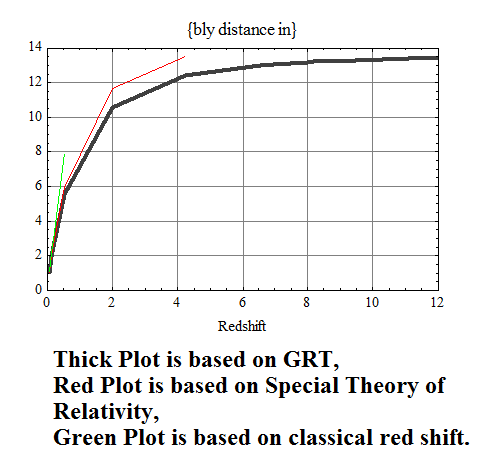
Renaissance of General Theory of Relativity
Einstein accepts the theory of an expanding universe and proposes, in 1932 with the Dutch physicist and astronomer Willem de Sitter, a model of a continuously expanding Universe with zero cosmological constant (Einstein–de Sitter spacetime) [43]. After the seminar in the Library of Mount Wilson Observatory in 1931, Journalist George Gray wrote in Atlantic [44]. “A radically new picture of the COSMOS emerges - a universe in expansion, a vast bubble blowing, distending, scattering out into gossamer, losing itself”.
The Universe is presently in an accelerated expanding phase. In 1998, two teams of astrophysicists, one led by Saul
Perlmutter, the other led by Brian Schmidt and Adam Riess, carried out measurements on distant supernovae which showed that the speed of galaxies’ recession in relation to the Milky Way increases over time. The universe is in accelerated expansion, which requires having a strictly positive Λ. The universe would contain a mysterious dark energy producing a repulsive force that counterbalances the gravitational braking produced by the matter contained in the universe (see Standard cosmological model). For this work, Perlmutter, Schmidt, and Riess jointly received the Nobel Prize in physics in 2011 [38, 39].
The most amazing discovery of 20th Century- Accelerated Expansion of Universe for last 5 by -the Triumph of Monotonic M1 World Scenario predicted by Friedmann in 1922.
Two group of astronomers working independently though using the same technique of observing SNe Ia at different red-shift came to the following conclusions:
In first 8.8by after the BB, Universe was decelerating. For the next 5by Universe has been accelerating. That is from 0 time to 400,000y after the BB, radiation dominated the Universe. From 400,000yrs to 8.8by after the BB, matter dominated the Universe. From 8.8by onward till now (i.e. for last 5by) Universe has been accelerating and Universe will continue to be dominated by Dark Energy which Einstein referred to as Cosmological Constant and it arises due to Vacuum Energy which was responsible for inflationary phase of the Universe at its inception. This is evident from the data in Table 8 and from the expansion history given in Figure 24.
| z | t(after BB) | Dist. From MW | Remark | Universe’s exp.rate |
|---|---|---|---|---|
| 1.7 | 3.82by | 10bly | 60% brighter than predicted | decelerating |
| 1.6 | 4by | 9.8bly | 60% brighter than predicted | |
| 1 | 5.85by | 7.97bly | 60% brighter than predicted | |
| 0.46 | 8.9by | 4.92bly | At the correct position | Inflexion-Cosmic Jerk |
| 0.425 | 9.18 | 4.64bly | 20%dimmer than predicted | accelerating |
| 0.4 | 9.38by | 4.44bly | 20% dimmer than predicted |
![Figure 24: Top: SNe Ia from ground-based discoveries in the gold sample are shown as diamond. HST discovered SNe Ia are shown as filled symbols. Bottom: Weighted Averages in fixed red-shift bins are given for illustrative purposes only. Data and Kinematic models of the expansion history are shown relative to an eternally coasting model q(z) = 0. Models representing specific kinematic scenarios are illustrated. (Courtesy: [41]).](/fulltextimages/13961/fig_24.png)
Figure 24: Top: SNe Ia from ground-based discoveries in the gold sample are shown as diamond. HST discovered SNe Ia are shown as filled symbols. Bottom: Weighted Averages in fixed red-shift bins are given for illustrative purposes only. Data and Kinematic models of the expansion history are shown relative to an eternally coasting model q(z) = 0. Models representing specific kinematic scenarios are illustrated. (Courtesy: [41]).
Utilizing a simple kinematic description of the magnitude red-shift data Reiss, et al. [40, 41] found that SNe favour recent acceleration and past deceleration at the 99.2% confidence level. The best fit redshift of the transition between these opposite kinematic phases is z = 0.46±0.13, although the precise value depends on the kinematic model. From the Table 4, it is evident that astrophysical reasons could not have been causing the dimming. Table 4 proves that in last 4 to 5by, Universe has been accelerated driven by strictly positive Cosmological Constant. SNe Ia were infact tracing the cosmic history. It was also found that Dark Energy was not evolving but keeping constant hence indeed it was Cosmological Constant.
The galaxies observed at r = 8.4 − 10.5 Gly away (1 < z < 1.6), are closer to the Milky Way more than they should be, given the acceleration rate shown by the galaxies 5 Gly away. Thus, at some time, the Universe switched from deceleration to acceleration. The inflexion point was estimated as being at about Rf = 5 ± 1Gly (z = 0.46 ± 0.13), and the M1 model triumphed.
1 1 2 3 3
0 0 0 0.3 0.6 2 2 0.7 f kc R R R R ρ = = = ∧ × (21) If R0=13.82Gly then Rf = 8.29Gly.
• If the Schwarzschild Radius is calculated it comes as follows:
3 0 0 0 2 2 0.6 2 s k R GM R R c ρ = = ≈
(22) This means the inflection point is very close to the event- horizon of the Universe. What this means is that in first 8.8Gy after the BB our Universe was Black Hole completely cut- off from the outside Universe. But after 8.8Gy, crossing the inflexion point, it became visible to other Universes.
Measuring deceleration weighs the Universe. Dense Universe leads to rapid deceleration. Sparse Universe leads to gradual deceleration. If vacuum energy (which is dark energy) exceeds the inertia, the Universe accelerates.
Gravity at the largest scale is repulsive. The acceleration of the Universe expansion rate is probably the most profound observational mystery in our current Physics.
Our Universe is Monotonic M1 Model, One of the Six Solutions of Einstein’s General Theory of Relativity, which has a Cosmic Jerk. [39]) Friedmann (1922) [26] set the correct framework for General Theory of Relativity (GTR), derived the set of correct equations (now known as Friedman Equations), solved them and discussed all three major scenarios for the expanding Universe. Friedman (1924) [42] presented the idea of infinite Universe, static or non-static, with a constant negative curvature, completing what would later be known as Friedmann-Lemaitre-Robertson- Walker (FLWR) metric. FLWR model is a mathematical model that describes the expanding Universe. It describes the Cosmic Space-Time including the evolution of Universe over time. The assumptions are Cosmological Principle which is homogeneity (spatial uniformity) and isotropicity (directional uniformity). The second assumption is that both contraction and expansion are possible. It is an exact solution of Einstein’s General Theory of Relativity. It is valid only for zero active mass where ρ and P are total energy density and Pressure of the cosmic fluid. This is called the Standard Model of Modern Cosmology defined by six parameters (see Subsection 10.3.2.6) [43].
There are 16 equations of GTR:
ik ik ik ik 1 R g R g kT 2 − − =− (23)
- Here i & k run from 1 to 4. 1,2,3 correspond to x, y, z and 4 corresponds to time.
- Here gik = metric tensor. Rik= Ricci tensor representing 2-D curvature.
R Scalar space time curvature = − , Constant ‘k’ =8πG/ c2=1.87×10⁻²⁷ cm/g.
- Tik= energy-matter tensor→ this represents the inertia of our Universe.
- T11, T22, T33 = - p where p is the radiation pressure. For non-diagonal terms Tik= 0.
- Equation 23 shows the equivalence between gravity (LHS) and inertia (RHS).
Due to non-linearity in ‘gik’ on LHS of the Equation, Einstein introduced a linear term ‘(Λ) gik’ where Λ is a cosmological constant which I have referred to as normalized Vacuum Energy Density (ΩΛ) and its value determined by Planck’s collaboration is 68.3% and has remained constant for Hubble Time as a cosmological constant should.
Einstein proposed Solution A, a static model of Universe where R = radius of our Universe is constant in space and time. Einstein Static Universe is 3-D sphere with R= constant and evolving in time as 4-D cylinder.
Einstein arrived at R=750×1024cm = 800Mly, ρ = 2/(kR2) = matter density =2×10- 27 g/cm3, Volume of a hypersphere = V = 2π2R3, M (mass) = V×ρ = 4π2R/k.
In contrast de Sitter proposed Solution B, which had no density and hence no mass. This violated Mach’s Principle of inertia being associated with mass. Therefore Solution B was unacceptable. But Solution B predicted red- shift in the observed galaxy and observational galaxy did show Doppler’s red-shift and hence the characteristics of recession. Evidence was mounting for receding galaxies and hence for Doppler Red-shift and de-Sitter Solution B seemed to explain this recession. Hence Solution B was non-static with exponentially growing R.
At that time in 1922, Friedman [7] published his paper “On the curvature of Space”. Friedman proposed a new class of non-static solution of Equation 23. Friedman’s dynamical solution of Equation 23 is a generalization of Einstein’s 3- D hyper-sphere with constant in space but evolving R(t). Equation 23 yields two ordinary linear differential Equation for R(t). These are known as Friedman’s Equations in Modern Terminology and are given as follows:
2 2
2 2 2R" R ' C 0 R R R + + −=
(24)
2 2 2 2 3 ' 3 R c kc R R ρ + −∧=
(25) Equation 24 is integrated to obtain:
− + =
3 2 2 2 A R R 1 3c R ' R c (26)
By correspondence between Equation 25 and Equation 26 we arrive at:
( ) 3 3A ñ average matter density kR =
(27)
2 kM A gravitational radius of universe & M massofuniverse V ñ 6ð = = = × (28) Integrating Equation 26 we get:
R
1 R t dR t c A R R 3c
1 = + − + ∫
0 3 R 2
0 (29) R0 = radius of our Universe and t0 = age of our Universe.
RHS of Eq.29 has a physical meaning only if C(R)= [A-R+ (ΛR3)/(3c2)] = Cubic in the denominator of RHS is positive.
![Figure 25: The behavior of the Friedman’s fundamental cubic term C(x) that governs the dynamics of our Universe for different values of Λ [44].](/fulltextimages/13961/fig_25.png)
In the cubic C(R), A = gravitational radius, Λ=Cosmological Constant,
(-)R= sign of the curvature.
Three Major Scenarios of Universe Evolution
The conditions for C(R) being positive is shown in the Figure 9.
We define Λcr = (4c2)/(9A2)
| Λ > Λcr | Λ = Λcr | Λ < Λcr | |
|---|---|---|---|
| No roots in RHP | Two repeated roots at x =3A/2 0 | Two simple positive roots at x and x 1 2 | |
| M1 World | C(x) is positive from 0 to x1 and from x2 to ∞ | ||
| Monotone World of First Kind | Periodic (2a_ scenario)) | Monotone World of Second Kind(2b_sce) | |
| Here C(x) is positive; From x= 0 to infinity | Oscillates between 0 and x 1 | M2 World | |
| Starts from singularity; R=0 and t=0. This Lemaiter’s case. | Decelerating and accelerating | Starts from R = x and min 2 expands to ∞ | |
| Universal starts from primeval atom | P-World | Always accelerating kind | |
| Universe end point asymptotic behaviour: | Universe end point: | ||
| (t−t ) 1 R≈R Exp[ 0 ]_where _τ= 0 τ Λ/ 3 | (t−t ) R≈R Exp[ 0 ] min τ where_τ=1/ Λ/ 3 R = x min 2 | ||
| Initially from R=0 to Rf, Universe is decelerating and is matter dominated and from R to R it is accelerating and f 0 is dark energy dominated. | |||
| Rf = point of inflexion in World evolution. | |||
| 3c 2A kc2ρ R =( )1/3 =( )1/3R f 2Λ 2Λ 0 kM R = 0 4π2 |
Table 11: Three scenarios corresponding to non-degenerate case-no roots in Right Half Plane and two simple positive roots in RHP.
![Figure 26: This shows the three major scenarios of Universe’s evolution predicted by Friedman (1922). The M1 world shows expansion from singularity with a flex point that signifies existence of two stages of evolution: deceleration (matter dominates) and acceleration (dark energy dominates). Bondi (1961,pp84) calls it “Lemaitre case”. The M2 world shows expansion from the non-zero radius to infinity. The P world shows periodic evolution, with expansion and contraction phases and point of maximum radius in between. Point t0 is the current stage of the Universe and tf is the point of inflexion in the M1 world [44].](/fulltextimages/13961/fig_26.png)
Figure 26: This shows the three major scenarios of Universe’s evolution predicted by Friedman (1922). The M1 world shows expansion from singularity with a flex point that signifies existence of two stages of evolution: deceleration (matter dominates) and acceleration (dark energy dominates). Bondi (1961,pp84) calls it “Lemaitre case”. The M2 world shows expansion from the non-zero radius to infinity. The P world shows periodic evolution, with expansion and contraction phases and point of maximum radius in between. Point t0 is the current stage of the Universe and tf is the point of inflexion in the M1 world [44].
![Figure 27: This shows the limiting case of P-World and M2-World in Figure 10. There are two scenarios corresponding to the degenerate roots at x0=3A/2 = Re . The two scenarios are the limiting cases of P World and M2 World. The upper curve is the limiting case of M2 world whre Time-Constant becomes very large as a result it starts at Re and keeps exponentially increasing. Bondi calls it “Eddington-Lemaitre” case. The lower case is the limiting case of P World or Periodic-World. It starts at R = 0 and keeps approaching Re indefinitely because of inordinately large Time Constant [44-46]](/fulltextimages/13961/fig_27.png)
Figure 27: This shows the limiting case of P-World and M2-World in Figure 10. There are two scenarios corresponding to the degenerate roots at x0=3A/2 = Re . The two scenarios are the limiting cases of P World and M2 World. The upper curve is the limiting case of M2 world whre Time-Constant becomes very large as a result it starts at Re and keeps exponentially increasing. Bondi calls it “Eddington-Lemaitre” case. The lower case is the limiting case of P World or Periodic-World. It starts at R = 0 and keeps approaching Re indefinitely because of inordinately large Time Constant [44, 45, 46]
| Λ = Λcr | Λ = Λcr |
|---|---|
| Limiting case of scenario_2a | Limiting case of scenario_2b |
| Time constant of expansion becomes too large hence it keeps expanding from 0 to R . E | Here also because of very large time-constant keeps expanding from R to infinity E |
| (t−t ) R≈R −Exp[− 0 ] E τ∗ where_τ∗ =1/ Λ 3A 2GM R R = = = S E 2 πc2 π | (t−t ) R≈R +Exp[ 0 ] E τ∗ where_τ∗ =1/ Λ 3A 2GM R R = = = S E 2 πc2 π |
| At t = 0, R =R -Exp(t /τ*) = 0 E 0 | For t < t , R = R 0 E |
| At t = ∞, R=R E | For t > t , 0 (t−t ) R≈R Exp[ 0 ]where _τ=1/ Λ/ 3 0 τ |
Table 12: Two scenarios corresponding to the degenerate or repeated roots at x0=3A/2=RE The three scenarios described in Table 9 a
M1 World Scenario - The Accepted Model of Universe Evolution Today’s M1 World scenario is the accepted Big Bang Scenario. In this BB scenario, Universe starts from a primeval atom (mathematically it is a singularity). It has decelerated expansion because of “Matter Domination” and after a point of Inflexion there is accelerated expansion because of “Dark Energy” domination. This has been confirmed by SN Ia studies conducted over a period from 1998 to 2004 as well as by BOSS. The results of this research led to Nobel Prize in Physics to the group which conducted this research namely: Saul Perlmutter + (Adam G.Reiss & Brian P. Schmidt).
The final result of the discovery of accelerating expansion of Universe after 8.8 billion years after the BB vindicates M1 world which has a decelerating expansion up to (13.8-5) billion years after the singularity (this is the point where Big Bang was kick started) and accelerating expansion since 5 billion years before the present. This 8.8 billion years from the singularity is referred to as inflection point or it is called the Cosmic Jerk.
Paradigm Shift in Modern Times
Aristotelian World view till the discovery of expanding Universe was as follows: Throughout all past times, through the records handed down from generation to generation we found no trace of change either in the whole of the outermost heaven or in any one of the parts. Right from classical antiquity to the present the astronomers and philosophers divided the night sky into two categories: first category of fixed stars which rise and fall with regularity, but their relative arrangement remains unchanged over time; the second category of wandering stars that include planets, Sun and Moon. In the Aristotelian World view the eternal backdrop of order reiterated “a preordained divine origin of COSMOS. Ptolemy’s geocentric world view as propounded in his Almagest (2nd century mathematics and astronomical treatise on the apparent motion of stars and planetary paths written by Claudius Ptolemy written in Koine Greek) still held sway in the scientific community. One of the earliest documents to deal with stars and constellations is a catalogue found in Latin astrological compendium called Liber Hermetis (130 BCE) [11]. Liber Hermetis (130 BCE) predates Ptolemy (150CE). Ptolemy lists 1020 new fixed stars in addition to those in Liber Hermetis. These 1020 stars became important to the Hellenistic Traditions. In classical antiquity, Hellenistic Period is Mediterranean history covering the time between the death of Alexander the Great, (323 BCE) to the time of death of Cleopatra VII in 30 BCE. followed by the ascendancy of Roman Empire (Battle of Actium 31 BCE) and Roman conquest of Ptolemaic Egypt by 30 BCE. The last major Hellenistic Kingdom was eliminated. Greek culture reached its peak in the Mediterranean and beyond. Attic based Greek dialect became the lingua franca throughout the ancient worlds. Greek culture was characterized by the work of Mathematician Euclid and the polymath Archimedes. Hellenistic Culture was characterized by grand monuments and ornate decorations exemplified by Pergamon Altar. The end of Hellenistic culture is marked by the 146 BCE conquest by Romans of Greek heartland following the Achaean war. The final defeat of Ptolemaic kingdom was at the battle of Actium in 31 BCE. In 138CE Greek rule of Hadrian came to an end and Roman Emperor King Constantine moved the capital of the Roman Empire from Rome to Constantinople (modern day Istanbul in Turkey) in 330 CE. Deep seated belief in fixed stars and static Universe led Einstein to introduce cosmological constant in his General Relativity Equation equation.
Two Contrasting Model of Genesis of Our Universe- Big Bang Model and Steady State Model. Steady State Theory proposed by Fred Hoyle, Bondi and Gold [47]: In 1948 Fred Hoyle, Bondi and Gold considered Big Bang Model of George Gamow as the scientific version of Biblical Genesis. They instead proposed the Steady State Theory of Expanding Universe. The expanding Universe was steadily generating matter so as to maintain a constant matter density at 10^-43 gm/second/cm^3 . It was a flat Universe, expanding exponentially with no beginning and no end. Fred Hoyle published his ideas in the paper titled “A new model for the expanding Universe,” [47].
Big Bang Model: In 1944 George Gamow along with Alpher RH [49] and Robert Herman came up with a comprehensive theory of expanding Universe from primordial state. This was called the Big-Bang theory. Their theory predicted 3K black body relic radiation in our present Universe left over as a legacy from the Big- Bang. This is called Cosmic Microwave Background Radiation (CMBR) which was subsequently discovered by Wilson and Panzias in 1965 while testing their microwave horn antenna for Radio Astronomy. For this 1978 Physics Nobel Prize was awarded to Wilson and Penzias. But even this could not explain the beginning or the kick start process for Big-Bang because as will be explained in subsequent sections a hot (1032K) and (1094gm/cc) dense compact object is doomed to be entombed in a black hole right at the beginning.
Inflationary phase of exponentially expanding Universe had to be incorporated in Big-Bang Model. Exponential expansion is faster than light. The matter inside the Universe fabric is not travelling at velocity faster than light but infact matter and energy are frozen in the original uniformity of the primordial quantum bubbles.
Starobinsky Model [49] was the first model incorporating inflation in 1970. Guth A [50] of MIT independently proposed a similar model in 1981[50]. This was improved upon by Andrei Linde and is called the New Inflation Model [51].
Reconciliation between the Observed Universe and Expanding Universe Model: The discovery of expanding Universe has led to a much wider perspective of Universe. So
we will look at the following questions:
Before the Big-Bang, at the Big-Bang followed by Inflationary Phase, end of Inflationary phase followed by decelerating expansionary phase, point of inflection, start of accelerating expansionary phase followed by cold death/ bouncing universe/big crunch.
We live in a multi-Universe called Metaverse. Metaverse is populated with large number of universes popping up. Each Universe popping up is like a Big-Bang of the given Universe. Our Universe underwent a similar fate. Our Universe also popped up like a bubble in the boiling water. Our Universe expands at the speed of light. Gravitational Energy density profile corresponding to our Universe is lower compared to the surrounding Energy Density profile of the metaverse. Our Universe as a whole is sitting in a Gravitational Potential Energy Valley and in the process acquiring a Saddle shaped curvature (super-curvature) as shown in Case (c) Figure 28 though in our local Universe WMAP and Planck studies have detected Flat Universe with near-zero curvature. This super-curvature as shown in case (c) will play a pivotal role in subsequent evolution of our Universe.
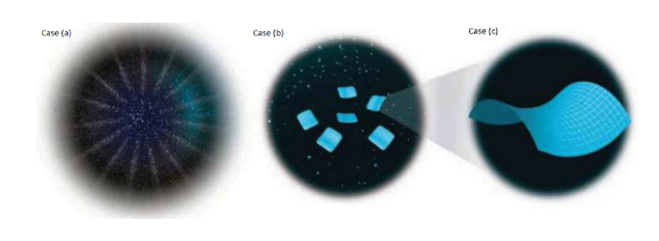
Figure 28: Case (a): “The Big-Bang was sparked when quantum fluctuation in the Metaverse caused a New Universe to pop-up into being like an air-bubble in the boiling water”. Case (b): “Within the Metaverse, other bubble Universes are being born. Each one expands at the speed of light”. Case (c): “Each Bubble Universe has a lower energy density than the surrounding Metaverse which means Space-Time Fabric takes on a saddle shape”.
We live in a multi-Universe called Metaverse. Metaverse is populated with a large number of universes popping up. Each Universe popping up is like a Big-Bang of the given Universe. Our Universe underwent a similar fate. Our Universe also popped up like a bubble in the boiling water. Our Universe expands at the speed of light. Gravitational Energy density profile corresponding to our Universe is lower compared to the surrounding Energy Density profile of the metaverse. Our Universe as a whole is sitting in a Gravitational Potential Energy Valley and in the process acquiring a Saddle shaped curvature (super-curvature) as shown in case (c), Figure 28, though in our local Universe WMAP and Planck studies have detected Flat Universe with near-zero curvature. This super- curvature will play a pivotal role in subsequent evolution of our Universe.
Guth A [50] postulated inflationary phase of expansion or exponential phase of expansion in the first split second before it was launched on a decelerating expansion phase. To achieve an ultimate cosmic free lunch a kick- start had to be given before a decelerated expanding Universe could be sustained within the next 8.8by after the Big Bang. In a metaverse devoid of everything, several universes were popping up and they could have very well collapsed as suddenly had these several universes not received kick starts to sustain as an independent expanding Universe. Each pop up was a BB and sum total of gravitational energy plus matter energy was zero. Here we take help of particle physics to explain this kick start which sustained the expanding pop universes.
In 1920, our vision of our Universe was confined to the galaxy Milky Way (MW). Edwin Powell Hubble while working on 60-inch telescope on Mount Wilson Observatory, California, USA, discovered that there were many other Galaxies farther beyond Milky Way. The radius of Milky Way, a spiral galaxy, has a radius 50Kly= 15.34pc (1 parsec or 1pc=3.26ly). By Cepheid Variable stars the distance to the given star can be measured. It became the cosmic benchmark for scaling galactic and extragalactic distances. Hubble observed many small diffuse patches besides the Milky Way. He assumed them to be inside the Milky Way but when he started measuring the distances, he found them much farther than 50 Kly limits. So he concluded that these patches were independent galaxies lying much beyond the Milky Way. He also found that most of the distant stars had their absorption spectrum Red-Shifted which implied that these distant galaxies were receding. He also found that the velocity of recession was directly proportional to the distance d of the galaxy and he put forth the now famous Hubble Law namely:
vrecession=d×H0 (1) where d=distance of the receding object and H0=Hubble Constant.
As already discussed in Subsection 6.1.1.3. , in Sub- Section 8.16 and Sub- Section 8.17, by measuring the redshift we can measure the cosmic distance of immediate neighbourhood galaxies, intermediate distant galaxies and farthest galaxies. The following two graphs show the extent to which we have fathomed our Universe.
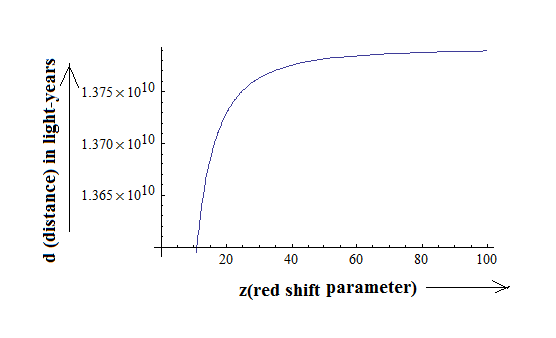
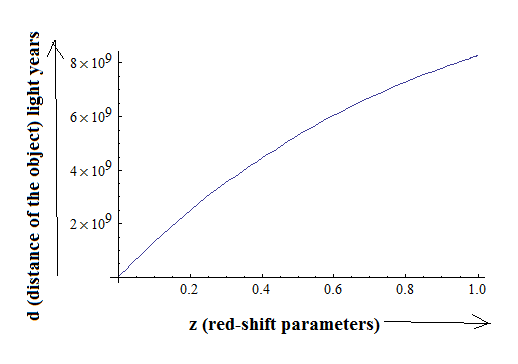
Serial z(red-shift) d(ly) Time from BB Comments Description of our Universe
0 0 0 13.8by Our galaxy
1 0.125 1638.85Mly 12.16by
2 0.26 3068.435Mly 10.73by Dec.Exp. stops and Accelerated Expansion starts because now Dark Energy dominates
3 0.46 4.98bly 8.8by Cosmic Jerk Decelerated expansion switched to
4 1 8.27508bly 5.5by
5 2 11.0334bly 2.758by (3by) Cosmic High Noon Star Formation Rate is at its peak
6 5 13.0463bly 745.5My (1by) Reionization is accelerated expansion H & He plasma is very dilute hence completed Universe remains transparent
| 8 | 11.35 | 13.6121bly | 179.7My (397My) | Half reionization era | UV light from the newly born stars reionize the ISM |
|---|---|---|---|---|---|
| 9 | 16 | 13.6967bly | 95.1My (250My) | First generation stars emerge | Densest of the clumps of density perturbation emerge as the 1st Generation stars |
| 10 | 1090 | 13.79177bly | 20,000y (380,000y) | Cosmic Haze lifted off | Plasma neutralizes below 4000K and radiation decouples as Cosmic Infrared Back Ground Radiation at 3000K (today it is Cosmic Microwave Background Radiation at 3K Black Body Radiation) and gravity dominates |
| 11 | 3402 | 13.79179bly | 2,400y (67,000y) | Dark Matter decouples and DM evolves into haloes and sub-haloes | DM builds the Cosmic Web scaffolding along which BM will clump into Superclusters,cluster,galaxies and solar systems |
| Inflationary phase ends and decelerated expansion starts- DM and BM dominate | |||||
| 10-32 second | Inflationary phase ends 10-33cm sized Universe blows up to 10cm golf ball instantaneously | Energy released is transferred to our Universe making it a fiery ball | |||
| 10-43 second | Inflationary phase begins | Decay of false vacuum propels our Universe to exponential expansion | |||
| 0 second | BB |
Table 13: The Landmark events after Big Bang while calculating d vs z The discovery of 3 Kelvin Black Body Microwave Background Ra
Table 11: The Landmark events after Big Bang while calculating d vs z The discovery of 3 Kelvin Black Body Microwave Background Radiation in 1965 by Robert William and Arno Panzias decisively proved that Big Bang had taken place 13.8 Billion years ago and today we witness the all-pervading afterglow of that Big Bang event [52]. Gamow team estimated CMBR to be 5K but they failed to explain why stable isotope atomic number 5 and why stable isotope of atomoc number 8 are absent in nature. Big Bang nucleosynthesis process is as follows: in the first few minutes after the Big Bang the Universe was hot and dense enough for nuclear reaction to occur. Nucleus fusion caused Hydrogen, Deuterium, Helium 3, Helium 4 and traces of Lithium 7 nuclei to be formed. But the production of element Boron and Beryllium was hindered by the bottleneck in nuclear reactions: there are no stable nuclei with atomic number 5 (5He, 5Li) and 8 (8Be). This creates a gap in nuclear reaction pathways, preventing the formation of heavier elements. The heavier elements are unstable and decay: 8Be→4He+4He. Without a stable intermediate it is difficult to bridge the gap and produce heavier elements. The conditions for Nuclear Fusion in the early Universe lasted only for a few minutes, limiting the time available to overcome the gap. The Gamow team did not address this problem. This problem was later understood by Fred Hoyle who proposed the triple alpha process for the formation of Carbon in the beginning. Gamow’s team addressed cooling of the Universe but he did not fully understand the nuclear physics constraint during Big Bang Nucleosynthesis. Big Bang Nucleosynthesis during first 3 to 20 minutes after the Big Bang- only during this time window nuclear fusion could occur. This was not enough to overcome the bottleneck or for processes like triple-alpha reactions to occur. 10^9K and above drove nuclear fusion as well as nuclear fission. Rapid cooling drove the temperature below nuclear fusion threshold (107K) n+γe (electron neutrino)→p+e-
4He, 2H Helium4 and Deuterium have high binding energy.
The probability of nuclear reaction depends on the cross-section of nuclear reaction.
4He + n →5He has low cross-section hence this nuclear reaction was limited.
Triple α process requires three 4He nuclei to collide simultaneously which is highly improbable in early Universe. Neutrinos decouple from matter 1 second after the Big Bang and then interaction drops. ----n and p interconversion froze. This freezes out determines the relative abundance of n and p.
-η = Photon/Baryon ~ 109 in the early Universe. Light nuclei got destroyed by high energy radiation. This limited the formation of De, 4He and 7Li.
So the early Universe had H 75% by mass, 4He 25% by mass and 3He and 7Li in traces. Heavier elements could not form. All the other heavier elements were formed in the heart of Stars and during the Supernova explosion.
Results of Numeric Simulation Studies: Numerical Simulation can be used as indispensable and powerful tool for discriminating among and validating models in conjunction with observed data. Astronomers cannot perform controlled experiments. Numerical simulation has become detailed surrogates for controlled experiments. By 1980 there were three modes of enquiry: theory, observation and numerical simulation. With rapid advances in technology and computing, it is possible now to achieve high resolution cosmological simulations. Now these simulations are not confined to confirming observations. They are driving astrophysics to questions which define their frontiers. The simulation is not just testing ideas Simulations have become generative, providing a new more powerful methodology to create new knowledge. These simulations provide an insight into complex astrophysical processes which cannot be acquired by simple theoretical deductions. For instance, evolution of galaxies over million years or the behaviour of stars as it nears the end of its life cycle and collapses into white dwarf or neutron star or black hole. Another advantage of numerical astrophysics is that it can provide insight into phenomena that is difficult to observe directly for instance the behaviour of Black Hole. Numerical Astrophysics have also helped to study the formation and evolution of planets which are too small or too faint to observe directly. By using numerical simulation, Astrophysicists can study phenomena that are difficult or impossible to understand through analytical or theoretical methods alone and gain valuable insight into the behaviour of astronomical systems.
Sloan Digital Sky Survey (SDSS): SLOAN programme, Sloan Digital Sky Survey (SDSS), catalogued the entire population of Galaxies in the visible sky [36]. The fully calibrated optical spectra for one million galaxies in the local Universe is available for Research purposes.
Use of Super-computers in Simulation Studies: Super- computers have made it possible to simulate the action of gravity over cosmic times starting from a rather uniform distribution of matter in the early Universe. While Universe expands globally, gravity tends to collapse small initial regions of over-density which was seeded in energy field of our Universe during the inflationary phase [53, 54]. Minute random quantum fluctuations in the structure of Universe that was present at the time of Inflation were amplified to cosmologically large scales. Density of matter fluctuated. These primordial fluctuations in the density of matter in the early Universe are the seeds of rich network of cosmic structures - stars, galaxies and clusters of galaxies. Owing to Sachs-Wolfe effect [55] these matter density fluctuations appear as the temperature fluctuations in Cosmic Microwave Background Radiation. kB Tcontrol the amplitude of Thermal Fluctuations and ℏ controls the amplitude of quantum fluctuations [56]. Temperature fluctuations reflect the matter distribution in our Universe at the time matter and radiation decoupled at z=1090. CMBR is the snapshot of matter distribution in the Universe at the time of recombination- matter radiation decoupling.
The need for Inflationary Phase and Cold Dark Matter in the Standard Cosmology Theory
Inflationary Cosmology offers elegant explanation to key features of our local Universe such as its large size and near spatially flat geometry. In static Universe over-density growth is exponential but in inflationary scenario it is linear [57]. Within this scenario the Universe underwent a brief period of exponential expansion [58, 59, 60, 61, 62, 63]. Universe doubled 90 times from sub-atomic size to golf ball size almost instantaneously. During this exponential expansion inflationary phase, quantum fluctuations were inflated in scale to become the classical fluctuations that we see today in the CMBR image.
According to the Standard Cosmology Theory, at time ‘0 second’ there was a Big Bang. From this grew an expanding Universe. But if this expanding Universe was to be seeded by some initial density perturbations, then “Inflationary Phase” had to be introduced. To solve the problem of flatness, horizon and magnetic monopole also, “Inflationary Phase” had to be introduced. “Inflationary Phase” was required for all the following reasons:
- Growth spurt explains why Universe is homogeneous and isotropic at the largest scale and still riddled with clumps, filaments and sheets of galaxies.
- It explains how it has grown by 54 orders of magnitude, and it has near-zero curvature. It is flat i.e. normalized matter density ~1. A normalized matter density greater than 1 would have implied positive curvature and spherical geometry i.e. a Closed Universe. A normalized matter density less than 1 would have implied negative curvature and saddle like geometry i.e. an Open Universe.
- The sudden ballooning of the Universe also amplified quantum fluctuations in matter density into clumps of matter that went to seed the first star and eventually the straggly supercluster of galaxies.
- The Inflationary Phase obviates the need for singularity. Singularity remains an arithmetical artifact. There is no physical singularity.
- Inflationary Phase dilutes the magnetic monopole and that justifies why we do not see any magnetic mono-pole today.
B-Mode Polarization Pattern on Cosmic Microwave Background Radiation. The wrenching moment of inflation should have shaken the space-time fabric resulting in primordial Background Gravitational Wave (BGW) emission which should leave B-Mode polarization pattern (Figure 31 right side} on Cosmic Microwave Background Radiation (CMBR). CMBR is described in Table 4 where at z=1090, 380,000 years after the Big Bang temperature falls below 4000K, Cosmic Haze lifts off, plasma neutralizes,, radiation decouples from matter and the radiation appears as as Black Body Radiation at 3000K pervading the Universe as Infra Red Radiation (peak wavelength at 966 nm) and today it is seen as 3K Black Body Radiation pervading the whole Universe as Cosmic Microwave Background Radiation (CMBR) at peak wavelength of 1 mm which happens to be in microwave part of the frequency spectrum. Cosmic Infrared Background Radiation at peak wavelength 966 nm at z=1090 gets Red Shifted to Cosmic Microwave Background Radiation at peak wavelength 1 mm in Modern Times at z = 0. To detect the B-Mode polarization in BGW Microsoft launched Background Imaging of Cosmic Extragalactic Polarization (BICEP) I and II project. BICEP was carried out from (2006 to 2012) by setting up Telescope on the South Pole. The inflationary phase (exponential expansion) in the first 10(-38) second after the Big Bang produces Background Gravitational Waves (BGW) which leaves an imprint of B-Mode polarization on CMBR. The matter density perturbation produces E-mode polarization but primordial BGW produces both E-mode and B-Mode perturbation The two kinds of patterns are shown in Figure 31.
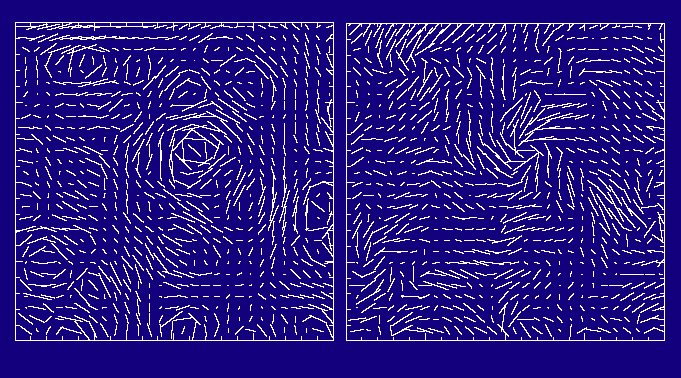
BICEP is an experiment to measure polarization of CMBR to unprecedented precision and in turn answer crucial questions about the beginning of the Universe- was there an inflationary phase after the Big Bang?
- Bicep I was carried out at 100GHz with angular resolution of 1 degree
- Bicep II was carried out at 150GHz and angular resolution of 0.7 degree.
The system had an array of 98 JPL polarization sensitive detectors. It used Robinson Gravitational Background Telescope. It mapped a large region around South Celestial Pole.
CMB observations by WMAP (Wilkinson Microwave Anisotropy Measurement from 2001 to 2010) have hinted at inflationary epoch in the first 10(-38) second producing near isotropy of the Horizon, the flat Geometry of the Universe and the peaks and valleys in CMB power spectrum [64]. Although these observations are consistent with the inflationary model, they are not sufficient to rule out other models of the early Universe. The litmus test for inflationary early Universe is to detect primordial BGW and its B-Mode polarization imprint on CMBR as shown in Figure 31 right side that is why BICEP missions and Keck mission became important.
In March 2014, BICEP 2 team announced in a Press Conference that they had obtained swirly Polarization Pattern in the CMBR, a hall mark of B-Mode polarization in Primordial Gravity Waves - a testimony to Inflationary Early Universe - a exponentially expanding Universe in first split second after Big Bang [65]. But this did not hold up to detailed scientific scrutiny. The swirly The Polarization Pattern could easily be contaminated by interstellar dust. Was the wiggly polarization pattern of primordial origin or was it an imprint due to foreground dust. Planck Satellite settled the dispute. The details of the systematic error in the estimate of the role of dust led to the spurious signal. There should be tiny ripples in space-time fabric---the primordial Background Gravitational Waves---created at the first split second after the Big Bang during the lightening exponential expansion of our Universe--as postulated by the currently accepted model. Bicep 2 results could not withstand the scientific scrutiny. Proper characterization of the dust sieve required measurement at multiple frequency channels. Planck Satellite has carried out the same at multiple frequencies-nine microwave and sub-nm frequency channel seven of which were also equipped with polarization sensitive detectors (Low Frequency Instrumentation 30- 70GHz and High Frequency Instrumentation 100-857GHz). When light waves vibrate preferentially in a certain direction, we say the light is polarized. CMBR is polarized. It exhibits a complex arrangement across the sky. E-mode Polarization is circular and radial. In contrast B-Mode Polarization is curly. Universe early inflationary phase gave rise to E-Mode as well as B-Mode polarization. The Milky Way (our home galaxy) is pervaded by a mixture of gas and dust shining at a similar frequency as those in CMBR. The foreground emission from dust and gas affects the observation of the most ancient light in the background. The foreground has to be separated from the background CMBR imprint. Interstellar dust also emits polarized light thus affecting the CMBR polarization imprint. In September 2014, Planck’s team revealed that polarized emission from dust is significant over the entire sky and comparable to the signal detected by BICEP2 even in the cleanest region. The joint work has shown that the detection of primordial B-Mode polarization is no longer robust once the emission from the Galactic dust is removed. So, the results of BICEP2 have not confirmed the inflationary phase of Universe in the first split second after the Big Bang.
Joint studies have set an upper limit on the primordial gravitational waves from inflation These might have been generated but it is too low to be confirmed by the present analysis. It may be there but it is not yet detected.
A gravitational lensing has been observed by Planck, BICEP2, and Keck Array. It is caused by a massive object bending the surrounding space and deflecting the trajectory of light as a magnifying glass does. BICEP2/Keck array have measured the gravitational lensing from large scale B-Mode polarization [66]. These results unambiguously demonstrate that B Mode reported by BICEP2 at intermediate angular scale (130 = l ˂ 356) is dominated by gravitational lensing.
End of Inflationary Phase. Inflationary phase lasted for Planck’s time = 10-43seconds. In this period Universe expanded exponentially, doubling 90 times and it grew from zero size to peanut size. After Planck’s time it expanded more sedately in decelerating fashion and as size grew the temperature of our Universe fell.
The Generation of Baryonic Acoustic Oscillations (BAO) and Large Structure in our Universe.
Early Universe after the inflationary phase was filled with hot dense fluid of electrons, protons and neutrons. This is known as the fourth state of matter namely PLASMA where matter and radiation are tightly coupled. Because of quantum fluctuations in the energy field of our bubble Universe density of matter and radiation had a tiny fluctuation of 1 in 100,000. These tiny fluctuations in matter-radiation density got frozen during the inflationary phase of Universe after the Big Bang. The current belief is that the Universe was built in bottom-up fashion - small fluctuations of the early Universe acted as the gravitational seeds for the structures seen today. The small anisotropy seen in the temperature of Cosmic Microwave Background Radiation have become the large structure seen today. Dense region attracted matter towards it the heat of matter-radiation interaction caused outward pressure. The counteracting forces created sound waves in air. Spherical Sound waves of baryon and photons with slightly greater than half the velocity of light travels to the sound horizon [67]. Sloan Digital Sky Survey has confirmed the WMAP results that sound horizon is 150Mpc (or 500Mly) [68, 69]. Once decoupling occurs 400,000 years after the Big Bang photons diffuse away to the horizon and they leave behind concentric shells of Baryon. The resonant shell corresponds to the first shell that travels the same distance from all over- density points. This distance is a sound horizon. The shells are ripples in matter density. These ripples form Galaxies.
This over-density attracted more matter and photons got bounced off due to thermal agitation. Alternating between pull of gravity and the repelling effect of thermal agitation created pressure waves - sound waves - these emerged from over-density points and rippled through the plasma towards the horizon. These sound waves are known as Baryonic Acoustic Oscillations (BAO). The length standard is given by the maximum distance BAO ripple travels primordial plasma before the plasma cooled below 4000K and plasma got neutralized (the epoch of recombination). At that point of time z=1090 these ripples froze. The length of the standard ruler can be measured by looking at the large- scale structure of matter in the observable Universe. In early Universe while matter-radiation were in plasma state light suffered Thomson Scattering leading to tight coupling of matter and radiation [68]. The length of the standard ruler can be measured by looking at the large-scale structure of matter in the Observable universe. Thomson Scattering
is the elastic scattering of electro-magnetic radiation by a free charged particle. It is low limit of Compton Scattering. After the inflationary phase Universe expanded sedately and monotonically and cooled below 4000K and plasma recombined to form neutral hydrogen, helium and traces of Lithium. The distribution of baryon in homogeneous plasma got frozen at the point of decoupling ar z=1090, leaving an excess of matter at a distance r_s from the initial over density point. This distance is known as Sound Horizon at decoupling and its value is 450,000ly (0.14Mpc). If the distance is re- scaled to the present times taking into account the expansion of Universe in past 13.8by, the Sound Horizon becomes 500Mly (or 150Mpc) [70]. Distances scaled to present times are called comoving distances.
In over-dense region, self-gravity wins in relation to radiation pressure hence it leads to a cumulative build-up of matter. In under-dense region, matter is removed to over- dense region leading to a complete void in the under-dense region. In 1 million years, density perturbation lead to BAO. This gives rise to the characteristic angular scale of 1° and famous acoustic peaks also called Doppler or Sakharov Peaks. BAO subtly influences the distribution of Galaxies. There is a slight bump in the probability of finding Galaxies at about 500Mly away from each other. Slightly more Galaxies form along the ripple of primordial Sound Waves than elsewhere.
Attempts were made to measure the acoustic peaks. The peaks correspond to large scale variation in the early Universe that are created by gravitational instabilities resulting in acoustical oscillation in the plasma. The first acoustic peak was detected by TOCO experiment, and the result was confirmed by Boomerang and MAXIMA experiments [70]. TOCO tentatively detected the first Acoustic Peak and Boomerang and MAXIMA confirmed the result in 2000. These measurements demonstrated that local Universe is flat and Cosmic Inflationary Theory was the right theory of structure formation. WAMP detected the second and third peak.
The same BAO creates a small residual imprint in the present-day clustering. In CMB we find patterns of over- density (hot spot) and under-density (cold spots). Universe contains DM, Baryonic Matter, Photons and neutrino. Since initial perturbations are assumed to be adiabatic, hence all the species are perturbed by the same amount. So small density fluctuation in Baryonic Matter will cause the same perturbation in DM, photons and neutrinos. In fact photons and neutrinos are ultra relativistic hence they have energy perturbation about 4/3 bigger than those of DM and gas. In course of time the two look the same. The a spherical shell of gas has imprinted itself on DM. Since DM outweighs gas by 5 times hence the acoustic peak decreases in contrast as gas comes in lock-step with DM as seen in Figure 34. Galaxies form in the region of over density and hence act as biased tracers of the matter field on large scale and therefore reveal BAO. In turn BAO can be used as a standard ruler to constrain the distance-redshift relation. The BAO peak has been observed in many many Galaxy sample survey:
- First observed by SDSS; [69.71];
- Degree Field Galaxy RedShift Survey (2dFGRS) [72, 73, 74, 75];
- BAO peak has been confirmed in latter SDSS releases [76, 77];
- 6dFGS (6d Field Galaxy Survey [78, 79, 80]. Early Universe was filled with plasma (tightly coupled Baryon and Photons). Tiny variation in over density points caused Sound Waves that rippled through the fluid. 400,000 years after the Big Bang was the last Scattering Surface. Photons decoupled and BAO froze at the current positions. Along the frozen ripples excess of Galaxy Formation took place. As the Universe expanded, the spherical shells of BAO stretched, and intergalactic distances increased. BAO’s left their imprints on CMB. We have studied these imprints up to 3 by from the BB. For most of the half billion years the Universe looked very different. Universe was filled with a sea of uniform plasma. This caused an uniform energy field in the bubble Universe. Because of quantum fluctuations there were tiny fluctuations of about 1 in 100,000. These tiny fluctuations took the form of a denser kernel of matter. Since these clumps had had more mass, gravity attracted additional matter. Because of the heat of collision between particles, they could not stick together when they collided. They bounced off. Alternating between the pull of gravity and the repellent effect of thermal agitation - waves of pressure (sound waves) were created. These propagated through the plasma. At 370,000 years after Big Bang temperature fell below 4000K and recombination era emerged. Thermal agitation was lowered and plasma recombined to form hydrogen, helium and traces of lithium. Photons and matter decoupled. The ripples of BAO froze. These frozen ripples of BAO carried more matter (peak of BAO) and gravity dominated. Clumps from plasma attracted more matter to become stars, and stars gravitated to form Galaxies. More Galaxies formed along the ripples than elsewhere. The frozen ripples stretched as the Universe expanded sedately at a decelerated rate. We are more likely to find a Galaxy at 500Mly not more nor less. BAO subtly influenced the distribution of Galaxies. There is a slight bump in the probability of finding Galaxies at about 500Mly away from each other. BAO has an impact in Galaxy clustering. Slightly more Galaxies form along the ripple of the primordial sound wave. Ring of Galaxies stretched.
- Wiggle-z (Dark Energy Survey Experiment - it uses a Reference Spectrum to measure BAO and test Cosmological Models) [81];
- BOSS (Baryon Oscillation Spectroscopic Survey)[82];
- eBOSS Luminous Red Galaxies (SDSS BAO and Red Shift
Space Distortion give an uninterrupted view of COSMOS over 11by. These measurements are described in eBOSS [83];
- QUASAR Samples tested for BAO peaks [84];
- At higher RedShift using Ly-α forest in BOSS and eBOSS [85, 86, 87, 88, 89];
- The BAO features have been measured using Void as a cluster tracer [90, 91];
- The BAO features have been measured in BOSS;
These measurements give distance reconstruct that span from z=0 to z=0.8 using conventional Galaxy Redshift Surveys and extend to z ~ 1.5 through eBOSS Quasers and to z = 2.3 when Ly-α Forest is included.
![Figure 32: At 474.5My after the BB, acoustic peak decreases in contrast as the gas comes in lock-step with Dark Matter simply because latter outweighs the gas by 5 to 1. [58]](/fulltextimages/13961/fig_32.png)
![Figure 33: Baryonic Acoustic Oscillation Spectrum.{Credit: Reference 57A]](/fulltextimages/13961/fig_33.png)
![Figure 34: Galaxies form in the region of over density and hence act as biased tracers of the matter field on large scale and therefore reveal BAO. In turn BAO can be used as a standard ruler to constrain the distance-redshift relation. The BAO peak has been observed in many many Galaxy sample survey: • First observed by SDSS; [69.71]; • Degree Field Galaxy RedShift Survey (2dFGRS) [72-75]; • BAO peak has been confirmed in latter SDSS releases [76,77]; • 6dFGS (6d Field Galaxy Survey [78-80]. Early Universe was filled with plasma (tightly coupled Baryon and Photons). Tiny variation in over density points caused Sound Waves that rippled through the fluid. 400,000 years after the Big Bang was the last Scattering Surface. Photons decoupled and BAO froze at the current positions. Along the frozen ripples excess of Galaxy Formation took place. As the Universe expanded, the spherical shells of BAO stretched, and intergalactic distances increased. BAO’s left their imprints on CMB. We have studied these imprints up to 3 by from the BB. For most of the half billion years the Universe looked very different. Universe was filled with a sea of uniform plasma. This caused an uniform energy field in the bubble Universe. Because of quantum fluctuations there were tiny fluctuations of about 1 in 100,000. These tiny fluctuations took the form of a denser kernel of matter. Since these clumps had had more mass, gravity attracted additional matter. Because of the heat of collision between particles, they could not stick together when they collided. They bounced off. Alternating between the pull of gravity and the repellent effect of thermal agitation - waves of pressure (sound waves) were created. These propagated through the plasma. At 370,000 years after Big Bang temperature fell below 4000K and recombination era emerged. Thermal agitation was lowered and plasma recombined to form hydrogen, helium and traces of lithium. Photons and matter decoupled. The ripples of BAO froze. These frozen ripples of BAO carried more matter (peak of BAO) and gravity dominated. Clumps from plasma attracted more matter to become stars, and stars gravitated to form Galaxies. More Galaxies formed along the ripples than elsewhere. The frozen ripples stretched as the Universe expanded sedately at a decelerated rate. We are more likely to find a Galaxy at 500Mly not more nor less. BAO subtly influenced the distribution of Galaxies. There is a slight bump in the probability of finding Galaxies at about 500Mly away from each other. BAO has an impact in Galaxy clustering. Slightly more Galaxies form along the ripple of the primordial sound wave. Ring of Galaxies stretched. • Wiggle-z (Dark Energy Survey Experiment - it uses a Reference Spectrum to measure BAO and test Cosmological Models) [81]; • BOSS (Baryon Oscillation Spectroscopic Survey)[82]; • eBOSS Luminous Red Galaxies (SDSS BAO and Red Shift](/fulltextimages/13961/fig_34.png)
In 2023 astronomers used SDSS catalog as well as the Cosmic Flow-4 catalog They had found evidence of BAO Bubbles of radius 155h75 (-1)Mpc radius containing some of the largest structures of the Universe. These large-scale structures are: • Howard/Smithsonian Great Wall containing Coma Cluster, Hercules Cluster, Sloan Great Wall, Bootes SuperCluster. Residing at the center of Bootes Supercluster is Bootes Void. BAO signal has been detected in the power spectrum of 26 Galaxies in the Void in 2005 through [85].
At 370,000 years the recombination era started. The plasma got neutralized into Hydrogen, Helium and traces of Lithium. The radiation got decoupled from matter and radiation raced to the horizon from the last scattering surface (LSS) and today this radiation pervades the Universe as 3K Black Body Radiation known as Cosmic Microwave Background Radiation (CMBR).
The era of recombination (370,000 years after the Big Bang), decoupling of matter and radiation and the origin of present day 3K Cosmic Microwave Background Radiation (CMBR).
In the first three minutes that followed the burst of inflation, baryonic particles such as protons, neutrons and leptonic particles electrons are formed as a hot soup and photons bounced around like pin balls with very short mean free path. At 400,000 yrs after BB i.e. z ~ 1090, plasma neutralized at temperatures less than 4000K because of insufficient thermal energy for ionization of H and He. This is known as the recombination era. In this recombination era, photons (in visible spectrum range) decoupled and raced to the horizon at the velocity of light ‘c’. This is the last surface of scattering [LSS] for photons imaged in CMB. The mean free path of photons became larger than Hubble Distance = cH(-
1)= velocity of light × Hubble Time = 4.42Gpc = 14.4bly They carried the imprints of the quantum fluctuations that roiled the inflationary Universe. Today this CMB radiation is in microwave range similar to Black Body Radiation at 2.725K. Because of 1000 times expansion of the Universe since the era of recombination, photons have undergone strong red- shift lengthening from Visible Wavelength (IR 950nm) to Microwave Wavelength (1mm). The primordial temperature perturbations due to quantum fluctuations in the energy field of the bubble Universe were the result of matter density perturbations point to point. These primordial matter density perturbations became the seeds of the highly structured Universe.
For 370,000 years after the Big Bang, matter was in a plasma state and Universe was filled with hot soup of plasma and photons. Thomson Scattering was the primary mechanism for keeping the Thermal Equilibrium in the hot soup meaning by both plasma and photon were kept at the same temperature. Thomson Scattering implies elastic scattering of photons by free non-relativistic charged particles like electrons and during elastic scattering photon energy and momentum remained unchanged.
In contrast Compton Scattering involves the scattering of photons by relativistic electrons, and the energy of photons changes due to the interaction. This type of scattering became important 10,000 years after the Big Bang. It plays a significant role in thermalization of the photon spectrum and in the thermal evolution of Universe. It has a insignificant role in maintaining the thermal equilibrium between plasma and photon.
Though plasma and photons had different adiabatic indices, photons had the same density distribution as the matter density distribution. (Adiabatic index γ of a system is related to the compressibility and on the type of particle and their interaction. For photons γ =4/3 and radiation pressure depends on T4 . Baryonic matter, non-relativistic gas has γ =5/3). Despite the difference Thomson Scattering causes tight coupling between radiation and matter, hence they behave as a single fluid sharing the same density distribution. When temperature fell below 4000K, matter and radiation decoupled, and matter changed from ionized state to neutral state. Since the two cooled independently, Temperature of matter fell inversely as the square of the Radius of the Universe and temperature of radiation fell inversely as the Radius of the Universe. The Black Body Radiation (CMBR) carried the imprint of the matter density distribution as thermal fluctuations at the time of parting at 370,000 years after the Big Bang.
Discovery of the constant hiss at Bell Labs in 1965 At Bell Laboratories, Crawford Hills, Holmdel, New Jersey, a Radio Horn antenna for satellite communication was being tested by Arno Panzias and Robert Woodrow Wilson. It was to be used for Radio Astronomy also. The Crawford Telescope had a very sensitive radio receiver. It was a transponder and an amplifier for ECHO communication system tuned to 4.08GHz (microwave band). This was to be used for detecting extremely weak microwave signals coming from astronomical sources hitherto undiscovered radio sources. All static noise had to be eliminated so as to effectively use it as a Radio Telescope.
They were detecting a constant hiss, a static noise (Figure 35). They checked the noise from the ground, from the molecular jittering in upper atmosphere, from the working of the apparatus itself and even from two nesting pigeons. The constant hiss never subsided regardless of the season or regardless of the direction in which it was pointed. This was constant in space and time. The temperature of the feeble Radio Waves was roughly 3 Kelvin. After returning from a conference a fellow astronomer, Bernard Burke pointed to a new paper by James Peebles working under Robert Dicke at Princeton [92].
James Pebble under Robert Dicke at Princeton had independently predicted the existence of all pervading CMBR. (He was unaware of the work done by Gamow and his collaborators in 1940- see Section 7.1.4.). James Pebble calculations in the context of hot big bang had predicted that the fireball which started the Universe had left behind a relic background Radio Waves.
The afterglow of the Big Bang would fill all space uniformly and have steady, detectable temperature of 10K to 3.5K. CMBR was the Rosetta Stone of the Universe, the signal that was key to the deciphering of the origin of our Universe. So by agreement two groups two separate papers back- to-back in Astrophysical Journal in 1965 [92, 93]. Panzias and Wilson summarized that a persistent, isotropic radio noise in microwave band with temperature 3.5K Observed using the Holmdel Horn Antenna. They concluded that excess the signal was of cosmic origin. Dicke and his team concluded that `Microwave Background Radiation was the cooled remnant of the hot, dense state of early Universe now observable as nearly uniform Black Body Spectrum at microwave frequency.
![Figure 35: In 1965, Arno Penzias and Robert Wilson discovered the cosmic microwave background. Their giant but crude microwave receiver saw the radiation as being the same in all directions, occurring at 2.7 kelvin. [Credit NASA]](/fulltextimages/13961/fig_35.png)
George Gamow and his team were the first to predict Cosmic 3K Blackbody Radiation in 1944:
The discovery of CMBR by Panzias and Wilson in 1965 was predicted in 1944 itself by George Gamow and his team. George Gamow and his colleagues including Ralph Alpher and Robert Herman were the first to predict the existence of CMBR. In 1944 Gamow’s team was working on Cosmic Chemistry. The early Universe after the inflationary phase had balanced creation and annihilation. Particles and anti- particles were morphing from energy to matter and from matter to energy.
Particle + antiparticle -> energy -> particle + antiparticle.
But an imbalance occurred known as Baryon asymmetry This occurred during the baryogenesis phase (when quarks triplet formed baryons and quark quadruplet formed mesons) at a temperature of 10^12 K (1TeV), within 10(-36) to 10(-12) sec after the Big Bang. Sakharov Criteria was fulfilled: conservation of baryons is violated: C (charge conjugation) and CP (charge parity symmetry) are violated and departed from thermal equilibrium (phase transition periods). This imbalance froze and led to a new thermal equilibrium. Universe is akin a Black Box which was adiabatic Box - which achieved adiabatic conditions- a given amount of matter and radiation are trapped forever. According to Quantum Mechanics, in a Black Box the temperature of the walls decides the spectrum of the radiation which follows Planck Distribution and Wien’s Displacement law. Thermal radiation and thermal equilibrium played an important role in the synthesis of elements. Universe absorbed all radiation, but it emitted this radiation in a specific spectrum known as Planck distribution. Gamow team surmised that hot, dense, early Universe on achieving a thermal balance would have behaved as a Black Body with a Cosmic temperature was estimated. A Black Body remains a Black Body forever even as it cools. They estimated it to be 5K. This paper fails to explain why stable isotope with atomic number 5 Boron and stable isotope of atomic number 8 Beryllium are absent in nature. But there is a consensus in scientific community that Alpher and Herman were the first to estimate the temperature of CMBR and to identify it as the temperature of the Universe. CMBR is one of the key signatures of Big Bang.
The results of COBE, WMAP and Planck space satellites: • NASA’s Goddard Space Flight Center on 18th November 1989 launched Cosmic Background Explorer (COBE). It measured the tiny variations in temperature of CMBR, the imprint of matter encountered in its journey across the COSMOS (Figure 38). This imprint was as it occurred at the time of decoupling at 370,000 years after the Big Bang at z =1090. Differential Microwave Radiometer installed in COBE gave the Planck distribution curve of CMBR. Data points from COBE traced the smooth curve of Black Body. The curve was so accurate that the measurement errors were thinner than the thickness of the printer’s rendition of the graph that overlays its shape. The new results have gone well beyond just validating the hot Big Bang Model, beyond testing models of elementary particles, beyond the overall paradigm for the formation of structures in the Universe. The accepted theory of for the formation of all structures in our Universe is based on the growth of small fluctuations in the matter distribution of the very early Universe. At z= 3400, about 50,000 years after Big Bang Dark Matter started dominating the Universe and amplified the tiny fluctuations which generated mass clumps that eventually hosted the formation of first stars and galaxies.
• Wilkinson Microwave Anisotropy Probe (WMAP) was launched by NASA on 30th June 2001 and Planck Satellite was launched by ESA on 14th May 2009. WMAP has an angular resolution which is 30 times that of COBE and Planck Satellite have a resolution 2.5 times that of WMAP. These two CMBR probes have measured incredibly tiny patterns of hot spots and cold spots with high precision. In addition to the splotch pattern, CMBR has several other signatures that prove the primordial origin of CMBR. It is extremely uniform and any two opposite points in the sky will differ in temperature only in the fifth decimal place. Earth’s motion through CMBR will make radiation temperature appear higher (1 in 1000) in the direction of our motion and slightly cooler on the other side in our wake. This is known as Dipole Anisotropy. These are predictable departure from uniformity in temperature distribution. Motion of Earth needed to be securely measured because only then could the sources of non-uniformity---which held the key to ratifying the entire cosmological edifice --- come in view.
![Figure 36: It was not until the launch of the Cosmic Background Explorer (COBE) spacecraft that astronomers could begin to see variations in the background, at levels of 1 part in 100,000 [Credit: NASA].](/fulltextimages/13961/fig_36.png)
In February 2003, the image of the infant cosmos only 380,000yrs old was received. The results from WMAP reveal that the CMB temperature variations follow a distinctive pattern predicted by cosmological theory: the hot and cold spots fall in characteristic sizes. The image of infant cosmos is shown in Figure 37.
![Figure 37: The Wilkinson Microwave Anisotropy Probe, launched in 2001, improved on COBE by looking for such anisotropy at much smaller angular scales [Credit: NASA].](/fulltextimages/13961/fig_37.png)
- WMAP key findings; Age of Universe = 13.8by; Dark Energy 68.3% (drives the accelerated expansion in the present Universe); Dark Matter 26.8%; Baryonic Matter 4.9%; Our Universe has Flat Geometry because total energy density = critical energy density; Confirmed the exponential expansion of Universe in first split second after Big Bang; Primordial Density fluctuations maps minutely the temperature fluctuations--these are the seeds of all current structures; H_0=70.4 Km/s/Mpc; Reionization Epoch 400My after Big Bang when first Stars are born and their UV light emission causes the reionization of neutral H, He and traces of Li; Supports the existence of Sound Waves in early Universe plasma-- this provides the standard ruler for measuring the cosmological distances measurement; It supports Neutrino Physics that there are only three species of light neutrino (electron neutrino; mu neutrino and Tau neutrio);
- WMAP gives the timeline of Universe as Big Bang 13.8 by ago; Recombination Era 380,000y after Big Bang; Reionization and first stars born 400My after Big Bang; Lemaitre (1931) Cold Dark Matter Model is the standard model of Universe is confirmed [25];
![Figure 38: TimeLine of Evolution of Universe [Courtesy:NASA/WMAP Science Team].](/fulltextimages/13961/fig_38.png)
| Time after BB | Z† (redshift) Or T(Kelvin) | Event | Comment |
|---|---|---|---|
| 0 year | Infinite | Big Bang occurs | Time is born with Big Bang |
| 10-43s | 3.16×1031K | 1st Symmetry breaking | Quantum Gravitation to GUT phase transition. Relic gravitons left out. Density of matter = 1093gms/cc. |
| 10-32s | Inflationary Phase ends | Primordial perturbations in matter-equivalent energy density freezes out. | |
| 10-10s | 1015K, 100GeV | 2nd Symmetry breaking | GUT to Electro-Weak Phase transition, weak force decouples, relic intermediate vector bosons left out, Universe filled with a soup of quarks, leptons, photons. Baryonic Number freeze out takes place and separation of radiation density and matter (DM+BM) density is formalized. |
| 10-6s | 1013K, less than 1GeV | Fission of nuclear particle stops | Quark-nucleon phase transition. The universe filled with a soup of leptons, nucleons, photons. Relic quarks left out. Density of matter = 1018gms/cc. |
| 10-4s | 1012K 1000×the core temp of Sun | Instability of lepton leads to instability of nucleons. | Continuous transmutation taking place between proton and neutron. Density of matter = 1014gms/cc. (nuclear density) |
| 4sec | 5×10⁹K | Leptons become stable hence nucleons stabilize. | p, n stabilizes to 7:1 |
| 3min | 745×106K | 75%H ions,25% He ions | |
| 15mins | 333.3×10⁶K | Nuclear fusion first stage completed. | Matter in plasma form stabilized at 75%H ions,25% He ions or 92% and 8% by atomic number density with traces of Lithium |
| From here onward the Universe enters the Dark Ages. But the matter is not uniformly distributed as confirmed by the study of Cosmic Microwave Background Radiation through COBE, WAMP and Planck Mission. The denser part of matter shows up as red in the CMBR map and the rarefied part shows up as blue. The denser part are the seeds of stars, galaxies and clusters which have followed a bottom-up model of hierarchical formation based on the ΛCDM Model. CMBR carries the imprint of the matter distribution at the time of decoupling which will occur at 370,000 years after the BB because temperature cools below 4000K which allows plasma to neutralize. Dichotomy of DM and BM leads to Baryonic Acoustic Oscillation generation from the hot spots. | |||
| 7,000yrs | Z = 10,000 | Dark Matter decouples from plasma | From this point onward DM starts evolving into halos and sub-halos |
| 370,000yrs | Z = 1090, 4000K | Plasma recombines into a cold, neutral, dark universe. | Temperature of the Universe falls to 4000K where all ions recombine to form neutral atoms and molecules of H2 and He. Gravity will dominate from now on. |
| The stage is set for the formation of Population III stars and galaxies. | |||
| 200My | Z = 18 | First stars and galaxies born | Universe reionizes. |
| 500My | Z = 8.5 | Not Known | Not Known |
| 600My | Z = 7 | Dark age ends and the epoch of reionization begins | Population III stars and galaxies are formed and these re-ionize the cold, neutral and dark universe. (detected by near-IR Wide Field Camera3 mounted on Hubble Space Telescope). |
| Population III stars were massive and hence short lived however through internal fusion followed by supernova explosion they must have commenced the process of chemical enrichment through recycling in the interstellar matter. This produced successive generations of Population II and Population I stars with progressively higher metallicity and alpha elements. | |||
| 1Gy | Z=6 | Rapid build-up of low metallicity stars. | Here heavier elements reside in cool gas and dust grains within the Galaxies. |
| 2Gy | Z=3 | Metallicity increases through nuclear synthesis. Star formation Rate = ρ = 0.2* | Heavier elements reside in stars, planets and interstellar gas. There is possibly a peak in Star Formation Rate. |
| 3Gy | Z=2 | Half the stars were in place and ρ ≥10 ρ0 | Population II & Population I stars and Galaxies are born. Milky Way is born at this time. It is the third Generation Galaxy (Population I). |
| 4Gy | Z=1 | Rate of star formation is 10 ρ = 0.1* 0 | |
| 8.8Gy | Z = 0.46 | Cosmic Jerk | Till this point Universe expansion rate was decelerating. From this point onward expansion rate is accelerating due to Vacuum Energy Density being greater than (Radiation Density + Matter Density). |
| 9.133Gy | Z = 0.43 | Our Solar Nebula is born. | Our Sun is Population I star. |
| 13.7Gy (present) | Z=0 | Rate of star formation is ρ0=0.01* |
Table 14: Timeline of Evolution of Universe. *Units of star formation rate is (MSUN) ×y-1×Mpc-3, ρ0 = present day star formation r
Four Scenarios of possible end of Universe: • First Scenario: Ω (actual density of (dark matter + baryonic matter +dark energy) > Ωcritical (critical density of dark matter + baryonic matter + dark energy) • This has a closed geometry with positive curvature. It is collapsing to zeru. Hence it ends in a BIG CRUNCH.
• Second Scenario: Ω = Ωcritical This has a flat geometry with zero curvature. Its expansion is decelerating. It keeps coasting. Hence it is called Coasting Universe. • Third Scenario: Ω < Ωcritical Geometry is open, negative curvature, expands to infinity which ends in BIG CHILL
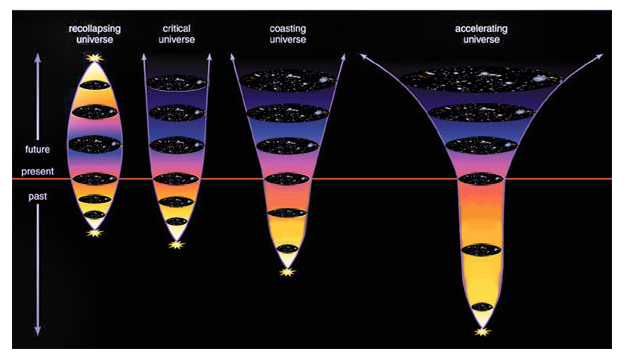
• Fourth Scenario: Ω = Ωcritical This has a flat geometry with zero curvature. Its expansion is accelerating. It will be expanding because of repulsion due to Dark Energy. This will result in a BIG RIP.
How and when the Universe became asymmetrical with respect to matter and antimatter?
Timeline of Events leading to asymmetry in the Universe: **
- Very Early Universe:** 10(-12) sec to 10(-6) sec after the Big Bang and Universe Temperature 10^12K we have quark-gluon plasma; particles and anti-particles were continuously morphing from matter to energy and energy to matter;
- CP violations were few and far between and the balance between particle and antiparticle was maintained; **
- Electro-weak Era and Higgs Field appeared:** At 10(-12) sec, electro-weak `phase transition occurred, and Higgs field give mass to the fundamental particles. Quarks and antiquarks annihilate each other.
- Soon CP violating processes occurred and quarks dominated over anti quarks ~ Baryogenesis and triplets of quarks-built BARYONS and quadruplets formed MESONS.
- This lasted from 10(-6) sec to first three minutes after the Big Bang when protons and neutrons were formed.
- Leptogenesis- decay of heavy right-handed neutron created imbalance between leptons and antileptons;
This imbalance was transferred to Baryons through sphaleron processes;
- Freeze out of Baryon Asymmetry- At few minutes after Big Bang Baryon Asymmetry got frozen out - this slight excess of matter over anti `matter led protons, neutrons, stars, planetary systems, galaxies and everything we observe;
- The Standard Model still has challenges: the strength of CP-violation is too small to explain the amount of observed baryon asymmetry- there may be some new physics involved;
- The nature of phase transition that allowed baryon number violation and CP violation is unclear;
- 10(-6) sec to a few minutes during the era of baryogenesis. The imbalance got frozen leading to matter dominated Universe;
- In 1967 SAKHAROV condition was enunciated Andres Sukhorov set the following conditions for baryon asymmetry:
- Condition 1-Baryon Number Violation and imbalance is created;
- Conditin 2-C and CP violation. Charge Conjugate Symmetry (C) and Charge Parity Symmetry are being violated If C and CP symmetry were strictly conserved then equal matter and antimatter would exist.
- Condition 3-Universe has departed from equilibrium condition;
![Figure 40: Planck, launched in 2009, provides a capstone to the study of the cosmic microwave background. But unambiguous confirmation of a cosmic burst of expansion known as inflation remains elusive. [Credit:ESA].](/fulltextimages/13961/fig_40.png)
PLANCK satellite was launched to further refine the CMBR data (see Figure 40).
Satellite Planck’s key findings: Age of Universe = 13.79by; Dark Energy 68.9% (drives the accelerated expansion in the present Universe); Dark Matter 26.8%; Baryonic Matter 4.9%; H0 = 67.4 Km/s/Mpc; Hubble Tension persists; Cosmic Inflation and initial conditions represent perfect flatness; detailed characterization of primordial fluctuations are nearly scale invariant and Gaussian Distribution consistent with inflationary predictions; temperature and polarization anisotropies are present in CMBR; temperature variations are the seeds of large scale structure; in Neutrino Physics relativistic particle species 3.046;sum of neutrino masses were more accurately determined; the cosmological parameters of ΛCDM are;
- Baryon Density Ωb =0.0486,
- Dark Matter Density Ωc = 0.2587,
- Total Density ΩTotal = 1;
- Spectral Index ηS = 0.965; Slight deviation from perfect scale invariance.
- Reionization Epoch = 550My after Big Bang;
- Temperature of CMBR 2.7255K;
- Baryonic Acoustic Oscillation verified;
- Anomalies have been mapped: Cold Spot - unexplained regions of lower temperature have been mapped; Large Scale Asymmetry Difference in temperature fluctuations on opposite hemispheres of the sky challenges the idea of complete isotropy;
![Figure 41: Two Cosmic Microwave Background anomalous features hinted at by Planck’s predecessor, NASA’s Wilkinson Microwave Anisotropy Probe (WMAP), are confirmed in the new high precision data from Planck. One is an asymmetry in the average temperatures on opposite hemispheres of the sky (indicated by the curved line), with slightly higher average temperatures in the southern ecliptic hemisphere and slightly lower average temperatures in the northern ecliptic hemisphere. This runs counter to the prediction made by the standard model that the Universe should be broadly similar in any direction we look. There is also a cold spot that extends over a patch of sky that is much larger than expected (circled). In this image the anomalous regions have been enhanced with red and blue shading to make them more clearly visible [Credit: ESA].](/fulltextimages/13961/fig_41.png)
Figure 41: Two Cosmic Microwave Background anomalous features hinted at by Planck’s predecessor, NASA’s Wilkinson Microwave Anisotropy Probe (WMAP), are confirmed in the new high precision data from Planck. One is an asymmetry in the average temperatures on opposite hemispheres of the sky (indicated by the curved line), with slightly higher average temperatures in the southern ecliptic hemisphere and slightly lower average temperatures in the northern ecliptic hemisphere. This runs counter to the prediction made by the standard model that the Universe should be broadly similar in any direction we look. There is also a cold spot that extends over a patch of sky that is much larger than expected (circled). In this image the anomalous regions have been enhanced with red and blue shading to make them more clearly visible [Credit: ESA].
On March 21st, 2013, scientists with the European Space Agency’s Planck mission announced their long-anticipated results from the spacecraft’s first 15.5 months of mapping the cosmic microwave background (Figure 41).
The CMB is the radiation released about 380,000 years after the Big Bang, when the newborn universe cooled down enough to become transparent and let light travel free. We see this light today redshifted to microwave wavelengths, wallpapering the whole sky behind the farthest galaxies. Slight temperature variations all across it reveal how matter was distributed at that early era. These variations allow cosmologists to test theories of what was happening in the universe in the tiniest instants after its birth, including how inflation drove the first 10–35 second of the Big Bang.
Planck’s superbly precise new picture of the CMB (below) shows remarkable agreement with theoretical work, confirming that observations fit a simple cosmological model defined by just six numbers(parameters). (Take that in for a moment: the whole physical universe is described by six parameters. Even your phone number takes 10 digits in the U.S.).
The graph in Figure 42 shows how much temperatures fluctuate in patches of various angular sizes all across the sky. Our inflationary model makes specific predictions about what this complex graph should look like. As you can see, Planck’s observations (red dots) trace nigh perfectly the theory (green line).
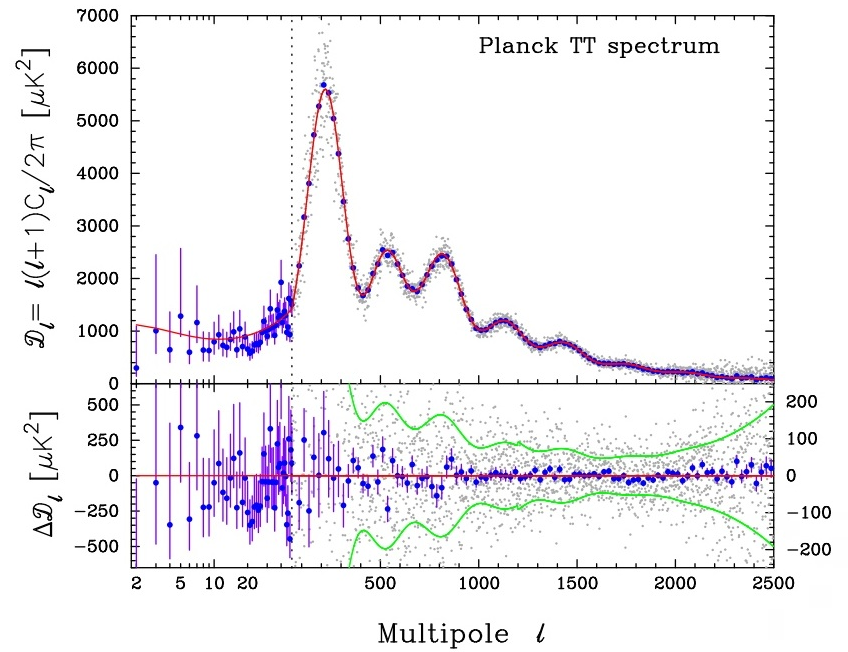
Planck foreground-subtracted temperature power spectrum (with foreground and other “nuisance” parameters fixed to their best-fit values for the base _CDM model). The power spectrum at low multipoles (`l = 2–49, plotted on a logarithmic multipole scale) is determined by the Commander algorithm applied to the Planck maps in the frequency range 30–353 GHz over 91% of the sky. This is used to construct a low-multipole temperature likelihood using a Blackwell-Rao estimator, as described in Planck Collaboration XV (2013). The asymmetric error bars show 68% confidence limits and include the contribution from uncertainties in foreground subtraction. At multipoles 50 ≤ l` ≤ 2500 (plotted on a linear multipole scale) we show the best-fit CMB spectrum computed from the CamSpec likelihood (see Planck Collaboration XV 2013) after removal of unresolved foreground components.
The light grey points show the power spectrum multipole-by-multipole. The blue points show averages in bands of width Δl ≈31 together with 1σ errors computed from the diagonal components of the band- averaged covariance matrix (which includes contributions from beam and foreground uncertainties). The red line shows the temperature spectrum for the best-fit base ΛCDM cosmology. The lower panel shows the power spectrum residuals with respect to this theoretical model. The green lines show the ±1σ errors on the individual power spectrum estimates at high multipoles computed from the CamSpec covariance matrix. Note the change in vertical scale in the lower panel at l = 50.
![Figure 43: The temperature angular power spectrum of the primary CMB from Planck, showing a precise measurement of seven acoustic peaks, that are well fit by a simple six-parameter _CDM theoretical model (the model plotted is the one labelled [Planck+WP+highL] in Planck Collaboration XVI (2013)). The shaded area around the best-fit curve represents cosmic variance, including the sky cut used. The error bars on individual points also include cosmic variance. The horizontal axis is logarithmic up to l` = 50, and linear beyond. The vertical scale is l`(`l + 1)Cl=2_. The measured spectrum shown here is exactly the same as the one shown in Fig. 1 of Planck Collaboration XVI (2013), but it has been rebinned to show better the low-l` region.](/fulltextimages/13961/fig_43.png)
Figure 43: The temperature angular power spectrum of the primary CMB from Planck, showing a precise measurement of seven acoustic peaks, that are well fit by a simple six-parameter CDM theoretical model (the model plotted is the one labelled [Planck+WP+highL] in Planck Collaboration XVI (2013)). The shaded area around the best-fit curve represents cosmic variance, including the sky cut used. The error bars on individual points also include cosmic variance. The horizontal axis is logarithmic up to l` = 50, and linear beyond. The vertical scale is l`(`l + 1)Cl=2. The measured spectrum shown here is exactly the same as the one shown in Fig. 1 of Planck Collaboration XVI (2013), but it has been rebinned to show better the low-l` region.
Planck launched on May 14, 2009, as successor to NASA’s phenomenal Wilkinson Microwave Anisotropy Probe (WMAP), which mapped the CMB for nine years. WMAP observed in five frequency bands spanning 22 to 90 GHz, and its results form the bedrock of modern cosmology — helping nail down values such as the age of the universe (13.77 billion years) and how much of the matter in the universe is “dark” (about 84%) when combined with other measurements.
Planck’s more precise numbers are slightly different from WMAP. Planck covered nine bands from 30 to 857 GHz, and it’s still working in the three lowest bands. The sweet spot for observing the CMB — where the galaxy’s dusty, star- studded plane is the least bothersome — is from 70 to 150 GHz, making Planck an ideal follow-up to WMAP, Planck team member Bruce Partridge (Haverford College) said last month in Boston at the annual meeting of the American Association for the Advancement of Science.
The oldest light in our universe, seen today as the cosmic microwave background, suffuses the cosmos. This all-sky map, created from all nine frequency bands of the Planck spacecraft, shows the CMB’s details at a precision never before acquired. Click for high resolution (5.5 MB). See comparison with WMAP.
Impact of these findings: ΛCDM established with unprecedented precision, most detailed and data sets for the early Universe have been obtained.
The six parameters that define the Universe. Table 13 gives the six parameters which are sufficient to describe the Universe.
| Parameter | definition | Numerical value | Comments |
|---|---|---|---|
| N | electricforce grav.force | 10-36 | If N is < then Universe would be short lived and life could not evolve. |
| ε | Binding strength of nuclei | 0.007 | If ε = 0.006 or 0.008 then no element beyond Lithium could form. |
| Ω | Total mass-energy content of Universe | 1 | If smaller than Unity then indefinite expansion and if greater than unity Universe would experience a crunch |
| Λ | Cosmological constant | 0.73 | Vaccum Energy = Dark Energy; Fundamental property of Space |
| Q | Size of initial fluctuation | 10-6 | Perfectly poised - if larger then Universe would be too violent for stars to survive and if smaller than large structure formation would be impossible. |
| D | Number of spatial dimensions | 3 | If D is 2 or 4, life could not exist. |
Table 15: Six parameters of the Universe.
If these parameters deviated even slightly from its ideal value by a few tenth of a percent we would not exist. No Universe, no Earth and no life. True nature of Dark Energy Total Mass-Energy sum of Universe is not understood. This has opened up new questions which hark back to the moment of creation.
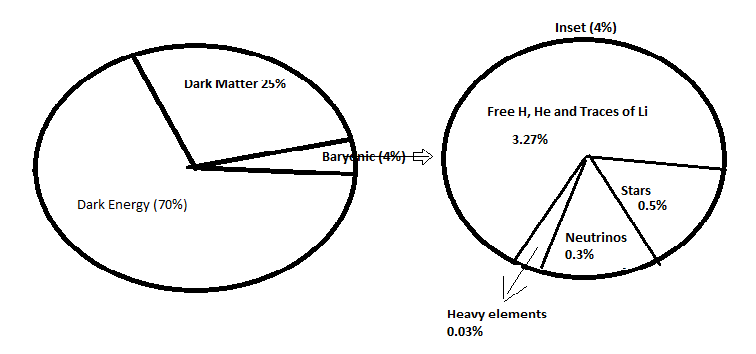
Determination of the Age of Universe and the time taken to travel from initial point to the given object of Doppler red-shift z
1/(1+z) gives the age of the source at z. Large z means young Universe.
Age of our Universe [33]:
1 1 − − − = +∞ ∧ = Ω× + Ω × + Ω + Ω × ∫
a r m k
2
0 0 0 0 (30) At the singularity, z2 = infinity. The present z1=0.
Ωr0 = 10-4, ΩM0 =0.317, ΩK0 = 0, ΩΛ0 = 0.683 and H0 = 67Km/s/Mpc, H0
-1=14.594Gy. These values have been taken from Planck’s collaborative results.
Substituting the above values in Eq.30;
Hubble Time = 1/H0 = 14.6Gy, Age = 13.86Gy, Recombination era at z = 1090 corresponds to 370,000 yrs, the clumping of DM starts at z = 10,000 which corresponds to 7000 yrs after BB The exotic bodies of our Universe. White Dwarfs, Neutron Stars/Pulsars and Black Holes are the exotic bodies of our Universe. The journey of acceptance of the heliocentric Solar System and the expanding Universe worldview was not linear. In the same way the journey of exotic mathematics of gravitational collapse to White Dwarfs, Neutron Stars/Pulsars and Black Holes was not straightforward. It was the worldview of General Theory of Relativity applied to Gravitational Collapse which clarified the picture of these exotic bodies.
In Black Hole a particle is gravitationally entombed with no path of return. The gravitational field within a Black Hole is so intense that even light cannot escape. In 1964 at a meeting of the American Association for the Advancement of Science (AAAS) Science Writer Marcia Bartusiak noted that the physicist John Archbald Wheeler did not originate the term but he definitely popularized and legitimized the use of Black Hole. Black Hole (BH) is inevitable consequence of the Standard Physics that describe the evolution of stars. Theory of stellar evolution in light of General Theory of Relativity give the birth of White Dwarf below Chandrasekhar Limit (Chandrasekhar Limit is 1.44MΘ where MΘ is the mass of Sun), from 1.44MΘ to 3MΘ star evolved into Neutron Star/Pulsar and above 3MΘ star evolved into BH. Below Chandrasekhar Limit 1.44MΘ after the nuclear fuel is used up the gravitational collapse takes over but it squeezes the body upto a point where electron degeneracy pressure prevents further gravitational collapse. This is a carbon-oxygen White Dwarf. But of the star is heavier than 1.44MΘ and lighter than 3MΘ then electron degeneracy cannot prevent further gravitational collapse and this leads to merger of electrons and protons into neutron and neutrons get tightly packed and neutron degeneracy pressure emerges and checkmates the gravitational collapse and we get Neutron Stars/Pulsars. If the mass of star is greater than 3MΘ then nothing can checkmate the gravitational collapse of the massive star more massive then 3MΘ and the star gets squeezed into singularity and we call this Black Hole. We will elucidate this point further in the following sections. Degeneracy pressure emerges because of Pauli - Exclusion Principle which is applicable to particles obeying Fermi-Dirac Statistics and these particles are called Fermions.
![Figure 45: Radius–mass relations for a model white dwarf. Mlimit is denoted as MCh [14].](/fulltextimages/13961/fig_45.png)
[It shows how radius varies with mass for non-relativistic (blue curve) and relativistic (green curve) models of a white dwarf. Both models treat the white dwarf as a cold Fermi gas in hydrostatic equilibrium. The average molecular weight per
- Asymmetry Irreversible Heterogeneity Quantum Cosmology Grand Mathematical PHYSICS
- Early Universe: Hadronic Crystals Coherent Micro Gravitational Wave Emitters PHYSICS Part II
- The Solar System Constraint Maze: A Scientific Dead-End Revealing the Interuniversal Machine
- Assessment of Radiofrequency Radiation from 2G and 3G Mobile Phone Handsets
- Early Universe Magneto-Gravitational Coupling Genesis Physics: Part I
- Falsifiability of the Classical Law of Gravitation and Unveiling the Time-temperature Entanglement of the Universe