
Performance Evaluation of Yanmar Harvesting Machine in MPOB Bangi, Selangor
In agriculture business mostly in the oil palm field, the harvesting activity is very important. Nowadays, the application of mechanization for harvesting purpose in the tall oil palm tree is rarely used and apply by the big company in Malaysia. This situation happen probably due to the lack of information and approach toward them. There are a lot of advantages by using the mechanization in term of harvesting purpose especially FFB harvesting machine. One of the advantage is will reduce the labor usage and cost. Other than that, the application of harvesting machine are very crucial in overcoming the problem of tall oil palm tree. Besides, it will increase the freshness and quality of the bunch since the bunch not fall direct to the soil. The purpose or objective of this study is evaluate the performance of the harvesting machine. This study was done at the MPOB, Bangi Selangor to carry out all the data and details about the harvesting machine. The secondary data was used in other to make the calculation and can know the effectiveness and the efficiency of the harvesting machine. In addition, the understanding about the fuel consumption also important because it is equivalent to the operating cost. From the overall study, it show that the harvesting machine are effective for the harvesting process mostly in reducing the usage of manpower and problem of tall oil palm tree.
Introduction
Malaysia is one of the biggest country that produce and export of palm oil in the world. In 2016, Malaysia produced about 30% palm oil in total around the world which is one of the good achievement [1]. The origin of oil palm growth is in tropical area which is at that region is the first grown of vegetative oil in term of industrial production [2].
In Malaysia right now, plantation worker most commonly use manual method for harvesting the fresh fruit bunch (FFB). The requirement of manual labor proves that to be inefficient by using the chisel or sickle [3]. This way is a barrier when the process of harvesting becomes multiply, when the tree grows taller [1]. In addition, the good skills and energy is required in order to get the effective cutting Thesis operation. As we know, the oil palm tree can reach at average high 18-20 m and remain productive up above 32 years age which is can affect uncomfortable ergonomic to oil palm harvester [1]. Other than that, the used of chisel and sickle to harvest the fresh fruit bunches (FFB) sometime can affect the quality of the FFB rather than applying the machinery.
The introduction of harvesting machine it can minimizes the loose fruit collection and control its damage by the worker which indirectly can reduce the time [3]. The machine used for harvesting the fresh fruit bunches (FFB) is a machine that contains scissor cutting mechanism which the power is derived from a hydraulic and it will produce enough force to cut the bunch stalks and fronds [1]. Then, this machine consists of grapple for cutting operation and it will deploy to hold the FFB, followed by the extending cutter for cutting the FFB [3]. The FFB will be loaded into the bucket by using the telescopic boom [3].
The dependency of oil palm industry towards labor is very high. For every stage or operation start from planting until processing the requirements of workers are really needed in a high amount of number [4]. In addition, the dependency towards foreign workers also high mostly in four categories of work which is cutter or harvester, collector of FFB, field worker and collecting of loose fruit. The labor shortage also face by Malaysia in the sector of plantation, this is the reason why the introduction of farm machinery as a good solution to increase the productivity labor [3].
There are many factors that need to be considered in order to determine if a machine is performing efficiently or not performing its tasks efficiently. In evaluate the performance of the machine, it involves the term of field capacity. According to Al-aani, et al. [5], field capacity is a machine performance rate that would be gauged relaying on the machine type either it is hactare per hour or kilogram per hour. Besides, the field capacity acts as essential parameter to determine the cost evaluation and the machine selection. The other meaning of field capacity is a function of speed, effective machine width, and unproductive time. The careful layout of the fields and thoughtful patterns of machine operation can improve the effective field capacity and also the field efficiency.
The main parameters that are applied to evaluate the performance of the machine are effective field capacity, theoretical field capacity and field efficiency. Based on Al- aani, et al. [5], theoretical field capacity is known as machine performance at maximum rate with complete implement width specified as hectare per hour and forward speed are achieved. While for the field efficiency it will be described in term of ratio between effective field capacity and theoretical field capacity.
Aware of this problem, adoption of technology and mechanization in order to decrease the dependency towards human workers must be recommended by the industry and farmers. Hence, the aim of this study is to estimate and calculate the field capacity of Yanmar harvesting machine. Second, to estimate fuel and lubricant cost of Yanmar harvesting machine.
Materials and Methods
Data Collection Method
From the study, the data that had been recorded or tested by the company being taken. In term of the field capacity, the data that had been taken are area of harvesting cover which is in hectare and time in hours. While for the lubricant and fuel cost are according to the engine usage that running in a daily operation which are the harvesting activities and also about the expenses summary.
Data Analysis and Interpretation
For the data analysis and interpretation, the Microsoft excel was used to analyze all the data that had been taken. The data will be formed and inserted into a table and the interpretation were made from the graph. Besides, Microsoft excel is effective and easy to make a comparison about large amount of data and able to summarize the data based on the graph.
Measurement of Theoretical Field Capacity
From the formula below, the theoretical field capacity can be calculated. The width of the machine need to be multiplied with the speed of the operating machine and the constant has been given.
W S TFC Const an t × =
Equation 1
TFC = Theoretical Field Capacity W = Width. (Meter) S = Speed, km/hr C = Constant, 10
Measurement of Effective Field Capacity
From the formula below, the actual field capacity can be calculated. For the actual field capacity, the thing that will be used is harvested area and will be divided by time taken. Then the actual field capacity will be measured.
Area EFC Time = Equation 2
EFC = Actual field capacity, ha/hr A = Covered area, ha T = Time taken (area covering), hr
Measurement of Field Efficiency
From the formula below, the field efficiency can be calculated. To get the answer of field efficiency, the effective field capacity should be divided by theoretical field capacity and will be classified as ratio.
EFC FE(%) 100 TFC = ×
Equation 3
FE = Field efficiency % EFC = Effective field capacity TFC = Theoretical field capacity
Measurement of Material Capacity
Material capacity usually related to the bunch per hours. From the formula below, the material capacity can be calculated. To find the answer of material capacity, the weight of bunch will be divided by times Weight MaterialCapacity Time = Equation 4 W = Weight kg/hr T = Time taken, hr
Measurement of Fuel And Lubricant Cost
From the formula below, the fuel and lubricant cost can be calculated. The calculation of fuel consumption is very important because it can give impact to the cost of management. The formula used is stated below.
Fuel consumption = Horsepower (Hp) x for diesel Equation 5
Fuel cost = fuel consumption x price of diesel (RM 2.18/ liter) Equation 6
Average fuel and lubricant cost = fuel cost + (10% x fuel cost) Equation 7
Results and Discussion
Measuring Field Capacity
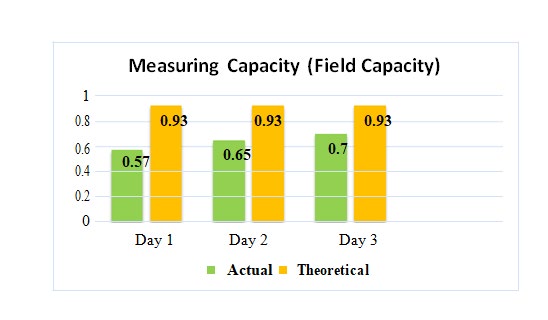
According to Al-aani, et al. effective field capacity is an actual data from the performance of the machine in regard to field efficiency [5]. The data of both theoretical and actual field capacity taken for three days and in form of hectare per hour. The data of theoretical is a little bit higher than effective field capacity is because of lost time in unloading the FFB, turning and the surface of field. From the figure 1 below states that at day 1, the actual data is 0.57 hectare per hour and for theoretical data is 0.93 hectare per hour. For second day, the actual data is 0.65 hectare per hour and theoretical data are 0.93 hectare per hour. Next for the third day, the actual data is 0.7 hectare per hour and theoretical data are 0.93 hectare per hour. All the results of field capacity data are using the calculation from equation 1 and equation 2.
Data for Field Efficiency
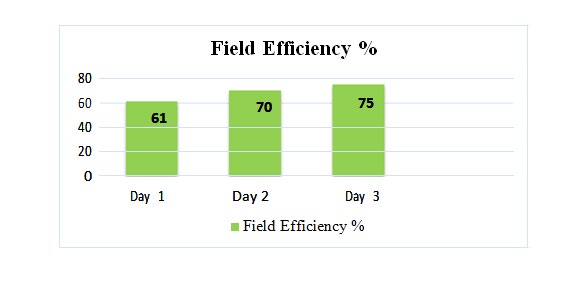
To get the percentage of field efficiency the effective field efficiency will be divided with theoretical field capacity and multiplied by 100% as stated in equation 3. Figure 2 state that, for day 1 the percentage of field efficiency is 61% which the lowest between day 2 and day 3. While the percentage of field efficiency for day 2 and 3 are 70% and 75% respectively. This situation means that, the maximum productivity of harvesting machine can achieve 61 % in day 1, and 70% in second and 75% in third day.
Data Material Capacity
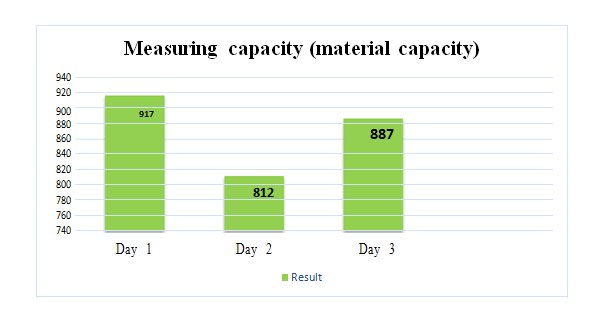
As stated in figure 3, from all three days the results shown are different for material capacity. All the results of material capacity for three days are using the equation 4. On day 1, the time taken is 3 hours which is the working hour of the harvesting machine with average bunches weight being harvested is 917 kilogram per hour. While the second day, the time taken is 2 hour with the average bunches weight is 812 kilogram per hour. For the last day which is day 3, the time taken is same with day 2 which is 2 hour where the average bunches weight is 887 kilogram per hour. The weight of bunches differently from day 1 until day 3 is due to the surface of land. Besides, other factor is the palm that consist of less maturity of bunch. All this kind of situations, will affect the speed and the weight of the bunch that has been harvested.
Data for Fuel and Lubricant Cost
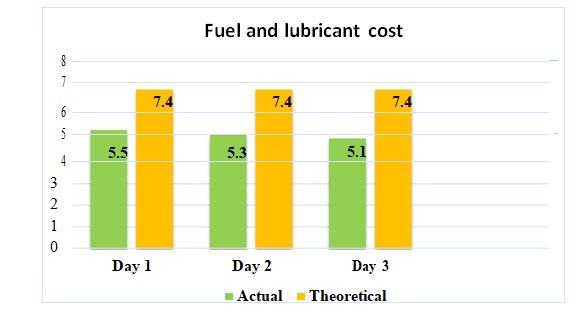
Figure 4 below shows a fuel and lubricant cost between the theoretical and actual data of harvesting machine from day 1 until day 3. On the day 1, the actual data is 5.5 liter per hour while for the theoretical is 7.4 liter per hour. On day 2, the actual data is 5.3 liter per hour while for the theoretical is 7.4 liter per hour. For the last day which is day 3, the actual data is 5.1 liter per hour while for the theoretical is 7.4 liter per hour. All the results are using the equation 5 and 6 respectively. From the equation 7 the fuel and lubricant cost can be calculated as shown below.
Average fuel and lubricant cost
Day 1 = RM 5.5 + (0.10 x RM 5.5)
=RM 6.05/ hr Day 2 = RM 5.3 + (0.10 x RM 5.3)
=RM 5.83/hr Day 3 = RM 5.1 + (0.10 x RM 5.1)
=RM 5.61/hr
Conclusion
In a nutshell, the main purpose of this study is to show the important of machine capacity and performance evaluation of FFB harvesting machine. Through this thing, a little bit information will be given to the farmer and big company of oil palm plantation. In addition, they can understand about the estimation capacities of the machine. Besides, it will give advantages for them to have an idea to make a plan such as timing operation, costing and analyze the performance of the machine in a daily work. This situation also will enable them to know and make some estimations about how many hectare that can be covered by the machine and yielded in a day.
Usually, the operating cost needs to be related when it involves about the fuel and lubricant which rely directly toward the amount of machine use. Through this thing, the fuel and lubricant cost are the true operating costs. The amount of energy exerted by the machine is related to the amount of fuel consumed and the cost can be estimated from the operation of the machine. The results of operating cost such as fuel, repairs and lubricants are increasing in term of the percentage of annual costs if the annual use increase.
Acknowledgement
We would like to express our deep appreciation to Faculty of Plantation and Agrotechnology, UiTM for all the support
References
-
Mahadi MR, Nai Sowat S, Bejo SK, Mohd Kassim MS, Wan Ismail WI (2018) Trend in the Development of Oil Palm Fruit Harvesting Technologies in Malaysia. Jurnal Teknologi 80(2): 83-91.
-
Khalid MR, Shuib AR (2014) Field Evaluation of Harvesting Machines for Tall Oil Palms. Journal of Oil Palm Research 26(2): 125-132.
-
Shuib AR, Khalid MR, Deraman MS (2010) Enhancing Field Mechanization in Oil Palm Management. Oil Palm Bulletin 61: 1-10.
-
Verheye W (2010) Growth and Production of Oil Palm: Soils, Plant Growth and Crop Production.
-
Al-aani FS, Hall E, Us IA (2016) The performance of farm tractors as reported by can-bus an asabe Meeting Presentation CAN-BUS MESSAGES Sponsored by ASABE, pp: 1-18.
- Enhancement of Vegetative Growth and Fruit Yield in Cucumber (Cucumis sativus L.) via Spiritual Blessing (Biofield) Energy Intervention
- Production of Açaí (Euterpe oleracea Mart.) under Different Agroforestry System Management Intensities in Amazonian Floodplain (Varzea) Forests
- Coffee and the Production Region: What is the Secret to the Expression "Quality"?
- Experiential Agripreneurship Training in Sub-Saharan Africa: Integrating a Business Incubator into Postgraduate Livestock Education at the University of Buea
- Advances in Agricultural High-Quality Development
- Linking Compost Residue to ABAGE in Plants - a Short Note