
A Study on Efficacy of Kalium Phosphoricum 6x and Sabal Serrulata 30c in Increasing the Rate of Growth and Yielding Capacity in Raphanus sativus
Agro-Homeopathy, inspired by the principles of homeopathy aimed at enhancing self-healing abilities in living organisms, explores the potential of potentized remedies to manage and prevent diseases in crops. This study evaluates the efficacy of Kalium Phosphoricum 6X and Sabal Serrulata 30C in enhancing the growth and yield capacity of Raphanus sativus (Radish). This research findings indicate that Kalium Phosphoricum 6X has a limited impact on promoting growth, while Sabal Serrulata 30C exhibits inhibitory properties, with no significant growth observed. These results also reveal the positive influence of NPK organic fertilizer in improving germination and growth. However, further research is necessary to understand and enhance the effects of Sabal Serrulata 30C in agricultural applications.
Viswasree M¹* and Shimmal Chenthik JP²
Introduction
Agro-homeopathy, a specialized field of homeopathy, offers a holistic approach to plant care, from seed germination to crop production through various researches has shown that homeopathic treatments can enhance plant growth, germination rates, and bolster defenses against pathogens and pests [1]. Proper selection of homeopathic remedies, their potency, and higher dilutions (1:500 or 1:1000) in water can be a profitable alternative to chemical inputs, potentially boosting farmers’ economy. Raphanus sativus, the radish, is a versatile root vegetable, rich in nutrients and antioxidants [2]. It grows rapidly but requires ample sunlight and moisture. Agro-homeopathy shows promise in altering plant physiology, managing stress, and treating plant Diseases efficiently.
Materials and Methods
Plant Sample Collection & Culture Conditions
The Raphanus sativus seeds are collected from the farmers, in Kulasekharam. Then, the seeds are planted in a suitable climatic condition. Raphanus sativus is a cool season crop, preferring temperatures between 40-70°F. Planting deeper than 2 cm, Produces elongated roots. The seeds were divided into four distinct batches, each set to be planted in suitable soil with a moderate temperature regime. Batch 1 seeds underwent hydro-priming, where they were treated with water to initiate germination. Batch 2 seeds were treated with Kalium Phosphoricum 6X through the osmopriming method, targeting to improve seed performance. Batch 3 seeds received the osmopriming treatment with Sabal Serrulata 30C, a homeopathic remedy believed to impact seed development.
Results and Discussion
Germination of Seeds
Batch 4 seeds were subjected to halopriming with an inorganic fertilizer boosting an N: P: K ratio of 5:10:5, promoting enhanced growth conditions.
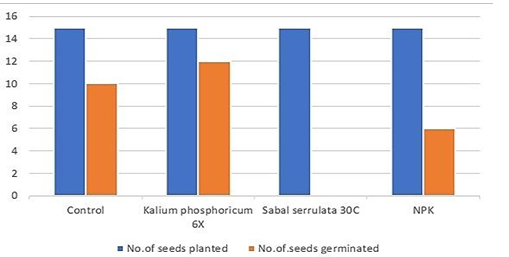
| Batch | No. of Seeds Planted | No. of Seeds Germinated |
|---|---|---|
| Control | 15 | 10 |
| Kalium Phosporicum 6x | 15 | 12 |
| Sabal | 15 | - |
| Serrulat A 30C | ||
| Npk | 15 | 6 |
Table 1: Number of Seeds Planted: Number of Seeds Germinated.
| Control | Kalium Phosphoricum 6x | Sabal Serrulata 30c | Npk | |
|---|---|---|---|---|
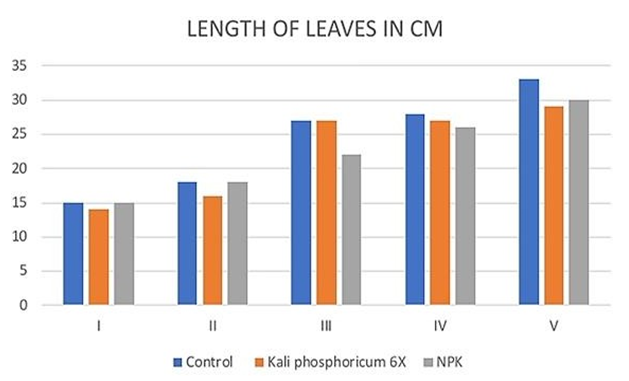
| 1st week | 15cm | 14cm | - | 15cm |
| 3rd week | 18cm | 16 cm | - | 18cm |
| 5th week | 26cm | 27cm | - | 22cm |
| 7th week | 28cm | 27cm | - | 26cm |
| 10 week | 33cm | 29cm | - | 30cm |
Table 2: Length of the leaves.
| Date | Control | Kalium Phosphoricum 6x | Sabal Serrulata 30c | Npk |
|---|---|---|---|---|
| 1st week | 8 | 4 | - | 4 |
| 3rd week | 8 | 4 | - | 6 |
| 5th week | 9 | 6 | - | 7 |
| 7th week | 10 | 8 | - | 9 |
| 10th week | 13 | 8 | - | 11 |
Table 3: No. of leaves in Raddish.
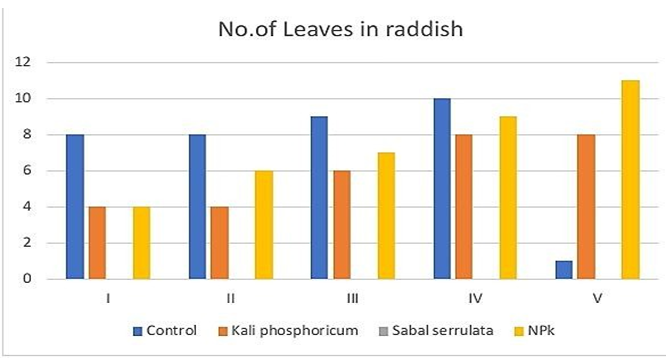
It is observed that Figure 3 shows the maximum number of leaves were presented in the control which is 13 leaves compared with all the batches. The minimum number of leaves were presented in the Kalium Phosphoricum 6x which is 8 leaves.
| Control | 24cm |
| Kalium | 18cm |
| Phosphoricu M 6x | |
| Sabal | - |
| Serrulata 30c | |
| Npk | 27.5cm |
Table 4: Length of the Raddish [After 10th Week].
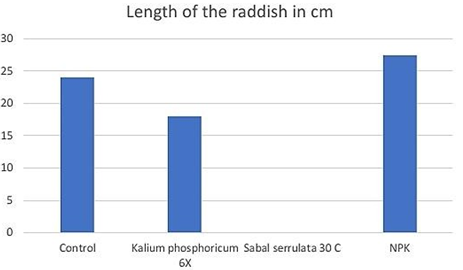
It is observed that the Figure 4 shows the lenght of raddish in all the batches after 10 th week.The maximum lenght of the raddish is present in the npk which is 27.5 cm and the minimum length of the raddish is seen in the Kalium Phosphoricum 6x which is 18cm.
| Control | 93g |
| Kalium Phosphoricum 6x | 70g |
| Sabal Serrulata 30c | - |
| Npk | 187g |
Table 5: Weight of the Raddish [After 10th Week].
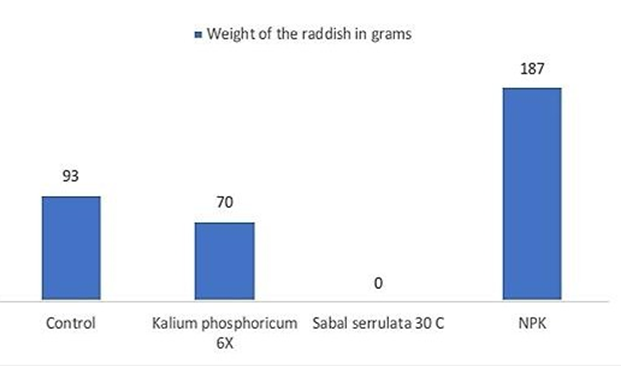
It is observed that the Figure 5 shows that the weight of the raddish in all batches after 10th week .The maximum weight of the raddish is present in NPK which is 187g and the minimum weight of the raddish is present in Kalium Phosphoricum 6x which is 70g.
Discussion
In a study by Carlos Moacir Bonato, et al. [3] the effects of various homeopathic Sulphur dilutions (5 CH, 12 CH, 30 CH, 200 CH, and 1 MCH) on radish growth were investigated. Weekly applications of these solutions significantly improved various plant characteristics, with the 5 CH, 12 CH, 30 CH, and 1 MCH dilutions showing the best results, while the 200 CH dilution had less positive effects [3].
This suggests that homeopathic medicine Sulphur could be an alternative for enhancing the productivity and appearance of agricultural products while reducing input requirements. In this study, it was found that NPK had a stronger influence on Raphanus sativus growth compared to Kalium Phosphoricum 6X, which had a less pronounced effect. Sabal Serrulata 30C showed no growth promotion and, in fact, displayed inhibiting properties.
Conclusion
As from the experiment we can observe that the NPK [ratio of nitrogen, phosphorus , potassium ] which were used on the Raphanus sativus shows a good response in the growth of the raddish compared to the other batch . In this study it shows that NPK has more action in growth of the raddish and control is more effective in height of the plant, Length of the root, growth of leaves and branches.
This method of treating the plants with homoepathic potentised medicines of Kalium Phosphoricum shows the increase in the germination of seeds in soil so it can improve the biological benefits.
However, further studies are required on its influence on the increasing the potencies of the Kalium phosphoricum and Sabal Serrulata in the Raphanus sativus.
References
-
Trebbi G, Lorenzo FV, Dinelli G, Marotti I (2021) Systemic agro-homeopathy: A new approach to agriculture. Lidsen 6(3): 020.
-
Mendez JP, García FP, Pérez AH, Morales LQ, Torres EA, et al. (2021) Agrohomeopathy-new-tool-to-improve-soils- crops-and-plant-protection-against-various-stress- conditions-review. 40(101).
-
Bonato CM, Silva ERD (2003) Effect of the homeopathic solution Sulphur on the growth and productivity of raddish.
- Enhancement of Vegetative Growth and Fruit Yield in Cucumber (Cucumis sativus L.) via Spiritual Blessing (Biofield) Energy Intervention
- Production of Açaí (Euterpe oleracea Mart.) under Different Agroforestry System Management Intensities in Amazonian Floodplain (Varzea) Forests
- Coffee and the Production Region: What is the Secret to the Expression "Quality"?
- Experiential Agripreneurship Training in Sub-Saharan Africa: Integrating a Business Incubator into Postgraduate Livestock Education at the University of Buea
- Advances in Agricultural High-Quality Development
- Linking Compost Residue to ABAGE in Plants - a Short Note