
Understanding the Indian Mindset Regarding Preferred Family Structure for a Better Application of Scientific advances to Reduce Maternal Morbidity and Mortality
India is facing a declining female sex ratio. PCPNDT (Pre - Conception Prenatal Diagnostic Technique) Act was implemented in 1994 to control the decline as it was thought that ultrasound had led to diagnosing the sex of foetus followed by abortion of female foetuses. In a study conducted it was proved that PCPNDT Act after 20 years of its implementation had failed to control declining female sex ratio and the same study had suggested alternative methods for solving the issue .That study further pointed that PCPNDT had resulted in conviction of doctors on clerical errors and not on sex determination case being proved against them. The families wanting a boy were not afraid of law and by alternative approaches (through dais and quacks and technicians working as night squads ) continued getting Sex Determination done followed by abortions by untrained people and resorting to unsafe abortions . It has been shown in prior studies that unsafe abortions increase the maternal mortality and morbidity rates. The present study analyses the Indian mindset regarding their preference for family structure and comes up with the conclusion that it is not that Indian community believes in selective female feticide but does believe in a balanced structure that is they want to have children of both the sexes in their family and thus preferred a balanced family structure. The majorities do not believe in Sex determination and MTPs (Medical Termination of pregnancy) but have faith in God's decision. Majority want one daughter and one son and a few wanted even two daughters. A few families do not want to undergo Sex determination nor abortion but after giving birth to first child as per God's grace want to undergo PGD (Pre Gestational Diagnosis) and implantation for procuring second child of opposite sex to get a one girl one boy family structure. With prevailing traditional values PCPNDT is forcing birth of unwanted girl child degrading their value further and adding to troubles of females belonging to more conservative families as seen in daily practice by the obstetricians in India leading them to think that alternatives to PCPNDT should be thought of to control the declining female sex ratio in India.
Introduction
According to some; India is facing a declining female sex ratio [1, 2]. PCPNDT (Pre Conception Prenatal Diagnostic Test) was implemented in 1996 to control it as it was thought that ultrasound had led to diagnosing the sex of foetus followed by abortion of female foetuses. The law has failed to control the declining female sex ratio in the 20 years of its implementation; instead has reduced the level of antenatal care available to females and has become only a tool for harassing doctors and extraction of money from them [3]. It has also led to the following behaviors’ amongst the doctors: Radiologists are afraid of conducting ultrasound on females and Gynaecologists are afraid to admit any threatened abortion or inevitable abortion case with the fear that if a female foetus is aborted their neck will be at stake and it will be used as a tool to defame them or act as a tool for extraction. Some have been convicted on clerical errors without the proof of sex determination [4, 5, 6]. As a practicing gynaecologist with more than 30 years of experience in the field, I thought of conducting a formal research into the reasons and prepared a power point presentation. The following link summarizes the results of my research [7]. Thus in conclusion of the study it was proved that PCPNDT (Pre conception Prenatal Diagnostic Technique) has been unsuccessful in controlling the declining female sex ratio and instead of wasting revenues on maintaining this machinery if we shift our attention to other measures summarized very well in the diagram below we would be more rational in our approach (Figure 1).
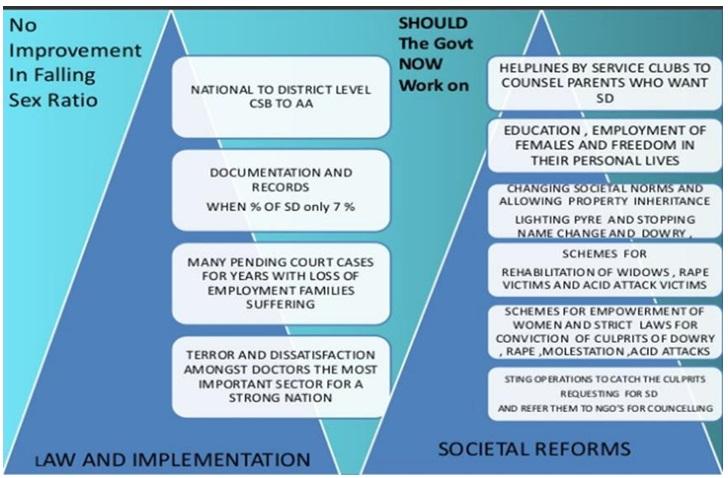
Continuing the efforts further to understand the Indian mindset regarding what type of family structure Indians preferred if given a choice; a questionnaire was prepared for the Indian population on monkey survey and people were asked to attempt it. The results further helped to understand if PCPNDT was really needed to bring improvement in declining female sex ratio and what percentage of population really needed such a control so that the problem of declining sex ratio could be approached more rationally.
Materials and Methods
A survey devised on monkey survey consisting of a questionnaire. It was a net based survey and was open for all to attempt. The following questions were asked 1. What family structure would you prefer if given a choice?
a. One son, One daughter b. Two sons c. Two daughters d. Whatever God gives us without undergoing Sex Determination or abortion e. If we could plan by conceiving a male or female baby with the help of science without abortion we would like one son and one daughter. f. If early abortion with help of pills is possible and sex determination can be done that early we would like to have one son and one daughter g. More than two children h. Other (Please specify) 2. If your answer is one son one daughter family; you will opt for a. Sex detection and abortion if possible early with medicine. b. No Sex detection or abortion, will accept God's decision. c. If sex detection is possible by doctors by any technique before implantation in uterus will give birth to first child as wished by God and for 2nd child of opposite sex will take doctor's help d. If others please specify. 3. If more than two children; how many?
a. 2-3 b. More than 3 c. Will avoid contraception and will bear as many as God gives us. 4. If more than two children want a. Girls and boys in equal proportion. b. I want all boys c. I want all girls d. Will take no steps for abortion or Sex
Determination and will accept whatever God gives me e. After two girls I want to get sex determination so that I can be blessed with a boy.
Result
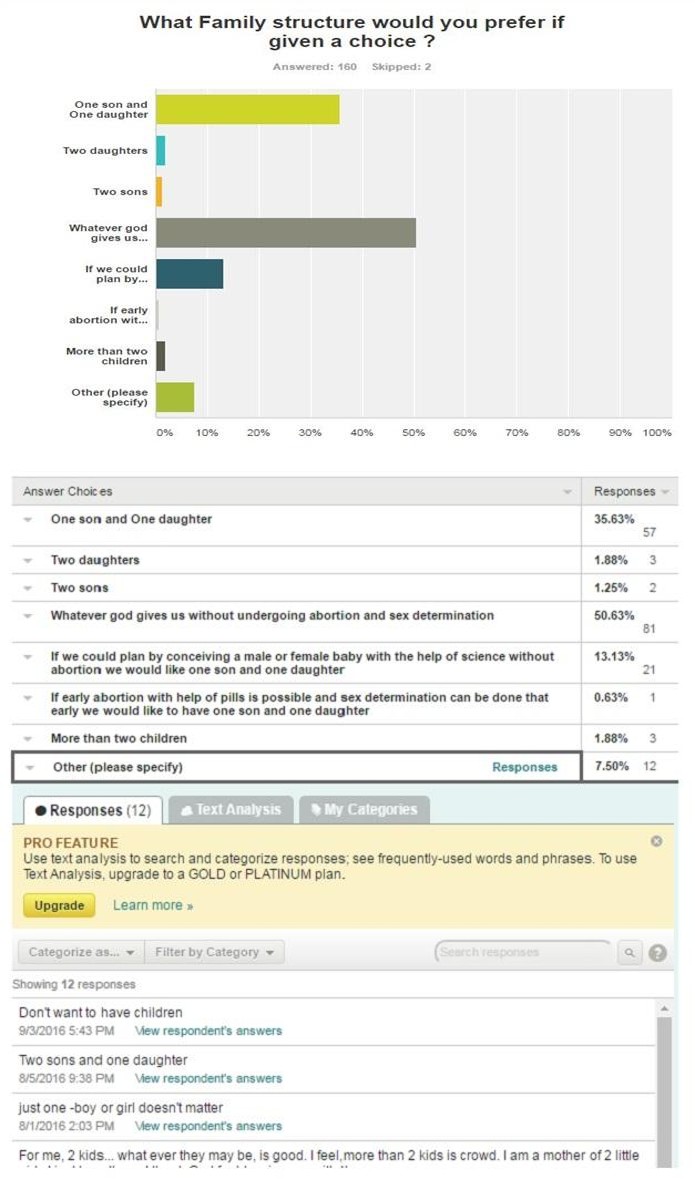
Results of Survey to -date can be viewed at the following link [8]. The results obtained till 16th Sept are taken into consideration as the survey is still ongoing and I try to analyze the data obtained till 16th September. The results obtained till 16th September show that largest segment of the population, 50.63 % believe in God's blessings and do not believe in getting Sex determination or Abortion done. 13.13 % believe that they will not get Sex determination done or abortion done, but if they can be helped by PGD (Pre Gestational Diagnosis) in conceiving the second child of opposite sex to the first child, they would go ahead with it. So they too will not be disturbing the male to female ratio balance. 0.63% says that if SD and early abortion is possible, they would like to have one son, and one daughter, and 1.88 % wants only two daughters and 7.50 % of others also consist of people who value a female child equal to a male and have no prejudice for a male child.35.63 % believe in one daughter one son family structure. Only 1.25 % of Families opt for two sons (Figures 2&3).
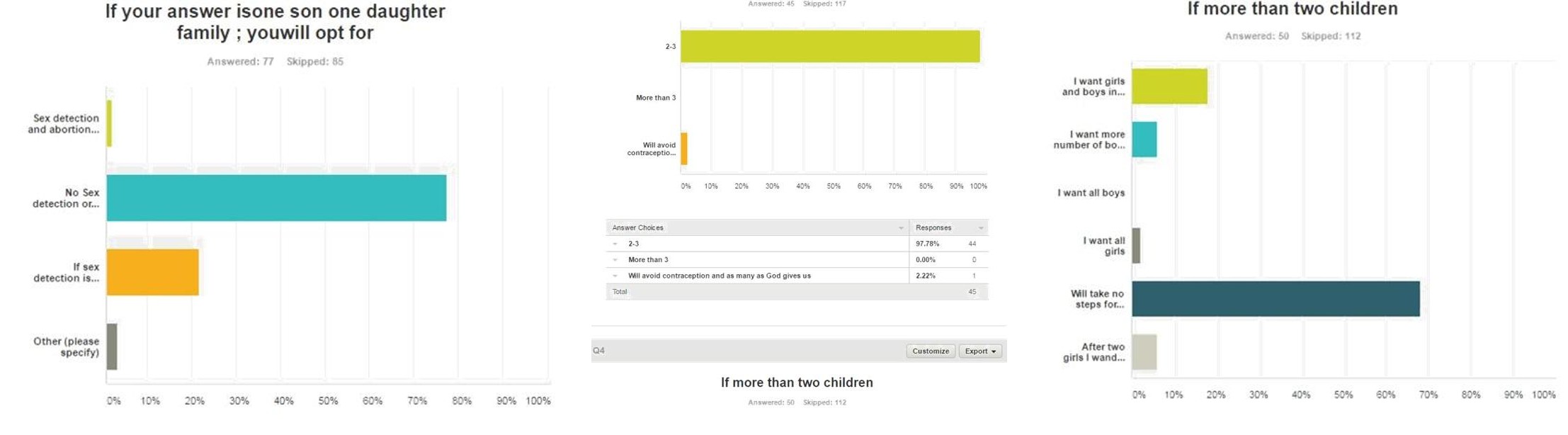
Let us further analyze the results: Out of the 35% who say one son One daughter; 76.62% say they will not go for SD (sex determination) or feticide. 20.78 say will use science (Pre gestational diagnosis if allowed) to have this structure without abortion that is without resorting to feticide in their 2nd issue to get baby of other sex. 1.30 % say will opt for Sex determination and early abortion before 10 weeks to get both the sexes as babies to complete their family. One person attempting the survey said that No Sex detection ever and one survey member wanted to go for PGD and give birth to 2nd female child; if first is male. Here again only 1.30% are willing for feticide if you can call it feticide as early as 10 weeks to get one male one female structure (Figure 4) (Table 1).
| Answer choices | Responses | |||||||
|---|---|---|---|---|---|---|---|---|
| Sex detection and abortion if possible early with medicine | 1.30% | 1 | ||||||
| No sex detection and abortion, will accept God's Decision | 76.62% | 59 | ||||||
| If sex detection is possible by doctors by any technique before implantation in uterus.. Will give birth to first child as wished by God and for 2nd child of opposite sex will takes doctors help | 20.78% | 16 | ||||||
| Others(please specify) | 2.60% | 2 | ||||||
| Total | 77 |
Out of the 1.88 % who want more than two children 97.7% wish for only 2-3 children and 2.22 % say will not adopt any measure of contraception and will accept as many as God gives (Figure 5).
Those who wish for more than 2 children; 68% % will take no steps for SD or abortion to control their family structure and will leave it on GOD. 18% want girls and boys in equal proportion and 0.2 % want only girls, 6 % say will get Sex determination done or take help of PGD to have a son only if first two are girls (Figure 6) (Table 2).
| Response | ||||||
|---|---|---|---|---|---|---|
| Answer choices | ||||||
| s | ||||||
| I want girl and boy in equal proportion | 18.00% | 9 | ||||
| I want more number of boys than girls | 6.00% | 3 | ||||
| I want all boys | 0.00% | 0 | ||||
| I want all girls | 2.00% | 1 | ||||
| will take no steps for abortion or sex Determination and will accept whatever God gives me | 68.00% | 3 4 | ||||
| After two girls I want to sex determination so that I can be blessed with a boy | 6.00% | 3 | ||||
| Total | 5 0 |
Discussion
As seen in world scenario the ratio of male is to female is different in different parts of world. Some have more males than females and some countries have more females is to male ratio [9]. Below are shown the ratios from the first list; based on the projection by United Nations for year 2015 which included sex ratio of 201 countries and regions. Second list is based on the estimates by the World Bank for year 2013. This list contains population of 194 country/territory [9]. The human sex ratio is the number of males for each 100 females in a population. Sex ratio above 100 means there are more males than females. Sex ratio below 100 means there are more females than males. Sex ratio of 100 means there are equal numbers of females and males [9]. According to United Nations, Sex ratio of world in 2015 is 101.70. It means that World has 101.70 males for each 100 females or 98.33 females for each 100 males. In absolute terms, World has 61,591,853 more male population than female population. 13 countries have sex ratio less than 90.0 and 36 have less than 95.0. 124 countries have more females than males. 158 countries have better sex ratio than world average. Curaçao has lowest sex ratio of 82.10 followed by Latvia (84.37). Curaçao has 121.8 females per 100 males while Latvia has 118.5 females per 100 males. Martinique (85.08), Lithuania (85.24) and Ukraine (85.35) is at 3rd, 4th and 5th position, respectively. In the list of top 10 countries having lowest sex ratio, six countries are located in Europe continent, three in North America and one in Asia [9]. Top ten countries having more male population than female population are: Qatar, United Arab Emirates, Oman, Bahrain, Kuwait, Saudi Arabia, Bhutan, Western Sahara, China and India. Qatar and United Arab Emirates has sex ratio 324.35 and 228.2 respectively. Except Western Sahara, which belongs to Africa the rest of the nine countries are from Continent Asia [9]. In Indian scenario according to the latest census – Statistical Report 2014 age composition by residence and broad age groups 0-14, 15-59 and 60+ for the year 2014 at the National census shows that for most of the age groups, Male-Female differences in the age distribution of population are negligible except in the combined age- group of 0-14, 15-59, 60+, 15-64 & 65+. In the age-group 0-14, Male population is about one percent more than Female, whereas in the age-group 60+ as also 65+, percentage of Female are 0.6 and 0.5 percent more than Male [10]. So scenario in India is not very different from the scenario in the world. The results obtained from the present study point that 98.75 % population is not the causative factor for declining female sex ratio as they consist of a population which wants a one daughter ,one son structure and the majority of them will not resort to sex determination or abortion and will believe in God’s decision and those who want to design their family of one son and one daughter will either go in for PGD (Pre Gestational diagnosis ) or early abortion after NIPT (Non Invasive Prenatal Test ) which cannot be labeled as Female Feticide and will not increase maternal morbidity or mortality if done under trained doctors . Out of the population that wishes for more than 2 children; 6 % of population wanted to get Sex
determination done or take help of PGD to have a son only if first two were girls. So Sex determination comes into play only after first two issues and that too the thought is not corrupt. It is not for selective feticide but to balance the family structure. An insight into the study suggests that it is not justified to compromise with the level of antenatal care and use such a huge amount of resources to control only 1.25 % of the population who want only male off springs. This raises the question - is it justified to have this law? This 1.25 % population who are demanding Sex determination to get male child exclusively and the unscrupulous elements running this market of Sex Determination and Abortion can well be caught by sting operations and counseled by NGOs. With liberal MTP laws, prevailing traditional values PCPNDT is forcing birth of unwanted girl child degrading their value further and adding to troubles of females belonging to more conservative families. [7] The study cannot be compared with any other study as after a detailed search; no similar study could be found regarding preferred family structure by Indians. As this study is net based; it has a sample of people with access to internet; further sampling with larger sample sizes, including rural areas needs to be done by government authorities in areas where female population is less, to verify the data further.
Conclusion
The results arrived from the above study point out that the Indian population does not need PCPNDT to regulate it or govern it for preventing the declining female sex ratio as only this .63 % of the population studied opted for Sex Determination of the foetus pointing us to seriously think on other justified methods which are more scientific and acceptable to community at large and suit the politico -socio-cultural axis of India. To focus on controlling population of the country such as India along with maintaining a male female ratio as far as possible the following suggestions can be given due consideration. 1. Privileges like tax exemption should be given to people with 1 or 2 children 2. People with 1 or 2 daughters should be given the option for getting NIPT (Non Invasive Prenatal Test) followed by abortion to plan for a male child to get a balanced structure; but only up to the first 10 weeks for such cases.
3. People with more than 2 children who have one male amongst them - no option to be given to them for getting sex determination. 4 -NIPT (Non Invasive Prenatal Test) to be made available only in specially designed Matritva Clinics under DM (District Magistrate) and CMO (Chief Medical Officer). These clinics need to be run and controlled by Government authorities and manned by a team consisting of DM, NGO (Non – Government Organization), CMO, senior gynecologist, Senior Pathologist, Sociologist, with the facility of NIPT with strict control where it is provided after this committee recommends it for cases with one or two daughters to help them in procuring 2nd or 3rd male child after properly counseling and motivating for contraceptive measures or sterilisation thereafter. Such clinics can also help families with first male child to procure 2nd child as a female child. 4. All people with more than 2 children should be penalised by actions such as; no pension, TDS (Tax Deduction at Source) higher than for others and with drawl of reservation facilities etc. Indications for abortions after 12 weeks should be revised. 5. Aadhar card of parents should include the number of children they have. Simultaneously an insight to a previous study [7] points for a vigorous work on other issues like
- Education and empowerment of females.
- Severe capital punishment for Rape culprits.
- Molesters, Acid attack culprits to be severely punished.
- Meditation, spiritual and Yoga classes in schools for making children morally strong.
- Heavy taxation or resource overuse charge on families with more than 2- 3 children [7]. Matritva clinics once they become established will lead to the natural death of the unscrupulous market of Sex Determination, as it is only .63 % of population which demands Sex Determination and lands up with unscrupulous people running illegal market/business of Sex Determination in India. Such a rational and scientific approach will definitely help in reducing the maternal mortality and morbidity by not only reducing the incidence of unsafe abortions but also promote good antenatal care as doctors will be able to perform their duties without fear. An added attempt to build an atmosphere where the girl child is revered and cherished will definitely help in building a healthier society.
References
-
http://scroll.in/article/801242/three-charts- show-how-child-sex-ratio-in-india-has-dipped- further-but-there-is-a-silver-lining
-
http://unicef.in/story/1129/Declining-sex- ratios-a-matter-of-concern
-
Dhaduk KM, Parmar DV, Yadav BS, Sudha Yadav (2009) A Study on Doctors' Perspective on PNDT Act. Indian J Community Med 34(2): 160-161.
-
Giriraj R (2004) Changing Attitude to Female Infanticide in Salem. Journal Social Welfare 50(11): 13-14 & 34-35.
-
Haddad LB, Nour NM (2009) Unsafe Abortion: Unnecessary Maternal Mortality. Rev Obstet Gynecol 2(2): 122-126.
-
https://www.nrhm.maharashtra.gov.in/PCPNDT /Cour t_Cases__16-12-.2014.htm
-
http://www.slideshare.net/archanatandon7/aog gis-revere-the-girl-child-2
-
https://www.surveymonkey.com/r/LZNSFV3
-
Region-wise sex ratio : Asia : 104.8, Europe: 93.0 Africa: 100.1, South America : 97.5, Oceania : 100.0, Central America : 94.9, Caribbean : 98.3
-
http://www.censusindia.gov.in/vital_statistics/S RS_Report_2014/6.%20Chap%202- Population%20Composition-2014.pdf
- Postpartum Maternal Mental Health - A Narrative Review
- Beta HCG in Cervico-Vaginal Secretion as a Predictor of Preterm Delivery
- Successful Management of Mid Trimester Foetal Death with Major Placenta Previa by Expectant Management Followed by Induction of Labour
- To Evaluate the Expression of Egr2 Gene in Term Low Birth Weight Newborns
- Impact of Maternal Obesity on Maternal and Foetal Outcomes: A Prospective Cohort Study from Northern India
- ‘’Benefit of Pulsatile GnRH Therapy in Treatment of Functional Hypothalamic Amenorrhea (FHA) and Congenital Hypogonadotropic Hypogonadism(CHH) in Infertile Patients Over Canonical Gonadotropins with IVF –A Short Communication’’