
Clinical Study to Determine the Effectiveness of Pulsatilla Nigricans in the Management of Hypothyroidism with PCOD
The thyroid gland's inability to produce enough thyroid hormones to meet your body's needs is known as hypothyroidism, or underactive thyroid. The thyroid is a little gland at the front of your neck that resembles a butterfly. Genetic predispositions and hormonal imbalances are the main causes of PCOD (polycystic ovarian disease). Additionally, this causes the ovaries to expand and enlarge.The purpose of this study is to determine whether Pulsatilla Nigricans, a homoeopathic medication, is successful in treating hypothyroidism with Pcod when taken as directed by a homoeopathic physician. Five instances were chosen, given a thorough examination, and treated with Pulsatilla Nigricans.In addition to improving instances, Pulsatilla nigricans has been shown to promote overall wellbeing.
Abbreviations
PCOS: Prevalence of Polycystic Ovarian Syndrome; NIH: National Institutes of Health.
Introduction
The thyroid gland’s inability to produce enough thyroid hormones to meet your body’s needs is known as hypothyroidism, or underactive thyroid. The thyroid is a little gland at the front of your neck that resembles a butterfly [1]. T3 is in charge of influencing several organs and tissues across the body, which may be the result of elevated protein synthesis and metabolic rate. Calcitonin is produced and secreted by parafollicular cells, also known as C cells. In order to lower blood calcium levels and preserve calcium homeostasis, calcitonin works in opposition to parathyroid hormone [2]. A persistent condition known as hypothyroidism is linked to a lack of the thyroid hormones triiodothyronine (T3) and thyroxine (T4) [3].
Untreated or insufficiently managed hypothyroidism can lead to neurological and musculoskeletal problems, cardiovascular disease, and infertility [4, 5, 6]. Globally, environmental iodine shortage is the leading cause of thyroid disorders, including hypothyroidism [7]. In regions with adequate iodine, autoimmune thyroiditis (Hashimoto’s disease) is the leading cause of primary hypothyroidism [8].
The key factors’ etiology could be Hashimoto’s thyroiditis, atrophic thyroiditis, congenital conditions, medications, radiation therapy, and iodine deprivation are examples of autoimmune hypothyroidism.Subacute thyroiditis, postpartum problems, and silent thyroiditis are examples of temporary causes.T4 (thyroxine). The main hormone that your thyroid produces and secretes is this one. Even though your thyroid produces the most of this hormone, your metabolism isn’t much impacted by it [9]. Deiodination is the process by which your thyroid can change T4 into T3 after it has been released into your bloodstream. T3 (triiodothyronine) Although the thyroid generates less T3 than T4, it has a much greater effect on your metabolism than T4. Triiodothyronine in reverse (RT3) Very little RT3, which counteracts the effects of T3 and calcitonin, is produced by the thyroid. This hormone aids in controlling blood calcium levels [10]. Depending on the criteria employed, the prevalence of polycystic ovarian syndrome (PCOS), the most prevalent endocrine condition in women throughout their reproductive era, ranges from 6 to 20%. It is the most frequent cause of hirsutism and menstrual irregularities [11, 12]. Different diagnostic standards have been used at different times and in different research. In 1990, the National Institutes of Health (NIH) made the first attempt at diagnosis, which comprised oligo- or anovulation and hyperandrogenism (either biochemical or clinical), which showed up as either frequent (at intervals < 21 days) or infrequent (at intervals > 35 days) bleeding [13]. The most widely used criteria are the Rotterdam criteria, which were released in 2003. Two of the three criteria listed below should be met in order to diagnose PCOS: oligo- or anovulation, hyperandrogenism (either clinical or biochemical), and polycystic ovarian morphology (PCOM), which is determined by the presence of at least 12 follicles with a maximum diameter of 2 to 9 mm or an ovarian volume greater than 10 ml (without a cyst or dominant follicle) in either ovary [14]. Four distinct phenotypes (combinations) may be identified based on these characteristics. It should be mentioned that 32% of women who are normally ovulatory may meet the PCOM standard established by the Rotterdam group [15]. In order to achieve the highest resolution of ovarian follicles, a higher threshold of follicular number per ovary (FNPO) of ≥ 25 has been suggested utilizing more advanced ultrasound equipment. If not, ovarian volume is recommended for the diagnosis of PCOM rather than FNPO [16].
Methodology
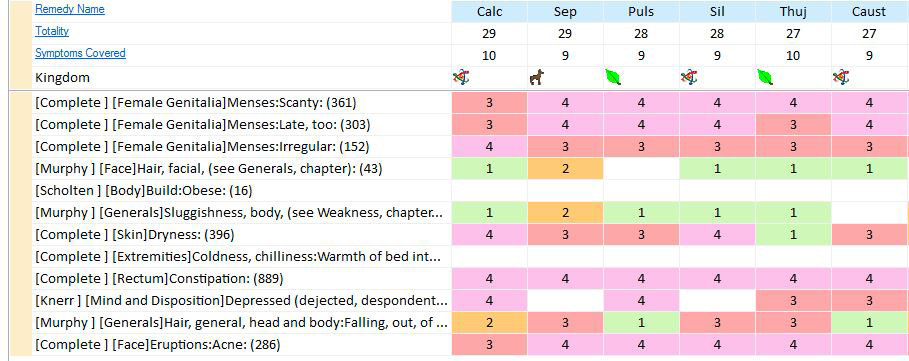
From the Sarada Krishna Homoeopathic Medical College OPD, five instances of hypothyroidism with PCOD were chosen. Every individual is selected at random and completely by chance, so that every group of individuals has the same chance of being selected for the sample as every other subset of individuals, and every individual has the same chance of being selected at any point during the sampling process. Women in the reproductive age range were chosen, and patients with chronic illnesses or other systematic illnesses were not included. Limited menstruation, premature menstruation, irregular menstruation, hirsuitism, weight gain, overall body weakness, dry, coarse skin, constipation, cold sensitivity, depression, facial acne, and hair loss were the symptoms of the cases that were taken.The instances where homeopathic medicine was used were gathered (Figure 1). Pulsatilla nigricans was given as a homoeopathic similimum in proper dosage and proper potency according to the homoeopathic principles and susceptibility of the patient. Analysis of the cases before and after administration of Pulsatilla is included. Assessment is based on the intensity of symptom score.
Result and Discussion
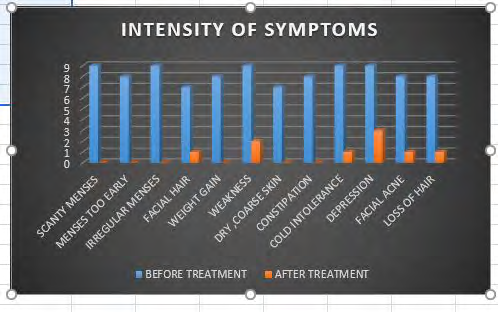
Here are the results of a study that was done on five patients of hypothyroidism with PCOD. These cases occur over a minimum of six months, and the outcomes are discussed below in relation to symptom similarity. Pulsatilla nigricans, a homeopathic treatment chosen for its efficacy based on symptom similarities, is examined. The severity of the symptoms was tracked over time [17]. To determine if the pre-treatment and post-treatment scores were significant, statistical analysis was performed (Table 1).
| Nature of Symptoms | Before Treatment | After Treatment |
|---|---|---|
| Scanty menses | 9 | 0 |
| Menses too early | 8 | 0 |
| Irregular menses | 9 | 0 |
| Facial hair | 7 | 1 |
| Gaining weight | 8 | 0 |
| Weakness of whole body | 9 | 2 |
| Dry,coarse skin | 7 | 0 |
| Constipation | 8 | 0 |
| Cold intolerance | 9 | 1 |
| Feeling depressed | 9 | 3 |
| Acne in face | 8 | 1 |
| Loss of hair | 8 | 1 |
Table 1: Showing the Distribution of Patients According to the Symptoms.
The findings were analyzed in light of the symptoms, charted, and documented for the study. Based on chronic totality and constitutional adoption, Pulsatilla nigricans is a homoeopathic medicine that is beneficial [18]. Master Samuel Hahnemann in aphorism 18 illustrated the importance of forming a totality of symptoms “The totality of symptoms is the only indication and guide to selection of a similimum”. In aphorism 83, individualizing examination of a case of disease. In the footnote of aphorism 94, Master states that “in chronic diseases especially those affecting females which is more necessary to pay the attention to pregnancy, sterility, sexual desire, accouchements, miscarriage, suckling and the state of the menstrual discharge”.
Master Samuel Hahnemann illustrated the importance of creating a totality of symptoms in aphorism. “The only indication and guide to selecting a similimum is the totality of symptoms.”Aphorism 83 mentions personalizing the examination of a medical situation. “In chronic diseases, especially those affecting females, it is necessary to pay attention to pregnancy, sterility, sexual desire, accouchements, miscarriage, breastfeeding, and the state of the menstrual discharge,” according to the addendum to aphorism 94. In Aphorism 147, a specific homoeopathic treatment is mentioned.In aphorism 153, Hahnemann addresses the importance of choosing the appropriate course of action, stating that “striking, singular, uncommon and peculiar symptoms of the disease are considered.” Master Samuel Hahnemann states in his lesser works, “But we moderns on the contrary are, and if this ruling just applied to some of us, I would almost give in to you for the sake of peace.
Conclusion
Women are disproportionately affected by the endocrine condition known as hypothyroidism. Since hypothyroidism’s symptoms are mild, they are sometimes mistaken for those of other illnesses, such depression or aging [17]. About 10–15% of people with hypothyroidism who take levothyroxine have ongoing symptoms and therapy dissatisfaction which may or may not be related to their hypothyroidism, which might result in overtreatment [18, 19]. The overall prevalence of hypothyroidism is 0.135% among young individuals under the age of 22, and 0.113% in the 11–18 age group; these figures are at least twice as high as earlier estimates. Like the increased prevalence of type 1 diabetes, this points to a rise in autoimmune thyroid illness, which may be a sign of a growing incidence of autoimmunity in young individuals. Pulsatilla nigricans worked well for treating hypothyroidism with pcod. Five examples in all were chosen at random. Following a thorough review based on the totality of the symptoms that were documented, the cases were prescribed. The study’s findings were derived via observations and statistical analysis.
The effectiveness of homeopathic treatment in the management of hypothyroidism with PCOD is determined by an analysis of improvement scores and symptoms [20]. As a result, homoeopathic dilutions benefit humanity and work best in hypothyroidism with PCOD. One of the important things to keep in mind was the grading of symptoms. Following a thorough study based on the totality of symptoms, which were then connected, the cases were prescribed.One of the most prevalent causes of irregular periods and infertility in women is PCOS [21] (polycystic ovarian syndrome). It was an endocrine condition that affected women in their reproductive years. widespread among 4–20% of all women worldwide. Menstrual irregularities, anovulatory cycles, obesity, hyperandrogenism, and metabolic abnormalities are some of its defining characteristics [22]. Modern medicine was discovered to have trouble managing it [21]. Pre- treatment and post-treatment scores are noted based on symptom analysis. When a significant decline in scores was seen, this study was interpreted. We can therefore draw the conclusion that treating hypothyroidism with PCOD with the homeopathic medicine Pulsatilla nigricans is fruitful.
References
-
Koumourou R (2004) Running on Empty: hypothyroidism, introduction to an underactive thyroid gland. Cocoon Books, Australia.
-
Armstrong M, Asuka E, Fingeret A (2023) Physiology, thyroid function.
-
Arthur JR, Beckett GJ (1999) Thyroid function. British medical bulletin 55(3): 658-668.
-
Chaker L, Bianco AC, Jonklaas J, Peeters RP (2017) Hypothyroidism. Lancet 390(10101): 1550-1562.
-
Gaitonde DY, Rowley KD, Sweeney LB (2012) Hypothyroidism: an update. Am Fam Physician 86(3): 244-251.
-
Magri F, Buonocore M, Oliviero A, Rotondi M, Gatti A, et al. (2010) Intraepidermal nerve fiber density reduction as a marker of preclinical asymptomatic small-fiber sensory neuropathy in hypothyroid patients. Eur J Endocrinol 163(2): 279-284.
-
Vanderpump MP (2011) The epidemiology of thyroid disease. Br Med Bull 99: 39-51.
-
Asvold BO, Vatten LJ, Bjoro T (2013) Changes in the prevalence of hypothyroidism: the HUNT Study in Norway. Eur J Endocrinol 169(5): 613-620.
-
Krohn K, Paschke R (2001) Progress in understanding the etiology of thyroid autonomy. The Journal of Clinical Endocrinology & Metabolism 86(7): 3336-3345.
-
Chiovato L, Magri F, Carlé A (2019) Hypothyroidism in context: where we’ve been and where we’re going. Advances in therapy 36(S2): 47-58.
-
Lujan ME, Chizen DR, Pierson RA (2008) Diagnostic criteria for polycystic ovary syndrome: Pitfalls and controversies. Journal of obstetrics and gynaecology Canada 30(8): 671-679.
-
Azziz R, Carmina E, Dewailly D, Diamanti-Kandarakis E, Escobar-Morreale HF, et al. (2009) The androgen excess and PCOS society criteria for the polycystic ovary syndrome: The Complete Task Force Report. Fertility and sterility 91(2): 456-488.
-
Prapas N, Karkanaki A, Prapas I, Kalogiannidis I, Katsikis I, et al. (2009) Genetics of polycystic ovary syndrome. Hippokratia 13(4): 216-223.
-
Engmann L, Jin S, Sun F, Legro RS, Polotsky AJ, et al. (2017) Racial and ethnic differences in the polycystic ovary syndrome metabolic phenotype. American journal of obstetrics and gynecology 216(5): 493E1-493E13.
-
Legro RS, Kunselman AR, Dunaif A (2001) Prevalence and predictors of dyslipidemia in women with polycystic ovary syndrome. The American Journal of medicine 111(8): 607-613.
-
Yusuf S, Hawken S, Ôunpuu S, Dans T, Avezum A, et al. (2004) Effect of potentially modifiable risk factors associated with myocardial infarction in 52 countries (the Interheart Study): Case-control study. The Lancet 364(9438): 11-17.
-
Dunn D, Turner C (2016) Hypothyroidism in women. Nursing for women’s health 20(1): 93-98.
-
Hegedüs L, Bianco AC, Jonklaas J, Pearce SH, Weetman AP, et al. (2022) Primary hypothyroidism and quality of life. Nature Reviews Endocrinology 18(4): 230-242.
-
Hahnemann S (2004) Organon of Medicine. In: 5th & 6th (Edns.), B Jain Publishers, Kuldeep Jain, New Delhi, India, pp: 215-216.
-
El-Shafie KT (2003) Clinical presentation of hypothyroidism. Journal of Family and Community Medicine 10(1): 55-58.
-
Hunter I, Greene SA, MacDonald TM, Morris AD (2000) Prevalence and aetiology of hypothyroidism in the young. Archives of disease in childhood 83(3): 207-210.
-
Billah MA, SK AH (2022) Management of Polycystic Ovarian Syndrome (PCOS) with Constitutional Homoeopathic Medicine-A Case Report. International Journal of AYUSH Case Reports 6(4): 435-442.
- Postpartum Maternal Mental Health - A Narrative Review
- Beta HCG in Cervico-Vaginal Secretion as a Predictor of Preterm Delivery
- Successful Management of Mid Trimester Foetal Death with Major Placenta Previa by Expectant Management Followed by Induction of Labour
- To Evaluate the Expression of Egr2 Gene in Term Low Birth Weight Newborns
- Impact of Maternal Obesity on Maternal and Foetal Outcomes: A Prospective Cohort Study from Northern India
- ‘’Benefit of Pulsatile GnRH Therapy in Treatment of Functional Hypothalamic Amenorrhea (FHA) and Congenital Hypogonadotropic Hypogonadism(CHH) in Infertile Patients Over Canonical Gonadotropins with IVF –A Short Communication’’