
Physical-Sports Activity Habits of Colombian Nationals and Migrants Residing in the City of Sincelejo
The investigation of physical activity habits is a common process in different contexts, so the present study aimed to analyze the physical activity habits of Colombian nationals and migrants residing in the city of Sincelejo. Within the framework of the project called "Citizen Culture and Integral Formation", a descriptive cross-sectional study was developed and a sample of 3464 people was taken. It can be concluded that 8 out of 10 migrants who engage in physical activity are located in strata 1 and 2, and that women prefer aerobics, walking or running, and men prefer walking, running or playing soccer. It is recommended that suitable spaces be guaranteed for the practice of sports for social and cultural integration.
Introduction
Physical activity includes any action that involves body movement where energy expenditure exceeds the basal level, in this sense, sports activities require significant efforts, which can range from moderate to intense, with the incorporation of participation standards for a competitive event or only with the intention of leisure and use of free time, as well as with the intention of improving physical condition. It has been widely demonstrated that the performance of moderate to high intensity physical activity promotes increased fitness in those who perform it, given the subsequent functional [1, 2, 3, 4]. Currently in the world 81% of adolescents [5] and 27.5% of adults [6] do not meet the minimum levels of physical activity recommended by the World Health Organization [7, 8]. For its part in Colombia according to the latest National Nutritional Status Survey of Colombia (ENSIN) conducted 2015 and published in 2017 children aged 5 to 12 years excess weight increased from
18.8% in 2010 to 24.4% in 2015, while for adolescents aged 13 to 17 years one in five presents excess weight (17.9%), for its part the group of adults 18 to 64 obesity is more frequent in women (22.4%) than in men (14.4%) [9, 10]. In addition to the differences in physical activity (PA) according to sex, the ENSIN presents differences in the prevalence of PA in leisure time according to age, Sisbén level, schooling, nutritional status, occupation and sub-region [11].
The inquiry of physical sport activity habits is a common process in different contexts, and population groups, in such a way that adult population has been studied [12, 13, 14] children [15] university students [16] and in Latin America intervention programs have been compared [17] as well as the sociocultural characteristics of physical activity in different regions [18] all this information becomes relevant in the creation of social programs of physical activity and sport and even public policies, which seek adherence to the regular practice of physical activity and sport all with the main purpose of winning in the fight against sedentary lifestyles, however such programs are usually not entirely effective, mainly in Latin America [17] so considering other aspects such as cultural interrelationships and habits according to the population origin could enhance their effectiveness.
In this order of ideas, taking into account how the transculturation of identities subtly permeates the configuration of concepts and habits of the population, although the main identities persist, the mass media of images introduce elements alien to the cultural models themselves [18], we must take into account the latent evidence of how sport permeates and can be adopted transversely in various groups and contexts, although for some observers this is transculturation, for example, the penetration of baseball in Latin America as a social phenomenon given the influence of the United States in Latin American culture as an economic power, with evidence of the practice of this sport in Latin American countries since 1840 by American sailors [19] these phenomena are regularly circular to such an extent that in 2015 it was found that 20% of major league baseball players are Latin American [20] permeating also within the North American sport the culture of the Latino.
In this sense, it can be foreseen that there are common aspects once the exchange is made in the habits and customs of physical activity and sport, being that each community has its own dynamics at a cultural level, elements in common are regularly found in this area [18]. In this order of ideas, it has been found that there is percentage similarity between the preference to practice some sports or activities between migrant and national subjects in Chile [21] considering the above, knowing the habits of physical activity in migrants and nationals of a region allows laying the groundwork for the development of programs and public policies that favor integration, adherence to healthy habits and increase the effectiveness of their purpose, being the Caribbean region of Colombia an area of cultural convergence given internal diversity as well as the important migratory flow, the present study proposes the analysis of the habits of physical-sports activity of Colombian nationals and migrants residing in the city of Sincelejo.
Methodology
The present work presents a descriptive cross-sectional study with a field design, since the information was collected directly from the subjects under study, all in response to the aspect of physical sports activity within the project called “Citizen Culture and Integral Formation” carried out in the city of Sincelejo and with the approval of the research and ethics committee of the Corporation Universitaria del Caribe.
Population and Sample
The population is comprised of 265190 inhabitants of the city of Sincelejo, the sampling was carried out in a non-probabilistic way obtaining a total of 3464 cases, being female 1683 and male 1791.
Procedure
The study was conducted through the application of a 16-question questionnaire by means of digital forms, which covered general social aspects and Physical Activity - Sports.
A search was subsequently carried out in Sport Discus, Google Scholar and Scopus using the following search formulas with Boléan operators with the aim of considering the references of studies relating them for the discussion of the study.
| Formula | SPORT Discus | Google Scholar | Scopus |
|---|---|---|---|
| (Physical activity OR sport) AND (Habits OR culture) AND (migrant OR migration) | 2 | 164 | 0 |
| ( ( activity AND physical OR sport ) AND ( habits OR culture ) AND ( migrant OR migration ) ) ) | 2 | 162 | 0 |
| ( activity AND physical AND migrant ) | 4 | 61.2 | 1 |
| ( activity AND physical AND in AND adults ) | 4 | 1.510.000 | 94 |
Table 1: Keyword formula search results using bolero operators.
It can be seen in Table 1 that the studies related to the subject are scarce and that although in scholar a greater volume of results can be seen when debugging results the operators take into account all the terms without discriminating, for which reason it was decided to review the related works in Scopus and Sport Discus for the discussion of this study.
Results
Table 2 shows the distribution of the sample according to the preference of doing or not doing physical sports activities and gender, where the migrant population is significantly lower than the nationals, as expected, however, proportionally there is a balance between the preferences of doing or not doing physical sports activities.
| Sex | Origin | Engages in Physical Activity- Sports | Frequency |
|---|---|---|---|
| Female | Migrant | Yes | 17 |
| No | 31 | ||
| All | 48 | ||
| Colombian | Yes | 662 | |
| No | 973 | ||
| All | 1635 | ||
| Male | Migrant | Yes | 32 |
| No | 40 | ||
| All | 72 | ||
| Colombian | Yes | 691 | |
| No | 1028 | ||
| All | 1719 |
Table 2: Preference of the physical sports activity habits of the sample according to sex and origin of the subjects.
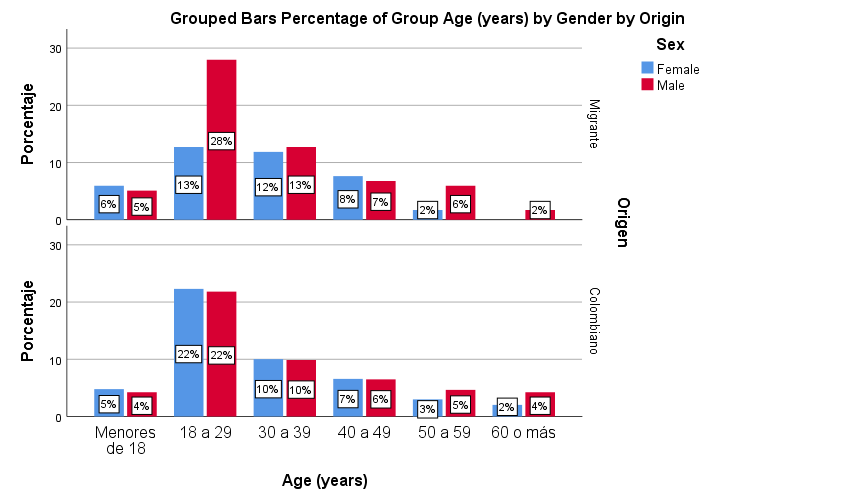
Figure 1 shows that there is a balance in the distribution of respondents in this study according to sex and population origin, although proportionally the migrant population presents a higher concentration of the total, with 28% of men between 18 and 29 years of age.
When characterizing the population that does practice physical activity and sports, Figure 2 shows that proportionally, Colombian women between 18 and 29 years of age 22% and foreign men between 30 and 39 years of age 23%, show a greater tendency to practice sports.
On the other hand, when comparing the groups that practice physical activity and sports, the highest proportion is found in stratum 1 regardless of the group of population origin as shown in Figure 3, with 20% of women and 33% of migrant men and 26% of Colombian men and women, while in stratum 2, 8% of women and 27% of foreign men and 17% and 18% of Colombian women and men, respectively.
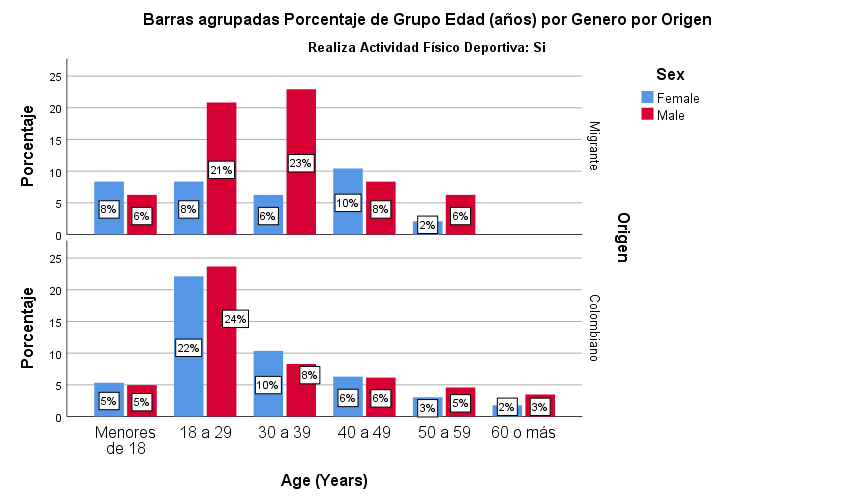
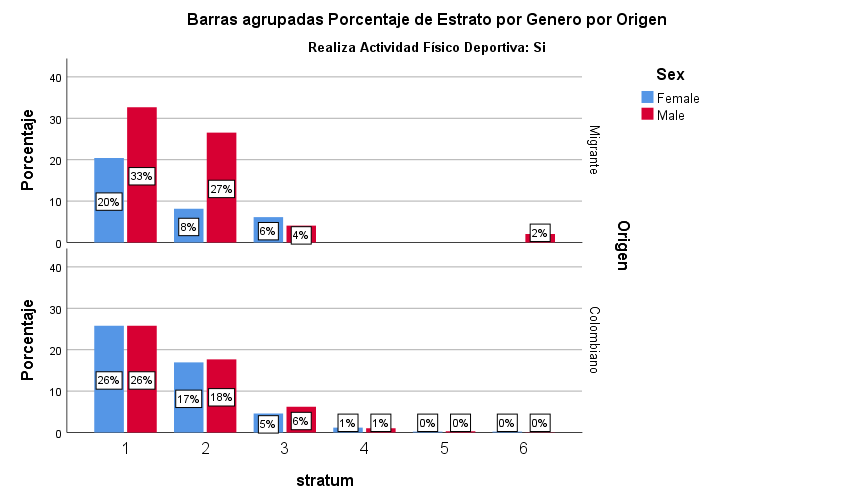
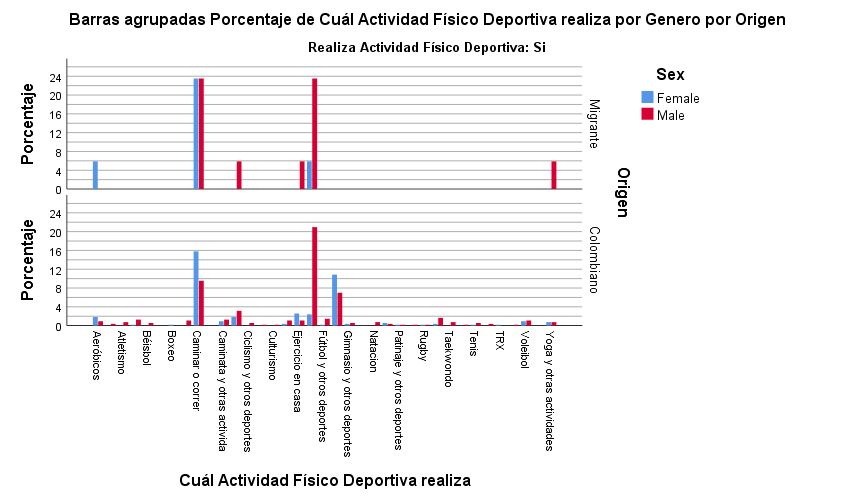
Figure 4 shows the specific preference for physical sports activities, finding important coincidences in walking or running with 24% of migrants regardless of sex and 16% female plus 9% male of Colombian nationals, also in soccer practice regardless of place of origin, with a preference for the male group of 24% among foreigners and 22% among nationals, with 6% of Colombian women standing out; In turn, a percentage close to 10% of the migrant population prefers cycling (8% male), exercising at home (8% male and female) or doing yoga (8% female), while Colombian nationals (12% for the female group and 8% for the male group) have a greater preference for going to gyms.
Discussion
The gradual increase of migratory processes at present is presented as a scenario of study for the strengthening of public policies, since these populations are part of the community and contribute value to the labor and fiscal market, they also deserve to be taken into account by governance in respect to their activity. In this sense, the objective of this study was to analyze the physical-sports activity habits of Colombian nationals and migrants residing in the city of Sincelejo.
The panorama in Latin America indicates that 50% of the population is irregularly active, and specific programs are presented in each nation since they all consider sedentary lifestyle as one of the main risk factors for mortality [17] unfortunately the global trend indicates that new generations have insufficient levels of physical activity estimating a prevalence of inactivity over 70% by 2030 [5] however older adults perceive physical exercise as an activity that benefits their health in addition to providing recreation, however emotional and socialization aspects may limit adherence to physical activity [13]. These aspects coincide with what was evidenced in the present study where the highest concentration of participants in physical sports activities is between 18 and 39 years of age, regardless of their population origin, this means that within the group of people who practice physical sports activity there is greater adherence for subjects between the aforementioned age ranges.
When the factors associated with compliance with the physical activity recommendations for adults have been studied, it is evident that being a woman, belonging to socioeconomic stratum 1, having high school or lower level of education, and having a home occupation are associated with a lower probability of complying with the physical activity recommendations, while young adults presented greater compliance [22]. These findings are similar to the present study where the groups of younger adults proportionally group a greater number of practitioners of physical activity than the older ones, however, when contrasted according to sex in the present study, strata 1 and 2 group the highest proportion of practitioners, contrary to the cited reference.
In consideration of the above, it can be affirmed that the organization of physical activity and sports plans and programs are of a strategic nature in the generation of public policies, which is ratified in the global action plan on physical activity 2018-2030, where four strategic areas are promoted: active societies, active environments, active people and active systems [7], whose recommended measures, if adopted, would achieve a relative reduction of 15% in the levels of sedentary lifestyles.
The present work is presented as one of the first to consider the analysis of physical sports activity habits among nationals and foreigners, and exposes data of particular interest such as activity preferences according to origin, and where walking or running is one of the main activities among migrants while Colombian nationals mostly prefer to play soccer or go to the gym, from which the economic possibilities and investment interests of each population group, beyond the declared stratum, should be taken into account for future studies.
Conclusions and Recommendations
In light of the results obtained, it can be concluded that 8 out of 10 migrants who are physically active are located in strata 1 and 2, and that women prefer to do aerobics, walk or run and men prefer to walk, run or play soccer, in addition to the fact that 4 out of 10 Colombian nationals prefer to go to the gym.
Thus, taking into account the recommendations of the World Health Organization considering active societies and active environments in public policy is fundamental, where not only a program of habits guarantees adherence to them, but also guarantees suitable spaces for the practice of sports where the exchange is provided and thus probably promotes social and cultural integration through the physical sports activity of migrants and nationals.
References
-
Castillo Garzón MJ (2007) La condición física es un componente importante de la salud para los adultos de hoy y del mañana. Selection 17(1): 2-8.
-
Castro-Jiménez LE, Argüello-Gutiérrez YP, Camargo- Rojas DA (2018) Physical activity within the framework of primary health care as perceived by the actors. Revista de Salud Publica 20(4): 415-421.
-
Pedersen BK, Saltin B (2015) Exercise as medicine – evidence for prescribing exercise as therapy in 26 different chronic diseases. Scandinavian Journal of Medicine & Science in Sports 3(25): 1-72.
-
Yau SY, Li A, Sun X, Fontaine CJ, Christie BR, et al. (2016) Potential Biomarkers for Physical Exercise-Induced Brain Health. En Role of Biomarkers in Medicine.
-
Guthold R, Stevens GA, Riley LM, Bull FC (2020) Global trends in insufficient physical activity among adolescents: a pooled analysis of 298 population-based surveys with 1·6 million participants. The Lancet Child and Adolescent Health 4(1): 23-35.
-
Guthold R, Stevens GA, Riley LM, Bull FC (2018) Worldwide trends in insufficient physical activity from 2001 to 2016: a pooled analysis of 358 population-based surveys with 1·9 million participants. The Lancet Global Health 6(10): e1077-e1086.
-
World Health Organization (2023) Informe sobre la situación mundial de la actividad física 2022.
-
Pan American Health Organization (2019) Global action plan on physical activity 2018-2030. More active people for a healthy world.
-
ICBF (2015) ENSIN: National Survey of Nutritional Situation Portal ICBF - Instituto Colombiano de Bienestar Familiar ICBF. Recuperado 17 de julio de 2023, de.
-
Minsalud (2017) Gobierno presenta Encuesta Nacional de Situación Nutricional de Colombia (ENSIN) 2015.
-
Instituto Nacional de Salud (2015) Actividad Física en Colombia. Recuperado 20 de junio de 2023, de Boletín n° 5.
-
Argentino J (1999) The practice of physical and sports activity as a habit in the adult population of the city of Apóstoles.
-
Porras C, Grajales I, Hernández MC, Alonso MM, Tenahua I (2018) Perception of older adults about the benefits, barriers and social support for performing physical activity. Revista Médica del Instituto Mexicano Seguro Social 48(2): 127-132.
-
Vázquez LÁ, Patón RN, Álvarez OR, Calvo MM, Fuentes CL (2023) Physical activity and quality of life in Argentinian older adults: a cross-sectional study. Retos 48: 86-93.
-
Beltrán Picón SP (2018) Sports, recreational, academic and cultural activities for children aged 6 to 12 years belonging to economic level 1 and 2 of Barranquilla- Colombia. Revista Encuentros 16(2).
-
Trejo-Ortíz PM, Mollinedo Montaño FE, Araujo Espino R, Valdez-Esparza G, Sánchez Bonilla M del P (2016) Hábitos de actividad física y cánones de imagen corporal en estudiantes universitarios. Revista Cubana de Medicina General Integral, 32(1): 72-82.
-
De Souza Martins M, Pinzón AM, Salazar A (2014) Comparison of physical activity and sports programs aimed at the Latin American population 20(2).
-
Robledo-Martínez R (2006) Características Socioculturales de la Actividad Física en Tres Regiones de Colombia. En Rev Salud pública 8.
-
Atencio D (2021) Béisbol, Economia y Movilidad social en Cartagena 1976-1966 Universidad de Cartagena.
-
Alba O (2016) Baseball: North American sport with a Hispanic American seal pp: 3-5.
-
Feller C, Alvarado PA, Doña C, García I (2018) Physical activity and sport participation among immigrants in Chile. Cuad Méd Soc 58(4).
-
Aristizábal JC, Estrada-Restrepo A, Patiño-Villada FA (2022) Factors associated with compliance with physical activity recommendations for adults in Antioquia – Colombia. Revista Facultad Nacional de Salud Pública 40(2): e344839.
- An Evaluation of Distraction Control in Experienced Cyclists During a 20 Minute Time-Trial Performance
- Do Games Missed Predict Rankings in the NBA A Machine Learning Approach
- Elite Taekwondo Athletes: The Relationship among Sport Psychology, Mental Health, and the National Sport Organization
- Immediate Effect of Continuous Running on Red Blood Cells (RBC), Packed Cell Volume (PCV) and Red Blood Cell Distribution Width (RDW) Among Physically Trained Boys
- Echocardiographic Insights into Left Ventricular Functional Adaptation in Track and Field Athletes: A Comprehensive Review
- Could there be a Relationship between early Specialization and Load Management Practices in Professional Athletes