
Vitamin D Enriched Edible Mushrooms: A Review
Vitamin D is one of the most important vitamins to human health as it plays a significant role in human’s various physiological functions including metabolism of phosphorus and calcium, neuromuscular and skeletal homeostasis and is also effective against various diseases. Although it is found in two major forms, vitamin D3 (from animal-derived products) and vitamin D2 (from plant, mushrooms and yeast), it is reported that vitamin D2 functions similar to vitamin D3 as both possess the ability to improve overall vitamin D levels in blood. Also, vitamin D2 obtained from mushrooms do not show hypercalcaemic effects reported during the use of vitamin D3. Hence, we aimed in this study to put mushrooms as a potential source of dietary vitamin D under the spot. Moreover, we mentioned examples of mushroom species reported to contain vitamin D in their composition. Some factors controlling the level of vitamin D in these mushrooms were also highlighted.
Introduction
The rapid growth of human civilizations has led to escalating pressures to develop new functional food products with nutritional characteristics having therapeutic all potentials. Mushrooms have been utilized in a wide variety of foods for thousands of years and have gained extensive attention in research communities and commercial ventures seeking to explore new and innovative applications in a diverse array of food products of therapeutic all potentials. Technological advances in the cultivation and processing of mushrooms have created new frontiers in the control of textures, flavours, and nutritional properties of fungi-based foods [1, 2, 3, 4, 5, 6, 7, 8, 9, 10].
Edible mushrooms are an excellent source of proteins, minerals, polysaccharides, unsaturated fatty acids, and secondary metabolites [11, 12, 13, 14, 15, 16, 17, 18, 19]. Numerous studies have provided evidence for the protective effects of edible mushrooms against various chronic diseases [20, 21, 22, 23, 24, 25, 26, 27, 28, 29, 30, 31, 32, 33]. Mushrooms have provided food for millennia and production methods and species diversity have recently expanded. Beside mushrooms, cultured fungal mycelia are now harvested as a primary product for food. Mushrooms and mycelia provide dietary protein, lipids and fatty acids, vitamins, fibre, and flavour, and can improve the organoleptic properties of processed foods (including meat analogues). Further, they are often key ingredients in nutritional or therapeutic supplements because of diverse specialised metabolites. Mycelia can also improve feed conversion efficiency, gut health, and wellbeing in livestock [34].
The most important vitamin is vitamin D (Sunshine vitamin) which is a fat-soluble vitamin plays a significant role in human’s various physiological functions such as metabolism of phosphorus and calcium, neuromuscular and skeletal homeostasis and is also effective against various diseases [35, 36]. Although it is found in two major forms, vitamin D3 in animal-derived products and vitamin D2 in mushrooms and yeast, it is reported that vitamin D2 functions similar to vitamin D3 as both possess the ability to improve overall vitamin D levels in blood. Also, vitamin D2 obtained from mushrooms do not show hypercalcaemic effects as in the case of vitamin D3 [37].
Mushrooms are a low-calorie food that packs a nutritional punch. Loaded with many health-boosting vitamins, minerals, and antioxidants, they’ve long been recognized as an important part of any diet. For instance, mushrooms raised with exposure to ultraviolet light are a good source of Vitamin D, an important component in bone and immune health. Mushrooms (Maitake, enoki, shiitake, oyster, crimini, morel, and chanterelle) are one of the few plant foods which contain ergo sterol, a precursor to vitamin D2 (Figure 1). The two major physiological forms of active vitamin D for humans are ergocalciferol D2 (Found in mushrooms and some dietary supplements) and cholecalciferol D3 (Found in animal sources and some dietary supplements). The current recommended Adequate Intake (AI) for Vitamin D for most adults is 5ug (200 IU). The amount of vitamin D2 in mushrooms can be significantly increased by exposing mushrooms to ultraviolet (UV) light [38].
Mushrooms as a Potential Source of Dietary Vitamin D
Recently, there is a growing concern about diseases associated with the deficiency of vitamin D in humans. As people stayed indoors, due to the COVID-19 pandemic, vitamin D levels are further affected. Many researches indicate vitamin D as a promising defensive or therapeutic agent against COVID, making this review more vital and important. Mushrooms, as a rich source of vitamin D along with various bioactive compounds [1, 2, 3, 4, 5, 6, 7, 8, 9, 10, 11, 12, 13, 14, 15, 16, 17, 18, 19], perform a significant role in resolving health issues [20, 21, 22, 23, 24, 25, 26, 27, 28, 29, 30, 31, 32, 33]. Mushroom-based medicinal formulations and functional foods serve to deliver vitamins and nutrients to humans, thus helping in health problems, especially in developing countries. Evidence from pre-clinical and clinical analyses suggests that vitamin D2 bioavailability in mushrooms is comparable with vitamin D from other sources [39].
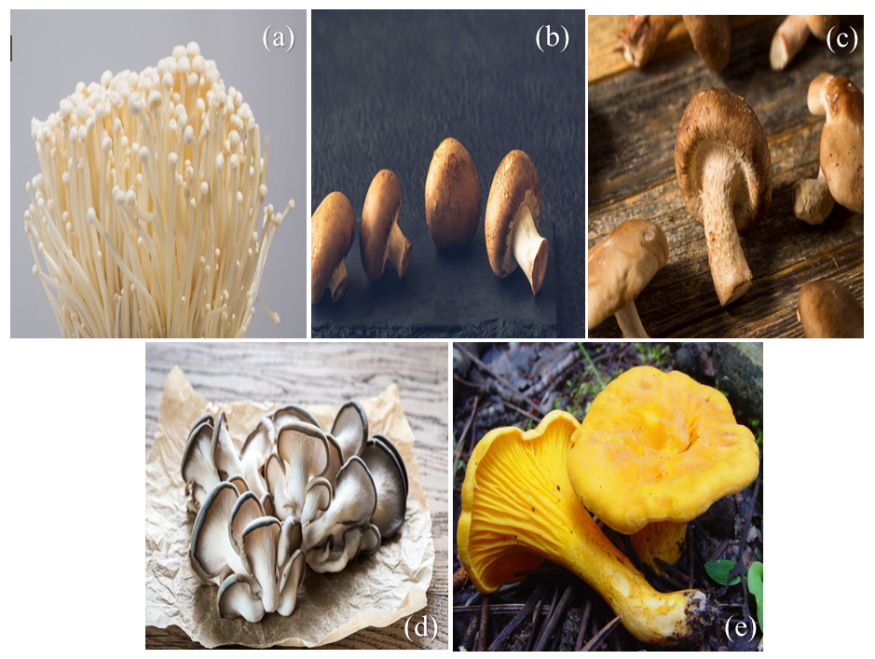
Figure 1: Flammulina velutipes mushroom Cited in: https://twigscafe.com/27-types-of-gourment-medicinal-mushrooms/. (b) Agaricus bisporus. Cited in: https://twigscafe.com/27-types-of-gourment-medicinal-mushrooms/. (c) Shiitake mushroom Letinula edodes. Cited in: https://twigscafe.com/27-types-of-gourment-medicinal-mushrooms/. (d) Oyster mushroom Pleurotus ostreatus. Cited in: https://twigscafe.com/27-types-of-gourment-medicinal-mushrooms/. (e) Cantharellus cibarius, (Photo was taken by: Scott T. Bates. Locality: USA, Arizona, White Mountains, and Hannagan Meadow (Cited in: https://mycoportal.org).
Vitamin D deficiency is highly prevalent in Egypt and worldwide. Mushrooms are important nutritional foods, and in this context shiitake (Lentinula edodes), button (Agaricus bisporus) and oyster (Pleurotus ostreatus) (Figure 1) mushrooms are known for their bioactive properties [33]. The application of ultraviolet (UV) irradiation for the production of substantial amounts of vitamin D2 is well established [40]. Levels of serum 25-hydroxy vitamin D (25- OHD), parathyroid hormone (PTH), calcium, phosphorus and alkaline phosphatase (ALP) were significantly (p < 0.05) improved in vitamin-D-deficient rats after feeding with UVB irradiated mushrooms for 4 weeks [40].
The ergocalciferol and 25-hydroxyergocalciferol contents in cultivated Agaricus bisporus and in five different wild mushroom species were determined by high-performance liquid chromatography (HPLC), using internal standard methods and the level of previtamin D-2 was screened by Mattila, et al. [41]. Wild mushrooms, especially Cantharellus cibarius and Cantharellus tubaeformis, contained high amounts of ergocalciferol, 12.8 and 29.82 mu g/100g of fresh weight; respectively [42]. Mattila, et al. [41] reported that about 90% of the total vitamin D content in the mushrooms studied was derived from ergocalciferol, whose content was remarkably high in wild mushrooms, especially in the genus Cantharellus (Figure 1).
Fractions containing up to 18% (w/w) ergosterol and other ergosterol derivatives can be obtained by 289 supercritical fluid extractions from Lentinula edodes mushroom. They can be further processed to induce partial 290 transformation of this provitamin D2 into vitamin D2 by UV-light irradiation (Figure 1). Then, the SFE extracts should 291 be dissolved in organic solvents such as methanol or ethanol, exposed at room temperature under WS-UV 292 or UV-C rather than UV-A light and as closer as possible to the UV source. WS-UV irradiation also induced 293 vitamin D4 formation although in lower amounts than vitamin D2 or lumisterol2 [42].
Pleurotus florida and Pleurotus cornucopiae are Oyster mushrooms that are widely grown all over the world. White Oyster mushroom, Pleurotus florida is a commonly grown mushroom species due to its high nutritional value, ease and low cost of cultivation. Begum, et al. [43], reported that Vitamin D2 from fruiting bodies of two Oyster Mushroom species, namely Pleurotus florida and Pleurotus cornucopiae, is quantified using a spectrophotometer at 264nm and it was observed that Vitamin D2 levels varied with different wavelengths used. Both the species, Vitamin D2 levels increased in the UV-B range than in the UV-A range. Moreover, between the two species under study, Pleurotus florida showed the highest Vitamin D2 accumulation potential at 280nm when exposed for 120 minutes. The level of Vitamin D2 increased to an optimum level at 120 minutes of UV exposure. Vitamin D2 levels obtained from Pleurotus florida and Pleurotus cornucopiae safe and can be used in the preparation of Vitamin D supplements in the future [43].
Since mushrooms provide nutritionally relevant amounts of B group vitamins and of the minerals selenium, potassium, copper, and zinc, they are a nutritious, low energy-dense food [44, 45]. Presently, some larger commercial mushroom farms in the USA, Ireland, The Netherlands, and Australia expose fresh mushrooms to UV radiation, generating at least 10 µg D2/100 g FW; therefore, a 100 g serve would provide 50– 100% of the daily required vitamin D to consumers. Exposing dried mushrooms to UV-B radiation can also generate nutritionally useful amounts of vitamin D2, although this practice is not widespread to date [40].
Several studies have shown that ultraviolet (UV)-treated mushrooms are a potential dietary source of vitamin D, as these mushrooms have a high rate of conversion of ergosterol to vitamin D2. However, there are gaps in knowledge about the most appropriate irradiation conditions, including the source, dose, intensity, and duration of irradiation, for maximizing vitamin D2 content in mushrooms [46, 47]. UVB seems to be most effective in transforming ergo sterol to vitamin D2 in both fresh and dried mushrooms. This knowledge is important for the mushroom industry in order to provide the market with vitamin D2-enhanced mushrooms in a safe and affordable manner. Vitamin D2 bioavailability is still unclear, and there is an urgent need to investigate the effectiveness, safety, and adequate amount of vitamin D2- enhanced mushrooms for reducing vitamin D deficiency and maintaining vitamin D levels [48, 49, 50, 51].
Sunlight, regular UV lamps, and pulsed UV lamps have the capability to raise the vitamin D2 concentrations to nutritional significance, although pulsed UV lamps may be the most cost-efficient method for commercial production of vitamin D-enhanced mushrooms, because of the low exposure time (often in 1–3 seconds) to achieve at least 10 µg/100 g FW [52]. Vitamin D-enhanced mushrooms contain high concentrations of vitamin D2, which is bioavailable and relatively stable during storage and cooking. Therefore, consumption of vitamin D-enhanced mushrooms could substantially contribute to alleviating the global public health issue of vitamin D deficiency [53].
Conclusion
Edible mushrooms represented by Maitake, enoki, shiitake, oyster, crimini, morel, and chanterelle have a rich history of use as an edible source and well-claimed medicinal properties. Worldwide mushroom consumption has increased markedly in the past four decades, and mushrooms have the potential to be the only non-animal, unfortified food source of vitamin D that can provide a substantial amount of vitamin D2 in a single serve. The vitamin D2 produced in mushrooms can very well take care of vitamin D deficiency in human and can be used in the preparation of Vitamin D supplements in the future.
Further research is required to determine the optimal level of UV radiation required to produce a nutritionally useful amount of vitamin D2 in mushrooms, along with optimal storage conditions and cooking methods. The physiological benefits of mushroom-derived vitamin D2 compared with solar-derived vitamin D3 also require further investigation.
References
-
Elkhateeb WA, Daba GM, Thomas PW, Wen TC (2019) Medicinal mushrooms as a new source of natural therapeutic bioactive compounds. Egypt Pharmaceu J 18(2): 88-101.
-
Elkhateeb WA, Daba GM, Elnahas M, Thomas P, Emam M (2020) Metabolic profile and skin-related bioactivities of Cerioporus squamosus hydromethanolic extract. Biodiversitas J Biological Div 21(10).
-
Elkhateeb WA, Daba G (2020) The endless nutritional and pharmaceutical benefits of the Himalayan gold, Cordyceps; Current knowledge and prospective potentials. Biofarmasi Journal of Natural Product Biochemistry 18(2): 70-77.
-
Elkhateeb WA, Daba GM (2020) Termitomyces Marvel Medicinal Mushroom Having a Unique Life Cycle. Open Access Journal of Pharmaceutical Research 4(1): 1-4.
-
Daba GM, Elkhateeb W, ELDien AN, Fadl E, Elhagrasi A, et al. (2020) Therapeutic potentials of n-hexane extracts of the three medicinal mushrooms regarding their anti- colon cancer, antioxidant, and hypocholesterolemic capabilities. Biodiversitas Journal of Biological Diversity 21(6): 1-10.
-
Elkhateeb WA (2020) What medicinal mushroom can do? Chem Res J 5(1): 106-118.
-
Elkhateeb WA, Daba GM, Elmahdy EM, Thomas PW, Wen TC, et al. (2019) Antiviral potential of mushrooms in the light of their biological active compounds. ARC J Pharmac Sci 5(2): 45-49.
-
El-Hagrassi A, Daba G, Elkhateeb W, Ahmed E, El-Dein AN, et al. (2020) In vitro bioactive potential and chemical analysis of the n-hexane extract of the medicinal mushroom, Cordyceps militaris. Malays J Microbiol 16(1): 40-48.
-
Elkhateeb WA, Daba GM, El-Dein AN, Sheir DH, Fayad W, et al. (2020) Insights into the in-vitro hypocholesterolemic, antioxidant, antirotavirus, and anticolon cancer activities of the methanolic extracts of a Japanese lichen, Candelariella vitellina, and a Japanese mushroom, Ganoderma applanatum. Egyptian Pharmaceutical Journal 19(1): 67-73.
-
Elkhateeb WA, Zaghlol GM, El-Garawani IM, Ahmed EF, Rateb ME, et al. (2018) Ganoderma applanatum secondary metabolites induced apoptosis through different pathways: In vivo and in vitro anticancer studies. Biomedicine & Pharmacotherapy 101: 264-277.
-
Elkhateeb WA, Elnahas MO, Thomas PW, Daba GM (2019) To Heal or Not to Heal? Medicinal Mushrooms Wound Healing Capacities. ARC Journal of Pharmaceutical Sciences 5(4): 28-35.
-
Elkhateeb WA, Daba GM, Elnahas, MO, Thomas, PW (2019) Anticoagulant capacities of some medicinal mushrooms. ARC J Pharma Sci 5(4): 1-9.
-
Elkhateeb W, Elnahas MO, Paul W, Daba GM (2020) Fomes fomentarius and Polyporus squamosus models of marvel medicinal mushrooms. Biomed Res Rev 3(1): 3-119.
-
Elkhateeb WA, Daba GM (2021) Mycotherapy of the good and the tasty medicinal mushrooms Lentinus, Pleurotus, and Tremella. Journal of Pharmaceutics and Pharmacology Research 4(2): 1-6.
-
Elkhateeb WA, Daba GM (2021) The Fascinating Bird’s Nest Mushroom, Secondary Metabolites and Biological Activities. International Journal of Pharma Research and Health Sciences 9(1): 3265-3269.
-
Elkhateeb WA, Daba GM, Gaziea SM (2021) The Anti- Nemic Potential of Mushroom against Plant-Parasitic Nematodes. J Microbiol Biotechnol 6(1): 1-6.
-
Elkhateeb WA, Elnahas MO, Thomas PW, Daba GM (2020) Trametes Versicolor and Dictyophora Indusiata Champions of Medicinal Mushrooms. Open Access Journal of Pharmaceutical Research 4(1): 1-7.
-
Elkhateeb WA, Daba G (2020) The endless nutritional and pharmaceutical benefits of the Himalayan gold, Cordyceps; Current knowledge and prospective potentials. Biofarmasi Journal of Natural Product Biochemistry 18(2): 1-10.
-
Thomas PW, Elkhateeb WA, Daba GM (2020) Chaga (Inonotus obliquus): a medical marvel but a conservation dilemma? Sydowia 72: 123-130.
-
Thomas P, Elkhateeb WA, Daba GM (2021) Industrial Applications of Truffles and Truffle-like Fungi. In: Sridhar KR, Deshmukh SK (Eds.), Advances in Macrofungi. 1st (Edn.), CRC Press, Boca Raton, pp: 82-88.
-
Elkhateeb W, Thomas P, Elnahas M, Daba G (2021) Hypogeous and Epigeous Mushrooms in Human Health. In: Sridhar KR, Deshmukh SK (Eds.), Advances in Macrofungi. 1st (Edn.), CRC Press, Boca Raton, pp: 7-19.
-
Elkhateeb W, Elnahas M, Daba G (2021) Infrequent Current and Potential Applications of Mushrooms. In: Sridhar KR, Deshmukh SK (Eds.), Advances in Macrofungi. 1st (Edn.), CRC Press, Boca Raton, pp: 70-81.
-
Elkhateeb WA, El Ghwas DE, Gundoju NR, Somasekhar T, Akram M, et al. (2021) Chicken of the Woods Laetiporus sulphureus and Schizophyllum Commune Treasure of Medicinal Mushrooms. J Microbiol Biotechnol 6(3): 1-7.
-
Elkhateeb WA, Daba GM (2021) Highlights on Unique Orange Pore Cap Mushroom Favolaschia Sp. and Beech Orange Mushroom Cyttaria sp. and Their Biological Activities. Pharm Res 5(3): 1-6.
-
Elkhateeb WA, Daba GM (2021) Highlights on the Wood Blue Leg Mushroom Clitocybe Nuda and Blue-Milk Mushroom Lactarius Indigo Ecology and Biological Activities. Open Access Journal of Pharmaceutical Research 5(3): 1-6.
-
Elkhateeb WA, Daba GM (2021) Highlights on the Golden Mushroom Cantharellus cibarius and unique Shaggy ink cap Mushroom Coprinus comatus and Smoky Bracket Mushroom Bjerkandera adusta Ecology and Biological Activities. Open Access Journal of Mycology & Mycological Sciences 4(2): 1-8.
-
Thomas PW, Elkhateeb WA, Daba G (2019) Truffle and truffle like fungi from continental Africa. Acta mycologica 54(2): 1-15.
-
ALKolaibe AG, Elkhateeb WA, Elnahas MO, El Manawaty M, Deng CY, et al. (2021) Wound Healing, Anti-pancreatic Cancer, and α-amylase Inhibitory Potentials of the Edible Mushroom, Metacordyceps neogunnii. Research Journal of Pharmacy and Technology 14(10): 5249-5253.
-
Elkhateeb WA, Daba GM (2021) The coral mushrooms Ramaria and Clavaria. Studies in Fungi 6(1): 495-506.
-
Elkhateeb WA, Daba GM (2022) Medicinal mushroom: What should we know? International Journal of Pharmaceutical Chemistry and Analysis. 9(1): 1-19.
-
Elkhateeb WA, Daba GM (2022) The wild non edible mushrooms, what should we know so far? International Journal of Advanced Biochemistry Research 6(1): 43-50.
-
Elkhateeb WA, Daba GM (2022) Bioactive Potential of Some Fascinating Edible Mushrooms Flammulina, Lyophyllum, Agaricus, Boletus, Letinula, and Pleurotus as a Treasure of Multipurpose Therapeutic Natural Product. Pharm Res 6(1): 1-10.
-
Waktola G, Temesgen T (2018) Application of mushroom as food and medicine. Advances in Biotechnology and Microbiology 11(4): 1-4.
-
Strong PJ, Self R, Allikian K, Szewczyk E, Speight R, et al. (2022) Filamentous fungi for future functional food and feed. Curr Opin Biotechnol 76: 102729.
-
Theodoratou E, Tzoulaki I, Zgaga L, Ioannidis J (2014) Vitamin D and multiple health outcomes: Umbrella review of systematic reviews and meta-analyses of observational studies and randomised trials. BMJ 348: g2035.
-
Taofiq O, Fernandes Â, Barros L, Barreiro MF, Ferreira I, et al. (2017) UV-irradiated mushrooms as a source of vitamin D2: A review. Trends in Food Science & Technology 70: 82-94.
-
Koyyalamudi SR, Jeong SC, Pang G, Teal A, Biggs T, et al. (2011) Concentration of vitamin D2 in white button mushrooms (Agaricus bisporus) exposed to pulsed UV light. Journal of Food Composition and Analysis 24(7): 976-979.
-
Cardwell G, Bornman JF, James AP, Black LJ (2018) A review of mushrooms as a potential source of dietary vitamin D. Nutrients 10(10): 1498.
-
Tiwari A, Singh G, Singh U, Sapra L, Rana V, et al. (2022) Edible mushrooms: The potential game changer in alleviating vitamin D deficiency and improving human health. International Journal of Food Science & Technology 57(3): 1367-1377.
-
Malik MA, Jan Y, Al-Keridis LA, Haq A, Ahmad J, et al. (2022) Effect of Vitamin-D-Enriched Edible Mushrooms on Vitamin D Status, Bone Health and Expression of CYP2R1, CYP27B1 and VDR Gene in Wistar Rats. Journal of Fungi 8(8): 864.
-
Mattila PH, Piironen VI, Uusi-Rauva EJ, Koivistoinen PE (1994) Vitamin D contents in edible mushrooms. J Agric Food Chem 42(11): 2449-2453.
-
Morales D, Gil-Ramirez A, Smiderle FR, Piris AJ, Ruiz-Rodriguez A, et al. (2017) Vitamin D-enriched extracts obtained from shiitake mushrooms (Lentinula edodes) by supercritical fluid extraction and UV- irradiation. Innovative food science & emerging technologies 41: 330-336.
-
Begum M, Ghosh S, Saikia SP (2022) Study of Vitamin D. Eco Env & Cons 28(3): 1420-1426.
-
Feeney MJ, Miller AM, Roupas P (2014) Mushrooms- biologically distinct and nutritionally unique. Nutr Today 49(6): 301-307.
-
Jasinghe VJ, Perera CO, Sablini S (2007) Kinetics of the conversion of ergosterol in edible mushrooms. J Food Eng 79(3): 864-869.
-
Kristensen H, Rosenqvist E, Jakobsen J (2012) Increase of vitamin D2 by UV-B exposure during the growth phase of white button mushroom (Agaricus bisporus). Food Nutr Res 56: 7114.
-
Leung, MF, Cheung P (2021) Vitamins D and D 2 in Cultivated Mushrooms under Ultraviolet Irradiation and Their Bioavailability in Humans: A Mini-Review. International Journal of Medicinal Mushrooms 23(11): 1-15.
-
Teichmann A, Dutta PC, Staffas A, Jägerstad M (2007) Sterol and vitamin D2 concentrations in cultivated and wild grown mushrooms: Effects of UV irradiation. LWT- Food Sci Technol 40(5): 815-822.
-
Urbain P, Jakobsen J (2015) Dose-response effect of sunlight on vitamin D2 production in Agaricus bisporus mushrooms. J Agric Food Chem 63(37): 8156-8161.
-
Nölle N, Argyropoulos D, Ambacher S, Muller J, Biesalski H, et al. (2016) Vitamin D2 enrichment in mushrooms by natural or artificial UV-light during drying. Food Sci Technol 85: 400-404.
-
Huang G, Cai W, Xu B (2017) Vitamin D2, ergosterol, and vitamin B2 content in commercially dried mushrooms marketed in China and increased vitamin D2 content following UV-C irradiation. Int J Vitam Nutr Res 87(5-6): 1-10.
-
Kalaras M, Beelman R, Elias RJ (2012) Effects of postharvest pulsed UV light treatment of white button mushrooms (Agaricus bisporus) on vitamin D2 content and quality attributes. J Agric Food Chem 60(1): 220- 225.
-
Ko JA, Lee B, Lee J, Park HJ (2008) Effect of UV-B exposure on the concentration of vitamin D2 in sliced shiitake mushroom (Lentinus edodes) and white button mushroom (Agaricus bisporus). J Agric Food Chem 56(10): 3671-3674.
- Diversity of Candida sp and Antifungal Susceptibility Patterns in Digestive Candidiasis among People Living with HIV in CHU of Libreville, Gabon
- Vulvovaginal candidiasis: Retrospective study (2019- 2021) at the Centre Hospitalier National de Pikine, Suburban Dakar, Senegal
- Identification of Environmental Fungal Species in Clinical Services of University Hospital of Angre, Abidjan (Cote d’Ivoire)
- New Location of some Gasteroid Basidiomycetes in Western Kazakhstan
- Evaluation of Various Extracellular Enzymes of Ectomycorrhizal Mushrooms
- Morphology and Phylogeny of Lactarius Wallichianae sp. nov and Xerula magnispora sp. nov. from India