
Termitomyces Marvel Medicinal Mushroom Having a Unique Life Cycle
The medicinal uses of the mushroom still need to be worked out for their biological activities. Current review demonstrate that Termitomyces mushrooms have medicinal properties possesses a number of beneficial medicinal properties such as antioxidants, immunomodulators, antitumors, and antimicrobials. These activities have been reported for various extracts and isolated compounds, such as phenolic compounds, polysaccharides, cerebrosides, serine protease, ergostanes, saponins, and fatty acid amides from Termitomyces fruiting bodies.
Introduction
Mushrooms need antibacterial and antifungal compounds to survive in their natural environment. Hence, they are rich sources of natural antibiotics [1, 2]. Mushrooms are worldwide appreciated for their taste and flavour and are consumed both in fresh and processed Apart from being delicacy and tasty foods, they have special biochemical compositions, with significant contents of proteins, carbohydrates, lipids, enzymes, minerals, vitamins and water which attract more attention as functional health promoters [2, 3, 4, 5].
Termitomyces Mushrooms Ecology
Termitomyces a genus of edible mushrooms commonly consumed in Africa and Asia among the mushrooms collected from the wild. Termitomyces mushrooms grow as symbionts in the termite nests, where they produce various enzymes to help termites digest lignocellulosic substrates.
On the termite comb white spherical yeast like colony fungal structures are commonly observed. These structures of Termitomyces have been described by various authors under different names [6]. Heim, [7] proved these structures exclusively as sporodochia which are found on the combs of Macro terminae and represent the anamorph of the genus Termitomyces. The fruiting bodies of Termitomyces are rich in nutritional and medicinal constituents. Many species of Termitomyces are used by different ethnic groups with ethnomedicinal knowledge [8]. Termitomyces R. Heim, a fungal genus belonging to the family Lyophyllaceae [9, 10].
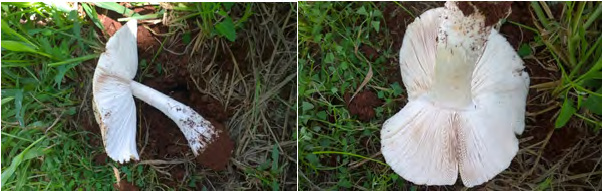
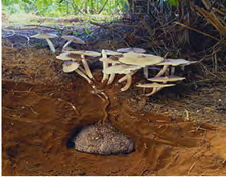
Termitomyces mushrooms grow exclusively inside nests of macrotermitine termites, Figures 1 & 2. These mushrooms are regularly collected both for home consumption and for sale in local markets or along roadsides [11, 12]. The fungi Termitomyces are known to have a unique life cycle. These fungi are distributed in tropical and subtropical areas from Africa to Southeast Asia [13], and are found only in nests of Macrotermitinae termites in the wild. They live in a medium called the fungus comb, located in a special chamber, fungus garden, inside the nest. The termites collect plant materials from outside the nest to maintain the fungus combs, which they later eat [14, 15]. Various species of Termitomyces are widely dispersed in Africa and Southeast Asia [16, 17]. Termitomyces mushrooms production of their fruiting bodies under artificial cultivation has not been successful yet [18].
Termitomyces Mushrooms Benefits and uses
Termitomyces mushrooms become an important source of nutrients as well as micronutrients including vitamins and minerals [19, 20]. Bioactive components that Termitomyces mushrooms contain have potential uses as antioxidants, immunomodulators, antitumors, and antimicrobials. Termitomyces also has a potential for treating neurodegenerative disorders. [8]. Several species of Termitomyces are commonly used ethnomedicinally for health promotion and treatment of illnesses. Termitomyces albuminosus is used in China for improving brain and stomach functions and curing hemorrhoids. In India, T. heimii and T. microcarpus are used in treatment for fever, cold, and fungal infections [21]; T. heimii is as blood tonics during wound healing and blood coagulation [22]; and T. eurrhizus is for curing of rheumatic disorder and diarrhea, and for lowering high blood pressure [23]. In Nigeria, gonorrhea is treated with a preparation containing T. microcarpus [24]. In Cameroon, T. titanicusis used for treatment of stomach complications [25].
Termitomyces mushrooms (methanolic, ethanolic, aqueous) extracts were selected for in-vitro studies against selected pathogenic microorganism to investigate the efficacy of their different. The antifungal activity of various solvent extracts of Termitomyces was tested against five species of fungus Aspergillus flavus, Aspergillus niger, Candida albicans, Penicillium notatum, Mucor racemous. The different extracts showed wide spectrum of a fungal activity [26].
Li, et al., [27] results that Termitomyces albuminosus possess the pharmaceutical potential for Alzheimer’s disease, and it was an effective way to dig new pharmaceutical agent of T. albuminosus with the microbial fermentation technique. Termitomyces mushrooms extracts have revealed potent antioxidant activities and they have also shown promising antimicrobial activities against Escherichia coli, Klebsiella pneumoniae, Pseudomonas aeruginosa, and Staphylococcus aureus [28].
Termitomyces Mushrooms Bioactive Compounds
Termitomyces mushrooms rich in proteins (27– 36%) and ascorbic acid (10–18 mg/g) [8]. Some of the ethnomedicinal uses of Termitomyces mushrooms can be related to certain bioactive compounds that these mushrooms contain. The bioactive compounds from Termitomyces species that have been isolated including phenolic compounds, polysaccharides, cerebrosides, serine protease, ergostanes, saponins, and fatty acid amides [8]. Many compounds with medicinal capabilities have been obtained from Termitomyces dried fruiting bodies, such as novel cerebrosides termitomycesphins A–H with significant neuritogenic activity and cerebroside A with the potent neuroprotection activity. Termitomyces has also displayed antioxidant capacity and high content phenolic ingredients [29, 30, 31, 32].
Conclusion
As a conclusion Termitomyces mushrooms is an edible mushrooms, grow as symbionts in the termite nests. Like several well-known edible mushrooms such as button mushroom (Agaricus blazeiis), wood ear mushroom (Auricularia auricular-judae), and Ganoderma lucidum (polypore mushroom), Termitomyces mushrooms are also effective in antioxidation, anti-inflammation and antitumor [33, 34, 35]. Termitomyces mushrooms may be developed into health care products as dietary supplements. Polysaccharides prepared from Termitomyces may be beneficial for the control of hyperlipidemia. The cultivation of Termitomyces for the fruiting body production is unavailable at present. The chemical analysis of the various compounds obtained from Termitomyces mushrooms fruiting bodies showed that it is a rich source of bioactive compounds with various potential uses as antioxidants, immunomodulators, antitumors, and antimicrobials. Much effort is still needed in discovering further bioactive materials from Termitomyces mushrooms and establishing a system to test their potential uses.
References
-
Lindequist U, Niedermeyer TH, Julich WD (2005) The pharmacological potential of mushrooms-Review. Evid Based Complement Alternat Med 2(3): 285-299.
-
Elkhateeb WA, Daba GM, Wen TC, Thomas PW (2019) Medicinal mushrooms as a new source of natural therapeutic bioactive compounds. Egyptian pharmaceutical Journal 18(2): 88-101.
-
Lakhanpal TN, Rana M (2008) Medicinal and nutraceutical genetic resources of mushrooms. Plant Genetic Resource 3(2): 288-303.
-
Wong JY, Chye FY (2009) Antioxidant properties of selected tropical wild edible mushrooms. Journal of Food Composition and Analysis 22(4): 269-277.
-
Elkhateeb WA, Elnahas MO, Thomas PW and Daba GM (2020) Trametes Versicolor and Dictyophora Indusiata Champions of Medicinal Mushrooms. Open Access Journal of Pharmaceutical Research, 4(1): 1-7.
-
Gomathi V, Esakkiammal M, Thilagavathi SS, Ramalakshmi A (2019) Lignocellulosic Enzyme Production by Termitomyces spp from Termite Garden. Universal Journal of Agricultural Research 7(2): 100- 111.
-
Heim R (1977) Termites et Champignons. Les termitophiles d’Afrique Noire at d’Asie Meridionale. Societe Novelle des Edition, Paris, France, pp: 205.
-
Hsieh HM, Ju YM (2018) Medicinal components in Termitomyces mushrooms. Appl Microbiol Biotechnol 102(12): 4987-4994.
-
Aanen DK, de Fine Licht HH, Debets AJ, Kerstes NA, Hoekstra RF, et al. (2009) High symbiont relatedness stabilizes mutualistic cooperation in fungus-growing termites. Science 326: 1103-1106.
-
Mueller UG, Gerardo NM, Aanen DK, Six DL, Schultz TR (2005) The evolution of agriculture in insects. Annu Rev Ecol Evol Syst 36: 563-595.
-
Ghorai S, Banik SP, Verma D, Chowdhury S, Mukherjee S, et al. (2009) Fungal biotechnology in food and feed processing. Food Res Int 42: 577-587.
-
Sangvichien E, Taylor-Hawksworth PA (2001) Termitomyces mushrooms: a tropical delicacy. Mycologist 15(1): 31-33.
-
Ono K, Hata T, Yoshimura T, Kinjo K. (2017) Wood decaying properties of the termite mushroom Termitomyces eurrhizus. Journal of Wood Science 63(1): 83-94.
-
Otani Y (1992) The fungi grown with termites (in Japanese). Shiroari 90: 3-10.
-
Aanen DK, Eggleton P (2005) Fungus-growing termites originated in African rain forest. Curr Biol 15(9): 851- 855.
-
Kone N, Soro B, Vanie-Leabo LPL, Konate S, Bakayoko A, et al. (2018) Diversity, phenology and distribution of Termitomyces species in Cote d’Ivoire. Mycology 9(4): 307-315.
-
Ye L, Karunarathna SC, Li H, Xu J, Hyde KD, et al. (2019) A Survey of Termitomyces (Lyophyllaceae, Agaricales), Including a New Species, from a Subtropical Forest in Xishuangbanna, China. Mycobiology 47(4): 391-400.
-
Hsieh HM, Chung MC, Chen PY, Hsu FM, Liao WW, et al. (2017) A termite symbiotic mushroom maximizing sexual activity at growing tips of vegetative hyphae. Bot Stud 58(1): 39.
-
Nakalembe I, Kabasa JD, Olila D (2015) Comparative nutrient composition of selected wild edible mushrooms from two agro-ecological zones, Uganda. Springerplus 4: 433-447.
-
Sargunam SD, Johnsy G, Samuel AS, Kaviyarasan V (2012) Mushrooms in the food culture of the Kaani tribe of Kanyakumari district. Indian J Tradit Knowl 11(1): 150-153.
-
Venkatachalapathi A, Paulsamy S (2016) Exploration of wild medicinal mushroom species in Walayar valley, the Southern Western Ghats of Coimbatore District Tamil Nadu. Mycosphere 7(2): 118-130.
-
Chandrawati PS, Narendra K, Tripathi NN (2014) Macrofungal wealth of Kusumhi forest of Gorakhpur, UP, India. Am Int J Res Int Form Appl Nat Sci 5(1): 71-75.
-
Sachan SK, Patra JK, Thatoi HN (2013) Indigenous knowledge of ethnic tribe for utilization of wild mushrooms as food and medicine in similipal biosphere reserve, Odisha, India. J Agric Technology 9(2): 403-416.
-
Oyetayo OV (2011) Medicinal uses of mushrooms in Nigeria: towards full and sustainable exploitation. Afr J Tradit Complement Altern Med 8(3): 267-274.
-
Kinge TR, Apalah NA, Nji TM, Acha AN, Mih AM (2017) Species richness and traditional knowledge of macrofungi (mushrooms) in the Awing forest reserve and communities, northwest region, Cameroon. J Mycol, pp: 1–9.
-
Singh R (2017) Antifungal activity of Termitomyces. Int J Adv Res 5(7): 1503-1505.
-
Li W, Liu Q, Cheng S, Li S, Zheng Y (2019) New Sesquiterpenoids from the Fermented Broth of Termitomyces albuminosus and Their Anti- Acetylcholinesterase Activity. Molecules 24(16): 2980.
-
Gebreyohannes G, Nyerere A, Bii C, Sbhatu DB (2019) Investigation of antioxidant and antimicrobial activities of different extracts of Auricularia and Termitomyces species of mushrooms. Scientific World Journal, pp: 1-10.
-
Qu Y, Sun KY, Gao LJ, Sakagami Y, Kawagishi H, et al. (2012) Termitomycesphins G and H, additional cerebrosides from the edible Chinese mushroom Termitomyces albuminosus. Biosci Biotechnol Biochem 76(4): 791-793.
-
Qi J, Ojika M, Sakagami Y (2001) Neuritogenic cerebrosides from an edible Chinese mushroom. Part 2: Structures of two additional termitomycesphins and activity enhancement of an inactive cerebroside by hydroxylation. Bioorg Med Chem 9(8): 2171-2177.
-
Li L, Yang R, Sun K, Bai Y, Zhang Z, et al. (2012) Cerebroside-A provides potent neuroprotection after cerebral ischaemia through reducing glutamate release and Ca2+ influx of NMDA receptors. Int J Neuropsychopharmacol 15(4): 497-507.
-
Guo YJ, Deng GF, Xu XR, Wu S, Li S, et al. (2012) Antioxidant capacities, phenolic compounds and polysaccharide contents of 49 edible macro-fungi. Food Function 3(11): 1195-1205.
-
Elkhateeb WA, El-Hagrassi AM, Fayad W, El-Manawaty MA, Zaghlol GM, et al. (2018) Cytotoxicity and hypoglycemic effect of the Japanese Jelly Mushroom Auricularia auricula-judae. Chemistry Research Journal 3(4): 123-133.
-
Elkhateeb WA, Daba GM, Elnahas MO, Thomas PW (2019) Anticoagulant Capacities of Some Medicinal Mushrooms. ARC Journal of Pharmaceutical Sciences 5(4): 1-9.
-
Elkhateeb WA, Elnahas MO, Thomas PW, Daba. GM (2019) To Heal or Not to Heal? Medicinal Mushrooms Wound Healing Capacities. ARC Journal of Pharmaceutical Sciences 5(4): 28-35.
- Acido Labile or Gastro Irritant Apis and Enteric Release in Galenic Practice: An Overview
- A Study on Knowledge, Attitude and Practice of Hand Hygiene among Healthcare Professionals at a Tertiary Care Hospital, India
- Influence of Inoculum Concentration on In Vivo Incubation Period of Emmia lacerata, Pathogenesis and Management of Wilt in Pepper (Capsicum annuum L.)
- Vanilla’s Chemistry
- Marine Anti-Cancer Compounds and Adverse Effects of Global Warming on Oceans: An Overview
- Serological Investigation of Chikungunya Virus Antibody among Malaria-Suspected Febrile Patients in Some Healthcare Facilities in Rivers State