
Modeling Tree Height, Crown Diameter, Volume and Carbon in Response to Diameter at Breast Height of Schima wallichii and Catanopsis indica: A Study from Midhills, Nepal
The study regarding correlation between diameter at breast height (DBH) and other variables like height, crown diameter, volume and carbon of the tree species of Schima wallichii and Castonopsis indica was not done yet. Thus, this research was objectively carried out to assess the correlation between DBH and different parameters particularly height, crown diameter, volume and carbon stock. The study was centered on the mid hill region where natural Schima-Castonopsis forest is abundantly found. Total 360 nested sample plots were established having 12.62 m radius for tree, 5.58 m radius for pole, 2.78 m radius for Sapling, 1.76 m radius for seedling measurement. The DBH and height were measured of these tree species in the plots. Collected data was analyzed using Pearson correlation to show the relation of different characteristics of tree and equations were examined using ANOVA and t-test. The descriptive statistics mean ± standard error (SE) of DBH was 28.65±1.25 cm, standard deviation was 19.682, minimum value was 5.2 and maximum value was 161.5 of Castonopsis indica. Similarly, mean±standard error of DBH was 22±0.96 cm, standard deviation 10.254, minimum value was 5.5 and maximum value was 54.3 of Schima wallichii. Moreover, there was positive and strong correlation between DBH and height of Castonospsis Indica with R square value 0.71 and the equation was Y=7.1075ln(X)-9.4467 whereas, Y is the height of the tree and X is DBH. This correlation between DBH and height of Schima wallichii also showed positive and strong with R square value 0.81 and the equation was Y=7.9982ln(X)-11.277. Same correlation was found between DBH and crown diameter of Castanopsis Indica having equation Y=3.4335ln(X)-6.8637 whereas Y is the crown diameter of the tree and X is DBH. Moreover, similar correlation between DBH and volume was also found. Statistically, ANOVA and t-test showed that there was significant correlation between DBH and tree characteristics like height, crown diameter and volume at 95% confidence level. This research will be useful for the decision maker and scientific community to assess the volume and carbon measuring single variable i.e. only DBH.
Introduction
Schima wallichii and Castanopsis Indica are hilly plant species generally found in Bangladesh, Bhutan, southwestern China, Myanmar, Thailand, Laos, Vietnam, northern India and Nepal. Both species are medium fast growing. Schima wallichii is an evergreen tree belonging to the tea family Theaceae while Castanopsis Indica is belonging to Fagaceae family. These species are used mainly for timber to construct the house in hilly areas in these countries. The, leaves of these species are used for fodder and nuts are edible. The mid hill is very suitable habitat for this species. These species generally distributed in eastern central hilly region of Nepal.
Several types of models are essential to understand tree characteristics [1, 2, 3]. These models are differed according to species and their use [4, 5]. The timber is most valuable forest product which is traded in volume unit [6, 7, 8]. Similarly, another important product is biomass and carbon [9]. Carbon sequestration is vital role of tree which is also known as carbon credit [10, 11, 12]. This carbon sequestration helps us to understand the phenomenon of climate change [6, 13, 14]. The volume and carbon assessment of felled trees is easy and convenient job but it is very difficult to assess theses parameters of standing trees [15]. Thus, reliable equations are needed. There are very limited equations to assess the volume and carbon in Nepal.
The diameter is most important variable in the forest science. Almost all parameters correlate with the diameter at breast. There is strong correlation between diameter and other variables like height, volume and carbon. However, these correlations are varied according to species, climatic condition and geographical areas. The correlations of these variables of Schima wallichii and Castanopsis Indica are limitedly explored in Nepal. The assessment of correlation between the variables is important to show the height, volume and carbon of the tree with respect to diameter at breast height. These equations will help to evaluate volume and carbon stock only measuring the diameter at breast. Thus, such types of research are essential. Therefore, this study was carried out to assess the correlation between DBH and different parameters like height, volume and carbon stock.
Materials and Methods
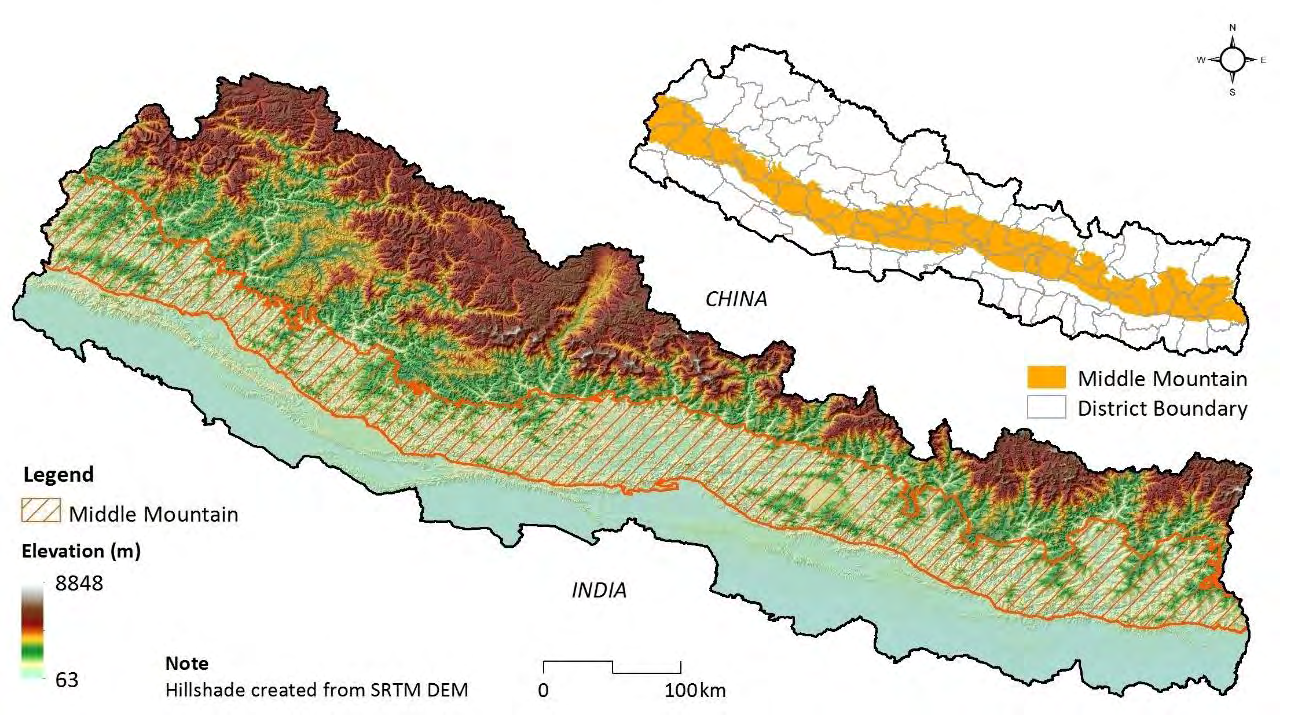
Study area: The study was centered on the mid hill region where natural Schima-Castonopsis forest is dominantly found. Mid Hills, lie north of Churia along the southern flanks of the Himalayas [16]. The region occupies 4,306,230 ha (29.2%) of the total land area of the country and covers parts of 55 of the nation’s districts. The specific plots for the study were determined after the preliminary visit and study Figure 1.
Sampling Design
Permanent sample plots (PSP) were used for inventory works. The sample plots were chosen in such a way that environmental variability can be incorporated into the growth of species. Plot sizes were chosen according to the guideline of Forest Research and Training Centre (FRTC) of Nepal and measurement was done.
Data Collection and Analysis
Total 360 nested sample plots were established to collect the data. The plots were established having 12.62 m radius for tree, 5.58 m radius for pole, 2.78 m radius for Sapling, 1.76 m radius for seedling measurement. The DBH and height were measured of these tree species in the forest.
The following formulae were used for the quantitative analysis.
Volume Calculation
2 d ( *Height*formfactor) 4 ( ) 10000 Volume V
π = Whereas, V = Volume in m3 and d = diameter in cm
Above Ground Tree Biomass (AGTB)C
The equation developed by Chave, et al. [17] was used to calculate above ground tree biomass, 𝐴𝐺𝑇𝐵 = 0.0509 ∗ ρ ∗ d2 ∗ H Where, AGTB = above ground tree biomass (kg), ρ = wood density of the species (gm/cm3) d= diameter (cm) and H= tree height (m) Carbon Calculation Again, the total biomass stock was converted into carbon stocks using conversion factor 0.47. 𝐶𝑎𝑟𝑏𝑜𝑛 (𝐶) = 0.47 ∗ 𝑡𝑜𝑡𝑎𝑙 𝑏𝑖𝑜𝑚𝑎𝑠𝑠 Collected data was analyzed using Pearson correlation to show the relation of different characteristics of tree and these equations were examined using ANOVA and t-test.
Results
Descriptive Statistics of Different Parameters of Castanopsis Indica and Schima wallichii
The descriptive statistics includes mean, standard error, standard deviation, minimum and maximum value of diameter, carbon, height, and crown diameter of Castanopsis Indica. The mean and standard error (SE) value of DBH was 28.65±1.25 cm, standard error was 1.25, standard deviation 19.682, minimum value was 5.2 and maximum value was 161.5. Similar values were estimated for height, crown diameter, volume and carbon of Schima wallichii. The mean and standard error value of DBH was 22±0.96 cm, standard error was 0.96, standard deviation 10.254, minimum value was 5.5 and maximum value was 54.3. Similar values were estimated for height, crown diameter, volume and carbon (Table 1).
| Mean ± SE | Standard Deviation | Minimum Value | Maximum Value | |
|---|---|---|---|---|
| Castonopsis indica | ||||
| DBH | 28.65±1.25 | 19.682 | 5.2 | 161.5 |
| Height | 13.13±0.32 | 5.018 | 3.9 | 32.8 |
| Crown diameter | 4±0.143 | 2.252 | 1.4 | 15 |
| Volume | 1±0.187 | 2.94 | 0 | 32.96 |
| Carbon | 1464.83±259.56 | 4056.74 | 9.45 | 45472.1 |
| Schima wallichii | ||||
| DBH cm | 22±0.96 | 10.25 | 5.5 | 54.3 |
| Height m | 12±0.40 | 4.29 | 3 | 25 |
| Crown diameter | 9.5±0.58 | 6.19 | 1 | 20.5 |
| Volume | 0.3±0.04 | 0.47 | 0 | 2.5 |
| Carbon | 509±60 | 653.15 | 6.45 | 3576.57 |
Table 1: Descriptive statistics of characteristics of Castonopsis indica and Schima wallichii.
Correlation Between DBH and Height of Castanospsis Indica as Well as Schima wallichii
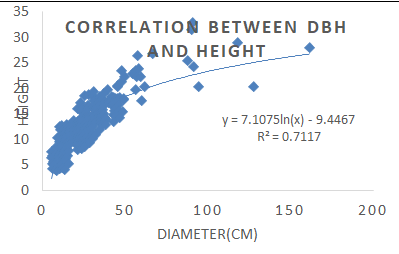
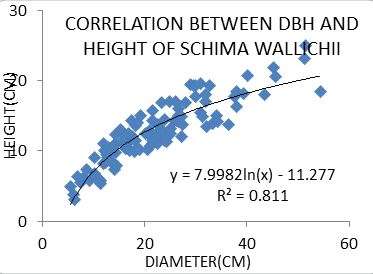
The result showed that there was positive and strong correlation between DBH and height of Castonospsis Indica. The equation was Y=7.1075ln(X)-9.4467 whereas, Y is the height of the tree and X is diameter at breast height. The estimated R-square value was 0.7117 (Figure 2). Similar correlation was found between DBH and height of Schima wallichii. The equation was Y=7.9982ln(X)-11.277 whereas, Y is the height of the tree and X is diameter at breast height. The estimated R-square value was 0.811 (Figure 3).
Statistically, ANOVA showed that there was significant relation between DBH and height. In addition, t-test also showed that intercept and x-variable of the equation was significant since P-value was less than 0.05 in both tests.
Correlation Between DBH and Crown Diameter of Castanopsis Indica as Well as Schima wallichii
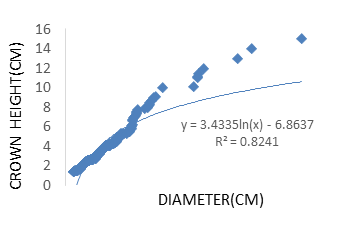
The correlation between DBH and crown diameter of Castanopsis indica was also strong and positive. The derived equation was Y=3.4335ln(X)-6.8637 whereas Y is the crown diameter of the tree and X is diameter at breast height. The estimated R-square value was 0.8241 (Figure 4). This result was also same to show correlation between DBH and crown diameter of Schima wallichii but the equation was different, i.e. Y=11.803ln(X)-25.663 whereas, Y is the crown diameter of tree and X is diameter at breast height. The estimated R-square value was 0.8462 (Figure 5).
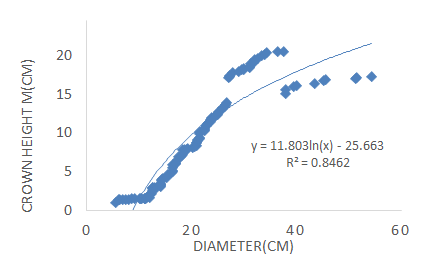
The equation and its intercept and x-variable were significant at 95% confidence level, as the p-value of ANOVA and t-test showed less than 0.05.
Correlation between DBH and Volume of Castanopsis Indica and Schima wallichii
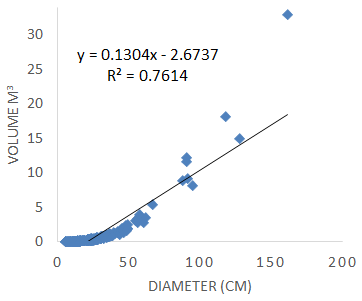
It was positive and strong correlation between DBH and volume of Castanopsis Indica. The equation was Y=0.1304ln(X)-2.6737 whereas, Y is the volume of Castanopsis Indica and X is the diameter at breast height. The estimated R-square value was 0.7614 (Figure 6).
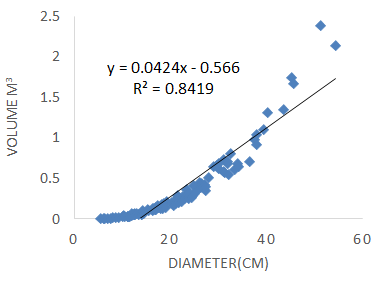
Similar correlation was found between DBH and volume of Schima wallichii. The equation was Y=0.0424ln (X)-0.566 whereas, Y is the volume of Schima wallichii and X is the diameter at breast height. The estimated R square value was 0.8419 (Figure 7). ANOVA and t-test showed that the equation showing correlation between DBH and volume of Castonopsisi Indica and Schima wallichii was significant, the intercept as well as x-variable was also significant since p-values of these tests were less than 0.05.
Correlation between DBH and Carbon Stock of Castonopsis indica and Schima wallichii
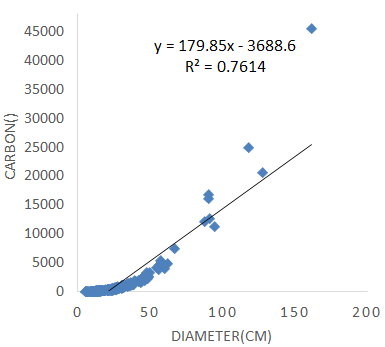
The correlation between DBH and carbon stock of Castanopsis Indica was also positive and strong. The equation was Y=179.85ln(X)-3688.6 whereas, Y is the carbon stock of Castanopsis Indica and X is the diameter at breast height. The estimated R-square value was 0.7614 (Figure 8). Similar correlation was found between DBH and carbon stock of Schima wallichii. The equation was Y=58.445ln(X)-780.91 whereas, Y is the carbon stock of Schima wallichii and X is the diameter at breast height. The estimated R-square value was 0.8419.
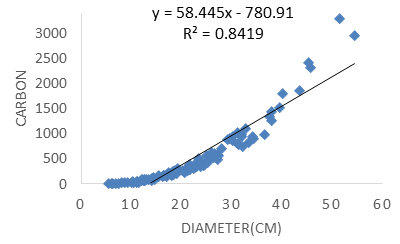
The p-value of ANOVA and t-test analysis showed that the carbon estimation equations of Castonopsisi Indica and Schima wallichii was significant, the intercept as well as x-variable was also significant since p-values of these tests was less than 0.05 (Figure 9).
Discussion
There was positive and strong correlation between DBH and height of Castonospsis Indica and Schima Wallichi [18, 19, 20]. This research also showed an excellent relationship between DBH and tree height. Several authors support this concept and many authors showed this relation. The findings of this research showed that, as the diameter increases the height also increase but at a certain point height growth is constant. This concept is also supported by West and West (2009), West (2015).
The most common use variables are diameter at breast height, height, form factors and site quality. To determine the volume, crown diameter and carbon. This model is based on diameter at breast height. The height, crown diameter, volume and carbon models were developed with respect to DBH. Similar variables are used to determine the height, crown diameter, volume and carbon.
The correlation between tree characteristics like height, volume and carbon stock and DBH was affected due to several factors [21, 22, 23]. Overall, fire was the most prominent cause in all community forests followed by litter. In fact, intentional fire was general cause of the forests carbon loss. The report of DFRS [16] also showed that grazing as the most disturbing factor in carbon stock. The report published on drivers of deforestation and forest degradation showed illegal logging, grazing and fire were the main drivers of carbon loss [24, 25, 26, 27].
Conclusion and Recommendation
The correlation between diameter and other parameter like height, volume, crown diameter and carbon stock was strong and positive. The ANOVA and t-test showed that the correlation between diameter and other parameter was significant. These equations can be used to assess the height, volume, crown diameter and carbon stock only measuring single parameter i.e. diameter at breast height. Similarly, these equations will be useful to derive other equation at local level as well. The research should be carried out to show the relation between DBH and other parameters as well as how these relations response to factors likes aspect, altitude and soil.
Acknowledgement
We would like to acknowledge for technical support provided by Forest Research and Training Centre and Kathmandu Forestry College, Nepal.
References
-
Kempes CP, West GB, Crowell K, Girvan M (2011) Predicting maximum tree heights and other traits from allometric scaling and resource limitations. PLoS One 6(6): e20551_._
-
Mandal RA, Dutta IC, Jha PK, Karmacharya S (2013) Relationship between Carbon Stock and Plant Biodiversity in Collaborative Forests in Terai, Nepal_._ International Scholarly Research Notices 2013: 1-7.
-
Temesgen H, Affleck D, Poudel K, Gray A, Sessions J, et al. (2015) A review of the challenges and opportunities in estimating above ground forest biomass using tree-level models. Scandinavian Journal of Forest Research 30(4): 326-335.
-
Condit R (2008) Methods for estimating aboveground biomass of forest and replacement vegetation in the tropics. Center for Tropical Forest Science Research Manual pp: 1-73.
-
Köhl M, Lasco R, Cifuentes M, Jonsson Ö, Korhonen KT, et al. (2015) Changes in forest production, biomass and carbon: Results from the 2015 UN FAO Global Forest Resource Assessment. Forest Ecology and Management 352: 21-34.
-
Seidl R, Rammer W, Jäger D, Currie WS, Lexer MJ, et al. (2007) Assessing trade-offs between carbon sequestration and timber production within a framework of multi-purpose forestry in Austria. Forest Ecology and Management 248(1-2): 64-79.
-
Kurz WA, Dymond CC, White TM, Stinson G, Shaw CH, et al. (2009) CBM-CFS3: a model of carbon-dynamics in forestry and land-use change implementing IPCC standards. Ecological modelling 220(4): 480-504.
-
Powell SL, Cohen WB, Healey SP, Kennedy RE, Moisen GG, et al. (2010) Quantification of live aboveground forest biomass dynamics with Landsat time-series and field inventory data: A comparison of empirical modeling approaches. Remote Sensing of Environment 114(5): 1053-1068.
-
Hunt CAG (2009) Carbon Sinks and Climate Change: Forests in the Fight Against Global Warming. Edward Elgar Publishing, pp: 256.
-
Banskota K, Karky B, Skutsch M (2007) Reducing carbon emissions through community-managed forests in the Himalaya.
-
Gonzalez P, Battles JJ, Collins BM, Robards T, Saah DS, et al. (2015) Aboveground live carbon stock changes of California wildland ecosystems, 2001–2010. Forest Ecology and Management 348: 68-77.
-
Mandal RA, Dutta IC, Jha PK, Karmacharya SB (2016) Carbon sequestration potential in community and collaborative forests in Terai, Nepal. Tropical Ecology 57(4): 655-662.
-
Gautam KR (2002) Carbon sequestration in agroforestry and annual cropping system in inner Terai, Central Nepal.
-
Baral SK, Malla R, Ranabhat S (2009) Above-ground carbon stock assessment in different forest types of Nepal. Banko Janakari 19(2): 10-14.
-
Vallet P, Dhôte JF, Le Moguédec G, Ravart M, Pignard G, et al. (2006) Development of total aboveground volume equations for seven important forest tree species in France. Forest Ecology and Management 229(1-3): 98- 110.
-
DFRS (2015) States of Nepal’s Forests, Department of Forest Research and Survey and Forest Resource Assessment. Nepal, pp: 34-45.
-
Chave J, Andalo C, Brown S, Cairns MA, Chambers JQ, et al. (2005) Tree allometry and improved estimation of carbon stocks and balance in tropical forests. Oecologia 145(1): 87-99.
-
Kohyama T, Suzuki E, Partomihardjo T, Yamada T, Kubo T, et al. (2003) Tree species differentiation in growth, recruitment and allometry in relation to maximum height in a Bornean mixed dipterocarp forest. Journal of Ecology 91(5): 797-806.
-
Buba T (2013) Relationships between stem diameter at breast height (DBH), tree height, crown length, and crown ratio of Vitellaria paradoxa CF Gaertn in the Nigerian Guinea Savanna. African Journal of Biotechnology 12(22): 3441-3446.
-
Shrestha S, Karky BS, Gurung A, Bista R, Vetaas OR, et al. (2013) Assessment of Carbon Balance in Community Forests in Dolakha, Nepal. Small-Scale Forestry 12(4): 507-517.
-
Malhi Y, Grace J (2000) Tropical forests and atmospheric carbon dioxide. Trends Ecol Evol 15(8): 332-337.
-
Luyssaert S, Schulze ED, Börner A, Knohl A, Hessenmöller D, et al. (2008) Old-growth forests as global carbon sinks. Nature 455(7210): 213-215.
-
Domke GM, Woodall CW, Smith JE, Westfall JA, McRoberts RE, et al. (2012) Consequences of alternative tree-level biomass estimation procedures on US forest carbon stock estimates. Forest Ecology and Management 270(15): 108-116.
-
Geist HJ, Lambin EF (2001) What Drives Tropical Deforestation? A meta-analysis of proximate and underlying causes of deforestation based on subnational case study evidence.
-
Go N (2015) Middle Mountains Forests of Nepal. Department of Forest Research and Survey, Government of Nepal.
-
Li YQ, Deng XW, Huang ZH, Xiang WH, Yan WD, et al. (2015) Development and evaluation of models for the relationship between tree height and diameter at breast height for Chinese-fir plantations in subtropical China. PLoS One 10(4): e0125118.
-
Houghton RA, House JI, Pongratz J, van der Werf GR, DeFries Rs, et al. (2012) Carbon emissions from land use and land-cover change. Biogeosciences 9(12): 5125- 5142.
- Electronic Waste Management in the Top Ten Economies in the World: A Critical Review on Waste Generation, Regulations, Collection, Recycling and Environmental Challenges
- Some Challenging Transdisciplinary Aspects of the Sustainable Waste Management in the Permacrisis Context
- Use of Mobile Autonomous Systems for Pollution Control of Inland Water Bodies
- Environmental Impact Perspective Sustainable Online Textile Retailing: Harnessing Augmented Reality-Based Digital Twins in Bangladesh
- Composite Treatment Module for Removing Acidity and Metal (Loid)S from Acid Rock Drainage
- Household E-Waste Management Systems [E-Wms] in Malaysia