
A New and Fast Method in the Regeneration of Skin Grafts Low Level Laser Therapy
Skin transplant or skin graft is a type of transplant surgery that is performed on an area of the skin that lacks natural tissue due to factors.
Editorial
Skin transplant or skin graft is a type of transplant surgery that is performed on an area of the skin that lacks natural tissue due to factors [1].
Skin Grafts are usually used to Treat
- Large wound and trauma
- Burns
- Special surgery that requires a skin graft for treatment, such as skin cancer, in which a portion of the skin is removed.
- Parts of the skin that need skin grafting: If the burn is extensive, the priority for grafting is the face, neck, hands, elbows, armpits, and knees to prevent deformity and shrinking of the skin.
The Risks of Skin Graft Surgery Include
- Bleeding
- Infection
- Bleeding, infection, nerve damage, graft rejection are complications of transplantation, and a person must protect his skin completely for months. Caring for the recipient area of the transplant, the success of the transplant is when blood supply and conditions for blood flow from the recipient area are provided for the transplanted skin, for this purpose, two open and closed methods are used. In the open type, the transplanted area is kept covered with wet gauze and changed every 2 to 3 hours and kept moist regularly. The first 48 to 72 hours, the transplant should be immobile and this method helps to improve blood supply to the skin. , be under observation and if blood or secretion collects under the graft, it can be drained and the graft can be returned to its original place. In the closed method, the operated area is immobilized and is used in elderly people and children who do not cooperate well. A compression bandage is performed with a brief pressure on the graft to minimize the possibility of accumulation of secretions under the graft. The first dressing change is done 3-5 days after the operation. If the transplant site has discharge or bad smell, the dressing change is done earlier. If the graft is separated from its place, we keep it moist with gauze moistened with saline so that the doctor can put it in place again. During the first 3-5 days, moving the patient should be done carefully. As much as possible, the receiving member should be placed higher to avoid pressure on the area. After 5-7 days, the transplanted limb can be exercised. The organ should be monitored for bleeding and infection, odor and unpleasant secretions [2, 3].
- Loss of sample skin graft
- Nerve injuries
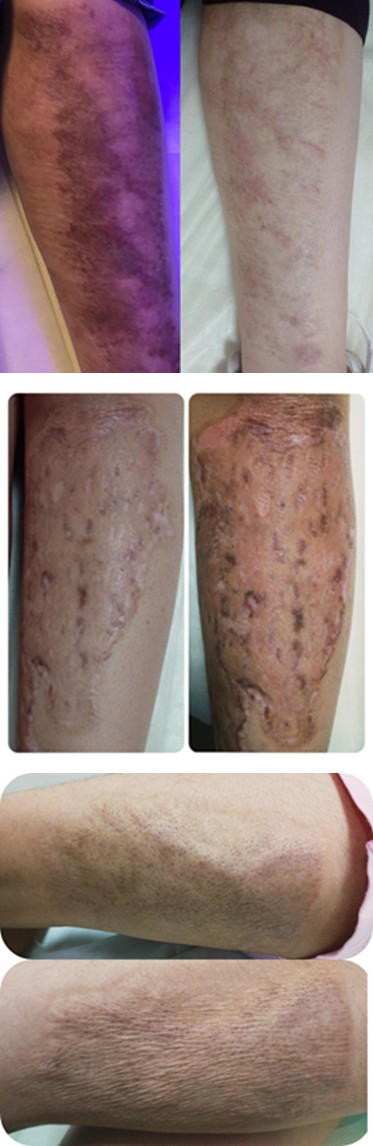
- Disease caused by skin grafts in the host One of the big problems of most people after the graft will be its repair. Things like ointments and high-power lasers are used, which ointments do not have the power to restore completely, and high-power lasers cannot be used for at least a year due to their high power and causing burns. Sometimes, in some cases, we prohibit lasers due to direct heat and subsequent complications. But now our solution is the new science of low-power laser devices, which are completely non-destructive and maintenance-free [4, 5].
Advantages of this Method
- It will be applicable at least 15 days after the graft
- It does not have the effects of burns and destruction
- There is no age limit and it is completely safe
- Very high healing power
- Short treatment period without care
Biography: I am Ehsan Kamani, born in 1994, who has been working on low-power lasers for several years, and the main topics of my work are the use of low-power lasers in the treatment of covid, neurological diseases, blood cells, wounds and burns, and cancer, and the results of my activities are published There have been 3 books and now all universities and researchers have announced cooperation Hoping for world peace to promote the health of the people of the world
Methods
Low-power lasers in the wavelength range of 400 to 905 nm and the power range of 50 to 200 milliwatts in a period of one to four months have the power to repair all types of grafts; even the old scars of the graft will be improved. This method is completely safe and care-free [6, 7, 8].
2. Geoffrey CG, Werner S, Barrandon Y, Michael TL (2008) Wound repair and regeneration. Nature 453(7193): 314-321.
3. Singer AJ, Clark RA (1999) Cutaneous wound healing. N Engl J Med 341(10): 738-746.
4. Jie L, Juan C, Robert K (2007) Pathophysiology of acute wound healing. Clin Dermatol 25(1): 9-18.
5. Ying YH, Chen ACH, Carroll JD, Hamblin MR (2009) Biphasic Dose Response in Low Level Light Therapy. Dose Response 7(4): 358-383.
6. Michael H, Tatiana ND (2006) Mechanisms of low level light therapy. Proceedings of SPIE The International Society for Optical Engineering 6(140): 1-12.
7. Hoon C, Tianhong D, Sulbha KS, Ying YH, James DC, et al. (2012) The Nuts and Bolts of Low-level Laser (Light) Therapy. Ann Biomed Eng 40(2): 516-533.
8. Nelson JS (1993) Lasers: state of the art in dermatology. Dermatol Clin 11(1): 15-26.
References
-
Davis MH, Dunkley P, Harden RM, Harding K, Laidlaw JM, et al. (1992) The wound programme. Dundee, United Kingdom: Centre for Medical Education. Cause: types of wound and ulcers, pp: 109-132.
- Understanding Pediatric Multiple Sclerosis: Clinical Presentation, Diagnostic Criteria, Therapeutic Advances, and Supportive Care Approaches
- Hemophilia in Children
- Xia-Gibbs Syndrome- A Case Report
- A Study to Assess Effectiveness of Play Therapy in Reducing Post-Operative Pain among Children Age 2 To 5 Year who have Undergone General Surgeries in Selected Pediatric Hospitals of Vadodara
- Preterm Birth: Scope of the Problem, Cost of Care, Potential Complications and Current Guidelines for Management
- Noradrenaline: Can we Use it to Manage Hemodynamic Instability among Neonatal Septic Shock at the NICU?