
Prevalence of Mental Stress and Myalgia in Software Professionals
Objective To Ascertain the Prevalence of Mental Stress and Myalgia in Software Professionals through Online self-report questionnaire Software developers from various locations participated in this descriptive, cross-sectional study, which was conducted in online from February 2022 to August2022. A non-probability purposive sampling strategy was used to choose people who spend at least 6 hours per day in front of computers and have at least 6 months of work experience. An easily completed questionnaire was used to obtain the data. Data analysis was performed using SPSS 21. Of the 100 individuals, 31-45 yrs Age Group of 49% and 73% are males in this study. According to The Kessler Psychological Distress Scale (K10) and Oswestry Low Back Pain Disability Questionnaire. “Mental score of Mean 21.3 comes under likely to have mild psychological distress and Physical score of Mean 11.10 comes under minimal disability.Neck pain brought on by using a computer extensively is likely to occur at least occasionally.
Introduction
Numerous studies conducted worldwide suggest that among the many people’s work-related musculoskeletal illnesses (WRMSDs) linked to computer users may have work-related neck pain (WRNP) more frequently than non- users. It has been established that neck discomfort is a persistent, incapacitating illness that experiences flare-ups and remissions. People in their late 20s experience significant movement limitations as a result of using computers [1].
Pilot Study
According to clinical symptoms and signs, trapezius myalgia (38%), tension neck syndrome (17%), and cervicalgia (17%) are the most common causes of neck pain [2]. It is believed that a variety of individual, behavioural, physical, and environmental factors might contribute to the development of neck discomfort [3].
There has been many research done on the prevention and treatment of neck pain brought on by computer use. Keeping a good posture is still essential for preventing neck problems. Several interventions, including as online training, have been suggested to improve computer users’ postures through self-efficacy [4]. The best ways to deal with the general health issues among regular computer users, such as software workers, are proper rest periods, exercise, enough sleep, and relaxation at home [5]. In addition to rest, physiotherapy and muscle relaxants, it has been shown that computer users’ WRNP significantly improves while receiving these treatments [6]. The purpose of this study was to create and validate an online questionnaire on computer work-related Mental stress and Myalgia. To cover all potential elements in the digital age, identifying risk factors for MSDs among office employees is still crucial. Furthermore, it’s important to identify the link between standing up from a seated position at work and a decreased risk of MSDs [7]. Musculoskeletal complaints in neck and back are very common in computer professionals [8, 9]. In addition to individual characteristics, physical elements, psychological issues, and organisational aspects are also considered. To impact the musculoskeletal health of the workforce [10]. Working at computer stations causes a number of odd behaviours, such as prolonged periods of static posture, repetitive motion, poor posture, inappropriate seating, and sedentary lifestyle [11]. Mediation model predicting that a quantitative multi locus genetic profile score – reflecting the additive effects of alleles known to confer relatively increased dopamine signalling in the ventral striatum would relate positively to a composite measure of addictive behaviours, and that this association would be mediated by personality traits consistently associated with addiction disorders [12]. Digital addiction, or DA for short, has become into a major problem with a range of socioeconomic negative consequences. DA received little acknowledgement or direction regarding how software engineering should take it into account despite its significant value. This stands in stark contrast to other fields associated with conventional addiction (such as drugs, gambling, and alcohol), where there are established guidelines for the production, promotion, and sale of the products [13]. K10 scale has satisfactory psychometric properties for use as a measure of non-specific psychological distress in the military population Sampasa-Kanyinga, et al. [14] The Oswestry Disability Index (ODI) is one of the most commonly used outcome measures for individuals with low back pain. Psychometric properties of the ODI will determine the questionnaire’s suitability as a useful clinical tool [15]. These Scales are used for survey.
Materials and Methods
100 software professionals were included in a descriptive study that was designed using a online survey by creating google forms. The two-month study took place between April 2022 and September 2022. The study used samples of software professionals with more than two years of experience, people in the 25–40 age range, both sexes, who use desktop computers for work, people who are currently involved in projects, and those who work more than 40 hours on a computer each week.
Results and Discussion
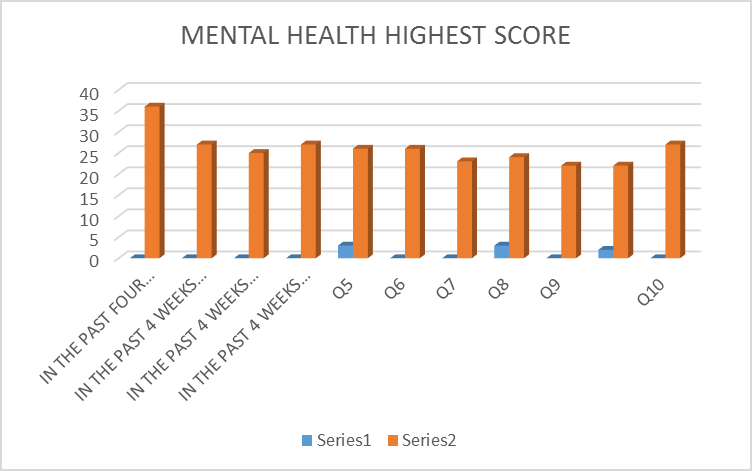
In this Survey Age group mainly participated was 31-45 yrs of 49 percent and Male gender of 73 percent. Hunched C curve seating position 42 % (Tables 1-7; Figures 1 & 2).
FREQUENCIES VARIABLES=AGE, GENDER, NEUTRAL SITTING_POSITION Mental stress, Pain Intensity, Personal Care, Lifting Work, Headache, Concentration Sleeping Driving Reading Recreation.
| Frequency | Percent | ||
|---|---|---|---|
| Valid | < 30 YEARS | 48 | 48 |
| 31 - 45 YEARS | 49 | 49 | |
| 46 - 60 YEARS | 3 | 3 | |
| Total | 100 | 100 |
Table 1: Age.
| Frequency | Percent | ||
|---|---|---|---|
| Valid | Male | 73 | 73 |
| Female | 27 | 27 | |
| Total | 100 | 100 |
Table 2: Gender.
| Frequency | Percent | ||
|---|---|---|---|
| Valid | Neutral Siting Position | 34 | 34 |
| Excessive Low back arch | 13 | 13 | |
| Hunched C Curve | 42 | 42 | |
| NONE | 11 | 11 | |
| Total | 100 | 100 |
Table 3: Neutral Sitting Position.
| Frequency | Percent | ||
|---|---|---|---|
| Valid | Foam | 51 | 51 |
| Spring | 30 | 30 | |
| Latex | 19 | 19 | |
| Total | 100 | 100 | |
| 1 | In the past four weeks, about how often did you feel tired out for no good reason? | 36 | |
| 2 | In the past 4 weeks about how often did you feel nervous? | 27 | |
| 3 | In the past 4 weeks about how often did you feel so nervous that nothing could calm down? | 25 | |
| 4 | In the past 4 weeks about how often did you feel hopeless? | 27 | |
| 5 | In the past 4 weeks about how often did you feel restless or fidgety? | 26 | |
| 6 | In the past 4 weeks about how often did you feel so restless you could not sit still? | 26 | |
| 7 | In the past 4 weeks about how often did you feel depressed? | 23 | |
| 8 | In the past 4 weeks about how often did you feel everything is effort? | 24 | |
| 9 | In the past 4 weeks about how often did you feel so sad that nothing could cheer you up? | 22 | |
| 10 | In the past 4 weeks about how often did you feel worthless? | 22 |
Table 4: Bed Matresses.
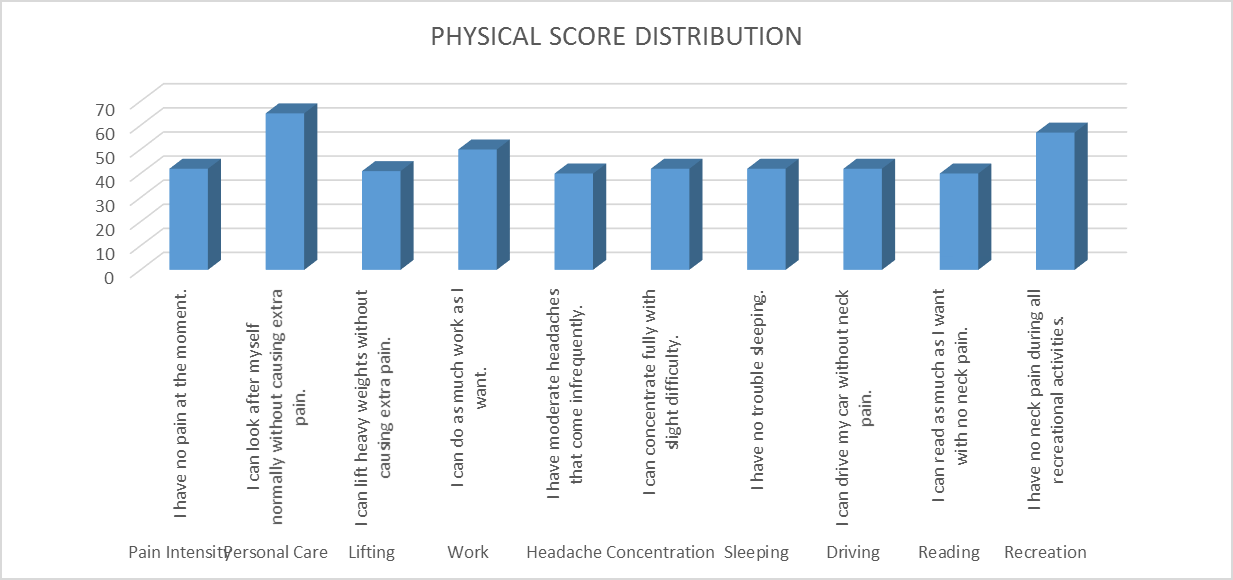
| 1 | Pain Intensity | I have no pain at the moment. | 42 |
|---|---|---|---|
| 2 | Personal Care | I can look after myself normally without causing extra pain. | 65 |
| 3 | Lifting | I can lift heavy weights without causing extra pain. | 41 |
| 4 | Work | I can do as much work as I want. | 50 |
| 5 | Headache | I have moderate headaches that come infrequently. | 40 |
| 6 | Concentration | I can concentrate fully with slight difficulty. | 42 |
| 7 | Sleeping | I have no trouble sleeping. | 42 |
| 8 | Driving | I can drive my car without neck pain. | 42 |
| 9 | Reading | I can read as much as I want with no neck pain. | 40 |
| 10 | Recreation | I have no neck pain during all recreational activities. | 57 |
Table 5: Master Chart of Physical Score.
| N | Minimum | Maximum | Mean | |
|---|---|---|---|---|
| MENTAL_SCORE | 100 | 0 | 50 | 21.34 |
| PHYISCAL_SCORE | 92 | 0 | 42 | 11.1087 |
| Valid N (list wise) | 92 |
Table 6: According to the Kessler Psychological Distress Scale (K10) and Oswestry Low Back Pain Disability Questionnaire. “Mental
Conclusion
The questionnaire to explore Factors affecting WMSD, Pain and area of pain and stage of WMD was developed. The Findings shows that Mild Psychological distress and Minimal disability in software professionals. Psychiatry consultation is to implemented in all software companies in order to reduce psychological stress. Some modification should be maintained in work station in order to prevent recurrence of minimal physical disability
References
-
Yoo WG (2014) Comparison of Cervical Range of Motion and Cervical FRR between Computer Users in Their Early and Late 20s in Korea. J Phys Ther Sci 26(5): 753-754.
-
Hoyle JA, Marras WS, Sheedy JE, Hart DE (2011) Effects of postural and visual stressors on myofascial trigger point development and motor unit rotation during computer work. J Electromyogr Kinesiol 21(1): 41-48.
-
Johnston V, Jull G, Souvlis T, Jimmieson NL (2010) Interactive effects from self-reported physical and psychosocial factors in the workplace on neck pain and disability in female office workers. Ergonomics 53(4): 502-513.
-
Keykhaie Z, Zareban I, Shahrakipoor M, Hormozi M, Sharifi-Rad J, et al. (2014) Implementation of internet training on posture reform of computer users in iran. Acta Inform Med 22(6): 379-384.
-
Das R (1970) Occupational health concerns of software professionals and their coping strategies: Semantic scholar.
-
Patel HD, Uppin RB, Naidu AR, Rao YR, Khandarkar S, et al. (2019) Efficacy and Safety of Combination of NSAIDs and Muscle Relaxants in the Management of Acute Low Back Pain. Pain Ther 8(1): 121-132.
-
Mekhora K, Jalayondeja W, Jalayondeja C, Bhuanantanondh P, Dusadiisariyavong A, et al. (2014) Online self-report questionnaire on computer work- related exposure (OSCWE): validity and internal consistency. J Med Assoc Thai 97(S7): S80-83.
-
Bhanderi D, Choudhary S, Parmar L, Doshi V (2007) Influence of psychosocial workplace factors on occurrence of musculoskeletal discomfort in computer operators. Indian J Community Med 32(3): 225-226.
-
Tittiranonda P, Burastero S, Rempel D (1999) Risk factors for musculoskeletal disorders among computerusers. Occup Med 14(1): 17-38.
-
National research council, institute of medicine (2001) Musculoskeletal disorders and the workplace. Low back and upper extremities. National academy press, Washington (DC), USA.
-
Charpe NA (2009) Reducing back pain and increasing performance in software proffesionals. International NGO Journal 4(3): 66-69.
-
Davis C, Loxton NJ (2013) Addictive behaviors and addiction-prone personality traits: associations with a dopamine multilocus genetic profile. Addictive Behaviors 38(7): 2306-2312.
-
Alrobai A, Keith P, Ali R (2014) Digital Addiction: A Requirements Engineering Perspective pp: 112-118.
-
Sampasa-Kanyinga H, Zamorski MA, Colman I (2018) The psychometric properties of the 10-item Kessler Psychological Distress Scale (K10) in Canadian military personnel. PLoS One 13(4): e0196562.
-
Vianin M (2008) Psychometric properties and clinical usefulness of the Oswestry Disability Index. J Chiropr Med 7(4): 161-163.
- Occupational Stress and Mental Health Outcomes Among Police Officers: A Mini Review
- The Experience of Counterproductive Leadership on Mental Health and Impact on Retention in U.S. Marines: A Phenomenological Study
- Nomophobia in the Digital Age: A Study on College and University Students
- Emotional Regulation in Children with Autism and Learning Disabilities
- Antisemitism on American College Campuses and Its Impact on Jewish Students
- Exploring the Role of Empathy in the Associations of Family Functioning and Purpose in Life with Attitude towards Abortion among Undergraduates: A Moderation Analysis