
Thermodynamic Basis of Coevolution and Self-optimization, and Ecosystem
First, Darwinian evolution and mutual help seem to conflict. Second, since the second law of thermodynamics is based on isolated-equilibrium systems, it is in fact very limited. But, in essence, the vast majority of systems in the universe and nature are constantly changing and evolving with “life”. We proposed possible entropy decrease in isolated system due to internal interactions, etc. Based on biophysics, we research coevolution from thermodynamics and entropy by unified method. Let the entropy change dSA of a subsystem A is a set of its elements dSi , which may have various internal interactions with cooperation and complementary each other, so entropy may be decrease. This corresponds to the principle of least action of entropy change. It includes self evolution, and competition each other, etc. Third, evolution may combine self-optimization and selforganization, etc. Brain control of the body is the most typical of an internal interaction. No one would think that this only leads to an entropy increase. Fourth, we discuss the biological synergetics, ecosystem, and sustainable development. The cooperation-competition is a common phenomenon in the ecosystem. Coevolution is the more general evolution-development law of biological and active systems. This can unify natural competition and mutual help in biology, and is an important model for human development direction.
Introduction
Darwinian biological evolution is a great progress in science. It points out that natural selection, survival of the fittest, and harsh competition in the biological world are essential conditions for optimizing species and maintaining ecological balance. In 1902 P. Kropotkin was not satisfied with the one-sidedness of Darwin’s evolution and published his monograph on Mutual Help: An Evolutionary Factor. Its basic idea is that mutual help is an important progressive factor and natural law in evolution, and is the best weapon for animals in the competition for survival. But, it and Darwinian seem to show greatly different, even total conflict, so it is seen as pseudoscience by some scientists. Both unify is a question worthy of study.
New development has established that biological mutual help includes: 1. Intraspecific mutual help, where individuals or populations of conspecifics cooperate with each other in life to maintain the survival. The group lifestyle of many animals is common, this can be social insects such as ants, bees, with a clear division of labor, and work together to maintain the survival of the group at the same time. This can also be some insects (such as flying locusts), fish, birds and mammals, in order to facilitate prey, etc. 2. Interspecific mutual help involves mutualism, with two organisms living together, and are interdependent, advantageous, and coevolving.
Cooperative evolution (coevolution) is development of two or more interacting species that influence and adapt to each other in a common environment. Coevolution was first proposed by P.R. Ehrlich and P.H. Raven in 1964. Later, Jazen gives a strict definition of coevolution.
The research content of coevolution is extremely extensive, which includes the coevolution among competing species, predator and prey system, parasite and host system, etc. A general coevolution is dependence between organisms, and among organisms and the environment in the process of evolution. It can be studied from the molecular level, cell level, individual level, population level and ecosystem level.
Coevolution can promote increased biodiversity and co-adaptation of species, and is mainly in numerous instances of mutualism. This has implications for genome evolution, and is beneficial to maintaining the stability of biological communities and ecosystems. Coevolution recognizes biodiversity and the self-organization function and maintenance ability of nature, and obeys the law of self- regulation of nature. The life diversity and coevolution have great value, and create the diversity of the biosphere, and maintain the continuous evolution and development of the biosphere. It coordinates the relative balance of the global ecological environment, and jointly constitutes an important material basis for the survival and development of mankind.
The whole biological world is the higher and lower organisms together, simple and complex organisms coexist, and is colorful and collaborative evolution. Various organisms are closely related and interdependent, evolving along the general trend of coevolution. The struggle for survival of the fittest is only one of the restriction mechanisms. Coevolution includes two mechanisms: mutual benefit and mutual restriction between organisms and the environment. Through the long process of coevolution, not only various species appeared on the earth, but also a variety of environments. In this paper, based on biophysics, we research coevolution from thermodynamics and entropy by unified method. Further, it may combine the self-optimization, and discuss ecosystem, etc.
Thermodynamics and Entropy in Coevolution
Thermodynamics originates from studies of thermal engine. Entropy is a great development in science. But, this must be emphasized that preconditions of entropy increase are 1) for isolated systems; 2) various internal interactions in system must be neglected, i.e., it has the statistical independence [1] and the additivity of entropy; 3) they must be thermal equilibrium processes. But, the equilibrium system is a dead or tend toward dead system. And some dead solidification systems, such as solids, do not necessarily entropy increase, but have constant entropy.
Living (active) systems must be non-equilibrium systems. They have various external and internal interactions, in which the former corresponds to the dissipative structure theory and the latter is our research direction. These form self-optimization and self-organization. In essence, the vast majority of systems in the universe and nature are constantly changing and evolving with “life”. Therefore, the second law of thermodynamics is very limited.
It is known that work W=dQ=TdS. Entropy increase means that the available energy is constantly decreasing. Finally, entropy in heat death is great, and the available energy is zero. But, the energy can be converted in a system, and there have various entropy, etc. For non-equilibrium thermodynamics, such as hydrodynamics, Prigogine proposed the minimum entropy production [2]. For isolated systems, the entropy production rate is [3]:
/ s V dS dt dV σ = ∫ . (1)
According to the second law of thermodynamics, for irreversible or spontaneous processes dS/dt>0, and the local entropy production s σ must be positive [3]. But, for nonlinear systems, situations can vary, such as by changing parameter, it may form an unstable state, and has a phase transition far away from equilibrium [3]. If dS<0, s σ <0.
A well-known development of thermodynamics is the theory of dissipative structure proposed by Prigogine. We proposed that if internal interactions, fluctuations and their magnified exist among various subsystems of an isolated system, entropy decrease in the isolated system is possible [4, 5]. They includes physics [6, 7, 8, 9, 10], chemistry [11, 12, 13], astronomy [14, 15], geoscience [16] and social sciences [17, 18, 19]. For attractive process, internal energy, system entropy, and nonlinear interactions, etc., an isolated system may form a self-organized structure with lower entropy. Some possible entropy decreases are calculated quantitatively [6, 9]. We proposed quantitatively a total formula of entropy change for universal evolution of any natural and social systems. As long as we break through the bondage of the second law of thermodynamics, the rich and complex world is full of examples of entropy decrease [4, 5, 6, 7, 8, 9, 10, 11, 12, 13, 14, 15, 16, 17, 18, 19]. In Greek, entropy simply means evolution [20, 21].
Prigogine discussed from being to becoming [22]. We define the entangled scale, which mainly involves the number n and entangled degree. Since coherence, entanglement and correlation are all internal interactions in information systems, we discussed quantitatively entropy decrease along coherence, and entropy increase only for incoherence. Based on some astrophysical simulation models, they shown that the universe evolves from disorder to structures, which correspond to entropy decrease. This is consistence with theoretical result. The simulation must be an isolated system only using internal gravitational interactions [23].
Various complex biological structures provide a rich platform for the possibility of entropy decrease [24, 25]. In biology the neuroscience, the permeable membrane, the molecular motor, etc., are all some internal interactions. They and physiology, psychology, and Qigong and various practices are often related to these order states with entropy decrease. Further, we proposed entropy decrease as an index of therapeutics in biophysics, and life lies in a combination between motion and rest, etc [24]. The biological systems possess many internal interactions. We discussed systems biology and evolution. Life always changes from every individual to total system for various levels and different times. This not only input energy, and more is determined by tissues, structures and interactions inside system. Inside and outside combination determines the growth and evolution of life system. It is not possible that self- assembly, self-organization, self-production, self-fabrication, self-maintaining, etc., all are always entropy increase. The biological membrane is already a natural existent Maxwell demon. Thermodynamics as science must be developed, from this will accelerate the next great advance [25].
Many ecosystems can be approximated as isolated systems, such as Galapagos Islands and Barro Colorado Island in Gatun Lake [26]. Their entropy cannot increase forever. We researched possible entropy decrease in isolated system for various complex systems [4, 5, 6, 7, 8, 9, 10, 11, 12, 13, 14, 15, 16, 17, 18, 19, 24, 25], and proposed a universal formula for any isolated system [5]:
a i dS dS dS = + . (2) It is symmetry with the formula:
i e dS d S d S = + , (3) in the theory of dissipative structure. Such the total formula of entropy change is:
a i i i e e dS dS dS dS dS dS dS + − + − = + − + + − . (4)
When a i i i e e dS dS dS dS dS dS + − + − + + + > + , (5)
entropy increase dS>0, the system tends to disorder. When
a i i i e e dS dS dS dS dS dS + − + − + + + < + , (6) entropy decrease dS<0, the system tends to order. Both differences are determined by the input negative entropy flow in open system and the internal attractive interactions in isolated system i e dS dS − − + . From this we derived a complete symmetrical structure on change of entropy:
.
increase → = + → = +
.
Entropy dS S S decrease dS dS dS i e d d (7)
a i .
Here entropy decrease may be the dissipative structure for an open system, or be the internal interactions for an isolated system [9]. J. Holland emphasized the importance of units in the ecosystem formed by the operation of individual groups of species. From a group of genes, a group of cells to a class of organs, a group of people, a unit as a relatively independent subsystem, the coevolution shows the superiority [27]. There are various interactions within the subsystem.
In fact, various self-organization, self-optimization, natural selection, self-lubrication, emergence, etc., are all internal interactions in system. In particular, self- optimization must be entropy decrease.
We propose that the entropy change A dS of a subsystem A is a set of its elements i dS , and corresponding function is:
( ) A i dS f dS = . (8)
It may have various internal interactions. If this set is simple additive group, so A i i dS dS = ∑ . This may be cooperation and complementary each other, so entropy may be decrease. This includes:
- Self-evolution. It corresponds to self-optimization processes, different entropy n dS correspond to different stages of an evolutional process, and different phase transitions. It is a comparison of own before and after, and entropy may decrease constantly.
- Competition with each other. It may compare the entropy of each isolated subsystem A and B: A dS and ( ) B j dS f dS = . If A B dS dS < , so a subsystem A excel another subsystem B. It is the comparison between different subsystems each other.
- Subsystems with internal interaction cooperate each other, and form more orderly unit, which can be entropy decrease, and self-optimization structure. They are complement each other, and play cooperative advantages, which is conducive to better competition and coevolution.
- This result leads to complexity, order and entropy decrease, and form super-organism, and derives hierarchy of ecosystems.
From the cooperative hunting of animals, sexual reproduction with division of labor, hibernation in cold and low-feeding places, to the human mutual help, they all serve as the internal self-optimization of the subsystem, and reach the external competition. The self-optimization may lead to a competitive advantage. These all reduce the survival threshold, and entropy production is smaller, entropy decrease dS<0. Changes of different beaks at Galapagos Islands may be less energy consumption and smaller entropy.
This is consistent with the entropy of the composite system B A ⊕ :
) ( ) ( ) 1( ) ( ) ( ) ( B S A S q B S A S B A S q q q q q − + + = ⊕ . (9)
If q>1, it will be ) ( ) ( ) ( B S A S B A S q q q + < ⊕ . This is also consistent with the system theory [7]. In fact, if various internal complex mechanism and interactions exist, a state with smaller entropy (for example, self-organized structure) will be able to appear. For these cases, the second law of thermodynamics should be different [4, 5, 6, 7, 8, 9, 10, 11, 12, 13, 14, 15, 16, 17, 18, 19].
The mathematical form of coevolution may correspond to the principle of least action of entropy change:
t
2 n i t dS f dS t dt δ δ = = ∫ . (10)
1 ( ) ( , ) 0
This can unify natural competition and mutual help in biology. It should be an important model for human development direction, overall coevolution, not the naked war.
Based on the extensive quantum mechanics in biology, Schrödinger equation at column coordinates and its solution may derive the double helical structure of DNA. It is necessity mathematical conclusion that quantum mechanics has symmetry. We discussed the nonlinear biomechanics, which is related to chaos, fractal and soliton, etc. An important character of the nonlinear biosystems is the formation of self-organization, which should decrease entropy. Complex biology provides a wide region for entropy decrease in various isolated systems [28].
Self-optimization, Self-organization and Evolution
In coevolution there have self-optimization and self- organization, etc.
In cellular communications technology, self-optimization is an autonomous and continuous internal process. It is one of the key pillars of the self-organizing (Figure 1).
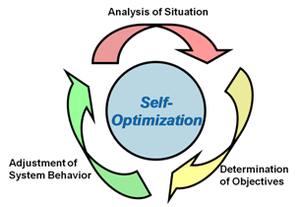
The classic optimization methods generate a determined sequence of calculations that is based on a gradient or a derivative of a target function of a higher range. Self- optimization means that the technical machining system possesses the ability to adapt and adjust itself without intervention by the operator in order to improve the performance with respect to part quality and accuracy, process stability, productivity, and resource efficiency. Self- optimization should correspond to the principle of least action Eq.(10), and the minimum entropy production principle. Entropy decrease must exist in the self-organization and self- optimization.
Now the molecular-sized machines can be self-assembly. One of the important techniques is that Whitesides, et al., designed self-assembled monolayer (SAM) [29], such as alkanethiol and some multilayer film. This may produce or corresponds to Maxwell demon.
In physics various possible entropy decreases include phase transformation from disorder uniformity to order state. The solidification forms spontaneously an order structure, and entropy decrease exists necessarily in self- assembly as isolated system [10].
Wilson proposed that artificial living systems can self- combine, self-survive, constantly changing, self-reproduce [26]. At present the biological evolution of various organs of living things and the human body has reached the optimal structure, in which the brain structure can not only improve the speed of signal transmission, but also reduce the energy cost of the brain lines in architecture and maintenance [26]. Brain control of the body is the most typical of an internal interaction. No one would think that this only leads to an entropy increase, since brain can produce a crazy sense with entropy increase, or a rational sense with entropy decrease.
The evolution does not choose some structures with maximum entropy [30], or maximum free energy [31], or maximum efficiency of thermodynamics [32]. The physical and chemical systems at far-equilibrium tend probably to metastable state, which may form the isolated system with better order and power of self-assembly (SA) [33, 34]. Dobzhansky proposed a well-known viewpoint: “Nothing in biology makes sense except in the light of evolution” [35].
Maturana and Varela proposed the autopoiesis theory [36]. Letelier, et al. contacted the replicative metabolism- repair (M,R) systems, the autopoietic system and metabolized network, and analyzed terms of (M,R) systems for organization invariance and metabolic closure [37, 38].
Von Neumann proposed the self-reproducing automaton based on the general and logical theory of automata [39]. Hofmeyr discussed the metabolism-construction-assembly system, which is the system self-fabricating. The purpose of an organism is to fabricate itself, i.e., self-fabrication [40].
In biology origins of order are spontaneously due to self- assembly (SA) and self- organization (SO) [41, 40]. SA and SO are universal phenomena. SO is base of any organizations, and may form self-production (SP) and self-maintaining (SM), and must be a nontrivial form of self-maintaining (NTSM), whose structure is a core of metabolism. SA, SO and SM must possess both conditions on inside and outside. The base of SM is autocatalysis, which products bigger self-reaction and self-maintain network [41, 42]. This is necessarily internal interaction. Hofmeyr proposed the self-fabricating metabolism-construction-assembly system, i.e., (M,C,A) organisation of living cells, and the isolated self-assembly constructs finally the self-replication process [40]. Organism is a machine with self-production, whose existence passes through circulated whole network maintained. Complex components determine total system. System can maintain due to more self-organization than exterior circumstance, so system is self-sustaining, and is an autopoietic system (AS). Membrane is key factor of maintaining biological energy of systems [43].
Self-sustain products circulated network [44]. The evolutionary self-sustain is a precondition for existence of evolutionary system. Szathmary, et al. proposed that life depends on replicators that can exist in an unlimited heredity [45], which is internal interaction. Ruiz-Mirazo, et al. applied the hereditary autonomous systems (HAS) in the synthesis of life [46], which is also internal interaction.
Hordijk and Steel detected autocatalyctic, self-sustaining sets in chemical reaction systems [47]. For evolution the adjustability of life is a process through different generations produced spontaneously, for example, the autocatalysis cycle [48]. Cycle proves an explained method for growth and reproduction. Much biological systems possess cycles, which include multifarious biochemical metabolized cycles, cellular cycles, propagated cycles and a big cycle of whole ecosphere, etc [49]. A key is cycles in life systems, which and internal interactions form tissues. Various cycles are not related to surroundings, which all are internal interactions in isolated systems.
In biological systems various evolutions are not only open and absorbed energy, and must be the cooperative self-interactions each other. Because of the conversation of total energy in isolated system, all in the systems must be evolution and absorbed energy, so it forms the Darwin evolutionism with competition. But, this should be more universal evolutionism with competition and cooperation. In particular, the cooperation is more important in an ecosystem and in the same population, for example, the cooperation is indispensable in human evolution.
Hofmeyr pointed out: “The essence of life must lie somewhere between molecule and autonomously living, unicellular organism” [40]. Every organism is all a system that may be self-production, and is composed of various substances, and is independent. Modern biology explains life from an evolutionary viewpoint, with reproduction (of cells) and replication (of DNA). Organisms possess self-regulation and self-steering, and achieve self-formation and self- generation. Bak, et al. proposed the evolutionary dynamics model with self-organized criticality, which only passes through self-internal dynamics to form a critical state [50, 51, 52]. New characters may obtain new forms of interactions.
In a word, internal interactions may form tissues, and produce functions, and obtain further self-formation and self-generation, etc.
Biological Synergetics, Ecosystem and Sustainable Development
In 1977 Haken proposed synergetics, which introduces nonequilibrium phase transitions and self-organization in physics, chemistry, biology, etc. Its main goal is the search for common features of self-organizing systems in a great variety of seemingly quite different systems, and the search for general principles underlying the spontaneous formation of spatial, temporal or functional structures [53]. Any natural environment is all a self-organized result. Synergetics may be applied to ecology and general biology [54].
Based on the synergetic equations, we derived the Lorenz model, which may describe the change between two species. By a way of the adiabatic approximation, different models of population dynamics are obtained. Further, we researched various simplified results in the model and their ecological meaning by the qualitative analysis theory of the nonlinear equations, etc. From this it points out two outlets on the protection of rare species: an existence environment is improved or the propagation rate must increase. The ecological synergetics promulgates deeply a complex nonlinear relation between competition and cooperation on different species. Then the general nonlinear evolutional equations of ecosystem are searched [55].
Synergetics can be used as the basis of mutual help theory, and explain the relations between competition and mutual help. In fact, competition and cooperation are complement each other. For different plants or organisms both form various plant communities and biosphere.
Coevolution in nature forms rich ecosystem. Ecology is the cooperation in competition, and is the order in chaos. Only the order parameter reaches a certain threshold, it can ensure the overall balance of each species in the ecosystem. Ecosystems are the result of long-term evolution among subsystems. Based on the inseparability and correlativity of the biological systems, we proposed and discussed the nonlinear whole biology and four basic hypotheses [56, 57], whose fourth hypothesis is namely that a basic property of any biological systems as an open system is that this system and its environment must be a whole. It corresponds to a generalized metabolism. Usually environment is regarded as a boundary condition of the system, but it and the biological systems have often various nonlinear relations. The nonlinear whole biology may unify reductionism and holism, structuralism and functionalism. The self-construction of general living systems is from molecules to cells, to organisms, and then to ecosystems [26]. This process can not always be an entropy increase.
Life processes with entropy decrease exist on the surface of the earth. Living growth implies increase of order, and entropy decrease. The nonlinear thermodynamics is actually the kinetics [58]. The formation of new species during population evolution is similar to a phase transition [30].
Based on the coevolution of nucleic acids and proteins, the primitive living systems with highly self-organized are generated. Further the small systems develop into the hypercycle large system. In conclusion, cooperation- competition is a common phenomenon in the ecosystem.
In 1970s Eigen and Schuster proposed the hyper cycle [59, 60]. This is a scientific theory on the relationship between protein and nuclei acid, and on the origin of life, and discussed self-organization of matter and the evolution of biological macromolecules [59].
Based on the many levels and their cycles in geoscience, we researched the hypercycle of geoscience. This is the hypercycle as a tool of self-organization applied to geoscience. It may form from a level to other higher levels. These levels influence each other and the coevolution. And we discussed some possible mathematical methods. This method can be developed and perfected. Further, we proposed the nonlinear whole geoscience and its three basic laws, and discussed thermodynamics of geoscience, and in which possible entropy decrease under some sates, such as evolution and cycles of Earth, etc. Sustainable development of society must study the mode from high entropy to low entropy. Various cycles in geoscience cannot all be entropy increases, and cannot all be originated from the external interactions [16].
Since humanity has been faced with various crises, a sustainable development is proposed. Humanity and our total natural environment are a huge common system. It includes very much interacting elements. Synergetics, as a quantitative cooperation theory of different subsystem, may be considered as a strategy to copy with complex systems. It can be applied to the sustainable development. The synergetic equations can become the Lotka-Volterra equations, whose solution is a cycle model with period. This corresponds to a circulation of natural resources [55].
Chinese traditional farming and sustainable development are based on coevolution, and have minimal entropy production and entropy decrease.
Based on the brief introduction of complexity, we proposed four basic scientific characters of complexity: much elements, various interactions, hierarchies, evolutions, and researched some corresponding mathematical methods of complexity. We try to define a mathematical function of complexity ) , , , ( t x g e C i j k oml , in which i j k x g e , , represent different elements, interactions, and hierarchies of space, respectively. Any complex system can be as an information processing system [61], the increase of complexity should be the increase information. This is the entropy change system, in which increasing entropy always is too simple for complexity. Complexity is the unity of unification and diversity, the unity of order and disorder, the unity of entropy increase and entropy decrease. We researched complexity in biology and neural networks, and general sciences of complexity from chemistry, social sciences, to various applications. In a word, complexity is a complex science. Its investigations, developments and applications must be simplification and quantification [62].
Moreover, Wilson, et al. proposed the gene-culture coevolution [63, 64]. Our research is consistent with big consilience as the unity of knowledge proposed by Wilson [26].
Conclusions
Since the second law of thermodynamics is based on isolated-equilibrium systems, it is in fact very limited. By entropy we describe coevolution, which may unify Darwinian evolution and mutual help, and unify thermodynamics, theory of dissipative structure, and synergetics, etc. This can be applied to self-optimization and ecosystem. Cooperation- competition is a common phenomenon in nature and ecosystem. Coevolution is the more general evolution- development law of biological and active systems. Further, it may be applied and extended to the social systems, and may combine hypercycle [59, 60], the three dimensional philosophy for complex systems [65], and social synergetics [66], etc. Entropy, as a new world view [67], should have a more comprehensive understanding.
References
-
Landau LD, Lifshitz EM (1980) Statistical Physics. Pergamon Press, Oxford, UK, pp: 447.
-
Prigogine I (1968) Introduction to Thermodynamics of Irreversible Processes. 3rd (Edn.), Wiley-Inter Science, New York.
-
Reichl LE (1980) A Modern Course in Statistical Physics. University of Texas Press, USA.
-
Chang YF (1997) Possible decrease of entropy due to internal interactions in isolated systems. Apeiron 4(4): 97-99.
-
Chang YF (2005) Entropy, fluctuation magnified and internal interactions. Entropy 7(3): 190-198.
-
Chang YF (2012) Negative temperature fallacy, sufficient- necessary condition on entropy decrease in isolated systems and some possible tests in physics, chemistry and biology. International Review of Physics 6(6): 469- 475.
-
Chang YF (2013) Unified quantum statistics, possible violation of Pauli exclusion principle, nonlinear equations and some basic problems of entropy. International Review of Physics 7(4): 299-306.
-
Chang YF (2015) Entropy decrease in isolated system and its quantitative calculations in thermodynamics of microstructure. International Journal of Modern Theoretical Physics 4(1): 1-15.
-
Chang YF (2019) Self-organization, critical phenomena, entropy decrease in isolated systems and its tests. International Journal of Modern Theoretical Physics 8(1): 17-32.
-
Chang YF (2020) Entropy decrease in isolated systems: theory, fact and tests. International Journal of Fundamental Physical Sciences 10(2): 16-25.
-
Chang YF (2013) Chemical reactions and possible entropy decrease in isolated system. International Journal of Modern Chemistry 4(3):126-136.
-
Chang YF (2014) Catalyst theory, entropy decrease in isolated system and transformation of internal energy. International Journal of Modern Chemistry 6(2): 74-86.
-
Chang YF (2022) Possible entropy decrease in physical chemistry. Chemical Science & Engineering Research 4(11): 48-53.
-
Chang YF (2013) Grand unified theory applied to gravitational collapse, entropy decrease in astronomy, singularity and quantum fluctuation. International Journal of Modern Applied Physics 3(1): 8-25.
-
Chang YF (2018) Belief of entropy increase, fallacy of black hole thermodynamics, and its development. International Journal of Modern Applied Physics 8(1): 1-10.
-
Chang YF (2023) Hypercycle of geoscience, nonlinear whole geoscience and possible entropy decrease. World Journal of Geomatics and Geosciences 3(1): 1-12.
-
Chang YF (2013) Social thermodynamics, social hydrodynamics and some mathematical applications in social sciences. International Journal of Modern Social Science 2(2): 94-108.
-
Chang YF (2015) Entropy economics, entropy sociology and some social developed patterns. International Journal of Modern Social Science 4(1): 42-56.
-
Chang YF (2020) Development of entropy change in philosophy of science. Philosophy Study 10(9): 517-524.
-
Prigogine I, Stengers I (1984) Order Out of Chaos. Bantam Books, New York, pp: 385.
-
Prigogine I (1997) The End of Certainty: Time, Chaos, and the New Laws of Nature. The Free Press, New York, pp: 240.
-
Prigogine I (1980) From Being to Becoming: Time and Complexity in the Physical Sciences. WH Freeman, pp: 293.
-
Chang YF (2021) Information, entropy decrease and simulations of astrophysical evolutions. Physical Science & Biophysics Journal 5(2): 1-11.
-
Chang YF (2013) Possible entropy decrease in biology and some new research of biothermodynamics. Neuro Quantology 11(2): 189-196.
-
Chang YF (2018) Entropy change in biological thermodynamics. International Journal of Research Studies in Biosciences 6(6): 5-12.
-
Wilson EO (1998) Consilience: The Unity of Knowledge. Alfred A Knopf, Vintage, New York, pp: 384.
-
Gribbin J (2005) Deep Simplicity: Bringing Order to Chaos and Complexity. Random House, pp: 304.
-
Chang YF (2022) The double helical structure of DNA in quantum mechanics, and nonlinear biomechanics. Physical Science & Biophysics Journal 6(2): 1-9.
-
Whitesides GM (1995) Self-assembling materials. Scientific American 273: 146-149.
-
Schrödinger E (1945) What Is Life? The Physical Aspects of the Living Cell. Cancer Research 5(11): 670-672.
-
Nicolis G, Prigogine I (1977) Self-Organization in Nonequilibrium Systems: From Dissipative Structures to Order through Fluctuations. John Wiley and Sons, Inc, New York, USA.
-
Westerhoff HV, Van Dam K (1987) Thermodynamics and Control of Biological Free Energy Transduction. The Quarterly Review of Biology 63(4).
-
Back T, Fogel DB, Michalewicz Z (1997) Handbook of Evolutionary Computation. Oxford University Press, UK.
-
Frauenfelder H, McMahon BH (2001) Relaxations and fluctuations in myoglobin. Biosystems 6(1-3): 3-8.
-
Dobzhansky T (1973) Nothing in biology makes sense except in the light of evolution. The American Biology Teacher, 35: 125-129.
-
Maturana HR, Varela FJ (1980) Autopoiesis and Cognition: The Realisation of the Living. 1st(Edn.), Springer Dordrecht, pp: 146.
-
Letelier J, Marin G, Mpodozis J (2003) Autopoietic and (M,R) systems. Journal of Theoretical Biology 222(2): 261-272.
-
Letelier JC, Soto-Andrade J, Abarzua GF, Cornish-Bowden A, Cárdenas ML (2006) Organization invariance and metabolic closure: analysis in terms of (M,R) systems. Journal of Theoretical Biology 238(4): 949-961.
-
Von Neumann J (1966) Theory of Self-Reproducing Automaton. University of Illinois Press, London, pp: 25.
-
Hofmeyr JHS (2007) The biochemical factory that autonomously fabricates itself: A systems-biological view of the living cell. Systems Biology: Philosophical Foundations, Elsevier, pp: 217-242.
-
Kauffman SA (1993) The Origins of Order: Self Organization and Selection in Evolution. Oxford University Press, USA, pp: 728.
-
Steel M (2000) The emergence of a self-catalysing structure in abstract origin-of-life models. Applied Mathematics Letters 13(3): 91-95.
-
Pereto J (2005) Controversies on the origin of life. International Microbiology 8(1): 23-31.
-
Moreto A, Barandiaran X (2004) A naturalized account of the inside-outside dichotomy. Philosophica 73(1): 11- 26.
-
Szathmary E, Maynard-Smith J (1997) From replicators to reproducers: the first major transitions leading to life. J Theor Bio 187(4): 555-571.
-
Ruiz-Mirazo K, Moreno A (2004) Basic autonomy as a fundamental step in the synthesis of life. Artif Life 10(3): 235-259.
-
Hordijk W, Steel M (2004) Detecting autocatalyctic, self- sustaining sets in chemical reaction systems. J Theor Biol 227(4): 451-461.
-
Ganti T (2003) The Principles of Life. Oxford Scholarship Online, New York, pp: 224.
-
Smil V (1997) Cycles of Life: Civilization and the Biosphere. Scientific American Library, New York, pp: 17.
-
Bak P, Tang C, Wiesenfeld K (1987) Self-organized criticality: an explanation of 1/f noise. Phys Rev Lett 59(4): 381-384.
-
Bak P, Sneppen K (1993) Punctuated equilibrium and criticality in a simple model of evolution. Phys Rev Lett 71(24): 4083-4086.
-
Bak P (1995) How Nature Works: The Science of Self-Organized Criticality. Oxford University Press, Copernicus New York, NY, pp: 212.
-
Haken H (1977) Synergetics. Springer Berlin, Heidelberg, pp: 276.
-
Haken H (1983) Advanced Synergetics. Springer Berlin, Heidelberg, pp: 356.
-
Chang YF (2013) Environment, population dynamics and ecological synergetics. Int J Environ Bioener 7(1): 18-27.
-
Chang YF (2012) Nonlinear whole biology and loop quantum theory applied to biology. NeuroQuantology 10(2): 190-197.
-
Chang YF (2013) A testable application of nonlinear whole neurobiology: Possible transformation among vision and other sensations. NeuroQuantology 11(3): 399-404.
-
Volkenstein MV (1982) Physics and Biology. Academic Press, New York, pp: 174.
-
Eigen M (1973) The origin of biological information. In: Mehra J, et al. (Eds.), The Physicist’s Conception of Nature. D Reidel Publishing Company, Dordrecht, Netherlands, pp: 594-632.
-
Eigen M, Schuster P (1979) The Hypercycle: A Principle of Natural Self-organization. Springer Berlin, Heidelberg, Germany, pp: 92.
-
Mainzer K (2007) Thinking in Complexity: The Computational Dynamics of Matter, Mind and Mankind. 5th (Edn.), Springer Berlin, Heidelberg, Germany, pp: 351.
-
Chang YF (2021) Research on basic scientific characters of complexity, and their mathematics and applications. European Journal of Applied Sciences 9(2): 302-318.
-
Wilson EO, Lumsden CJ (1981) Genes, Mind, and Culture: The Coevolution Process. Harvard University Press, Cambridge, USA.
-
Durham WH (1991) Coevolution: Genes, Culture, and Human Diversity. Stanford University Press, California, pp: 656.
-
Chang YF (2013) Structure-function-result mode in sociology, hypercycle and knowledge economic theory. Int J Modern Soc Sci 2(3): 155-168.
-
Chang YF (2000) Social Synergetics. Science Press, Beijing, china, pp: 113-188.
-
Rifkin J, Howard T (1981) Entropy-A New World View. Bantam Books, New York, pp: 302.
- Sense, Gravity, Parity & Chirality in Mathematical Physics
- Quantum Lattice Simulations PHYSICS: Microcircuit Particle Formation and Observable Macroscopic Irreversible Time - A Discrete Lagrangian with Cellular Automata Framework
- Quantum Biology from Biomacromolecule to Cell, and Central Dogma Described by Quantum Theory
- Focus, Agility, Speed and Technology (FAST) for Sustainability and Growth
- Square Root Metric Geometry and Pati-Salam Model in Curved Space-Time
- A Simple System Demonstrating the Mpemba Effect in Classical Mechanics