
Nanomaterial Breakthroughs for Precision Medicine and Drug Delivery
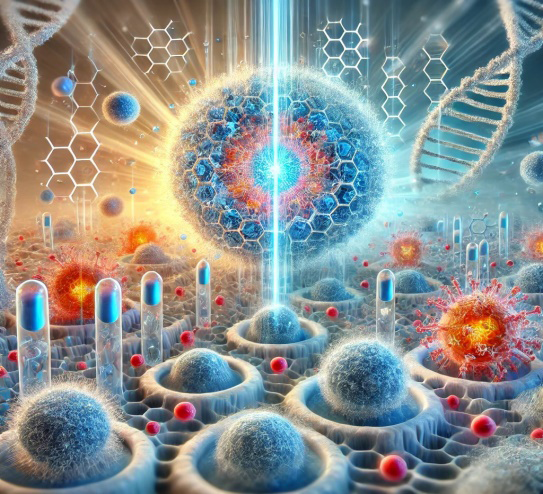
The field of drug delivery has undergone significant transformations with the advent of nanomaterials, which offer remarkable advantages such as enhanced targeting, reduced side effects, and controlled drug release. Their unique properties, such as high surface area, tunable size, and multifunctionality, allow for advancements in addressing challenges associated with conventional drug delivery as seen the following figure 1.
Opinion
The field of drug delivery has undergone significant transformations with the advent of nanomaterials, which offer remarkable advantages such as enhanced targeting, reduced side effects, and controlled drug release. Their unique properties, such as high surface area, tunable size, and multifunctionality, allow for advancements in addressing challenges associated with conventional drug delivery as seen the following figure 1.
Nanomaterials; Drug Delivery; Nanoparticles
Opinion
Abbreviations
PLGA: Polylactic-Co-Glycolic Acid; SLN: Solid Lipid Nanoparticles; CNTs: Carbon Nanotubes.
Types of Nanomaterials in Drug Delivery
Polymeric Nanoparticles
- Biodegradable polymers like PLGA (polylactic-co- glycolic acid) are widely used.
- These systems allow for controlled drug release and reduced systemic toxicityipid-Based Nanocarriers, improving therapeutic outcomes.
- Liposomes and solid lipid nanoparticles (SLNs) are effective in delivering hydrophilic and hydrophobic drugs.
- Lipid nanoparticles enhance bioavailability and stability, as seen in mRNA vaccines for COVID-19 .
Metal Based Nanoparticles
- Gold, silver, and iron oxide nanoparticles show promise in drug delivery due to their stability and ease of functionalization.
- Magnetic nanoparticles enable targeted delivery using external magnetic fields.
Carbon-Baterials
• Carbon nanotubes (CNTs) and graphene oxide offer high drug loading capacity and enhanced cellular uptake.
Nanogels
• H polymers capable of absorbing large quantities of water; ideal for localized drug delivery.
Advances in Functionality
Drug Delivery
Functionalization of nanocarriers with ligands (e.g., antibodies, peptides) allows drugs to specifically target cancer cells or inflamed tissues, minimizing side effects.
Stimuli-Responsive Systems
• Nanocarriers sensitive to environmental triggers like pH, temperature, or light enable on-demand drug release in specific environments such as tumors or infections.
Combination Therapy
• Nanocarriers can deliver taneously, enhancing therapeutic efficacy and overcoming drug resistance, especially in cancer.
Crossing Biological Barriers
Advances in designing nanoparticlesthe blood-brain
barrier (BBB) have opened avenues for treating neurological disorders like Alzheimer’s and brain cancers.
Applications
- Cancer Therapy: Nanoparticles enhance the deliverys to tumors, reducing systemic toxicity.
- Gene Therapy: Lipid nanoparticles are employed to deliver nucleic acids (e.g., siRNA, mRNA) to specific cells.
- Infectious Diseases: Recent success of mRNA-lipid nanoparticle vaccines has underscored the potential of nanomaterials in immunotherapy.
- Ophthalmology: Nanogels are being developed for sustained drug release in eye diseases.
Future Directions
Despite their advantages, nanomaterials face challenges such as
- Biocompatibility and long-term toxicity concerns.
- High production costs and scalability issues.
- Regulatory hurdles due to their complexity.
- Solution-Processed Chiral Perovskites for Biomedical Applications
- Nanotechnology in Health Chemistry and Medicine: Current Challenges and Future Directions
- Human Exposure to Micro- and Nanoplastics: Pathways, Toxicity, and Intervention Strategies
- Exosome Nanomedicine for Cancer Therapy
- Micro and Nanoplastics–Plastisphere, Biotoxicity, Impact on Human Health, and Mitigation Strategies
- Process Validation of Cefixime Powder for Suspension Dosage Form, 50 mL