
Polarity of Public Perception over General Consent: Survey on Consciousness of Healthy Japanese Participants in Brain Database Projects
Researches based on clinical big data and Researches using bio-bank are recently increasing. In this study we discuss the issues involving general consent through a quantitative analysis of a national random sample survey in Japan. Among the 3,295 respondents, 42% of respondents agreed to general consent in some form. On the other hand, 58% of respondents preferred "tiered consent," or "specific consent." We interpreted this result as polarity of public perception over general consent. Referring to logistic regression analysis, the likelihood of preferring general consent increased with age (p<0.05), and "benefit of participating in research" was positively correlated, and "anxiety about participating in research" and "mindset that brain imaging is special" negatively correlated to the affirmative view of general consent (p<0.001).
Introduction
Research on psychiatric disorders like dementia and schizophrenia has recently made breakthrough by using databases of brain imaging information obtained by magnetic resonance imaging (MRI), positron emission computerized tomography (PET), and other technologies. Under the leadership of the University of California comprehensive database is currently being built in the field of neuroscientific research on Alzheimer's disease and other forms of dementia as well as mental/neurological disorders such as schizophrenia and dementia-related depression. This is done by collecting time-series brain images taken with MRI or PET scans and adding clinical, biochemical, and genetic information to them.1Such database project brings light to a major
1Japanese Alzheimer’s Disease Neuroimaging Initiative (J-ADNI) is a leading researcher on integration of human brain image database in Japan. Other studies are also conducted with research institutes in the US and Europe. The purpose of the research is to establish imaging biomarkers for diagnosing Alzheimer’s syndrome, and to controversy regarding the most appropriate means of obtaining general consent”2” from study participants in an informed consent procedure (hereinafter IC procedure). This controversy has risen in relation to the IC procedure that is required upon the registration of specimens or information of study participants in biobank or databases, even before the ultimate research objectives have been specified. This study aims to discuss the issues involving general consent through a quantitative analysis of the survey results on brain image database projects conducted across Japan.
The use of general consent in biobank or database projects involves relaxing the traditional informed consent requirements, and significantly contradicts with the doctrine of informed consent, which was established as the gold standard of research ethics as repentance for Nazi human experiments and Tuskegee syphilis study [1]. The main dilemma lies in how to obtain consent from participants in studies in which the objective is not yet defined. Appelbaum and Grisso [2] summarized the four components of IC as follows: (1) consent ability of study participants, (2) appropriate explanation to study participants, (3) understanding of the explanation by the study participants, and (4) spontaneous consent by the study participants. However, it is extremely difficult to satisfy these factors in research conducted in biobank or database projects due to the nature of the data source.
According to Hansson, et al. [3], the IC procedure for research can be categorized into four approaches: (1) consent to a specific study, (2) consent to research on a specific disease (e.g., cancer research), (3) consent to biomedical research, and (4) blanket consent (consent with no restrictions on the range of research). The degree of respect for autonomy by the study participants declines as it goes from (1) to (4). As symbolized by the argument by Arnason [4], “the more general the consent is, the less informed it becomes,” and the wider the scope of the content, the more difficult to implement strict IC on individual research.
Existing Quantitative Survey Research
According to Caulfield, the issue in research ethics concerning general consent has been discussed from the perspectives of “public good” and “public perception.”The develop therapeutic agents for psychiatric disorders including schizophrenia and depression. 2IC procedures required in biobank or database projects are referred to as “general consent,” “broad consent,” or sometimes “blanket consent.” In this article, we use the term “general consent” to represent the extensive consent procedures.
argument from the former perspective emphasizes the importance of new findings in medical science that would be brought by biobank and database businesses, and points out that applying the strict, conventional IC format to medical research would be a major barrier to research progress due to the cost, time and the procedural inconvenience to research participants. In fact, discussions centering on how to introduce the desired IC format have unfolded.3 In contrast, the latter perspective has opened up discussions regarding the social perception concerning the sense of support or inconvenience experienced by non-expert individuals such as study participants when requesting general consent. Discussions concerning “public perception” could be made from the viewpoint of “social understanding” on multipurpose use of research samples. The discussions have referred to some media scandals, as in the case revealed in February 2000 in which samples obtained from 5,000 people were used in genetic analysis without consent at the National Cardiovascular Center in Japan.3 This article focuses on the “public perception” perspective in terms of general consent and establishes a basis for the desirable IC procedure for study participants, especially those participating in future brain image database projects.
Traditionally, general consent for research has been viewed as a “socially acceptable” IC procedure based on a large-scale survey presented by Wendler [5] of the National Institutes of Health (NIH). This article aims to partially modify Wendler’s framework to interpret the public’s view on general consent.
In many cases, surveys on general consent have been conducted with a limited sample size and without randomization or proper allocation according to population distribution in the society. Conducted with a relatively large sample of 3,295 persons randomly selected throughout Japan, our survey is different from prior studies in terms of study design and sample size.
3The case of unauthorized use of study specimens surfaced in February 2000 at the then National Cardiovascular Center in Suita City, Osaka (NCVC; now known as the National Cerebral and Cardiovascular Center).The NCVC had been collecting blood samples from about 5,000 local residents upon health checkup, and performed gene analysis with these blood specimens without consent from the subjects. The “scandal” was featured on The Mainichi Shimbun and other major newspapers on February 3rd, 2000 and was discussed on February 28 of the same year at the Budget Committee’s 4thStudy Group of the House of Representatives of the 147th Diet, and attracted the public’s attention.
Therefore, our survey should provide valuable data in selecting IC procedures for study participants in future biobank and database projects.
We have organized the points on current discussion over general consent in the first half of Section 2 and have clarified the limitations of existing empirical research on general consent in the second half. The survey design of this study is outlined in Section 3, and the outcomes are presented in Section 4. Finally, findings that would be useful in actual IC circumstances are provided based on the results obtained from the present survey.
Issues of the Argument on General Consent
Background in Which General Consent is required in Medical Science Research
General consent is the proper IC procedure required for medical science research that collects study specimens and imaging information, stores them in a biobank or database, and uses them for a wide range of research purposes. General consent needs reconsideration in view of IC requirements that have become even stricter after the Declaration of Helsinki. While acknowledging that “the blanket consent strategy is a move away from the traditional standards of consent,” Caulfield summarizes the characteristics of general consent suitable for biobank projects as follows [6].
i. Biobank is not an individual study project but a study platform utilized by many researchers. In this regard, it is impossible to obtain informed consent in its original sense. ii. Risks related to sensitivity of personal information arise, when information in a biobank is associated with other medical information or socioeconomic information. iii. Biobank will be used for a long term over decades.
Elger and Caplan [1] pointed out that regarding the IC issues, the “European solution” deems general consent as acceptable while the “American solution” emphasizes consent to specific research projects, and this discrepancy in research ethics guidelines presents a barrier to collaborative studies. Current research ethics guidelines in Japan (“Ethical Guidelines for Medical and Health Research involving Human Subjects” issued in 2014) support broad consent without explicitly using the term general consent.
In addition, Hansson, et al. [3] stated that the issues with general consent in IC procedures would resolve if the general consent satisfies the following three requirements: (1) personal information related to research is safely managed; (2) the right to withdraw the consent is granted to study participants; and (3) new research is approved by the ethics review committee. This is the most widely accepted interpretation of the term general consent4.
“Public perception” on general consent -impact of the article by Wendler and points of arguments
As described above, the points of discussion on general consent issues are often classified into “public good” and “public perception.” One of the most influential studies concerning “public perception” on general consent was a meta-analysis conducted by Wendler [5], and the results are most frequently cited in other studies on general consent. In the great meta-analysis, 30 studies on medical research participation were identified as eligible. Those studies provided data of over 33,000 people, which included study participants, family members, religious leaders, and the public. Among the 30 studies, six specifically examined people’s preferences in IC options. Results showed that most people (79-95%) supported one-time general consent, and preferred to rely on ethics committees to decide for which studies their samples would be used. Wendler states that general consent is a “socially acceptable” IC procedure. Analyzing people’s preferences for general consent, Wendler argues that, in general, if the consent form and process contain some IC elements adequately, then the one-time general consent will be justified [5].
However, the interpretation by Wendler is not comprehensive, and there are some problems with reading the existing survey results. Caulfield, et al. [6] pointed out that the 30 studies included the results indicating that four in five people wanted explanation of consent for individual study utilizing DNA databases and 87% of people preferred specific consent. In this regard, interpretations of existing surveys by Wendler [5] are rather one-sided. In our study, we attempt to avoid these one-sided analyses and elucidate specific factors that could affect the public perception on general consent by quantitatively examining the results of a national random sample survey in Japan.
4For example, Hofmann [7] presented a discussion on points to consider for these requirements.
Design of the Survey
This study was conducted from September 14 to 18, 2012. The questionnaire was sent to 11,105 people by e- mail. These people were chosen from a major research firm with approximately 1.2 million employees. Initially, a random number generated by a computer was assigned to each employee. After that, 11,105 employees (corresponding to the assigned numbers) were selected based on the population distribution in 47 prefectures, and demographics such as gender and marital status provided in the 2005 Population Census of Japan. Responses were obtained from 3,295 subjects, yielding a response rate of 29.7%.Considering the low response rate from survey samples selected from the Basic Resident Register and the voter registration list, and the declining response rate of recent mail surveys, we believe the nationwide e-mail survey to be a better option despite some biases in the sample. This survey was conducted with the approval of the Research Ethics Review Committee, Faculty of Medicine, the University of Tokyo [8, 9].
First, on a four-page web screen, we laid out a set of brain images generated by an MRI etc. and explained in a <Question> Which proposal would you consider most favorable if you were requested to provide brain images? Please choose one of the following options. [Proposal from Researcher I (general consent alone)] “When we request you to provide your brain images, we will first explain that the images will be used for various studies over an extended period of time, and then ask for your consent. After that, we would like you to trust us and give us full authority to decide what research your images would be used for in the future.” [Proposal from Researcher II (general consent + information disclosure)] “When we request you to provide your brain images, we will first explain that the images will be used for various studies over an extended period of time, and then ask for your consent. After that, whenever a new study plan is launched, we will provide you with information on the study using brochures or websites. [Proposal from Researcher III (tiered consent)] “When we request you to provide your brain images, we will first explain that the images will be used for various studies over an extended period of time, and then ask for your consent. At that time, we will ask you about your preference regarding the kinds of studies for which you do not want your images to be used. After that, we will only use your images for research that matches your preference. [Proposal from Researcher IV (specific consent)] “When we request you to provide your brain images, we will first explain that the images will be used for various studies over an extended period of time, and then ask for your consent. After that, whenever a new study plan is launched, we will explain its content and ask for your consent to use your images for the study.
simple manner how those images are used in database businesses to obtain health and genetic information. Next, on a three-page web screen, we illustrated a typical process of healthy volunteers participating in brain imaging research. The options of IC procedures were presented to the study subjects in an easy-to-understand manner, under the scenario that they would provide information for the database. Figure 1 shows the options presented: (1) general consent alone, (2) general consent + information disclosure, (3) tiered consent, and (4) specific consent. We asked the subjects to choose one preferred option among the four and explain the reason for the choice in detail.
Two different scenarios were used in the survey: one for prospective studies in which information is continually collected to establish a system, and another for retrospective studies in which existing materials are utilized. Space for comments was provided at the end of each question. We use only prospective research results, which include important discussion points in the current brain image database project. (The actual questionnaire and the basic aggregate results are provided as a reference at the end of this manuscript.) Figure 1: Options used in the survey on general consent (Scenario).
Results
Basic Aggregate Results
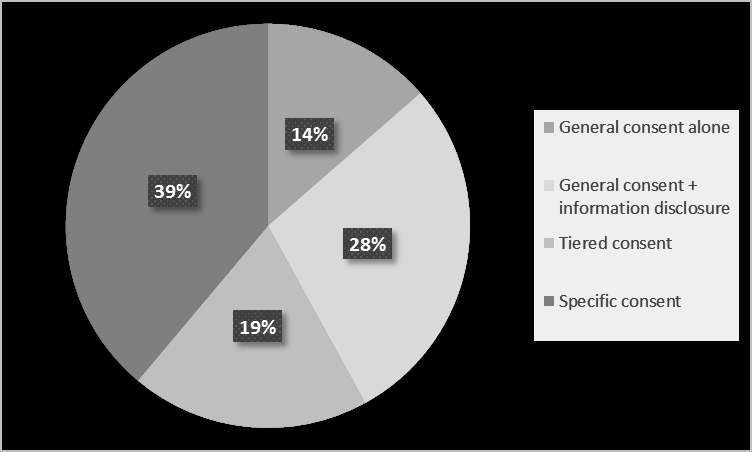
Table 1 shows the basic aggregate data on the distribution of respondents for the options above. Figure 2 provides the same data in a pie chart.
| Frequency | Percentage | Cumulative percentage | ||||||
|---|---|---|---|---|---|---|---|---|
| General consent alone | 448 | 13.6 | 13.6 | |||||
| General consent + information disclosure | 936 | 28.41 | 42 | |||||
| Tiered consent | 630 | 19.12 | 61.12 | |||||
| Specific consent | 1281 | 38.88 | 100 | |||||
| Total | 3295 | 100 |
Table 1: Basic aggregate results on the views on general consent.
Among the 3,295 respondents, 448 (13.6%) favored “general consent alone,” and 936 (28.41%) favored “general consent + information disclosure,” indicating that42% of respondents agreed to general consent in some form. In this regard, we have confirmed that there are a good proportion of supporters of general consent.
B Standard error Wald Degrees of Gender -0.096 0.074 1.678 1 0.195 0.908
Age 0.005 0.003 3.852 1 0.050 1.005
Brain science literacy -0.009 0.009 0.975 1 0.328 0.991
Certainty of brain myth -0.002 0.028 0.003 1 0.956 0.998
Benefit of participating in research 0.065 0.019 11.567 1 0.001 1.067
Anxiety about participating in research -0.124 0.015 65.265 1 0.000 0.883
Mindset that brain imaging is special -0.109 0.011 98.942 1 0.000 0.897
Constant 1.618 0.389 17.267 1 0.000 5.044
On the other hand, 630 respondents (19.12%) preferred “tiered consent,” and 1,281 respondents (38.88%) preferred “specific consent.”
Results of Logistic Regression Analysis
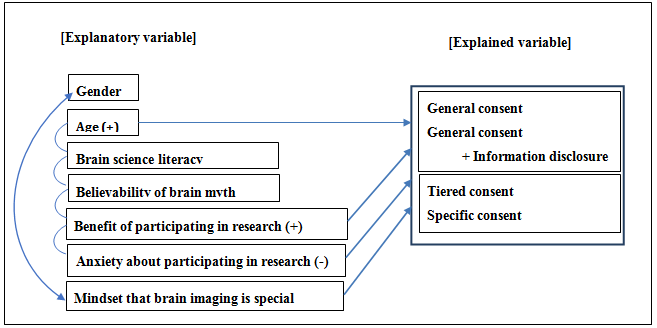
To evaluate the likelihood of preferring general consent (“general consent alone” and “general consent + information disclosure”), we performed a logistic regression analysis.
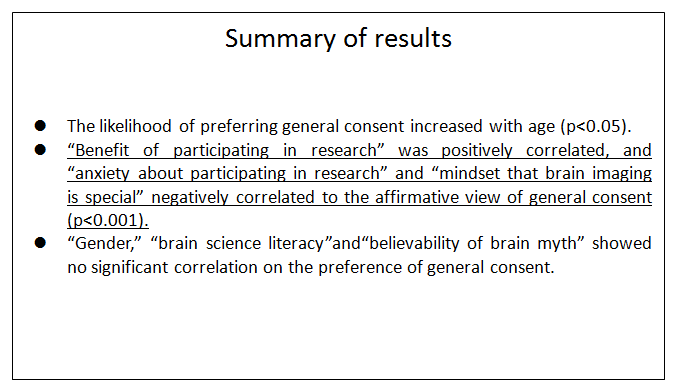
Results showed that the likelihood of having a positive opinion toward “general consent” increased with age (p<0.05). Moreover, “benefit of participating in research” was positively correlated, and “anxiety about participating in research” and “mindset that brain imaging is special” were negatively correlated to the affirmative view on general consent (p<0.001). With “gender,” “brain science literacy,” and “certainty of brain myth,” no significant correlation on the view on general consent was found.
Significance
probability Exp (B)
freedom
- 1: general consent & general consent +information disclosure, 0: tiered consent & specific consent
- (n=3,295)
Table 2: Results of logistic regression analysis predicting the preference for “general consent”.
Discussion and Future Challenges
Based on the basic aggregate results of this survey, it was suggested that the participants’ preference for IC procedures in database projects is polarized. One group is in favor of “general consent,” and the other is in favor of “specific consent.” Support for “tiered consent” was in the middle. The results of this survey are partially inconsistent with Wendler’s [5] interpretation of existing research on “general perception” on “general consent,” indicating that some adults have reservations about general consent and prefer specific consent when participating in studies.
The results of the logistic regression analysis implied that stronger support for general consent could be secured by thoroughly explaining the benefits a participant could gain and the information that could be obtained through brain images. In other words, factoring in how to relieve participants’ anxiety about study participation into the IC procedure may increase the affirmative view on general consent.
Based on these findings, the following two points should be noted when general consent is given to biobank and database projects in the future. 1. With respect to IC procedures, participants can be divided into two groups: one in favor of general consent and another in favor of specific consent. Thus, it is expected that a certain number of participants in brain imaging studies have reservations about giving general consent. Therefore, when obtaining general consent, careful explanation of the IC procedure is required while thoroughly explaining all options, including the possibility of not participating in the database project. 2. It is necessary to explain to the participants the benefits and risks of participating in the study and to ensure their understanding. Given the fact that many people supporting “specific consent” have expressed serious concerns about personal information leakage and privacy, more attention should be paid to the information security of biobank and database projects. When collecting brain images, it is important to clarify the information obtained by analyzing brain imaging data, and provide thorough explanations of information security efforts to address concerns about the safety of personal information and privacy.
In this report, we have revealed the issues pertaining to “general consent” in brain imaging database projects by analyzing its “public perception” aspect. The discussion points addressed by this study are only the beginning of research on “general perception” over “general consent.” In order to fully understand the overall picture of “general consent” from the viewpoint of “public perception,” further analysis and additional investigation will be necessary. Proposals for establishing optimal IC procedure remain as future challenges.
In addition to including questions regarding brain imaging studies, our survey asked the respondents how they feel about registering blood or genomic information in a biobank or database. Comparative studies using these items will be necessary to identify the unique feature on brain imaging in general perception. The survey respondents were adults randomly selected throughout Japan. The results may not fully reflect the perception and view toward “general consent” of those who have already participated in brain image research. In order to promote the development of appropriate IC procedures for future database projects, it is necessary to properly interview past participants and carefully analyze the obtained information.
Conclusion
Quantitative analysis of a national random sample survey in Japan showed that 42% of respondents agreed to general consent in some form. On the other hand, 58% of respondents preferred “tiered consent,” or “specific consent.” The results of this survey are partially inconsistent with Wendler’s [5] interpretation. This polarity of public perception over general consent reflects people’s age and their beliefs. The belief “benefit of participating in research” was positively correlated, and “anxiety about participating in research” and “mindset that brain imaging is special” negatively correlated to the affirmative view of general consent.
Acknowledgement
The authors are grateful to Simon Tashiro for collaboration on the early stages of this work. We also thank Akira Akabayashi for carefully proof reading the manuscript and for his supervising.
References
-
Elger BS, Caplan AL (2006) Consent and anonymization in research involving biobanks. EMBO Report 7(7): 661-666.
-
Appelbaum PS, Grisso T (1998) Assessing Competence to Consent to Treatment. Oxford University Press.
-
Hansson MG, Dillner J, Bartram CR, Carlson JA, Helgesson G (2006) Should donors be allowed to give broad consent to future biobank research? Lancet Oncol 7(3): 266-269.
-
Arnason V (2004) Coding and Consent: Moral challenges of the database project in Iceland. Bioethics 18(1): 27-49.
-
Wendler D (2006) One-time general consent for research on biological samples. British Medical Journal 332: 544-547.
-
Caulfield T (2007) Biobanks and blanket consent: The proper place of the public good and public rationales. Kings Law Journal 18(2): 209-226.
-
Hofmann B (2009) Broadening consent-and diluting ethics? Journal of Medical Ethics 35(2): 125-129.
-
Helgesson G (2012) In Defense of Broad Consent. Cambridge Quarterly of Healthcare Ethics 21: 40-50.
-
Maschke KJ (2005) Navigating an ethical patchwork- human gene banks. Nature Biotechnology 23(5): 539- 545.
- Are We Looking at an Overwhelming Crisis in Healthcare, or A Poorly Hidden Opportunity Calling on us to Improve our Systems? Perhaps Both?
- Sex, Metaphorical Drugs, and the Dissolution of Boundaries in the Perception of Time: Robert Muller’s Tropen: Der Mythos Der Reise (Tropics. The Myth of Travel) From 1915 Serves as an almost Forgotten Example
- Artificial Intelligence in Healthcare: Bioethical and Legal Challenges in the Brazilian Context
- Today Our Health and Our Principles are Challenged on Many Fronts Simultaneously, Where Can We Go from Here?
- The Value of Prevention, Avoid the Games and Focus on Real, Evidenced-Based Opportunities to Improve Health, Wellbeing and Longevity
- A Time of Opportunities to Improve our Health and Address Chronic Diseases