
Algorithm (Vado) and (Via) Mnemoic in the Airway Approach in Patients with Head and Neck Tumors: A Case Report
Head and neck tumors are considered potential and important malignancies. Airway management is a challenge for the surgical medical team, but for the anesthesiologist implies a challenge when choosing the approach and insurance method of the airway for each specific case. This is a case review of a 27-year-old female patient with a diagnosis of papillary thyroid tumor 9 months. We emphasize the importance and effectiveness of the VADO algorithm and the V.I.A mnemonic in patients with head and neck tumors as a tool when planning and performing a difficult airway approach. The importance of having an anesthetic plan prior to the surgical procedure in order to avoid complications in order to reduce the morbidity and mortality of patients with head and neck tumors when undergoing general anesthesia, always considering other precautions such as Video-Assisted Laryngoscopy or Awake Intubation in this patients.
Introduction
Head and neck tumors are classified among the 10 most important malignancies, airway management is a challenge for the surgical medical team, but for the anesthesiologist it implies a challenge when choosing the approach and insurance method of the airway for each specific case. Given the lack of identification and anticipation of possible difficulties in airway control, the algorithms currently described are useful since they guide to cover unforeseen difficulties such as the lack of experience in both routine intubation and rapid sequence intubation [1].
Objective
Reference the usefulness of the VADO algorithm and the V.I.A mnemonic in patients with head and neck tumors as a tool when planning and performing a difficult airway approach.
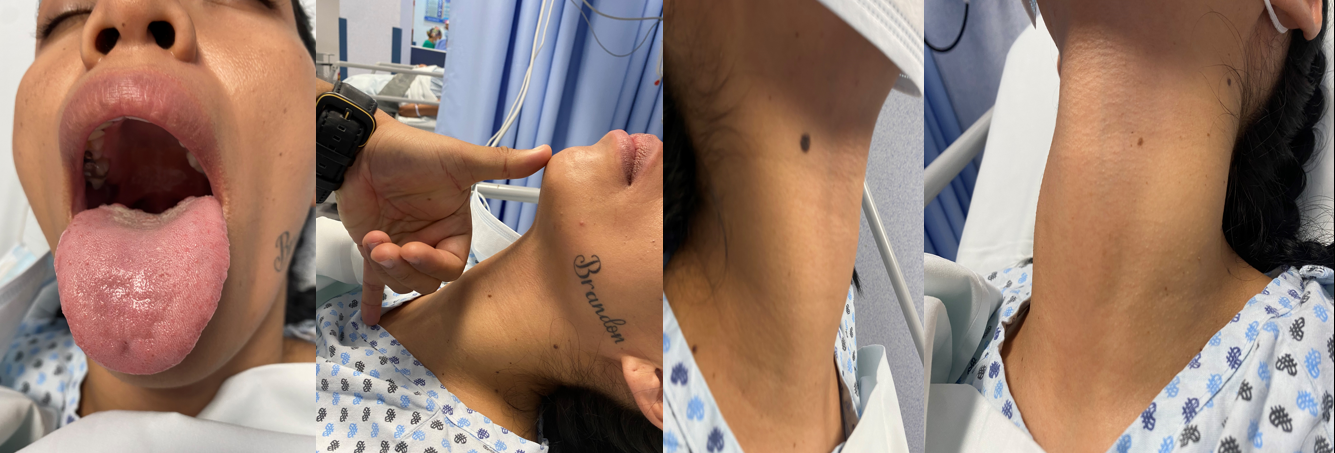
A 27-year-old female patient with a diagnosis of papillary thyroid tumor 9 months, which is accompanied by early satiety and dysphonia, scheduled for thyroidectomy and wide neck dissection. In her physical examination using El- Ganzouri Risk Index (EGRI): Mouth Opening (4 cm), Modified Mallampati Classification (II), Trhyromental Distance (6.5cm), Neck Movement (90°), Ability to Prognath(advance lower jaw forward, (YES), Weight (65kg), History of Difficult Intubation (No) EGRI (2 points Risk of difficult airway) (Figure 1) Advice: Consider Precautions such as Video- Assisted Laryngoscopy or Awake Intubation in this patients [2] (Table 1). Regarding to VADO algorithm we made the Plan
A our first attempt ion, quiet we had plans B, C and D in a failure case (Figure 2).
| Ventilation | Intubation | Aspiration |
|---|---|---|
| 0. Adequate ventilation with bag mask. | 0. successful intubation with successful conventional laryngoscopy | 0. Minimal risk |
| 1. Need for a supraglottic device. | 1. advanced intubation device may be required | 1. Risk that can be overcome with rapid sequence intubation |
| 2. inability to ventilate after anesthetic induction | 2. inability to intubate after anesthetic induction | 2. High risk for aspiration |
Table 1: VIA score a mnemonic for airway assessment and management.
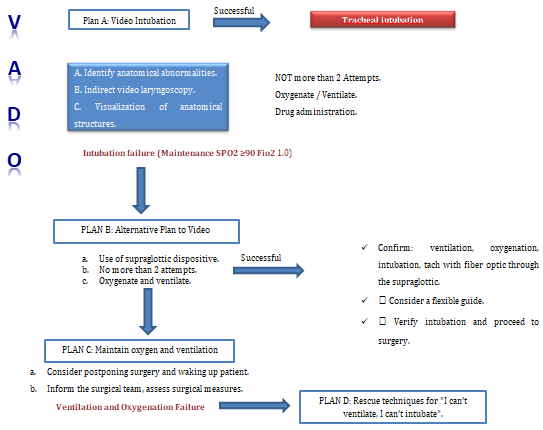
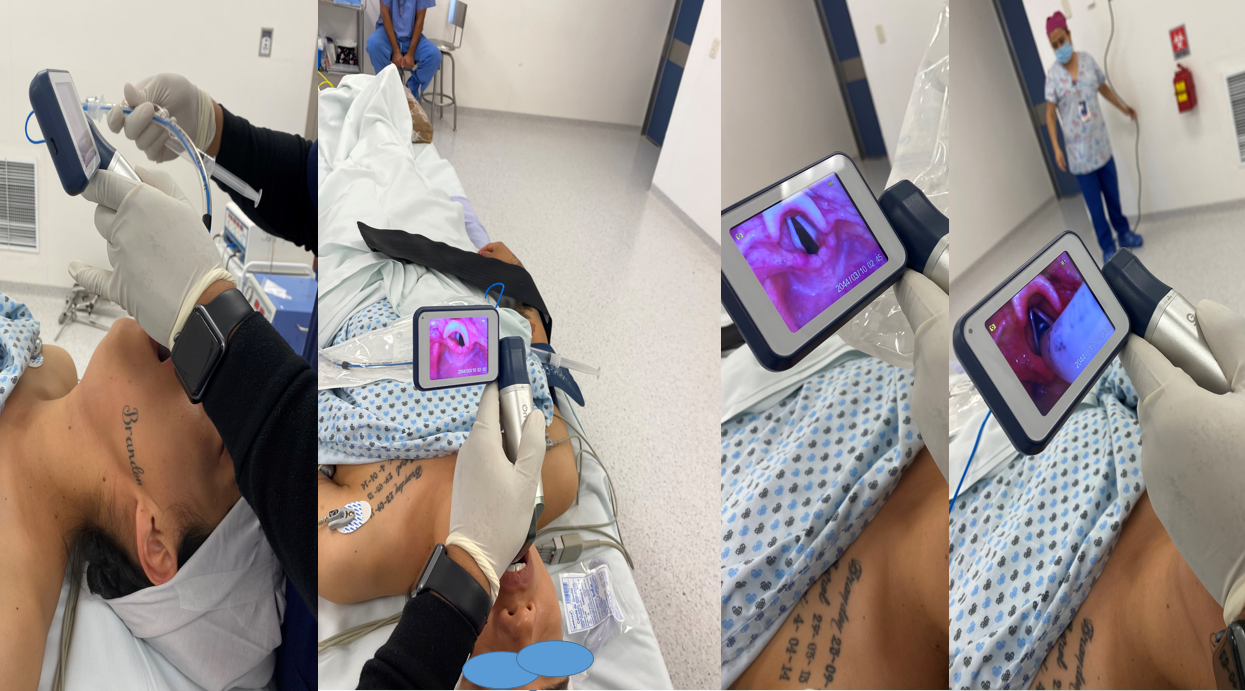
The Induction is performed based on Lidocaine 100mg Fentanyl 250 mcg IV, Propofol 75 mcg IV (Fractionated), video laryngoscopy is performed with an OnFocus® device with a hypercurved blad visualizig POGO (75%) anatomical structures and Rocuronium 50 mg IV is administered, ringed TOC no 6.5 is introduced on the 1st attempt without incidents or complications (Figure 3), anesthetic maintenance with sevoflurane at 2 vol. % CAM 1.0%, after anesthesia without complications, extubation is performed with the patient awake without incidents or complications. Regarding to VADO algorithm we made the Plan A our first attemption, quiet we had plans B, C and D in a failure case (Figure 2).
Discussion
Patients with head and neck tumors may present complications for the airway approach, such as restricted movement of the head and neck, decreased mouth opening or reduced mouth space. upper airway, presence of cancer growth itself, anatomical changes to fibrosis due to previous surgery or radiotherapy, among others. For which the Mnemonics (VIA) serves as a reminder of the risk factors that influence the moment of decision making and significantly affect the approach to the airway while the V.A.D.O algorithm (oncological difficult airway) can cover unforeseen difficulties in both routine intubation and rapid sequence induction if necessary [3]. Therefore, the evidence suggests that the use of video laryngoscopes can improve the success of tracheal intubation, particularly when the patient has a difficult airway, taking into account the resources, training and skills of the team that addresses an anticipated or not planned difficult airway [4]. These new algorithms are the first to include evidence from oncologic patient’s airway management [5]. They highlight the importance of risk assessment, provide a new decision tree to help determine when to consider awake airway management, awareness of task fixation and time passage, limiting the number of tracheal intubation attempts, and assessing ventilation after every intervention [3, 6].
Regarding the VADO algorithm, its emphasis is placed on the evaluation, preparation, positioning, preoxygenation, maintenance of oxygenation and minimization of trauma to the airway interventions. It is recommended that the number of road interventions breathing is limited and that the blind techniques that use a cannula through airway devices , supraglottic have been replaced by optical intubation guided by video laryngoscope or fibroscopy. An algorithm can cover unforeseen difficulties both in routine intubation and induction of fast sequence [5].
Numerous practice guides have been developed for assist clinicians in the management of the difficult airway. The approach to the difficult airway is a challenge for the anesthesiologist still today despite different guidelines and existing algorithms [1]. However, they play an important role in patient safety, since the dissemination of these guidelines encourages respiratory professionals to consider their strategies and to formulate specific c plans for the management of a difficult or unexpected airway [5]. The use of video laryngoscopes can improve the success of tracheal intubation, particularly when the patient has a difficult airway [4].
Results
Regarding the VIA algorithm score, two points were given to this patient since Ventilation was adequate with a bag mask. Intubation 1 point because of the use of an advanced device (video laryngoscopy) and 1 point for the risk of aspiration that could be overcome. Regarding to VADO algorithm we made the Plan A our first attemption, we successfully could identify anatomical abnormalities, made an Indirect video laryngoscopy and had the v visualization of anatomical structures. These algorithms help us to have an anesthetic plan from the moment of the evaluation, as well as the reduction of complications during the trans anesthetic.
Reducing the morbidity and mortality of our patients.
Conclusion
Neoplasic disease affecting patients head and neck is one of the greatest challenges for anesthesiologist. The role of the anesthesiologist is currently extremely important and relevant when talking about airway management, so the knowledge and application of VIA Mnemonics can be useful as a time out before proceeding to approach an oncology airway. The VADO algorithm, is a systematized option on the strategies and specific plans to be developed for the management of the expected or unexpected difficult airway in patients with head and neck tumors, for which makes them an important and useful strategy when planning to aboard or approach an oncology patient with a head and neck tumor [3, 4].
References
-
Rosentblatt WH, Yanez ND (2021) A decision Tree Approach to Airway Management Pathways in the 2022 Difficult Airway Algorithm of the American Society of Anesthesiologist. Anesth Analg 134(5): 910-915.
-
Cortellazzi P, Minati L, Falcone C, Lamperti M, Caldiroli D (2007) Predictive value of the El-Ganzouri multivariate risk index for difficult tracheal intubation: a comparison of Glidescope® video laryngoscopy and conventional Macintosh laryngoscopy. Br J Anaesth 99(6): 906-911.
-
Truong AT, Truong DT (2016) VIA score: a mnemonic for airway assessment and management. J Clin Anesth 28: 87.
-
de Carvalho CC, da Silva DM, Lemos VM, Dos Santos TGB, Agra IC, et al. (2022) Videolaryngoscopy vs. direct Macintosh laryngoscopy in tracheal intubation in adults: a ranking systemic review and network meta-analysis. Anaesthesia 77(3): 326-338.
-
Alvarado-Pérez J, Mille-Loera JE, García-Velasco O, Cuellar-Guzmán LF, Fabela-Barragán JA (2017) vado: algoritmo de vía aérea difícil oncológica en el instituto nacional de cancerología de méxico. Revista Mexicana de Anestesiología a 40(S1): S129-S131.
-
Apfelbaum JL, Hagberg CA, Connis RT, Abdelmalak BB, Agarkar M (2022) 2022 American Society of Anesthesiologists practice guidelines for management of the difficult airway. Anesthesiology 136(1): 31-81.
- Editorial on Multimodal Analgesia
- Surgical Incision Site Local Anaesthetic Infiltration and Superior Hypogastric Plexus Block in Total Abdominal Hysterectomy Under General Anaesthesia- A Placebo-Controlled, Randomized Clinical Trial
- Supraglottic Airway Insertion in Semi Fowler Position Due to Severe Thoracic Hyperkyphosis: A Case Report
- Anaesthetic Management of Cardiac Myxoma Patient with Systemic Involvement: A Case Report
- Current Problems in Pulmonary Respiratory Distress Syndrome (Literature Review)
- Evolution of Perioperative Hemodynamic Monitoring from the Hand on Pulse to Hypotension Prediction Index