
COVID-19 Implication by Physical Interaction of Artificial fog on Respiratory Aerosols
Background: Artificial fog consists of small liquid aerosols suspended in air which reduce visibility and reflect light. Artificial fog is used in the film, television, and live entertainment industries to enhance lighting, as a visual effect, and to create a specific sense of mood or atmosphere. Objective: This study investigated the suspension time for liquid respiratory aerosols spiked with tagged deoxyribonucleic acid (DNA) tracers in the presence and absence of glycerin- or glycol-containing artificial fogs. Methods: Liquid respiratory aerosols with tagged DNA tracers were sprayed into a closed environment without and with glycerin- or glycol-containing artificial fog, with air samples taken at regular intervals to determine the decay of tagged DNA tracer over time. The study treatments included Control (no fog), Glycerin Low (~3 mg/m3), Glycerin High (~15 mg/m3), Glycol Low (~5 mg/m3), and Glycol High (~40 mg/m3). Results: All artificial fog treatments had lower mean log reduction curves compared to the Control treatment. The differences in mean log reduction for artificial fog treatments vs. control treatments were all statistically significant (p<0.001), except for Glycerin Low treatment (p=0.087). The differences in mean log reduction between treatments using glycerin fog (p=0.129) and glycol fog (p=0.209) were not statistically significant. Conclusion: Artificial fog use does not increase suspension time of liquid respiratory aerosols, and therefore does not appear to increase the risk of airborne transmission of diseases from liquid respiratory aerosols, such as COVID-19. The suspension time of aerosols in glycol-containing artificial fog decreased more than glycerin-containing fog. In practice, the additional reduction in suspension time provided by the physical interaction of liquid respiratory aerosols with artificial fog does not suggest any practical benefit for using artificial fog as a control measure.
Introduction
Artificial fog consists of small liquid aerosols suspended in air which reduce visibility and reflect light [1]. Artificial fog is used most often for creating special effects in the film, television, and live entertainment industries to make lighting or lighting effects visible, and to create a specific sense of mood or atmosphere [2]. Fog machines either condense vapor generated by heating liquid fogging fluid, or mechanically generate aerosols directly from these liquid fogging fluids to create artificial fog in air [2, 3]. Based on historical data of a variety of glycerin- and glycol-based fog fluids, at least approximately 62% of liquid aerosols generated by fog machines have a mean aerodynamic diameter of 10.0 µm or less; of the smaller size fraction, a large percentage are less than 3.5 µm [4, 5, 6]. The aerosols are composed of the same ingredients as the fluids used in the machines, which is primarily water combined with a percentage of glycerin, glycols, or highly-refined mineral oils [1, 2]. Thermal decomposition or burning of fluid ingredients generally does not create the aerosols, although a small amount of thermal decomposition byproducts may be produced during the process of heating the fluid if the fluid is overheated [2, 3, 7].
With the onset of the severe acute respiratory syndrome coronavirus 2 (SARS-CoV-2) pandemic, now termed as Coronavirus Disease 2019 (COVID-19), there has been anecdotal uncertainty expressed within these entertainment industries regarding the interaction of artificial fog and respiratory aerosols, which may contain and transmit COVID-19 [8]. Respiratory aerosols generated by coughing, sneezing, or speaking can remain suspended in air from minutes to hours depending on their size and environmental conditions, presenting a COVID-19 transmission hazard to others [9, 10, 11].
There is debate over what size range constitutes a “respiratory aerosol” that could be important for aerosol transmission of COVID-19 [8, 11]. Regardless of this debate, aerosol transmission of COVID-19 is recognized to be an important exposure pathway [12, 13]. Many environmental factors influence the aerodynamic behavior of particles apart from size, including aerosol velocity, air flow, temperature, relative humidity, and evaporation [11, 14]. Respiratory aerosols generated by speaking and coughing range in size between 0.1 micrometers (µm) to over 100 µm, with two primary distributions centered around 1 µm and 100 µm [15, 16, 17]. Evaporation of larger liquid aerosols is an important process which creates additional liquid respiratory aerosols [14]. Through modelling, it was estimated that the cut-off diameter of larger liquid aerosols that evaporate sufficiently to become liquid respiratory aerosols and stay airborne rather than settle onto surfaces, is 73.5 µm [14]. Therefore, there are two sources of liquid respiratory aerosols that should be considered when exploring aerosol transmission: 1) respiratory aerosols directly generated by the source, and 2) respiratory aerosols generated from the evaporation of larger liquid aerosols. Given the range of “respiratory aerosol” definitions, this study defined “liquid respiratory aerosols” as those having an aerodynamic diameter between 0.1 µm to 10 µm.
The key question addressed by this study is: does the physical interaction of artificial fog on liquid respiratory aerosols increase their suspension time, and thus increase the likelihood of COVID-19 transmission and subsequent infection? This study investigated the suspension time for liquid respiratory aerosols spiked with tagged deoxyribonucleic acid (DNA) tracers in the presence and absence of glycerin- or glycol-containing artificial fogs.
Methods and Materials
DNA Tracers
The tagged DNA tracers, known as veriDART supplied by SafeTraces Inc., were housed in and sprayed by Flairosol spray bottles. The DNA tracer solutions were approximately 1% solids to mimic saliva. The veriDART solution in the Flairosol spray bottle was tested to confirm the liquid aerosol size distribution it generated. In the first test, a Flairosol spray bottle was tested in triplicate, for a total of six samples, where a Spraytec (Malvern Panalytical, USA) instrument six inches from the nozzle measured the liquid aerosol size distribution (between 0.1 µm to 2000 µm diameter). In the second test, one Flairosol spray bottle was tested by discharging 10 full sprays in a room and measuring liquid aerosols (between 0.3 µm to 25 µm diameter) 50 inches perpendicular to the spray bottle over 25 minutes by an AeroTrak Handheld Airborne Particle Counter (TSI, USA).
Study Design Summary
The study design was developed by the researchers. Respiratory aerosols with tagged DNA tracers were sprayed into a closed environment with and without artificial fog. Air samples of aerosols were taken at regular intervals to determine the decay of tagged DNA tracer over time. A small office boardroom measuring 545 cubic feet (8’11” long by 8’ 4” wide by 7’ 5” high), occupied with one table and two chairs, was sealed along the walls, door, window, supply air diffuser, and ceiling with one-millimeter-thick poly sheeting (HDX, Canada). This poly sheeting created a closed environment where airflow in or out of the room was minimized, thereby limiting tagged DNA tracer decay due to natural settling processes only. Five treatments were completed: one control treatment, two glycerin-containing artificial fog treatments, and two glycol-containing artificial fog treatments. The
two glycerin-containing artificial fog treatments aimed to maintain airborne glycerin concentrations at approximately 1.5 milligrams per cubic meter (mg/m3) or 15 mg/m3. The two glycol-containing artificial fog treatments aimed to maintain airborne glycol concentrations at approximately 5 mg/m3 or 40 mg/m3. These glycerin and glycol concentrations aligned with regulatory or guideline limits commonly used for workplaces in North America (i.e., for 12-hour time-weighted average and ceiling limits, respectively). For each treatment, six trials were completed. Each trial consisted of spraying a unique tagged DNA tracer into the room and collecting one five-minute sample every five minutes from the time of spray until thirty-minutes had elapsed, for a total of six samples collected per trial and 36 samples per treatment.
Air Sampling
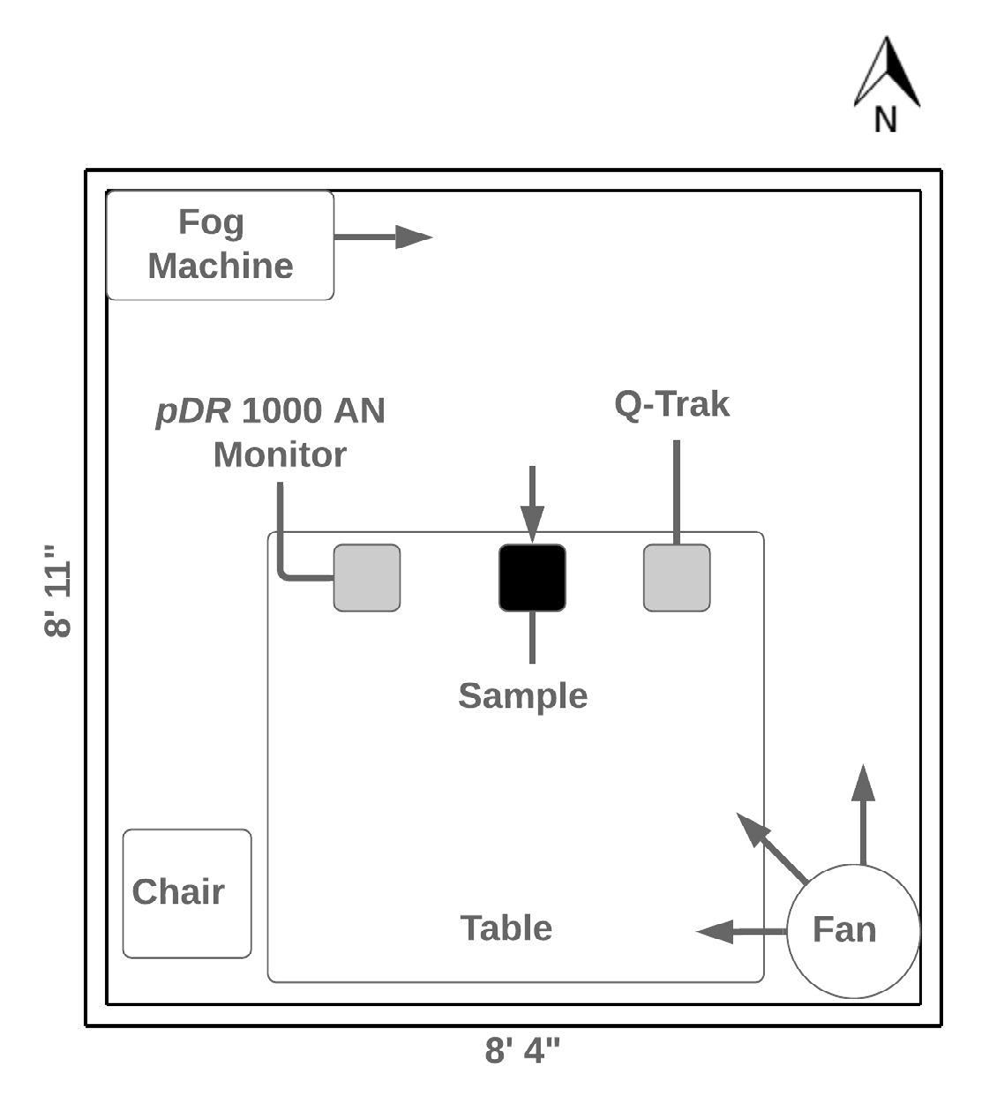
The researchers conducted two pilot studies to develop the air sampling method (Figure 1). Sampling was completed between November 2020 and January 2021 in Burnaby, British Columbia, Canada. All treatments were completed by the same Researcher, in the same office space, under similar environmental conditions. Each sample consisted of a Grade A-E 25-millimeter (mm) glass fiber filter (Sterlitech Corporation, USA) housed in a 50 mm long, three-piece conductive black polypropylene cassette housing cowl with a backing pad (Zefon International, USA) attached to a Leland Legacy Pump via Tygon® tubing (Saint-Gobain Performance Plastics Corp., USA). The Leland Legacy Pump was pre-calibrated to draw air at approximately 8 liters per minute using a Defender 510 (Mesa Labs, USA) with the first sample. The cowl was angled downward at approximately 45 degrees and suspended approximately five feet above the ground in the middle of the room by an aluminum tripod (Environmental Monitoring Systems, USA). The cassette angle minimized collection of larger aerosols that deposit quickly due to deposition and mimicked the human nose more accurately when used in conjunction with the cowl. Once the first sample was ready, the tagged DNA tracer fluid was sprayed five times from a Flairosol spray bottle, distributing the aerosols into each corner and center of the room; the different directions of each spray assisted in homogenizing the aerosol in the room quickly. Five sprays were discharged to generate enough of a tagged DNA tracer signal for detection. Although the number of sprays were primarily chosen to provide a sufficient DNA signal, practically, five sprays may be equivalent to loud talking for ten seconds, singing for ten seconds, or five coughs or sneezes, all without face coverings. Once this first sample started, a table fan with a blade diameter of twelve inches (GD Midea Environment Appliance Mfg. Co., Ltd, China) located in the Southeast corner was turned on to its lowest speed (660 feet per minute (ft/min) at the face, 275 ft/min at a distance five feet away) and oscillated over a 90 degree range from the Southwest to Northeast corners. Operation of the fan began after the sprays to ensure it did not disrupt the initial natural dispersion of aerosols but helped homogenize the aerosols in the room afterwards. After a sample duration of five minutes, the Leland Legacy Pump was paused, sampled cassette was removed, a new cassette was attached to the Tygon® tubing, and then the Leland Legacy Pump was restarted; it took approximately ten seconds to complete sample swapping. The same Leland Legacy Pump was used to ensure the flow rates and pump parameters were consistent between each sample. This process was repeated for each subsequent sampling time: 5 to 10 minutes, 10 to 15 minutes, 15 to 20 minutes, 20 to 25 minutes, and 25 to 30 minutes. After all six samples were completed for a given trial, the last sample was used to post-calibrate the Leland Legacy Pump.
Artificial Fog
The methods used to generate artificial fog were developed by researchers for this study. Water-Vapor HazeTM (CITC, USA) was used in a Haze Max machine (CITC, USA) to generate the glycerin-containing artificial fog treatments.
SmartFogTM Fogging Fluid: 3 Minute Low-Ground Fog (CITC, USA) was used in a Fog Max machine (CITC, USA) to generate the glycol-containing artificial fog treatments. The fog machines were turned on and dispensed fog until the desired airborne glycerin or glycol concentration was reached. A personal DataRAMTM pDR-1000AN Monitor (Thermo Fisher Scientific Inc., USA) placed next to the samples was adjusted using a calibration factor of 1.87 [18] to measure glycerin aerosols and 0.66 [19] to measure glycol aerosols. Calibration factors adjusted the instrument’s sensors to specifically measure glycerin or glycol aerosols. This instrument was moved around the room periodically to ensure homogeneous glycerin and glycol concentrations. Before each treatment, the instrument was zero calibrated and programmed to record every ten second average concentration. The pDR- 1000AN Monitor has an aerodynamic particle cut point range at 10 µm and a concentration measurement range from 0.001 to 400 mg/m3. The size fraction of the artificial fogs was not directly measured during this study. Based on the pDR-1000AN Monitor size cut point, historical data from fog monitoring, and literature, the size of Water-Vapor HazeTM and SmartFogTM Fogging Fluid: 3 Minute Low-Ground Fog aerosols were assumed to be no greater than 10 µm and on average at or below 3.5 µm [4, 5, 6]. The Researcher inside the room encouraged dispersion of the artificial fog by manually fanning the air with a clipboard. When fanning, care was taken to not fan air upwards towards the sample being collected. Once the desired concentration was reached, the tagged DNA tracer and sample collection process started. Periodically throughout the sampling period, the fog machine dispensed artificial fog in 0.5 to 1.5 second bursts, followed by dispersion via fanning, to maintain a consistent glycerin or glycol concentration in the air. The same process and actions were repeated with the Control treatment, except distilled water was used in the fog machine instead of a glycerin- or glycol-containing artificial fog. The natural decay of artificial fog in air was semi-quantitatively assessed by bringing up fog levels to high levels and observing the decay with the pDR-1000AN Monitor while in the small office boardroom.
Temperature and Relative Humidity
Temperature in Celsius (°C) and relative humidity in percentage (%) were measured continuously during every sample using a Q-Trak Model 7565 with Probe 982 (TSI, USA). Every ten second average reading was recorded. The instrument probe was located next to the samples in the middle of the room.
Sampling Shipment
All trials for a treatment were completed in the same day. A unique tagged DNA tracer was used for each trial to eliminate possible cross-contamination between trials. At the end of each treatment, each sampled filter was removed from its cowl using clean plastic tweezers and placed into a 2 milliliter (mL) DNA LoBind Tube (Eppendorf AG, Germany), then placed into a 2-millimeter-thick plastic bag. All samples were shipped to SafeTraces Inc. (Pleasanton, California, USA) for laboratory analysis. Bulk liquid samples of each tagged DNA tracer used were collected by pouring 2 mL of the fluid into a 2 mL DNA LoBind Tube and placing into a 2-millimeter- thick plastic bag. The floor, walls, ceiling, table, and chairs of the closed environment and plastic tweezers were cleaned with a 10% bleach solution at the end of each treatment.
Quality Control
An OmniAire 1200PAC Portable Air Cleaner (Omnitech Design, USA) was operated overnight for approximately sixteen hours at medium speed to filter the air between treatments to minimize cross-contamination between different treatments. This was done because the same set of tagged DNA tracers were used for each treatment. Approximately three field blanks per treatment were collected for quality assurance and quality control purposes to evaluate sample handling and potential routes of contamination. Each field blank was treated the same as samples, except no air was drawn through them.
Laboratory Analysis
Laboratory analysis followed the standard laboratory operating procedures used by SafeTraces Inc. Filtered samples contained inside 2 mL DNA LoBind Eppendorf Tubes were stored at SafeTraces Inc. in a -20°C freezer prior to starting the DNA extraction protocol. Samples were then taken out of the freezer and allowed to equilibrate for approximately 10 minutes to room temperature (21°C). A volume of 0.5 mL of elution buffer was added into the 2 mL tube containing the filter samples, vortexed at full speed for 2 minutes using a VortexGennie2, then centrifuged using a minifuge at 10,000 revolutions per minute (rpm) for 10 seconds to pool the eluate at the bottom of the tube. A 4 microliter (µL) sample of the eluate was transferred to the corresponding reaction well of a 0.2 fast 96-well non-skirted polymerase chain reaction (PCR) plate which contained 16 µL of master mix reagents (IDT prime time gene expression master mix, water, primers, and SYBR green) per well. The 96-well was sealed using a MicroAmp Optical Adhesive Film and centrifuged using an Eppendorf centrifuge 5810 at 4,000 rpm for 1 minute. The qPCR plate containing a 20 µL total reaction volume per well (4 µL sample with 16 µL master mix) was then loaded into a QuantStudio3 or QuantStudio5 qPCR instrument operated following these thermal cycling parameters: activation step of 95°C for 1 minute, then 40 cycles of 95°C for 0.1 second and 60°C for 20 seconds of annealing time using the standard FAM 2-step
fast qPCR protocol. Readings were collected at the end of the annealing/extension step. The QuantStudio platform generated a quantification cycle (Cq) value associated with the input DNA concentration. The Cq value was then used to estimate the number of DNA copies in the reaction well using a standard curve.
DNA Tracer Quantification
The number of DNA copies aerosolized were calculated and adjusted based on the concentration of DNA measured in each bulk liquid sample following standard mathematical logic (Equation 1, Appendix A). This value was also adjusted based on an aerosol fraction, which synchronized the Flairosol spray bottle aerosol fraction to that generated from sneezing, talking, and coughing. An aerosol diameter cut-off point of 73.56 µm was selected, in line with the value estimated by Zhao, et al. [14]. This also aligned with the described distribution of aerosol sizes generated from sneezing, talking, and coughing, and the potential for partial or total evaporation of liquid aerosols between 60 to 100 µm [15]. This cut-point corresponded to 37.35% volume of the distribution of aerosols released by the Flairosol spray bottle. For each sample, the logarithmic (log) reduction, using base ten, and the number of copies per million copies aerosolized were calculated using standard mathematical logic (Equations 2 and 3, Appendix A).
Mean Log Reductions
For each treatment, the mean log reduction, standard deviation, sample size, and 95% confidence interval were calculated for each sampling time. This analysis was repeated for the number of DNA copies per million sprayed. For each treatment, the mean log reduction and 95% confidence interval were plotted against the sampling time, with the x-axis for sampling time and y-axis on a log scale for log reduction and number of DNA copies per million sprayed, yielding a mean log reduction curve for each treatment.
Temperature and Relative Humidity Analysis
The mean temperature, relative humidity, and artificial fog concentration were calculated for each sample, sampling time, trial, and treatment. The mean differences in these variables were calculated and compared between all treatments, between all sampling times, and between trials within each treatment.
Statistical Analysis
All data were organized using Microsoft Excel [20]; statistical analyses and figures for log reductions were conducted and produced in R version 4.0.3 [21] using packages contained in Tidyverse [22]. The assumption of normality for the treatments was qualitatively assessed, because the sample size was too small for formal statistical tests. The assumption of homogeneity of variance was tested using a Bartlett Test of Homogeneity of Variance [23, 24], applied to the combined levels of the variables “Treatment- Sampling Time”. A two-way analysis of variance (ANOVA) [24, 25] was performed with the levels of the variables “Treatment” and “Sampling Time” to determine if there was any significant interaction between the two variables. An ANOVA and Tukey Honest Significant Differences test [24, 26] was performed for “Treatment” and “Sampling Time” to determine if mean differences in overall log reductions were statistically significant. For all statistical analyses, a significance level of 5% was used to reject the null hypothesis (𝛂 = 0.05).
Results
VeriDart
The tagged DNA tracers used by SafeTraces are generally recognized as safe (GRAS) by qualified experts when aerosolized in this type of application. When aerosolized, they are well below the U.S. Occupational Safety and Health Administration’s exposure limit for particulates not otherwise regulated [27]. For the first veriDART test at six inches from the nozzle, the Flairosol spray bottle produced liquid aerosols with a median aerosol size (D50) of 87.3 µm (+/- 1.62 µm) with a distribution ranging from 43.25 µm on the 10th percentile to 191.36 µm on the 90th percentile. The volume mean diameter (if all aerosols were the same sized spheres) was on average 103.87 µm (+/- 1.92 µm). These results indicated that large liquid aerosols are released and correlate to the larger liquid aerosols emitted during coughing and sneezing. For the second veriDART test at fifty inches from the nozzle immediately after spraying, the majority of liquid aerosols produced had diameters at or below 10 µm, and predominantly between 0.3 µm to 3.0 µm. After 25 minutes, the number of liquid aerosols in this predominant size range remained near original levels, which indicated sustained suspension of these liquid aerosols and possibly the generation of smaller liquid aerosols from the evaporation of larger liquid aerosols. These results indicated that the aerosols that are released correlate to the liquid respiratory aerosols emitted during coughing, sneezing, and talking. Based on these two tests, SafeTraces’ veriDART solution and Flairosol spray bottle reproduced the large and small size ranges of aerosols generated by sneezing, coughing, and talking, and mimicked evaporation of larger liquid aerosols, supporting its use for this study.
Glycol and Glycerin Fogs
In the Control treatment with no artificial fog, 36 samples were collected over six trials (Table 1); the mean temperature and relative humidity for this treatment were 21.7°C and 76.6%, respectively. In the Glycerin Low treatment, the average glycerin concentration was 3.0 mg/ m3 across 30 samples collected over five trials; the mean temperature and relative humidity for this treatment were 23.0°C and 69.8%, respectively. In the Glycerin High treatment, the average glycerin concentration was 15.6 mg/ m3 across 36 samples collected over six trials; the mean temperature and relative humidity for this treatment were 22.8°C and 70.7%, respectively. In the Glycol Low treatment, the average glycol concentration was 5.2 mg/m3 across 30 samples collected over five trials; the mean temperature and relative humidity for this treatment were 19.4°C and 70.9%, respectively. In the Glycol High treatment, the average glycol concentration was 38.8 mg/m3 across 36 samples collected over six trials; the mean temperature and relatively humidity for this treatment were 22.0°C and 64.1%, respectively. Nearly all treatments with artificial fog maintained glycerin or glycol concentrations near the desired concentration. One exception was the Glycerin Low treatment, where the glycerin concentration was higher. The maximum mean difference in temperature and relative humidity between treatments was 3.6°C and 12.5%, respectively.
The glycerin-containing artificial fog took approximately one hour and seventeen minutes to decay 90% from a starting concentration that matched the “High” treatment. The glycol- containing artificial fog took approximately ten minutes to decay 90% from a starting concentration that matched the “High” treatment. The presence of the tagged DNA tracer in air did not appear to drastically alter this natural decay duration.
| Treatment | Condition | Trials | Samples | Mean Temperature (°C) | Mean Relative Humidity (%) |
|---|---|---|---|---|---|
| Control | No Artificial Fog | 6 | 36 | 21.7 | 76.6 |
| Glycerin Low | Glycerin Concentration 3.0 mg/m3 | 5* | 30 | 23.0 | 69.8 |
| Glycerin High | Glycerin Concentration 15.6 mg/m3 | 6 | 36 | 22.8 | 70.7 |
| Glycol Low | Glycol Concentration 5.2 mg/m3 | 5** | 30 | 19.4 | 70.9 |
| Glycol High | Glycol Concentration 38.8 mg/m3 | 6 | 36 | 22.0 | 64.1 |
| Total | - | 28 | 168 | - | - |
Table 1: Summary of Sampling Completed. Key: mg/m3 = milligrams per cubic meter; * Trial #1 was a calibration trial to refine the
Suspension Time
All artificial fog treatments had lower mean log reduction curves compared to the Control treatment, indicating the tagged DNA tracers in air decayed at a faster rate, and their suspension time in air was shorter (Table 2, Figure 2). The Glycol High mean log reduction curve was the lowest, with the shortest suspension time of tagged DNA tracers in air. The glycol-containing fog treatments had lower mean log reduction curves compared to the glycerin-containing fog treatments. The Glycerin High mean log reduction curve was lower than the Glycerin Low mean log reduction curve.
The overall mean log reduction, from the time of spray until 30 minutes had elapsed, ranged from 6.4 logs for the Control treatment to 7.5 logs for the Glycol High treatment. Within the first and last measured sampling times, the total log reduction measured for the Control treatment was 2.6 logs. The artificial fog treatments resulted in reductions ranging from 2.8 to 3.4 logs, with Glycol High yielding the largest overall log reduction. In general, with each successive sampling time, the magnitude of reduction decreased for all treatments. The largest mean log reductions for all treatments occurred during the first three sampling times, which were the first 15 minutes after spraying. Between 15 to 30 minutes, the total mean log reduction was 1.1 logs or less for all treatments.
| Treatment | Sampling Time | Sample Size | Mean Log Reduction | SD Log Reduction | 95% CI of the Mean Log Reduction | Mean # copies per million | 95% CI of the Mean # copies per million |
|---|---|---|---|---|---|---|---|
| Control | 0 to 5 | 6 | 3.83 | 0.11 | 3.75 – 3.95 | 146.77 | 112.04 – 192.28 |
| 5 to 10 | 6 | 5.06 | 0.15 | 4.91 – 5.21 | 8.7 | 6.10 – 12.41 | |
| 10 to 15 | 6 | 5.57 | 0.17 | 5.40 – 5.75 | 2.67 | 1.78 – 3.99 | |
| 15 to 20 | 6 | 5.91 | 0.13 | 5.78 – 6.04 | 1.23 | 0.90 – 1.67 | |
| 20 to 25 | 6 | 6.18 | 0.12 | 6.05 – 6.31 | 0.66 | 0.49 – 0.88 | |
| 25 to 30 | 6 | 6.39 | 0.16 | 6.23 – 6.55 | 0.41 | 0.28 – 0.59 | |
| Glycerin Low | 0 to 5 | 5 | 3.92 | 0.4 | 3.42 – 4.42 | 120.79 | 38.18 – 382.17 |
| 5 to 10 | 5 | 5.17 | 0.35 | 4.74 – 5.60 | 6.74 | 2.49 – 18.27 | |
| 10 to 15 | 5 | 5.84 | 0.4 | 5.35 – 6.34 | 1.43 | 0.46 – 4.47 | |
| 15 to 20 | 5 | 6.25 | 0.43 | 5.72 – 6.78 | 0.56 | 0.17 – 1.91 | |
| 20 to 25 | 5 | 6.49 | 0.28 | 6.14 – 6.83 | 0.33 | 0.15 – 0.72 | |
| 25 to 30 | 5 | 6.68 | 0.45 | 6.12 – 7.23 | 0.21 | 0.06 – 0.76 | |
| Glycerin High | 0 to 5 | 6 | 4.31 | 0.49 | 3.80 – 4.82 | 48.77 | 15.05 – 158.10 |
| 5 to 10 | 6 | 5.48 | 0.45 | 5.02 – 5.95 | 3.28 | 1.12 – 9.64 | |
| 10 to 15 | 6 | 6.05 | 0.43 | 5.60 – 6.50 | 0.88 | 0.31 – 2.49 | |
| 15 to 20 | 6 | 6.3 | 0.38 | 5.90 – 6.70 | 0.5 | 0.20 – 1.27 | |
| 20 to 25 | 6 | 6.61 | 0.39 | 6.20 – 7.02 | 0.25 | 0.10 – 0.63 | |
| 25 to 30 | 6 | 6.89 | 0.47 | 6.41 – 7.38 | 0.13 | 0.04 – 0.39 | |
| Glycol Low | 0 to 5 | 5 | 4.23 | 0.48 | 0.36 – 4.82 | 59.26 | 15.21 – 230.95 |
| 5 to 10 | 5 | 5.6 | 0.46 | 5.02 – 6.17 | 2.54 | 0.68 – 9.54 | |
| 10 to 15 | 5 | 6.22 | 0.45 | 5.66 – 6.78 | 0.61 | 0.17 – 2.21 | |
| 15 to 20 | 5 | 6.66 | 0.44 | 6.12 – 7.21 | 0.22 | 0.06 – 0.76 | |
| 20 to 25 | 5 | 6.92 | 0.39 | 6.44 – 7.40 | 0.12 | 0.04 – 0.36 | |
| 25 to 30 | 5 | 7.2 | 0.44 | 6.66 – 7.75 | 0.06 | 0.02 – 0.22 | |
| Glycol High | 0 to 5 | 6 | 4.09 | 0.37 | 3.71 – 4.48 | 80.55 | 32.92 – 197.08 |
| 5 to 10 | 6 | 5.56 | 0.36 | 5.18 – 5.94 | 2.78 | 1.15 – 6.68 | |
| 10 to 15 | 6 | 6.38 | 0.4 | 5.96 – 6.79 | 0.42 | 0.16 – 1.09 | |
| 15 to 20 | 6 | 6.88 | 0.39 | 6.47 – 7.29 | 0.13 | 0.05 – 0.34 | |
| 20 to 25 | 6 | 7.25 | 0.47 | 6.76 – 7.74 | 0.06 | 0.02 – 0.18 | |
| 25 to 30 | 6 | 7.45 | 0.26 | 7.18 – 7.72 | 0.04 | 0.02 – 0.07 |
Table 2: Summary of Treatment Results. Key: % = percent; CI = confidence interval; # = number; SD = standard deviation
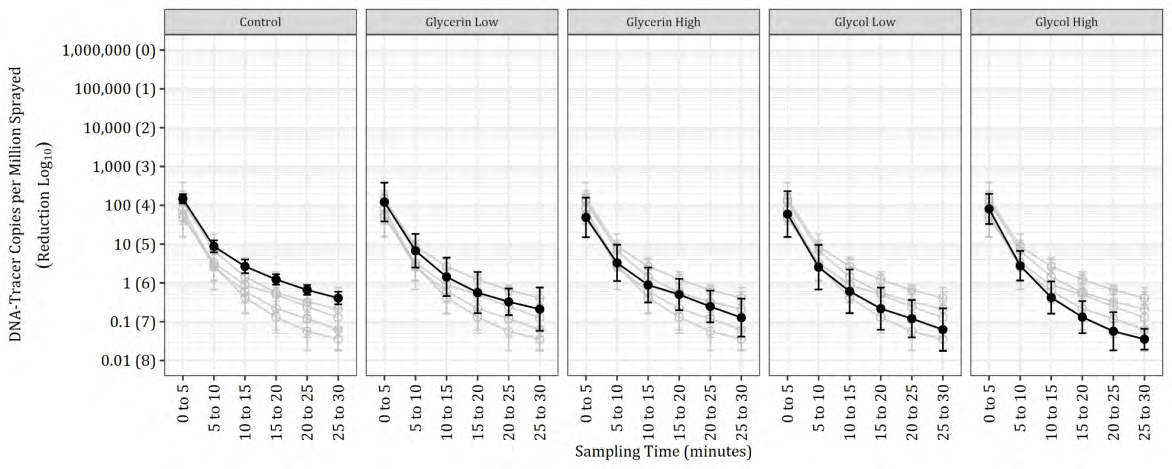
For each treatment, the mean log reduction (mean ± 95% CI) was calculated and plotted at each sampling time. The marker represents the mean and the bar and whiskers represent the 95% confidence interval around the mean. Within a treatment panel, the solid black marker and line represents that treatment’s mean log reduction curve while the grey curves represent all other treatment mean log reduction curves.
Given the sample size, no formal statistical test was applied to test the assumption of normality for the log reductions. Based on a qualitative assessment of the individual data points, the data follows a central trend;
therefore, this assumption was moderately accurate. The test for homogeneity of variance applied to the combined levels of the variables “Treatment-Sampling Time” yielded no statistically significant differences (p=0.11, K-squared=38.37). The two-way ANOVA determined the interaction between the variables “Treatment” and “Sampling Time” was not statistically significant (p=0.633, Table 3), indicating that there was no interaction between the variables and their effects on mean log reduction were independent of each other. When analyzed independently, the effect of “Treatment” was statistically significant (p<0.001), and the effect of “Sampling Time” was also statistically significant (p<0.001).
| Source | df | SS | MS | F | p |
|---|---|---|---|---|---|
| Treatment | 4 | 13.53 | 3.38 | 24.67 | <0.001 |
| Sampling Time | 5 | 154.66 | 30.93 | 225.55 | <0.001 |
| Treatment * Sampling Time | 20 | 2.37 | 0.12 | 0.86 | 0.633 |
| Residuals | 138 | 18.93 | 0.14 | - | - |
Table 3: Two-Way Analysis of Variance (ANOVA) for Treatment and Sampling Time. Key: df = degrees of freedom; SS = sum of squares;
Compared to the Control and Glycerin Low treatments, the differences in mean log reduction for nearly all other artificial fog treatments were statistically significant (p<0.001, Table 4). The difference in mean log reduction between Control and Glycerin Low treatments was not statistically significant (p=0.087). The differences in mean log reduction between treatments using the same artificial fog type were not statistically significant.
| Treatment Comparison | Mean Difference in Log Reduction | 95% CI of the Mean Difference | p | |
|---|---|---|---|---|
| Lower | Higher | |||
| Glycerin Low vs Control | 0.23 | -0.02 | 0.49 | 0.087 |
| Glycerin High vs Control* | 0.45 | 0.21 | 0.69 | <0.001 |
| Glycol Low vs Control* | 0.65 | 0.39 | 0.9 | <0.001 |
| Glycol High vs Control* | 0.78 | 0.53 | 1.02 | <0.001 |
| Glycerin High vs Glycerin Low | 0.22 | -0.04 | 0.47 | 0.129 |
| Glycol Low vs Glycerin Low* | 0.41 | 0.15 | 0.68 | <0.001 |
| Glycol High vs Glycerin Low* | 0.54 | 0.29 | 0.8 | <0.001 |
| Glycol Low vs Glycerin High | 0.2 | -0.06 | 0.45 | 0.209 |
| Glycol High vs Glycerin High* | 0.33 | 0.08 | 0.57 | 0.003 |
| Glycol High vs Glycol Low | 0.13 | -0.12 | 0.38 | 0.617 |
Table 4: Tukey Honest Significant Differences Comparing Treatment Mean Log Reductions. Key: * statistically significant; CI = con
The differences in mean log reduction between nearly each sampling time were statistically significant (p<0.05); the exception is between sampling times “20 to 25” and “25 to 30”, where the difference in mean log reduction was not statistically significant (p=0.18, Table 5).
| Sampling Time Comparison | Mean Difference in Log Reduction | 95% CI of the Mean Difference | p | |
|---|---|---|---|---|
| Lower | Higher | |||
| 5 to 10 vs 0 to 5* | 1.3 | 1.01 | 1.58 | <0.001 |
| 10 to 15 vs 0 to 5* | 1.94 | 1.65 | 2.22 | <0.001 |
| 15 to 20 vs 0 to 5* | 2.32 | 2.03 | 2.61 | <0.001 |
| 20 to 25 vs 0 to 5* | 2.61 | 2.32 | 2.9 | <0.001 |
| 25 to 30 vs 0 to 5* | 2.84 | 2.56 | 3.13 | <0.001 |
| 10 to 15 vs 5 to 10* | 0.64 | 0.35 | 0.93 | <0.001 |
| 15 to 20 vs 5 to 10* | 1.02 | 0.74 | 1.31 | <0.001 |
| 20 to 25 vs 5 to 10* | 1.32 | 1.03 | 1.6 | <0.001 |
| 25 to 30 vs 5 to 10* | 1.55 | 1.26 | 1.83 | <0.001 |
| 15 to 20 vs 10 to 15* | 0.38 | 0.1 | 0.67 | 0.002 |
| 20 to 25 vs 10 to 15* | 0.68 | 0.39 | 0.96 | <0.001 |
| 25 to 30 vs 10 to 15* | 0.91 | 0.62 | 1.2 | <0.001 |
| 20 to 25 vs 15 to 20* | 0.29 | 0.01 | 0.58 | 0.044 |
| 25 to 30 vs 15 to 20* | 0.52 | 0.24 | 0.81 | <0.001 |
| 25 to 30 vs 20 to 25 | 0.23 | -0.05 | 0.52 | 0.178 |
Table 5: Tukey Honest Significant Differences Comparing Sampling Time Mean Log Reductions. Key: * statistically significant; CI =
Discussion
At present, this study appears to be the only published and searchable study specifically investigating how artificial fog impacts the suspension time of respiratory aerosols. Related studies have investigated the health effects of artificial fog exposure or how natural fog in coastal communities enhance deposition of microbial aerosols compared to air alone [4, 7, 28]. Despite being related, those studies do not provide a useful comparison against the results of this study. The results of this study are therefore discussed with reference to other studies whenever relevant.
Suspension Time
The statistically significant findings for sampling time suggest that each subsequent five-minute interval yielded a significant decrease in suspended respiratory liquid aerosols. The suspension time trend for all treatments were similar over the first two sampling times, suggesting similar deposition activities of aerosols with and without artificial fog present. After 10 minutes, the trend for suspension time was different, suggesting that it may take time for the effect of artificial fog to impact respiratory liquid aerosols in air. After 20 minutes, the mean log reduction does not change significantly suggesting that the respiratory aerosols have deposited or are at levels below the laboratory limit of quantification.
Effect of Artificial Fog Type and Concentration
The two artificial fogs naturally decayed at different rates, in alignment with their created purposes. The glycerin- containing artificial fog was designed to stay suspended in air to create a haze effect, while the glycol-containing artificial fog was designed to be a low-lying fog [29, 30]. The difference in natural decay of each artificial fog, explained by each fog’s purpose, aligns with the observed suspension time results. Therefore, the difference in respiratory liquid aerosol suspension time may be partially explained by the natural decay properties of the artificial fogs used. There are no other relevant studies to compare these results to at present.
If the artificial fog aerosols physically combined with liquid respiratory aerosols, the newly combined liquid aerosols may be larger, heavier, resist evaporation more, and result in increased deposition regardless of the fog composition. This method of deposition via gravity, as calculated by the terminal settling velocity, is supported by particle physics and experimental data [31, 32]. Another possibility for this reduction in aerosol suspension time is the surrounding fog may not combine with the liquid respiratory aerosols, but simply reduce the potential for larger liquid aerosols to evaporate resulting in faster deposition. In this mechanism, the artificial fog, since being mainly water, acts to increase relative humidity which is known to decrease evaporation rate of liquid aerosols [33]. There are no other related artificial fog studies who conducted similar experiments to compare these observations to at present. The specific mechanism of how artificial fog aerosols influence the deposition of other liquid aerosols, particularly respiratory aerosols, is an area of research which requires additional investigation.
Given the possible effect of the physical interaction and evaporation prevention of artificial fog on respiratory aerosol suspension time, it follows that these effects would increase with increasing concentration. By the physical combination of artificial fog and respiratory aerosols mechanism, increasing fog concentration could create larger aerosols or more large aerosols, resulting in greater deposition via gravity [31, 32]. By the increased relative humidity mechanism, the increasing fog concentration could increase relative humidity, resulting in lower evaporation rates [33]. Alternatively, higher artificial fog concentrations required the fog machine to operate at higher capacity, and subsequently, resulted in more fanning of the air to disperse the fog. Turbulent air generally increases aerosol suspension time compared to stagnant air [11, 32]. Qualitatively, the fog machine released more fog and the researcher increased the rate of fanning when completing the glycol treatments and high fog concentration treatments, causing more turbulence. Therefore, it would be expected that these activities would increase suspension time of respiratory aerosols; however, the opposite was true. These activities may have led to an underestimation of the impact of the glycol and high concentration fog treatments.
Effect of Temperature and Relative Humidity
The relative humidity during the Glycol High treatment had a mean difference of -12.4% compared to the Control treatment, noticeably lower than the other artificial fog treatments. Lower relative humidity promotes increased desiccation of aerosols in air [14, 33]. One previous study identified that with decreasing relative humidity, the total mass of aerosols with a mean aerodynamic diameter of 2.5 µm in air increases, meaning the suspension time increases [14]. Given the mean differences in temperature and relative humidity between the Glycol High treatment (22.0°C and 64.1%) and Control treatment (21.7°C and 76.6%), the aerosol suspension time during the Glycerin High treatment is estimated to increase by approximately less than 1% based on the work performed by Zhao et al. (2020). Additionally, Chen and Zhao [34] determined that the influence of temperature and relative humidity on the dispersion of droplets with an initial diameter range of 0.1 to 200 µm was negligible. It is possible the differences in temperature and relative humidity may have affected the Glycol High treatment mean log reduction curve, but the impact was not expected to meaningfully alter its relationship with the Control treatment mean log reduction curve. The same is true for the other artificial fog treatments.
Statistical Significance versus Practical Significance
Across all disciplines, understanding the difference between statistical versus practical significance is important when understanding and applying study results [35]. Statistical significance determines whether the evidence supports or rejects the null hypothesis based on a set standard; however, practical significance “looks at whether the difference is large enough to be of value in a practical sense” [35]. The study results indicated that regardless of treatment type, an approximate four-log reduction was achieved in the first five minutes. A change from four to five logs is equivalent to a reduction of an additional 0.009%, and a change from five to six logs is equivalent to a reduction of an additional 0.0009%. Therefore, the amount of additional reduction yielded from using artificial fogs does not appear to be practically significant as a control measure for reducing airborne liquid respiratory aerosols.
Limitations
The limitations of this study are noteworthy. The small sample size for each treatment was limited, which impacted the resolution of mean log reduction curves and reduced the power to detect statistically significant differences in mean log reductions. Two trials were excluded from the analysis: one was a calibration trial to refine the methodology (Glycerin Low, Trial 1) and the other was analyzed for the incorrectly tagged DNA tracer (Glycol Low, Trial 3).
Despite the limited number of samples, there was consistency within each treatment and sampling time, with all mean standard deviations being less than 0.50. The samplers used were not size selective; therefore, they may have captured all aerosol size fractions and potentially captured larger aerosols outside the respiratory size range. This limitation was partially controlled by adjusting the calculated number of DNA copies to align the Flairosol spray bottle aerosol distribution with the distribution of aerosols generated by sneezing, talking, and coughing and which partially or totally evaporated. The size distribution of the artificial fog fluid aerosols generated were not measured during the study due to not having a direct-reading instrument that could provide size distributions with valid calibration factors. Therefore, the size distribution of these artificial fog aerosols was assumed based on historical data and literature. This study did not investigate how artificial fog may affect the propagation distance of respirable aerosols, nor the disinfection properties of glycerin or glycol on tagged DNA tracers. Only one type of each glycerin-containing and glycol-containing artificial fog fluid was used for this study. There are a large range of manufacturers and fluid types available, each with slightly different liquid compositions and percentages of glycerin or glycol. The impact of different liquid compositions and percentages of glycerin or glycol were outside the scope of this study.
Conclusion
This study supports that artificial fog does not increase the suspension time of respiratory aerosols in air, but rather has no effect or decreases the suspension time. Furthermore, artificial fog containing glycol decreased suspension time more than that containing glycerin. Regardless of the type of artificial fog used, suspension time decreased more with increasing artificial fog concentration, even though the decreases were not statistically significantly. In practice, the additional reduction in suspension time provided by the physical interaction of respiratory aerosols with artificial fog does not suggest any practical benefit for using artificial fog as a control measure. The principal outcome supported by this study was that artificial fog use does not increase suspension time of respiratory aerosols, and therefore, does not appear to increase the risk of airborne transmission of diseases from respiratory aerosols, such as COVID-19.
Conflicts of Interest
Authors ML, IA, PA, and MS had financial support from IATSE Local 891, DGC-BC, and UBCP/ACTRA for the submitted work; non-financial support from CITC & Omnitec Design was provided during the conduct of the study; outside the submitted work, ML, MK, and MS have performed consultancy services for Apple, Amazon Inc., IATSE Local 891, NBCUniversal, Netflix, Paramount Pictures, Sony Pictures, The Walt Disney Company, and Warner Bros Entertainment Inc. in the past three years; no other relationships or activities that could appear to have influenced the submitted work.
Acknowledgements
Thank you to the International Alliance for Theatrical Stage Employees (IATSE), Local 891, Directors Guild of Canada – BC (DGC-BC), and the Alliance of Canadian Cinema, Television and Radio Artists’ Union of British Columbia Performs (UBCP/ACTRA) for their financial support of this study. Thank you to SafeTraces Inc. for the tagged DNA tracers, sampling equipment, and laboratory analysis support. Thank you to CITC and Omnitec Design for supplying the artificial fog fluids, fog machines, and OmniAire 1200PAC Portable Air Cleaner.
Funding
This work was partially financially supported by the International Alliance for Theatrical Stage Employees (IATSE), Local 891, Directors Guild of Canada – BC (DGC-BC), and the Alliance of Canadian Cinema, Television and Radio
Artists’ Union of British Columbia Performs (UBCP/ACTRA).
References
-
Entertainment Services and Technology Association (2018) ANSI E1.5-2009 (R2018); Entertainment Technology-Theatrical Fog Made With Aqueous Solutions of Di-and Trihydric Alcohols. New York, NY: ESTA.
-
Entertainment Services and Technology Association (2019) Introduction to Modern Atmospheric Effects. 6th (Edn.), New York, NY: ESTA.
-
Magari SR, Wesley CJ, Katchen M (2017) Theatrical Fog Exposure Assessment Methods, Exposure Limits, and Health Effects-Literature Review. Prepared for Contract Services Administration Trust Fund (CSATF).
-
Teschke K, Chow Y, Netten van C, Varughese S, Kennedy SM, et al. (2005) Exposures to atmospheric effects in the entertainment industry. J Occup Environ Hyg 2(5): 277- 284.
-
Aura Health and Safety (2018a) Calibration factors for haze and fog in the film industry. Prepared for IATSE Local, pp: 891.
-
Aura Health and Safety (2018b) Addendum-Additional fog fluid calibration factors. Prepared for IATSE Local, pp: 891.
-
Teschke K, Chow Y, Brauer M, van Netten C, Varughese S, et al. (2003) Atmospheric effects in the entertainment industry: constituents, exposures and health effects. Prepared for SHAPE, the Worker’s Compensation Board of BC, and the BC Lung Association.
-
Rabaan AA, Al-Ahmed SH, Al-Malkey MK, Alsubki RA, Ezzikouri S, et al. (2021) Airborne transmission of SARS- CoV-2 is the dominant route of transmission: droplets and aerosols. Infez Med 29(1): 10-19.
-
Morawska L, Cao J (2020) Airborne transmission of SARS-CoV-2: The world should face the reality. Environ Int 139: 105730.
-
Nardell EA, Nathavitharana RR (2020) Airborne spread of SARS-CoV-2 and a potential role for air disinfection. JAMA 324(2): 141-142.
-
Tang JW, Bahnfleth WP, Bluyssen PM, Buonanno G, Jimenez JL, et al. (2021) Dismantling myths on the airborne transmission of severe acute respiratory syndrome coronavirus (SARS-CoV-2). Journal of Hospital Infection 110: 89-96.
-
Centers for Disease Control and Prevention (2020) Science Brief: SARS-CoV-2 and Potential Airborne Transmission. Centers for Disease Control and Prevention.
-
Morawska L, Milton DK (2020) It is time to address airborne transmission of coronavirus disease 2019 (COVID-19). ClNinical Infectious Diseases 71(9): 2311- 2313.
-
Zhao L, Qi Y, Luzzatto-Fegiz P, Cui Y, Zhu Y (2020) COVID-19: Effects of Environmental Conditions on the Propagation of Respiratory Droplets. Nano Letters 20(10): 7744-7750.
-
Xie X, Li Y, Chwang ATY, Ho PL, Seto WH (2007) How far droplets can move in indoor environments-revisiting the Wells evaporation-falling curve. Indoor Air 17(3): 211- 225.
-
Xie X, Li Y, Sun H, Liu L (2009) Exhaled droplets due to talking and coughing. Journal of the Royal Society Interface 6(6): S703-S714.
-
Johnson GR, Morawska L, Ristovski ZD, Hargreaves M, Mengersen K, et al. (2011) Modality of human expired aerosol size distributions. Journal of Aerosol Science 42(12): 839-851.
-
Environ International Corporation (2014) Calibration factors and time-and-distance guidelines for use of theatrical fog equipment: Aquamax with organic haze fluid and Hazemax with water vapour haze fluid. Prepared for CITC.
-
Environ International Corporation (2002) Calibration factors for monitoring theatrical smoke and haze. Prepared for Entertainment Services and Technology Association.
-
Microsoft Corporation (2018) Microsoft Excel.
-
R Core Team (2021) R: A language and environment for statistical computing. R Foundation for Statistical Computing, Vienna, Austria.
-
Wickham H, Averick M, Bryan J, Chang W, McGowan LDA, et al. (2019) Welcome to the Tidyverse. Journal of Open Source Software 4(43): 1686.
-
Bartlett MS (1937) Properties of sufficiency and statistical tests. Proceedings of the Royal Society of London. Series A-Mathematical and Physical Sciences 160(901): 268-282.
-
Montgomery DC (2017) Design and analysis of experiments. John Wiley and Sons.
-
Chambers JM, Hastie TJ (1992) Statistical models in S. Pacific Grove, CA: Wadsworth & Brooks.
-
Miller RG (1981) Simultaneous Statistical Inference. Springer.
-
SafeTraces Inc (2020) Assessing Engineering & HVAC Systems for Infection Control-The veriDARTTM Solution for the Built Environment. White Paper.
-
Evans SE, Dueker ME, Logan JR, Weathers KC (2019) The biology of fog: results from coastal Maine and Namib Desert reveal common drivers of fog microbial composition. Sci Total Environ 647: 1547-1556.
-
CITC (2021a) Water Vapor HazeTM Fluid-CITC Special Effects.
-
CITC (2021b) SmartFogTM 3 Minutes.
-
Tsuda A, Henry FS, Butler JP (2013) Particle transport and deposition: basic physics of particle kinetics. Compr Physiol 3(4): 1437-1471.
-
Kohanski MA, Lo LJ, Waring MS (2020) Review of indoor aerosol generation, transport, and control in the context of COVID‐19. Int forum of allergy rhinol 10(10): 1173- 1179.
-
Vejerano EP, Marr LC (2018) Physico-chemical characteristics of evaporating respiratory fluid droplets. Journal of The Royal Society Interface 15(139).
-
Chen C, Zhao B (2010) Some questions on dispersion of human exhaled droplets in ventilation room: answers from numerical investigation. Indoor Air 20(2): 95-111.
-
Matheson K (2008) About statistical versus practical significance. University of Guelph.
- Pattern of Gonadal Hormones in Oral Testosterone-Supplimented Male Wistar Rats with Diabetes-Induced Hypogonadism
- Re-Evaluation of the Genotoxicity of Currently Used Food Dyes in Mouse Multiple Organs Via Continuous Administration by Drinking Using the Comet Assay
- Pharmacogenetics of Type 2 Diabetes Mellitus: Linking Genetic Variability to Drug Efficacy and its Cardiovascular Outcomes
- Exploratory Proteomic Profiling of SARS-CoV-2 Infected THP-1 Macrophages Reveals Alterations in Inflammatory Response and Cellular Metabolism
- Study of Genotoxicity of Hepatocarcinogens in Multiple Organs in Mice by Feeding and Drinking Using the Comet Assay
- Spirulina Polypeptides Inhibit the Growth of Human Lung Tumor (H460) Cells