
How Bulky of Base Adducts can be Responsible for Clastogenicity rather than Mutagenicity?
Two types of TK mutants are induced by genotoxic factors; normally growing (NG) TK mutants due to point mutations of targeted TK locus, and slowly growing (SG) mutants due to gross structural changes involving the growth-regulating gene outside targeted TK locus. In this study, human lymphoblstoid WTK1 cells were used to consider how bulky n- alkylated bases can induce SG mutants. For this purpose, n-alkyl methanesulfonates (AMS) having an n-alkyl group with 3-7 carbons [n-propy methanesulfonate (PMS), n-butyl methanesulfonate (BMS), n-pentyl methanesulfonate (PeMS), n- hexyl methanesulfonate (HexMS), and heptyl methanesulfonate(HepMS)] were synthesized. n-alkyl methanesulfonates having n-alkyl groups with 1-7 carbons induced NG mutants, but n-alkyl methanesulfonates having n-alkyl groups with ≥4 carbons but not with ≤3 carbons induced SG mutants. n-Alkyl methanesulfonates having n-Alkyl groups with ≥4 carbons have been shown to induce bulky adducts that cause disturbances to the helical DNA structure and are removed by nucleotide excision repair. It could be considered that n-alkyl groups with ≥4 carbons causing disturbances to the helical DNA structure induce SG mutants to result in clastogenicity rather than mutagenicity.
Introduction
Base adducts are classified into bulky adducts and small adducts in relation to their removal processes: the former, including pyrimidine dimers induced by UV, cause disturbances to the helical DNA structure and are removed by the nucleotide excision repair (NER); the latter cause relatively minor disturbances to the helical DNA structure and are removed by the base excision repair (BER) [1]. We have previously shown that bases alkylated by n-alkyl groups with ≥4 carbons are bulky adducts that are removed by NER [2]. TK mutation assay is one traditional genotoxicity testing system. In which two types of TK mutants are detected; normally growing (NG) TK mutants due. To point mutations of targeted TK locus, and slowly growing (SG) mutants due to gross structural changes involving the growth-regulating gene outside targeted TK locus [3].
In this study, we studied how bulky n-alkylated bases can induce SG mutants. For this purpose, n-alkyl methanesulfonates (AMS) having an n-alkyl group with 3-7 carbons [n-propyl methanesulfonate (PMS), n-butyl methanesulfonate (BMS), n-pentyl methanesulfonate (PeMS), n-hexyl methanesulfonate (HexMS), and heptyl methanesulfonate (HepMS)] were synthesized.
Materials and Methods
Chemicals
AMSs having an n-alkyl group with 3-7 carbons (PMS, BMS, PeMS, HexMS, HepMS) were prepared as described previously [2, 4]. Approximately 0.1 mol of the n-alcohol [n-propyl alcohol, n-butyl alcohol, n-pentyl alcohol, n-hexyl alcohol, or n- heptyl alcohol, all alcohols (≥98% purity) were purchased from Tokyo Chemical Industry co., ltd.]. In methylene chloride solution containing a 20% molar excess of pyridine at 0°c was added to methanesulfonyl chloride over a period of 30 min, and then stirred for an additional 120 min. The reaction mixture was transferred to a separatory funnel with the aid of more methylene chloride, and then the mixture was first extracted with ice water, followed by cold 10% hydrochloric acid, saturated sodium hydrogen carbonate, and distilled water, and the methylene chloride solution was dried over anhydrous sodium sulfate and the oily ester was distilled under reduced pressure to afford 50-60% yield of the methanesulfonate ester as a colorless liquid. All n-alkyl methanesulfonates were confirmed by a Shimazu GC-8A gas chromatograph with a stationary phase of silicone DC QF-1 using the oven temperature at 180 ~ 200°C. The purity of the synthesized AMS were >99.9% from gas chromatograph meas AMS were characterized by a JEOL GX400 1H-NMR spectroscopy. The structures of synthesized AMSs were shown in Figure 1. AMSs having an n-alkyl group with 1 and 2 carbons [methyl methanesulfonate (MMS) and ethyl methanesulfonate (EMS)] were obtained from Sigma Chemicals inc. (St. Louis, MO, U.S.A.).
Cells and Chemicals
TK+/- heterozygotes of WTK1 human lymphoblastoid cells (kindly provided by Dr. M Honma, National Institute of Health Sciences) were maintained using RPMI 1640 medium (Nissui Pharmaceutical co., ltd.) supplemented with 10% horse serum (SAFC Biosciences) and 200 µg/ ml sodium pyruvate. methyl methanesulfonate (MMS) and ethyl methanesulfonate (EMS) were obtained from Sigma Chemicals inc. (St Louis, MO, USA).
TK Mutation Assay
Human lymphoblastois WTK1 cells (TK+/-) were exposed to each AMS for 2 h at the dose range at which relative survival levels were >20%. Immediately after the treatment, treated cells were seeded onto 96-well cluster dishes at 1.6 cells/well and cultured for 12 days, and then the numbers of wells with colonies were recorded to evaluate relative survival. To detect TK mutations, treated cells were cultured in fresh medium for 3 days, and then cells were seeded onto 96-well cluster dishes at 2000 cells/ well in fresh medium with 3.0 µg/ml trifluorothymidine (TFT) and 1.6 cells/well in fresh medium without TFT. For cells cultured without TFT, the numbers of wells with colonies were recorded to evaluate plating efficiency after 12 days. For cells cultured with TFT, the numbers of wells with normally growing (NG) and slowly growing (SG) colonies were recorded to evaluate TFT resistant mutation frequency after 12 and 30 days, respectively. Differences between the means of triplicated studies in treated and control groups were compared with the dunnett test after one-way anova. A p-value less than 0.05 was considered significant.
Results
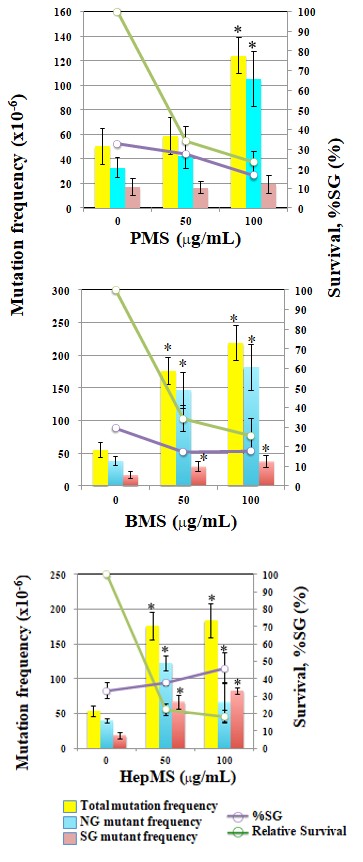
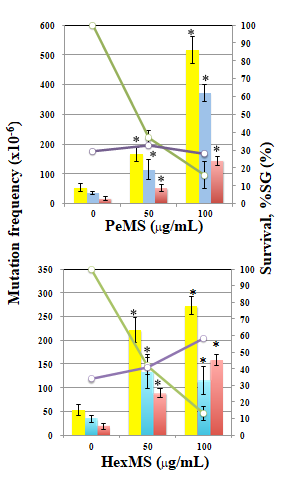
Results are shown in figure 2. BMS, PeMS, HexMS, and HepMS increased total mutation frequency and NG mutation frequency (NMF). MMS at >1 μg/ml at which relative survival was about <30% increased NMF but not SG mutant frequency (SMF). EMS increased NMF but not SMF at 200 μg/ml at which relative survival was about 30%. It also increased NMF but not SMF at 50 and 100 mg/ml at which relative survival was >50%. PMS increased NMF but not SMF at 100 μg/ml at which relative survival was <30%. BMS at 100 μg/ml at which relative survival was about 30% increased both NMF and SMF. PeMS at ≥50 μg/ml at which relative survival was about <30% increased both NMF and SMF. HexMS at ≥50 μg/ml at which relative survival was about <40% increased both NMF and SMF and % SG (% of SMF to total mutation frequency) increased dose dependently and reached to >50% at 100 μg/ml. HepMS at ≥50 μg/ml at which relative survival was about <30% increased both NMF and SMF and % SG increased dose dependently and reached to about 50% at 100 μg/ml.
![Figure 1: AMSs having an _n_-alkyl group with 1 and 2 carbons [methyl methanesulfonate (MMS) and ethyl methanesulfonate (EMS)] were obtained from Sigma Chemicals inc. (St. Louis, MO, U.S.A.).](/fulltextimages/9841/fig_1.jpeg)
Discussion
NG and SG mutants induced by 7 AMSs were studied at the dose range at which remarkable decrease in relative survival was not observed. Out of the seven, three AMSs (MMS, EMS, and PMS) did not induce SG mutants at the dose range at which relative survival was about <30%. On the other hand, four AMSs (BMS, PeMS, HexMS, and HePMS) induced not only NG but also SG mutants at the dose range at which relative survival was about <30%.therefore, it is considered that bases alkylated by n-alkyl groups with ≥4 carbons induce SG mutants. We have previously shown that NER acts to remove bases alkylated by n-alkyl groups with ≥4 carbons, BER acts to remove bases alkylated by n-alkyl groups with ≤5 carbons and that both NER and BER act to remove bases alkylated by n-alkyl groups with 4 and 5 carbons, from which it is considered that bases alkylated by n-alkyl groups with ≥4 carbons are NER-removal bulky adducts that cause disturbances to the helical DNA structure [2]. In this study, AMSs having n-alkyl groups with ≥4 carbons increased SG mutant frequencies, showing that SG mutants were induced by AMSs producing adducts repaired by NER. In WTK1 cells, ng mutants are mainly due to point mutations at targeted TK locus, while SG mutants are mainly due to gross structural changes that can result in chromosome aberrations observable by a microscopy involving the growth-regulating gene outside targeted TK locus [3]. Therefore, the former reflects mutagenic effects and the latter reflects clastogenic effects. It is known that a number of bulky base adducts produced by benzene metabolites can inhibit topoisomerase II activity, which may represent a potential mechanism for clastogenic effects of benzene [5, 6]. Based on those results, it could be considered that n-alkyl groups with ≥4 carbons causing disturbances to the helical DNA structure induce SG mutants can result in clastogenic rather than mutagenic effects.
Acknowledgements
This research was conducted in Material and Biological Engineering Course, National Institute of Technology, Hachinohe College as part of a graduation research project by Shuto Kudou and Runa Kobayashi under the research guidance of course staffs based on allocation of school educational expenses. The authors acknowledge the Material and Biological Engineering Course, National of Institute of Technology, Hachinohe College.
Consent
It is not applicable.
Ethical Approval
It is not applicable.
References
-
Mohrenweiser HW, Jones IM (1998) Variation in DNA repair is a factor in cancer susceptibility: A paradigm for the promises and Perils of individual and population risk estimation?. Mutat Res 400(1-2): 15-24.
-
Odajima C, Nakamura T, Nakamura M, Miura M, Yamasaki K, et al. (2014) Role of nucleotide excision repair or base Excision Repair in movement of various _n_-alkylated Bases, Investigated by the comet assay. Genes And Environment 36(1): 10-16.
-
Bakalkin G, Yakovleva T, Selivanova G, Magnusson K, Szekely L, et al. (1994) P53 binds Single stranded DNA ends and catalyzes DNA renaturation and strand transfer. Proc Natl Acad Sci USA 91(1): 413-417.
-
Muller Rk, Joos R, Felix D, Schreiber J, Wintner C, et al. (1976) Preparation of _n_-Aminoaziridine: trans-1-amino2,3-diphenylaziridine, 1-amino-2- phenylaziridium acetate. Organic Synthesis 55: 114-121.
-
Hutt AM, Kalf GF (1996) Inhibition of human DNA Topoisomerase Ii by Hydroquinone and _P_-benzoquinone, reactive metabolites of benzene. Environ Health Perspec 104(6): 1265-1269.
-
Hang BO (2010) Formation and repair of tobacco carcinogen-derived bulky DNA adducts. J Nucleic Acids 2010: 709521.
- Pattern of Gonadal Hormones in Oral Testosterone-Supplimented Male Wistar Rats with Diabetes-Induced Hypogonadism
- Re-Evaluation of the Genotoxicity of Currently Used Food Dyes in Mouse Multiple Organs Via Continuous Administration by Drinking Using the Comet Assay
- Pharmacogenetics of Type 2 Diabetes Mellitus: Linking Genetic Variability to Drug Efficacy and its Cardiovascular Outcomes
- Exploratory Proteomic Profiling of SARS-CoV-2 Infected THP-1 Macrophages Reveals Alterations in Inflammatory Response and Cellular Metabolism
- Study of Genotoxicity of Hepatocarcinogens in Multiple Organs in Mice by Feeding and Drinking Using the Comet Assay
- Spirulina Polypeptides Inhibit the Growth of Human Lung Tumor (H460) Cells