
Isolation and Characterization of Methoxy, Propoxy Dimethylamine from Detarium Senegalense Seed
Detarium senegalense Gmelin. is a leguminous tree widely used in Nigeria for food and medicine. It produces fruits that are nutritious. The seeds have been applied to control blood-glucose levels in diabetic individuals. Report showed that the seeds are used for the treatment of mosquito bites and as an antidote against arrow poison and snake bite. Despite its rich pharmacological potential, the plant has not been scientifically evaluated. Thus the Chemical investigation of the bioactive constituents of the seed of Detarium senegalense resulted in the isolation of a new compound, 2l, 2l,-dimethyl 11,11 7, 7- tetrahydroxy- 6 – methoxy –1- propoxy 3,4 –dimethylene 1,2, 5 –triamine. The structure was elucidated using NMR spectroscopy in combination with IR and MS spectral data. Antibacterial studies showed that the isolated compound successfully inhibited Escherichia coli, Pseudomonas aeruginosa and Proteus mirabilis. This result authenticates the use of the plant in phytomedicine for the treatment of infections and for prevention of diseases.
Introduction
Detarium senegalense Gmelin also known as “ofo” in Igbo tribe of Nigeria is a popular plant whose several parts are utilized for a variety of purposes, food, building and for folk medicine. The tree grows up to 38m high with a large very leafy crown. It produces its fruits from November to March. The fruits are 4-6 cm diameter, fibrous, sweet and one seeded [1]. The seed flour is used in food as a stabilizer, thickening and flavouring agent [2]. Recent studies showed that Detarium senegalense seed contains a large amount of water soluble, non-starch polysaccharide, zyloglucan. This suggests that it has considerable commercial potential in food, drugs and pharmaceutical industries [3]. The stem bark is macerated for preservation of palm wine in Igbo land, pulp from the bark is eaten as a remedy for tuberculosis. A bark decoction is given to women at childbirth to expel the placenta. It is used for cases of heavy blood loss and for the treatment of anaemia, skin problems, wounds, bronchitis, pneumonia, stomach ache and digestive disorders [4, 5]. The liquid from the boiled bark is taken for indigestion. A decoction of the leaves is taken to treat convulsions [2]. The roots are used for treatment against mental conditions and for protection against evil spirits [6].
Herein we report the isolation, characterization and structural elucidation of 2_l_, 2_l_,-dimethyl 1_l_ ,1_l_ 7, 7- tetrahydroxy- 6 – methoxy –1- propoxy 3,4 –dimethylene 1,2, 5 –triamine.
In addition, we investigated the antibacterial activity of methoxy, propoxy dimethylamine isolated from D. senegalense seed.
Material and Methods
Plant Materials
The seeds of Detarium senegalense were collected from the forest in Lokpaukwu, Umunneochi Nigeria. Authentication of plant materials was done by Dr. A. Nmeregini of Taxonomy Section, Forestry Department Michael Okpara University of Agriculture Umudike Nigeria. A voucher specimen No. DS/102 has been deposited at the Forestry Department Herbarium of Michael Okpara University of Agriculture Umudike, Nigeria.
Treatment of Plant Material
The seeds were soaked overnight. The loosened testa were then pealed off and dried in air. 3 kg of the seeds were air dried on the laboratory bench at Chemistry Department, Michael Okpara University of Agriculture, Umudike for 10 days. The dry sample was milled and grounded into powder (1.2 kg) using Thomas Wiley machine (model 5 USA). The powdered seed sample (1 kg) was packed into a soxhlet apparatus (2L) and extracted exhaustively with 1000 ml ethanol for 24 hours. The filtrate from the seeds was concentrated with Rotary evaporator at 40°C to a crude oil extract (59.7g). The crude extract was partitioned between CHCl3 and water and a CHCl3 - soluble fraction (18.8g) was obtained. 10.0g of the CHCl3 fraction was then partitioned between petroleum ether (60–80°C) and aqueous methanol The crude extract was partitioned between chloroform and water. A chloroform soluble fraction (20.8 g) was obtained. 15 g of the chloroform fraction were then partitioned between petroleum ether (60-80°C) and aqueous methanol. 4.0 g of the chloroform fraction was subjected to column chromatography over silica gel and eluted gradually with petroleum ether, petroleum ether- chloroform (90:10; 80:20; 70:30) to get a yellow solid 0.52 g, yellow crystal 0.73 g and yellow oil 0.20 g.
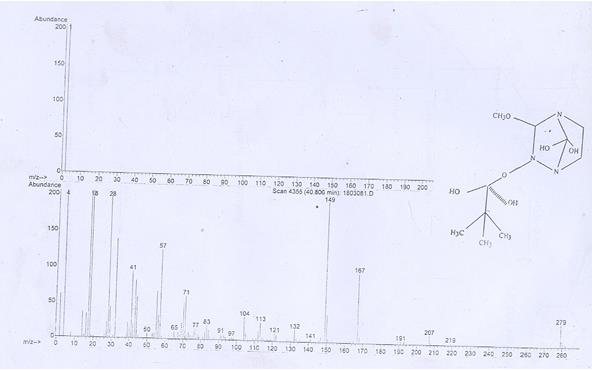
The yellow crystal (0.73 g) isolated from the seed was recrystallized from hexane, it afforded compound 1 yellow crystal solid (0.15 g). Thin layer chromatography (chloroform: methanol 7:3) iodine vapour shows the presence of one band Rf (0.81). IR Vmax 3122.01cm-1 (OH), 1650cm-1 (N-H), 2840cm-1 (C-H), 1260cm-1 (C-O) and 1211cm-1 (C-N). HEREIMS m/z 297 [m+] calculated for C10H21O6N3 and m/z 149(M+) base peak calculated for C5H11O3N2 (m/z 147).
Bioassay Procedures
The in vitro antibacterial activity of compound (1) was carried out for 24 hours culture of five selected bacteria. The bacteria organisms used were Escheria coli, Staphylococcus aureus, Pseudomonas aeruginosa, Proteus mirabilis and Klebsiella pneumonia. All the test organisms were clinical isolates of human pathogens obtained from the Federal Medical Centre (FMC) Umuahia, Nigeria.
Cultures were brought to laboratory conditions by resuscitating the organism in buffered peptone broth and thereafter agar medium and incubated at 37°C for 24 hours. The antibacterial activity was performed by filter paper disc diffusion technique. The medium (7g nutrient agar in 250 ml distilled water, auto claved at 115°C for 15 mins) was cooled to 50°C. 20ml of the medium was poured into a sterile petri dish and allowed to solidify. It was allowed to stay for 8 hours and observed for contamination. The sterility of the medium was tested. 1.0 g of compound (1) was dissolved in 1ml of absolute ethanol and made up to 10ml with distilled water to give a concentration of l00mg/ml (10% dilution), a colony of each test organism was sub- cultured on nutrient broth and incubated at 37°C for 8 hours. This was then used to flood the agar plates. Sterilized filler paper disc soaked in compound (1) was placed on the plates with test organisms. The plates were incubated at 37°C for 24 hours. After incubation, plates were observed for zones of inhibition (in mm diameter). The minimum inhibitory concentration was determined by comparing the different concentrations of compound (1) having different zones of inhibition and selecting the lowest concentration. The sensitivity susceptibility of the test bacteria to the standard drug was tested using inoculated agar plate and ciprofloxacin. The zones of inhibition were measured and compared with those of compound (1).
Results and Discussion
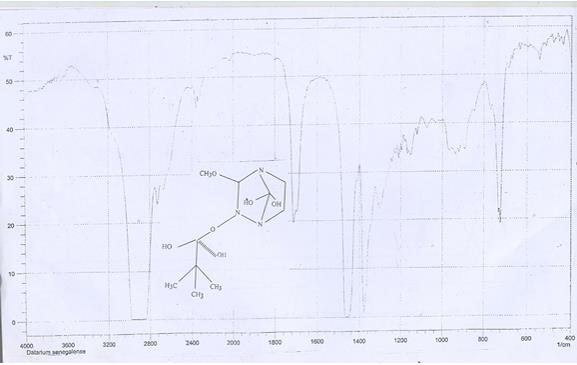
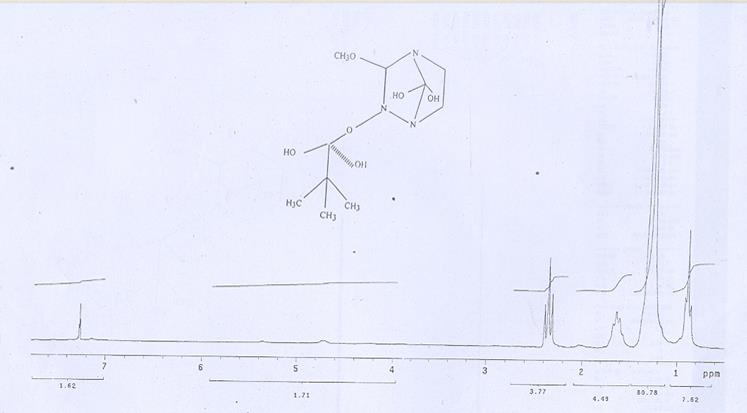
Compound (1) has Rf value of 0.394 with infrared absorption 3122.01cm-1 (OH) hydroxyl, 1650cm-1 (N-H), 2840cm-1 (C-H), 1260cm-1 (C-O) and 1211cm-1 (C-N) (Figure 3). HEREIMS m/z 297[M+] calculated for C10H21O6N3 and m/z 149(M+) base peak calculated for C5H11O3N2 (m/z 147). 1HNMR (CDCl3) has chemical shift absorption peaks at 0.98 (3Hs), 1.40 (9Hs), 1.60 (bs) OH and 2.40 (4Ht).
The result of these spectroscopic examinations IR, 1HNMR, 13CNMR and mass spectroscopy carried out on the isolate afforded compound (16). Compound (16) was identified as 2_1_,2_1_ – dimethyl 1_1_,1_1_,7,7 –tetrahydroxy – 6 – methoxy - 1 – propoxy 3,4 dimethylene 1,2,5 – triamine with the molecular formula C10H2106N3 based on HEREIMS m/z 279 with base peak at m/z 149(M+) calculated for C5H11O3 N2 (m/z 147).
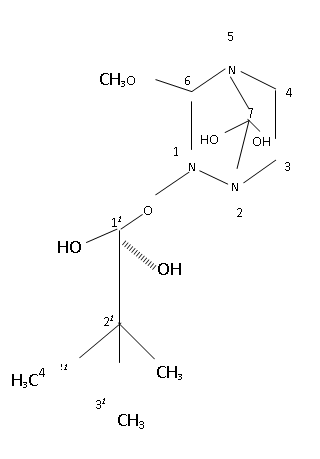
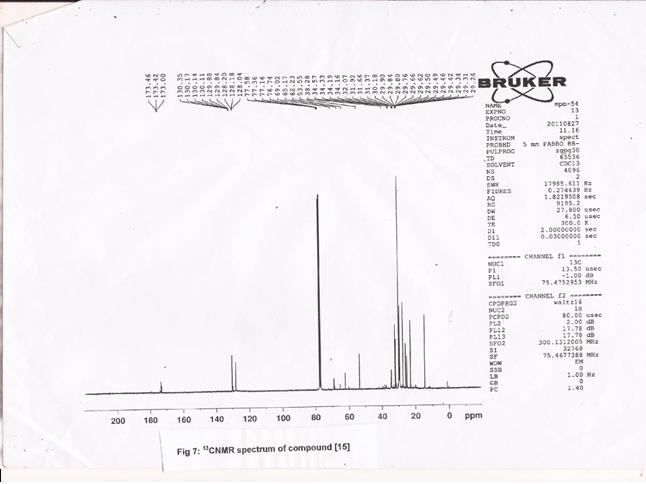
(I) 21 , 21 - dimethyl 11,11 7, 7- tetrahydroxy 6 – methoxy –1- propoxy 3,4 – dimethylene 1,2, 5 – triamine The Infrared (IR) spectrum indicated the presence of hydroxyl and tertiary amine bands (3000cm-1 and 1211cm-1) respectively. The relative molecular mass of 279 with base peak at m/z 147 (C5H11O3N2) confirmed compound (1) as 2_1_, 2_1_ -dimethyl 1_1_,1_1_,7,7 tetrahydroxy – 6- methoxy-1-propoxy 3,4-dimethylene- 1,2,5 – triamine. The 1HNMR spectrum showed four signal protons signals appearing at d 0.98 (3Hs), 1.40 (9Hs), 1.60 (OH) and 2.40 (4Ht). The three methyl protons attached to tertiary carbon (C21) appeared as a singlet absorption band at 1.40 ppm. The –CH2 –CH2- attached to C3 and C4 appeared at lower d 2.40 ppm. The 13CNMR spectrum indicated that two carbons were bonded to the hydroxyl group C-7 (δ C 33.98) and C-11 (δ 32.02). The tertiary butyl carbon C-21 appeared at δ C 29.16. Also 13CNMR showed that three carbons were bonded to a tertiary amine C-3 (δ C22.78), C-4 (δ C- 22.79) and C-6 (δ C 14.20). The results of these spectral data suggested compound (1) as 2_1_, 2_1_ –dimethyl, 1_1_, 1,1 7,7 – tetrahydroxy –6- methoxy -1- propoxy 3,4 – dimethylene 1, 2,5 –triamine.
This paper reported the isolation and characterization of an amine from the seed of D. senegalense. Amines are largely used in pharmaceutical industry. Some of them are used as analgesics, anesthetic, decongestant, antidepressants etc. Several simple amine compounds exhibit antiplasmodial and antibacterial activities. Not only are the molecules potent central nervous system stimulants but also increase cardiovascular activity and raise body temperature and cause loss of appetite. Amines are used to create amino acids, the building blocks of proteins in living beings thus they play an important role in the survival of life, many vitamins are also built from amino acids. An amine, Serotonin is an important amine that functions as one of the primary neurotransmitters for the brain. It controls the feelings of hunger and is critical for the speed with which the brain operates in general. It also affects the state of happiness and helps in regulating the sleeping and waking-up cycle of the brain [7].
The antibacterial activity of the compound isolated from the bark showed potent inhibition on some micro- organisms. The seed extracts inhibited P. mirabilis, P. aeruginosa and E.coli but did not show any activity against K. pneumonia, and S. aureus. The inability of the extracts of the seed to inhibit the growth of K. pneumonia and S. aureus indicates that the extracts of the seed cannot be used in the treatment of diseases caused by these organisms. The minimum inhibitory concentration (MIC) of the compound was 12.5 – 25 mg/ml (Table 3). P. mirabilis and E. coli are the common cause of urinary track infection and traveler’s diarrhoea, This finding showed that the seed of D. senegalense can be used in the treatment of diarrhea and urogenital infections in herbal medicine [8, 9, 10, 11]. And thus authenticates the use of the plant in phytomedicine for the treatment of infections and prevention of diseases.
| IR Absorption(CM-1) | Bond | Compound Type |
|---|---|---|
| 3122.01 | OH | Alcohol |
| 2917.00 | C-H | Alkyl |
| 1650.00 | N-H | Amine |
| 2840.00 | C-H | Alkyl |
| 1260 | C-O | Ether |
| 1211 | C-N | Amide |
Table 1: Infra-Red Analysis of Compound (1) from _Detarium Senegalense_ Seed.
| C | H | |||||
|---|---|---|---|---|---|---|
| Position | Chemical Shift() | Carbon | Chemical Shift() | Multiplicity | Proton | |
| 1 | ||||||
| 2 | ||||||
| 3 | 22.78 | CH CH 2 2 | 2.40 | 4Ht | CH CH 2 2 | |
| 4 | 22.79 | CH CH 2 2 | 2.40 | 4Ht | CH CH 2 2 | |
| 5 | ||||||
| 6 | 14.20 | OCH – N 3 | 0.98 | 3Hs | OCH 3 | |
| 7 | 33.98 | OH-C-OH | 1.60 | Bs | OH | |
| 11 | 32.02 | OH-C-OH | 1.80 | Bs | OH | |
| 21 | 29.16 | (CH ) C - 3 3 | 1.40 | 9Hs | (CH ) C 3) 3 | |
| 31 | 29.33 | CH 3 | ||||
| 411 | 29.46 | CH 3 | ||||
| 511 | 29.53 | CH 3 |
Table 2: 1h and 13c Nmr Data Of 21,21 Dimethyl 11, 11,7,7 – Tetrahydroxy 6- Methoxy – 1 – Propoxy 3, 4 –Dimethylene 1,2,5 – Triam
| Organism | Ciprofloxacin | D.senegalense Seed |
|---|---|---|
| CHCl extract 3 | ||
| Proteus mirabillis | 19.0 ± 0.05 | 6.00 ± 0.01 |
| Klebsiella pneumonia | 16.0 ± 0.02 | - |
| Staphylococus aureus | 11.0 ± 0.10 | - |
| Pseudomonas aeruginosa | 26.0 ± 0.01 | 4.00 ± 0.10 |
| Echerichia coli | 11.0 ± 0.20 | 2.00 ± 0.02 |
Table 3: Diameter of zones of inhibition (mm) of Compound (1) isolated from Detarium senegalese seed and ciprofloxacin.
Pathogens
Pseudomonas aeruginosa 9.00 6.00 2.00 1.00 - 12.5 Staphylococcus aureus - - - - - - Kebsiella pneumonia - - - - - - Proteus mirabilis 6.00 7.00 3.00 2.00 - 12.5 Concentration of seed isolate (100 mg/ml) MIC mg/ml 100 50 25 12.5 6.25 Zone of inhibition (mm) Escherichia coli 6.00 3.00 2.00 - - 25 Data are means of triplicate determinations - No zone of inhibition. Table 4: Minimum inhibitory concentration of Compound (1) isolated from seed of Detarium senegalese on the pathogens mg/ml.
References
-
Keay RWJ, Biol FT (1989) Trees of Nigeria. Oxford University press, New York, pp: 204-207.
-
Uchegbu RI, Okwu DE (2012) An Evaluation of the Phytochemical and Nutrient Composition of the Seeds and Stembark of Detarium senegalense Gmelin. Journal of Natural Sciences Research 2(5): 107-111. _3._ Wang Q, Ellis PR, Ross-Murphy SB, Burchard W (1997) Solution characteristics Of the Xyloglucan extracted from Detarium senegalense Gmelin. Carbohydrate polymers 31(2-3): 115-124_._
-
Adenkunle A, Afolayan A, Okoh B, Omotosho T, Pendota, C, et al. (2011) Chemical composition, antimicrobial activity, proximate analysis and mineral content of the seed of Detarium senegalense JF Gmelin. African Journal of Biotechnology 10(48): 9875-9879.
-
El-Kamali H (2011) Detarium senegalense. In: Gmel JF, Lemmens R, Louppe D, Oteng-Amoako A (Eds.), Protabase. Wageningen, Netherlands.
-
Dalziel JM (1995) The Useful Plants of West Tropical Africa. Crown Agents for Overseas Government and Administration, London, pp: 53.
-
Market Research Report (2014) Amines Market- Global Industry Size, Market Share, Trends, Analysis and Forecast, 2013-2019.
-
Uchegbu RI, Mbadiugha CN, Ibe CO, Achinihu IO, Sokwaibe CE (2015) Antioxidant, Anti-inflammatory and Antibacterial Activities of the Seeds of Mucuna flagellipes. American Journal of Chemistry and Applications 2(5): 116-119. _9._ Okigbo RN, Ajalie AN (2005) Inhibition of some Human Pathogens with Tropical Plants Extracts Chromolaenaodorata and citrus aurantifolis and some Antibiotics. International J of Molecular Medicines and Advance Sciences 1(1): 34-40_._ _10._ Okigbo RN, Omodamiro OD (2006) Antimicrobial effect of leaf extracts of Pigeon pea (_Cajanus cajan (L)_ _millsp_.) on some human pathogens. Journal of Herbs, Spices and Medicinal Plants 12(1-2): 117-127.
-
Burkill HM (1995) The useful plants of West Tropical Africa. Royal Botanic Gardens, London, 3: 101.
- Effects of 5-HTP and Melatonin on the Sleep Cycle of Medical Students
- Adsorption of Bisphenol A on NH4OH- Modified Rice Husk and Sugar Cane Bagasse Biochar
- Comparative Assessment of the Reinforcement Efficiency of Palm Fruit Fibre and Coconut Fibre in High Density Polyethylene (HDPE) Matrix Composite
- Importance of Bio Compounds Naturally Present in Food with Functionality in Animal Metabolism
- Sub-Acute Study on the Cardiotoxic Effects of Monosodium Glutamate Ingestion in Albino Rat
- Weight Management and Its Natural Solutions: A Review