
Effect of Food on Bioavailability of Drug through Gastro-Retentive Drug Delivery System
Gastro retentive drug delivery systems (GRDDS) have been explored for controlling the release of the drugs by oral administration. However, since these systems are intended to reside in the gastric region for longer period of time, several factors are expected to hamper the absorption rates of the drug in GRDDS. These systems are in contact with the gastric content for longer time and thus, “Food†is expected to interfere with the rate of absorption from these systems. This article focuses on various foods related factors responsible for affecting absorption from the GRDDS type of novel system.
Introduction
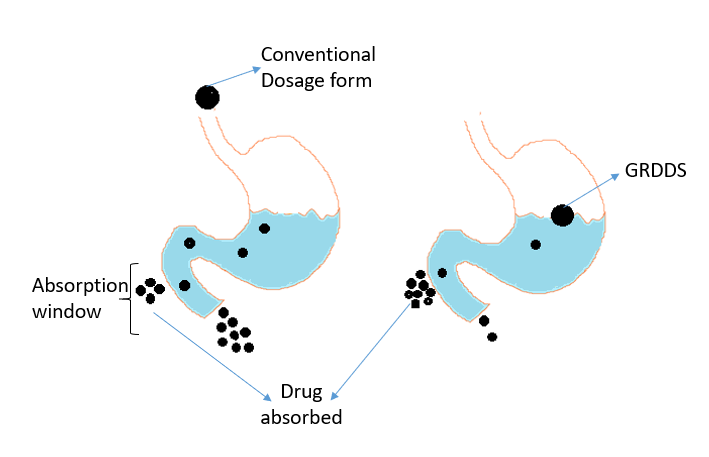
The main aim of any controlled drug delivery system is to increase the residence time of the formulation and bring about controlled release of the drug for a longer period of time. Orally administered conventional systems experience rapid gastrointestinal transit and hence complete drug release is not achieved in the gastric region. The drug incorporated in the formulation is not completely utilised and is excreted rapidly. Thus, the bioavailable fraction of the drug is very less and hence, Gastro retentive drug delivery systems (GRDDS) have been developed to increase the residence time of the dosage form in the stomach which will allow better utilization of the drug as depicted in Figure 1 [1].
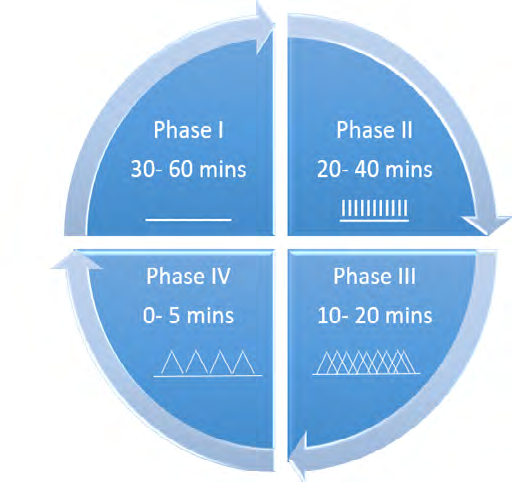
GRDDS has gained importance in oral controlled drug delivery. It is normally useful for the drugs which have absorption window in the stomach or in the upper part of intestine. The Gastrointestinal tract is continuously under the state of motility [2]. Since GRDDS resides in the stomach for longer period of time, it also experiences the gastric motility phases. The gastric motility takes place in 4 phases as depicted in Figure 2.
There are several modifications made in the GRDDS in order to resist these motility phases and to retain the system in the gastric region for extended period of time [3]. However, despite these changes, bioavailability of the drug enclosed in a GRDDS greatly depends on several factors. Since these systems have their residence in the stomach, food has a remarkable effect on the absorption of drug from these systems. Food can alter the bioavailability of a drug in various ways like stimulating gastric fluid secretion, delaying gastric emptying time, change in gastrointestinal (GI) pH, alter drug substance metabolism etc. Food interferes with the rate and extent of absorption of drug thereby varying the bioavailability of the drugs. Hence, it is essential to consider the influence of food on the bioavailability of the drugs incorporated in GRDDS.
The food related factors hampering the drug absorption are:
Fed and Fasted Condition
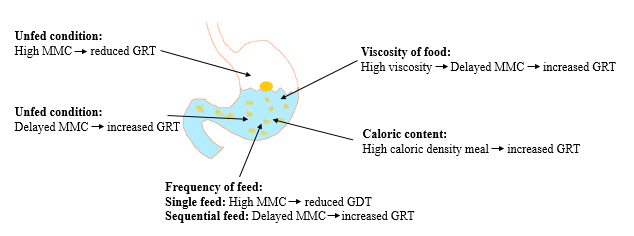
There is a strong migrating myoelectric complex that governs the gastric motility. During fasting period this wave occurs in 1 to 2 hours. The wave pushes the undigested content from the stomach to the intestine. Therefore, the time of administration of dosage form has an impact on its residence in stomach. If the time matches with that of MMC then the Gastric Residence Time of the formulation is expected to be shorter. In contrast, the fed state of stomach has delayed MMC and thus the Gastric Residence Time is competitively longer with improved absorption of drug [4]. However the studies conducted by Elkheshen et.al. showed contradictory results. The formulated Gastro retentive floating tablets of verapamil hydrochloride were tested in vivo using X-ray imaging studies on fasted beagle dogs to terminate the effect of food. It was seen that the gastric emptying time of the floating tablets was between 4 h and 5 h which means that under fasted conditions there was delay in gastric emptying time whereas according to the hypothesis fed state is the need for gastro retention of dosage form [5].
Frequency of Feed
The frequency of ingested food has an impact on MMC there by on the gastric residence time as well. When a single meal is ingested the MMC is higher leading to decrease in gastric residence time. However when the meal is taken sequentially the GRT is increase by 6-7 hours as the MMC is delayed [2, 3, 4, 5, 6].
Food Intake
The availability of meal has an influence on Gastric Residence Time of the formulation. It is reported that the Gastric Residence Time of the formulation increases if the food is present there by permitting the drug to remain in the upper gastric part for longer time ensuring increase in absorption and bioavailability of drugs [7].
Alcohol consumption is also known to have a considerable effect on gastric emptying rate. Depending upon the type of beverage and alcohol content in it, the gastric emptying rate is found to vary. Beverages with low alcohol doses like wine and beer increase gastric emptying and intestinal motility. However beverages with higher alcoholic content (ethanol) have been seen to cause increase in pyloric relaxation there by facilitating gastric emptying [8].
Type of Food
The viscosity of the food ingested also has an effect on the retention of the formulation in the upper gastro intestinal tract. Studies suggest that high viscosity food hinders the MMC there by increasing the Residence Time of the formulation [9].
The caloric content of the food greatly affects the gastric emptying rates. High caloric density meal usually increases the gastric residence time irrespective of the nature of calories namely, fats, proteins and carbohydrates. However, food rich in fats and proteins prolongs the gastric residence time of the formulation from 4hrs to 10 hrs. It is believed that osmolarity, high acidity and caloric value decreases the gastric emptying time [10, 11] (Figure 3).
Drug-Food Interdependency Based on US- FDA Guidelines
U.S. Department of Health and Human Services Food and Drug Administration, Center for Drug Evaluation and Research (CDER) has provided a database specifying various aspects of effect of food on bioavailability and fed bioequivalence studies. It is recommended to carry out randomized, single-dose, two treatment i.e fed and fasted using two sequence crossover design to study the effect of food on a modified release drug product like GRDDS. The formulation is administered under fed and fasted conditions. The fed meal should include high fat (50% of total caloric content of the food) and high calorie (800 to 1000 calories) meal food as a test meal to carryout BA and BE studies. Depending upon the food, its effect on gastric environment and its interaction with drug and the dosage form, it can be decided whether the formulation is to be given in fasted or fed conditions.
Presence or absence of food plays an important role in the rate and extent of drug absorption. The type of drug incorporated into a GRDDS will influence the requirement of food, e.g. drugs such as itraconazole, amprenavir, ketoconazole, etc. have reliable absorption depending on the acidic environment. Hence, it is recommended to take these drugs with meals, thereby prolonging the gastric retention time [12].
However, in case of certain drugs such as azithromycin, erythromycin, ampicillin, etc. show gastric instability and acid degradation and hence are recommended to be administered during fasted condition so as to increase gastric emptying in order to ensure minimum exposure to the acid environment. Hence, these drugs cannot be incorporated in the form of gastro retentive system.
References
-
Soni H (2015) Gastro retentive drug delivery system. Int J Pharm Sci Rev Res 31: 81-85.
-
Prajapati VD, Jani GK, Khutliwala TA, Zala BS (2013) Raft forming system - An upcoming approach of gastroretentive drug delivery system. J Control Release 168 (2): 151-165.
-
Mandal UK, Chatterjee B, Senjoti FG (2016) Gastro- retentive drug delivery systems and their in vivo success: A recent update. Asian J Pharm Sci 11(5): 575-584.
-
Shah S, Qaqish R, Patel V, Amiji M(1999) Evaluation of the Factors Influencing Stomach-specific Delivery of Antibacterial Agents for Helicobacter pylori Infection . J Pharm Pharmacol 51(6): 667-672.
-
Porwal A, Dwivedi H, Pathak K (2017) Decades of research in drug targeting using gastroretentive drug delivery systems for antihypertensive therapy. Brazilian J Pharm Sci 53(3): 1-15.
-
Zhu Y, Hsu WH, Hollis JH (2013) The Impact of Food Viscosity on Eating Rate, Subjective Appetite, Glycemic Response and Gastric Emptying Rate. PLoS One 8(6): 6-11.
-
Kumar N, Niranjan SK, Irchhaiya R, Verma V, Kumar V (2012) Novel approaches of floating drug delivery system: a review. Int J Pharm Res Sch 1: 96-111.
-
Bujanda L (2000) The effects of alcohol consumption upon the gastrointestinal tract. Am J Gastroenterol 95(12): 3374-3382.
-
Tripathi J, Thapa P, Maharjan R, Jeong SH (2019) Current state and future perspectives on gastroretentive drug delivery systems. Pharmaceutics 11(4): 1-22.
-
Streubel A, Siepmann J, Bodmeier R (2006) Drug delivery to the upper small intestine window using gastroretentive technologies. Curr Opin Pharmacol 6(5): 501-508.
-
Khosla R, Feely LC, Davis SS (1989) Gastrointestinal transit of non-disintegrating tablets in fed subjects. Int J Pharm 53(2): 107-117.
-
McLachlan A, Ramzan I (2006) Meals and medicines. Aust Prescr 29: 40-42.
- Effects of 5-HTP and Melatonin on the Sleep Cycle of Medical Students
- Adsorption of Bisphenol A on NH4OH- Modified Rice Husk and Sugar Cane Bagasse Biochar
- Comparative Assessment of the Reinforcement Efficiency of Palm Fruit Fibre and Coconut Fibre in High Density Polyethylene (HDPE) Matrix Composite
- Importance of Bio Compounds Naturally Present in Food with Functionality in Animal Metabolism
- Sub-Acute Study on the Cardiotoxic Effects of Monosodium Glutamate Ingestion in Albino Rat
- Weight Management and Its Natural Solutions: A Review