
Novel Approaches in Green Extraction for Natural Medicines
Green extraction is based on discovery and design of extraction process which will reduce unit operation, reduce energy consumption, reduce time consumption, reduce organic solvent use, alternate solvent with water or agro-solvent and ensure safe and high-quality extract. In this study the conventional extraction methods and various green extraction methods were compared. Both these studies on extraction process were done in the past, in this review those studies were compared. From this we can know that which method is suitable for extraction which will not harmful for the environment, promote the health of patient, produce by-product or co-product instead of waste.
Introduction
Extraction process of various bioactive compounds depends on several factors such as, a technique that is used, the raw material and the organic solvent. This is traditional method of extraction. This method is based on heating process that accelerate mass transfer between different phase of system which consumes a lot of energy and may results in degradation of thermo-labile compounds. In waste of food and plant material some bioactive compounds are present.
To overcome this problem green extraction techniques are investigated. The implementation of green extraction techniques minimizes the use of solvents decrease energy consumption, maximize efficiency, enabling process intensification and cost-effective production of high-quality extracts. The study of natural sources starts with pre- extraction and green extraction procedures. Extraction of plant materials can be done by various conventional and non-conventional methods. All these techniques have some common objectives, (a) to extract targeted bioactive compounds from complex plant sample, (b) to increase selectivity of analytical methods (c) to increase sensitivity of bioassay by increasing the concentration of targeted compounds, (d) to convert the bioactive compounds into a more suitable form for detection and separation and (e) to provide a strong and reproducible method that is independent of variations in the sample matrix.
Green Extraction
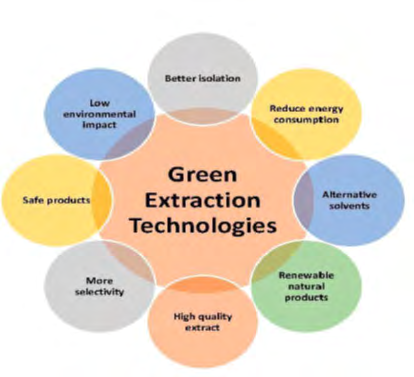
A general definition of green chemistry is the invention, design and process to reduce or to eliminate the use and generation of hazardous substance. In relation to green extraction this definition can be modified as follow “Green
extraction is based on discovery and design of extraction process which will reduce energy consumption, allows use of alternative solvents and renewable natural products, and ensure a safe and high-quality extract.” Green extraction is a way to protect both environment and human health and provide more ecologic, economic and innovative methods for that reason this method is new concept of the 21th century. Green extraction technologies are non-conventional technologies (Table 1).
| Conventional Extraction | Green Extraction |
| More Time Consuming | Less Time Consuming |
| More Energy Consumption | Less Energy Consumption |
| Use of Organic Solvent More | Use of Alternative & Agro-Solvent& Less use of Organic solvent |
| Extraction yield is low | Extraction yield is high |
| Many Unit Operations | Less Unit Operation |
| Production of Waste not Co-Product | Production of Co-Product instead of waste |
| Not use Innovative Technologies | Use Innovative Technologies |
Table 1: Conventional Extraction Vs Green Extraction.
Principles of Green Extraction
Innovation by Selection of Varieties and Use of Renewable Plant Resources
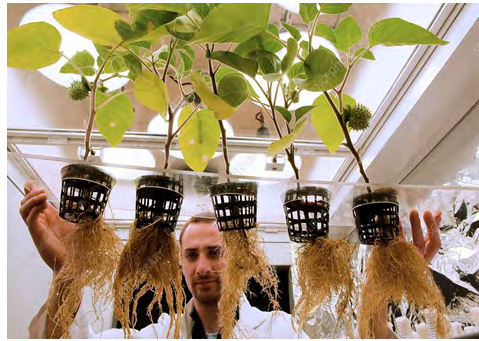
A new technology ―Plant Milking has been developed for the production and extraction of substances of interact without destroying the plant. Plants are grown in green house in liquid medium and secretion and exuding the substances through the roots in the culture medium are triggered by physical, chemical or biological stimulation. The substances are then collected by standard extraction and purification methods. This process is more directed to the production of active constituents from rare plants, whose chemical synthesis is difficultly and costly Figure 1.
Reduce Energy Consumption by Energy Recovery and Using Innovative Technologies
Extraction is particularly affected by environmental and economic factors that require a massive reduction of energy consumption and wastes produced. There are four routes to minimize energy consumption
- Optimizing existing processes
- Recovery the energy liberated during the extraction process
- Assisting existing process with intensification
- A full process innovation
Use of Alternative Solvents and Principally Water or Agro-Solvents
Current regulation on petrochemical solvent and volatile organic compounds (VOC) has effect in reducing the consumption of these chemicals. The manufacturers have to give information about the risk of using organic solvents during the extraction. Most organic solvents are flammable, volatile and often toxic and responsible for environmental pollution and damage ozone layer and greenhouse effect. For safety, environmental and economic aspects are forcing industry to use greener solvents as alternatives. The agro or bio-solvents are green solvents as alternative for petrochemical solvents. Wood, starch, vegetables oils or fruits etc. are renewable resource produced from biomass. This bio-solvents with high solvent power are non-toxic, non-flammable and biodegradable.
Reduce Unit Operation and Favors Safe, Robust and Controlled Process
To be competitive industries involved in extraction of natural products (perfume, cosmetic, pharmaceutical, food, and bio-fuel) have to combine process intensification with cleaner and safer extraction protocols. Reduce the number of steps in a process leads to reduction in costs and better use of energy. A single stage process would appear to be ideal. The arrival of new extraction technologies at production scale (pressurized liquid extraction, microwave-assisted extraction, pulsed electric field etc.) will certainly benefit those industries in the quest for more efficient extraction process on a long-term basis. For example, pulsed electric fields (PEF) assisted extraction reduces extraction time as PEF provide cell membrane permeabilization. Cell membrane is exposed to sufficient intense electric field for short time (millisecond or microsecond) during PEF treatments. For that reasons PEF enhances extraction of lipids and carotenoids (Figure 2).
Green Extraction Technologies
A number of new alternatives to conventional techniques have been proposed to extract target compounds from various plants are as follows:
- Microwave Assisted Extraction (MAE)
- Enzyme Assisted Extraction (EAE)
- Ultra-sound Assisted Extraction (UAE)
- Pulsed Electric Field Extraction (PEF)
- High voltage electrical discharges extraction (HVEDE)
- Supercritical Fluid Extraction (SFE)
- Pressurized Liquid Extraction (PLE)
Microwave Assisted Extraction (MAE)
Microwave Assisted Extraction (MAE) is innovative technology of green extraction which greatly shortens the extraction time, rate, reduce the consumption of solvent and high extraction efficiency. Unlike conventional heating which depends on conduction – convection phenomenon with eventually much of the heat energy being lost to the environment. Whereas in case of MAE, heating occurs in a targeted and selective manner with practically no heat being lost to the environment as the heating occurs in a closed system. This unique heating mechanism can significantly reduce the extraction time (usually less than 30 min) as compared to Soxhlet. The transformation of electro-magnetic energy in calorific energy occurs by Ionic conduction and Dipole rotation, which change microwave energy to thermal energy (Table 2).
| Solid-Liquid Extraction | Maceration | |
|---|---|---|
| Time of extraction 33sec | Time of extraction 24hr | Time of extraction 48hr |
| Total polyphenol content was 237.74 mg GAE/g | Total polyphenol content was 182.92 mg GAE/g | Total polyphenol content was 135.26 mg GAE/g |
| Total flavonoid content was 42.95 mg QE/g | Total flavonoid content was 37.58 mg QE/g | Total flavonoid content was 30.82 mg QE/g |
Table 2: Microwave assisted extraction for antioxidants from waste Achillea millefolium dust.
Enzyme Assisted Extraction (EAE)
Enzymes have the properties of high specificity and high efficiency. Enzyme-assisted extraction (EAE) is a potential green extraction method because of the mild extraction conditions, an alternative, ecofriendly technology that allows extraction with less use of solvents. Enzyme-assisted extraction methods are gaining more attention because of the need for eco-friendly extraction technologies. Recent studies on enzyme assisted extraction have shown faster extraction, higher recovery, reduced solvent usage and lower energy consumption when compared to non-enzymatic methods. Various enzymes such as cellulases, pectinases, β-glucosidase and hemicellulose are often required to disrupt the structural integrity of the plant cell wall, thereby enhancing the extraction of bio-actives from plants.
Ultrasound Assisted Extraction (UAE)
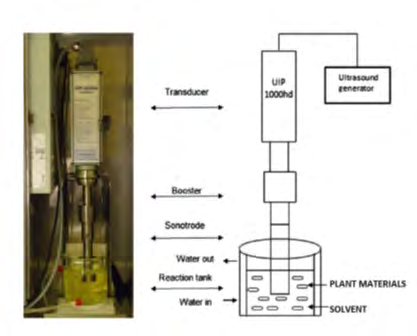
Ultrasounds have cavitational effects that accelerate heat and mass transfer via plant cell walls. Cavitation bubbles exist for few acoustic cycles before collapsing, giving rise to smaller bubbles that could act as new cavitation nuclei or simply get dissolved. The potential energy of the cavitation bubble is expanded and converted to kinetic energy. Cavitation modifies the chemical processes in the system, mainly enhancing the reaction rates of existing processes. Cavitation affects cellular structure and enhances mass transfer process. Disruption of cell walls leads to improve release of target compound from several natural sources. There is also oxidative energy of radicals created during sonolysis of the solvent which results in high extractive power of ultrasounds (Figure 3).
Pulsed Electric Field Extraction (PEF)
PEF technique is originally utilized as a non-thermal technique. Pulsed electric field treatment is a method for valuable compounds recovery from food wastes and by- products. On which material PEF is applied it is placed between two electrodes. Pulse amplitude in PEF equipment is ranging from 100-300 V/cm to 20-80 kV/cm. PEF treatment is conducted at ambient temperature or slightly higher than the ambient temperature and for a treatment time less than 1 sec. When the intensity of an applied electric field increases, the potential difference across a cell membrane also increases. If this trans-membrane potential exceeds a stated threshold value, a temporary loss of membrane semi- permeability occurs. This phenomenon of cell damage is called electroporation (or electro-permeabilization) and depending on the intensity of the electric field, it leads to the formation of temporary (reversible) or permanent (irreversible) pores. The fact that PEF is able to extract selectively the intracellular molecules without fragmenting the treated tissue makes it an interesting green extraction process, because it reduces the subsequent purification steps and also agro-solvents are generally used in the following diffusion step.
High Voltage Electrical Discharges Extraction (HVEDE)
The technology of high voltage electrical discharges is a green extraction technique as it allows enhancing the rate of extracted bio-compounds per initial vegetable material at low treatment energy input. The high voltage electrical discharges assisted extraction is a green extraction technique as it can enhance the rate of extracted bio-compounds at reduced time, low temperature and energy input. HVED technology has been used to recover bioactive compounds from several plant food materials, based on electrical breakdown phenomenon produced in cell tissues.
Supercritical Fluid Extraction (SFE)
Supercritical fluid extraction (SFE) as a green technology has been applied since the past decades. SFE can be a fast, efficient, and clean method for the extraction of natural products from several matrices. Studies on the supercritical fluid extraction of caffeic acid derivatives, phenolic compounds, flavonoids, anthocyanin, carotenoids, lycopodine, terpenoids and other antioxidants from food and medicinal plants have been done. SFE has been exploited to retain the natural character of products after their processing/ production stage and, simultaneously, avoid the presence of organic solvents as contaminants, thus increasing the market value of the final products. SFE is the process of extraction using supercritical fluids as the extracting solvent. Over the critical pressure (pc) and temperature (Tc), the solvent can be transformed into the supercritical state, which shows liquid-like (solvent power, negligible surface tension) and gas-like (elevated diffusivity and low viscosity) properties.
Pressurized Liquid Extraction (PLE)
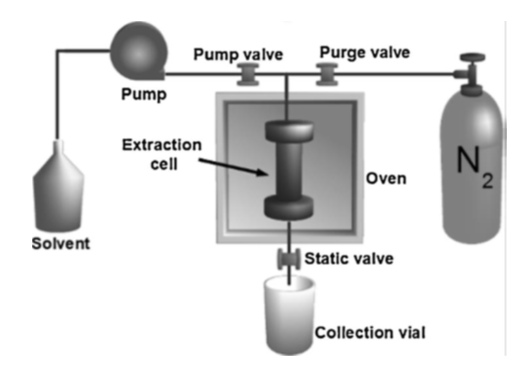
This approach for green extraction is considered as an efficient way to increase automation, which is one of the goals in the preparation of solid samples, but it may also shorten process times and reduce the amount of solvent required for sample preparation of solids. Other alternative names such as Accelerated solvent extraction ‘(ASE), Pressurized hot solvent extraction ‘(PHSE), High-pressure solvent extraction ‘(HPSE), Subcritical solvent extraction ‘(SSE) and Superheated liquid extraction ‘(SHLE). In this recently patented PLE system, the extraction process is carried out at temperatures exceeding the boiling point of a solvent what implies that the pressure inside the extraction cell must be kept high in order to maintain the solvent in a liquid state. Both temperature and pressure influence and increase the extraction efficiency (Figure 4).
Conclusion
Green extraction is a new concept with the six principles to meet challenges of 21st century, to protect environment, to promote health of patient. In this review various methods of the green extraction were compared with the conventional extraction methods. The comparison of this methods shows that green extraction method has many advantages over the conventional method. So, it can be concluded that the green extraction techniques have potential to replace the conventional extraction methods due to less time consuming, less energy consuming, water or agro solvent use as an alternative solvent, produce co-product and/or by-product instead of waste, reduce unit operations, higher extraction yield than conventional extraction.
Conflicts of Interest
The authors declare no conflict of interest.
References
-
Sic JMCJ, Barba FJ, Grimi N, Koubaa M, Brn M, et al. (2017) Electrotechnology, microwaves, and ultrasounds combined with binary mixtures of ethanol and water to extract steviol glycosides and antioxidant compounds from Stevia rebaudiana leaves. Journal of Food Processing and Preservation 41(5): 1-8.
-
Azwanida NN (2015) A Review on the Extraction Methods Use in Medicinal Plants, Principle, Strength and Limitation. Medicinal & Aromatic Plants 4(3): 3-8.
-
Soquetta MB, Terra LDM, Peixoto C (2018) Green technologies for the extraction of bioactive compounds in fruits and vegetables 16(1): 400-412.
-
Barba FJ, Zhu Z, Koubaa M, Souza A De, Ana S, et al. (2016) Green alternative methods for the extraction of antioxidant bioactive compounds from winery wastes and by-products: A review. Trends Food Sci Technol 49: 96-109.
-
Ran X, Zhang M, Wang Y, Adhikari B (2017) Novel technologies applied for recovery and value addition of high value compounds from plant byproducts: A review. Crit Rev Food Sci Nutr 59(3): 450-461.
-
Chemat F, Vian MA, Cravotto G (2012) Green Extraction of Natural Products: Concept and Principles. Int J Mol Sci 13(7): 8615-8627.
-
Chemat F, Rombaut N, Pierson JT, Bily A (2015) Green Extraction: From Concepts to Research, Education, pp: 1-36.
-
Azmir J, Zaidul ISM, Rahman MM, Sharif KM, Mohamed A, et al. (2013) Techniques for extraction of bioactive compounds from plant materials: A review. J Food Eng 117(4): 426-436.
-
Kuşçu A, Eroğlu S (2015) Applications of Green Extraction of Phytochemicals from Fruit and Vegetables. ISITES, Valencia, Spain.
-
Rombaut N, Avignon N, Vaucluse P De (2014) Green extraction processes of natural products as tools for biorefinery
-
Destandau E, Michel T, Elfakir C (2013) Microwave- assisted Extraction. In: Rostagno MA, et al. (Eds.), Natural Product Extraction: Principles and Applications. Royal Society of Chemistry, UK.
-
Calle I De, Costas-rodrı M (2017) Microwaves for Greener Extraction. In: Pereira FP, et al. (Eds.), The Application of Green Solvents in Separation Processes, pp: 253-300.
-
Mandal V, Mohan Y, Hemalatha S (2007) Review Article Microwave Assisted Extraction – An Innovative and Promising Extraction Tool for Medicinal Plant Research. Pharmacognosy Reviews 1(1): 7-18.
-
Xu D, Li Y, Meng X, Zhou T, Zhou Y, et al. (2017) Natural Antioxidants in Foods and Medicinal Plants: Extraction, Assessment and Resources. Int J Mol Sci 18(1): 96.
-
Milutinović M, Radovanovi N, Corovi M, Siler-marinkovi S, Stojanović MR, et al. (2015) Optimisation of microwave- assisted extraction parameters for antioxidants from waste Achillea millefolium dust. Industrial Crops and Products 77: 333-341.
-
Wong-paz JE, Muñiz-márquez DB, Aguilar-zárate P, Cruz K, Reyes-luna C, et al. (2017) Extraction of bioactive compounds by alternative technologies. In: Grumezescu AM, et al. (Eds,). Ingredients extraction by physicochemical methods in food, Academic Press, Alternative Technologies. Elsevier Inc, pp: 229-252.
-
Puri M, Sharma D, Barrow CJ (2012) Enzyme-assisted extraction of bioactives from plants. Trends Biotechnol 30(1): 37-44.
-
Saha S, Singh AK, Keshari AK, Raj V, Rai A, (2017) Modern Extraction Techniques for Drugs and Medicinal Agents. Elsevier Inc, pp: 65-106.
-
Rodriguez MM, Nolasco SM, Dimitrov K,.Carciochi RA, D’Alessandr LG, et al. (2017) Valorization of Agrifoo Extracting Valuable Bioactive Compounds Using Green Processes. Elsevier Inc.; 191-228.
-
Salina HF, Shima ARR, Masniza M, Faeizah HN (2013) Enzyme-assisted aqueous extraction and phenolic antioxidabts of onion oil. International Journal of Science, Environment and Technology 2(5): 949-955.
-
Tiwari BK (2015) Ultrasound: a clean, green extraction technology. Trends in Analytical Chemistry 71: 100-109.
-
Rutkowska M, Namie J (2017) Ultrasound-Assisted Extraction.
-
Pingret D (2013) Ultrasound-assisted Extraction. 21: 89- 112.
-
Li Y, Fabiano-tixier AS, Tomao V, Cravotto G, Chemat F (2013) Green ultrasound-assisted extraction of carotenoids based on the bio-refinery concept using sunflower oil as an alternative solvent. Ultrasonics Sonochemistry 20(1): 12-18.
-
Le H Van, Le VVM (2012) Comparison of enzyme- assisted and ultrasound-assisted extraction of vitamin C and phenolic compounds from acerola (Malpighia emarginata DC.) fruit. International Journal of Food Science & Technology 47(6): 1206-1214.
-
Yan L, He L, Xi J (2015) High Intensity Pulsed Electric Field as an Innovative Technique for Extraction of Bioactive Compounds - A Review. Crit Rev Food Sci Nutr 57(13): 2877-2888.
-
Puertolas E, Luengo E, Álvarez I Raso J (2012) Improving Mass Transfer to Soften Tissues by Pulsed Electric Fields: Fundamentals and Applications. Annual Review of Food Science and Technology 3: 263-282.
-
Luengo E, Álvarez I, Raso J (2013) Improving the pressing extraction of polyphenols of orange peel by pulsed electric fields. Innovative Food Science & Emerging Technologies 17: 79-84.
-
Boussetta N, Vorobiev E (2014) Extraction of valuable biocompounds assisted by high voltage electrical discharges: A review. Comptes Rendus Chimie 17(3): 197-203.
-
Roselló-soto E, Barba FJ, Parniakov O, Galanakis CM, Lebovka N (2014) High Voltage Electrical Discharges, Pulsed Electric Field, and Ultrasound Assisted Extraction of Protein and Phenolic Compounds from Olive Kernel. Food and Bioprocess Technology 8: 885-894.
-
Mendiola JA, Herrero M, Castro-puyana MA, Iba E (2010) Supercritical fluid extraction: Recent advances and applications. J Chromatogr A 1217(16): 2495-2511.
-
MeloInês MM.R.de, Portugal I Silvestre AJD, Silva CM (2017) Environmentally Benign Supercritical Fluid Extraction. In: Pereira FP, et al. (Eds.), The Application of Green Solvents in Separation Processes, pp: 325-348.
-
Wang L, Weller CL (2006) Recent advances in extraction of nutra- ceuticals from plants. Trends in Food Science & Technology 17(6): 300-312.
- Effects of 5-HTP and Melatonin on the Sleep Cycle of Medical Students
- Adsorption of Bisphenol A on NH4OH- Modified Rice Husk and Sugar Cane Bagasse Biochar
- Comparative Assessment of the Reinforcement Efficiency of Palm Fruit Fibre and Coconut Fibre in High Density Polyethylene (HDPE) Matrix Composite
- Importance of Bio Compounds Naturally Present in Food with Functionality in Animal Metabolism
- Sub-Acute Study on the Cardiotoxic Effects of Monosodium Glutamate Ingestion in Albino Rat
- Weight Management and Its Natural Solutions: A Review