
An Insight to Modified Release Dosage Form with Osmotic Drug Delivery System
Osmotic drug delivery is a technique for managing the controlled, prolonged release of medications. A semi-permeable membrane is used to separate two compartments, one of which contains the medicine and the other of which contains an osmotic agent, in the system, which is based on the osmosis principle. The medicine is pushed through the membrane at a controlled rate thanks to the pressure differential created when the osmotic agent sucks water from the body into the drug compartment. The system can be set up to disperse medications over long periods of time, from a few hours to several months. Osmotic drug delivery is superior to conventional drug delivery techniques in a number of ways, including patient compliance, adverse effects, and efficacy.
Introduction
A form of drug delivery system called osmotic drug delivery distributes medication over a long period of time at a predetermined rate. The system is based on osmosis, which is the transport of solvent molecules over a semi-permeable membrane from an area of low solute concentration to an area of high solute concentration [1, 2]. A semi-permeable membrane surrounds the medicine in an osmotic drug delivery device. Water molecules pass through the membrane and dissolve the drug when the system is exposed to bodily fluids like blood or digestive fluids [3]. The solution is then released through a tiny orifice in the membrane. The size of the aperture and the characteristics of the membrane regulate the pace of medication distribution [4].
Compared to other kinds of drug delivery systems, osmotic drug delivery systems provide a number of benefits. Without the need for frequent dosage, they can provide medication over an extended period of time, frequently for up to 24 hours or longer [5, 6]. Also, they provide regular drug delivery, which is crucial for medicines that call for exact dosage. Osmotic drug delivery systems can also be created to target certain organ systems, including the circulation or the digestive system [2, 7, 8].
Many pharmaceuticals, including painkillers, hypertension meds, and medications for treating gastrointestinal diseases, are delivered via osmotic drug delivery systems. To provide medication to animals, they are also utilized in veterinary medicine. Osmotic drug delivery systems are a form of controlled-release drug delivery system that distributes medications over an extended period of time at a controlled rate. Typically, they are made up of an osmotic agent, a semipermeable membrane, and a drug reservoir.
The medicine to be administered is kept in the drug reservoir, and the semipermeable membrane allows for the drug’s regulated release. The medicine is released as a result of the osmotic agent’s creation of a concentration gradient across the semipermeable membrane.
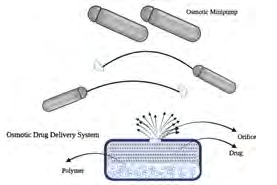
Brief explanation of Osmotic Drug Delivery Systems
Osmotic drug delivery systems may additionally incorporate other parts like a coating to shield the drug from moisture or to control the rate of release, a pump to speed up the rate of release, in addition to the drug reservoir, semipermeable membrane, and osmotic agent. In general, the precise components of an osmotic drug delivery system are adapted to the requirements of the drug being administered and the intended release profile [9, 10].
The release of medications from a device is controlled by an osmotic pressure gradient using the osmotic drug delivery technique. A semipermeable membrane, an osmotic engine, and a drug reservoir make up the osmotic drug delivery system. Water molecules enter the drug reservoir through the semipermeable membrane when the system is in an aqueous environment, causing a pressure gradient that forces the drug out of the device at a controlled rate. Consistent medication release, better patient compliance, and less frequent dosing are just a few benefits of this kind of drug delivery [11, 12]. Moreover, osmotic drug delivery systems can be created to release medications gradually over time, which is especially helpful for treating chronic illnesses.
Overall, the osmotic drug delivery system has proven to be a successful and reliable technique of drug delivery for a number of medicines and therapeutic applications. However, like any drug delivery systems, it has its limitations and possible downsides, such as the potential for membrane fouling or blockage. However, future osmotic drug delivery systems will function better and have more uses due to continuing research and development in this field. Table 1 included a few of the osmotic drug delivery systems that are readily available on the market.
| Osmotic System Type | Active Pharmaceutical Ingredients | Product Name |
|---|---|---|
| DynaCirc CR | Isradipine | Push–pull Osmotic Pum |
| Procardia XL | Nifedipine | Push–pull Osmotic Pump |
| Cardura CR | Doxazosin Mesylate | Push–pull Osmotic Pump |
| Jusnista | Hydromorphone | Push–pull Osmotic Pump |
| Topamax | Topiramate | Push–pull Osmotic Pump |
| Covera HS | Verapamil HCl | Push–pull Osmotic Pump |
| Minipress XL | Prazosin | Push–pull Osmotic Pump |
| Glucotrol XL | Glipizide | Push–pull Osmotic Pump |
| Oxycontin | Oxycodone | Push–pull Osmotic Pump |
| Acu System C | Vitamine C | Controlled Porosity Osmotic Pump |
| ActoPlus XR | Metformin HCl Pioglitazone HCl | Controlled Porosity Osmotic Pump |
| Tiamate | Diltiazem HCl | Controlled Porosity Osmotic Pump |
| Teczem | Enalapril Diltiazem | Controlled Porosity Osmotic Pump |
| Osmoran | Ranitidine HCl | Elementary Osmotic Pump |
| Volmax | Albuterol | Elementary Osmotic Pump |
| Mildugen D | Pseudoephedrine HCl Astemizol | Elementary Osmotic Pump |
| Teosona Sol | Theophylline | Elementary Osmotic Pump |
| Acutrim | Phenylpropanolamine | Elementary Osmotic Pump |
| Osmosin | Indomethacin | Elementary Osmotic Pump |
| Elafax XR | Venlafaxine HCl | Elementary Osmotic Pump |
| Tegretol XL | Carbamazepine | Elementary Osmotic Pump |
| Flexeril XL | Cyclobenzaprine | Elementary Osmotic Pump |
| Ditropan XL | Oxybutynin Chloride | Elementary Osmotic Pump |
| UT-15C | Treprostinil Diethanolamine | Implantable osmotic system |
| Altoprev | Lovastatin | Implantable osmotic system |
Table 1: Osmotic Drug Delivery System available in market.
Conclusion
In order to distribute medications at a controlled rate over a lengthy period of time, the osmotic drug delivery system makes use of osmotic pressure. The medicine is discharged from the osmotic delivery system through a tiny pore or hole in the membrane of the apparatus. The medicine is dissolved as water enters the device through a semipermeable membrane, and the resulting solution is then administered through the hole or pore. In comparison to conventional drug delivery methods, the osmotic drug delivery system provides a number of benefits, including increased patient compliance, decreased toxicity, and increased efficacy. Moreover, it offers a consistent and predictable rate of medication release, enabling more accurate dosing.
The drug being supplied and the ailment being treated determine the precise outcome of the osmotic drug delivery method. Yet, generally speaking, the system offers a dependable and regular medication delivery, making sure that the patient receives the right dosage of medication over a lengthy period of time, improving treatment outcomes.
Declarations
Consent for Publication
Nil.
Availability of Data and Material
Not Applicatble.
Authors’ Contributions
All the authors have contributed to the research work and preparation of the final manuscript.
Conflict of Interests
The authors declare no conflict of interests.
Acknowledgments
No acknowledgments.
Ethical Declaration
No animal or human subjects were used during the preparation of this manuscript.
Funding
No
References
-
Gundu R, Pekamwar S, Shelke S, Shep S, Kulkarni D (2020) Sustained release formulation of Ondansetron HCl using osmotic drug delivery approach. Drug Dev Ind Pharm 46(3): 343-355.
-
Laffleur F, Keckeis V (2020) Advances in drug delivery systems: Work in progress still needed? Int J Pharm 590: 119912.
-
Gundu R, Pekamwar S, Shelke S, Kulkarni D, Shep S (2021) Development, optimization and pharmacokinetic evaluation of biphasic extended-release osmotic drug delivery system of trospium chloride for promising application in treatment of overactive bladder. Future Journal of Pharmaceutical Sciences 7(1): 1-20.
-
Chu C, Jablonska A, Lesniak WG, Thomas AM, Lan X, et al. (2020) Optimization of osmotic blood-brain barrier opening to enable intravital microscopy studies on drug delivery in mouse cortex. J Control Release 317: 312-321.
-
Adepu S, Ramakrishna SJM (2021) Controlled drug delivery systems: current status and future directions. Molecules 26(19): 5905.
-
Rechberger JS, Power EA, Lu VM, Zhang L, Sarkaria JN, et al. (2020) Evaluating infusate parameters for direct drug delivery to the brainstem: A comparative study of convection-enhanced delivery versus osmotic pump delivery. Neurosurg Focus 48(1): E2.
-
Good WR, Lee PI (1984) Membrane–Controlled Reservoir Drug Delivery Systems. In: Langer R, et al. (Eds.), Medical applications of controlled release. 1st(Edn.), CRC Press, pp: 1-40.
-
Arévalo-Pérez R, Maderuelo C, Lanao JM (2020) Recent advances in colon drug delivery systems. J Control Release 327: 703-724.
-
Yang Q, Yuan F, Ma Y, Shi K, Yang G, et al. (2020) Electrostatic powder coated osmotic pump tablets: Influence factors of coating powder adhesion and film formation. Powder Technology 360: 444-451.
-
Chappel E (2021) Implantable drug delivery devices. In: Chappel E (Ed.), Drug Delivery Devices and Therapeutic Systems. 1st(Edn.), Elsevier, pp: 129-156.
-
Fayzullin A, Bakulina A, Mikaelyan K, Shekhter A, Guller A, et al. (2021) Implantable drug delivery systems and foreign body reaction: traversing the current clinical landscape. Bioengineering (Basel) 8(12): 205.
-
Borandeh S, Bochove BV, Teotia A, Seppälä J (2021) Polymeric drug delivery systems by additive manufacturing. Adv Drug Deliv Rev 173: 349-373.
- Effects of 5-HTP and Melatonin on the Sleep Cycle of Medical Students
- Adsorption of Bisphenol A on NH4OH- Modified Rice Husk and Sugar Cane Bagasse Biochar
- Comparative Assessment of the Reinforcement Efficiency of Palm Fruit Fibre and Coconut Fibre in High Density Polyethylene (HDPE) Matrix Composite
- Importance of Bio Compounds Naturally Present in Food with Functionality in Animal Metabolism
- Sub-Acute Study on the Cardiotoxic Effects of Monosodium Glutamate Ingestion in Albino Rat
- Weight Management and Its Natural Solutions: A Review