
Artificial Intelligence in Clinical Trials- Future Prospectives
Clinical trials are essential for delivering novel medications, technology, and procedures to the market and clinical practice. Only 10% of these studies complete the entire procedure from the drug design to the four phases of development, because clinical trials are becoming more expensive and difficult to perform. The population's health, standard treatment, health economics, and sustainability suffered greatly from this low completion rate. Artificial intelligence (AI) is one of the tools that could streamline some of the processes which are the most tedious operations, like patient selection, matching, and enrollment; better patient selection could also minimize harmful treatment and its side effects. The widespread implementation of AI technology in clinical trials still faces many challenges and requires more high-quality prospective clinical validation. In this review, we discussed the prospective applications of AI in clinical research and patient care in the future.
Introduction
Making intelligent machines is the goal of the technical and scientific discipline of artificial intelligence (AI). AI methods include Natural Language Processing (NLP), Machine Learning (ML), Optical Character Recognition (OCR), and Deep Learning (DL) [1]. It is one of the most recent advanced technologies that alter clinical trials. Due to the quick development of information technology and the accumulation of enormous amounts of biomedical data, AI development in the healthcare sector has a strong technical foundation. Researchers are exploring AI applications to enhance the effectiveness of medical diagnostics and service quality as well as reduce the complexity and risk of clinical trials [2]. Traditional clinical research is a time- consuming process with a 10% success rate. Currently, there are several areas of clinical trial process where AI is being implemented. With the help of AI, researchers can conduct a clinical study, using real-world data analysis to improve patient categorization and predict results [3]. The burden and cost of clinical development can be alleviated by using AI, while clinical trial phases can be improved. Now, many large clinical research organizations are beginning to invest in AI to advance clinical research [4]. AI could improve the effectiveness of the search for correlations between indications and biomarkers to assist in the selection of lead compounds that may have a higher possibility of success throughout clinical development. It holds out the possibility of altering critical phases of clinical trial conduct, such as study design, planning, and execution. By matching patient features to selection criteria, ML, DL, NLP, and OCR can be used to link large and heterogeneous datasets including electronic medical records (EMRs), published medical literature, and clinical trial databases to improve recruitment [5]. This article will provide an extensive review of how AI is being applied to clinical trials to make them more effective, safe, and practical for improving the design of clinical trials and promoting clinical transformation.
The Evolution of Ai In Clinical Trial
The technology and science of creating intelligent computer programs is known as AI, and it was originally defined in 1955 [6]. AI is quickly establishing itself as a comprehensive solution to a range of healthcare management issues. The global AI-based clinical trial solutions for the patient matching market size are expected to reach USD 1,969 million by 2030. According to predictions, the second fastest- growing discipline, clinical research, and development, would expand at a compound annual growth rate (CAGR) of 22.0% from 2023 to 2030 [7] Figure 1.
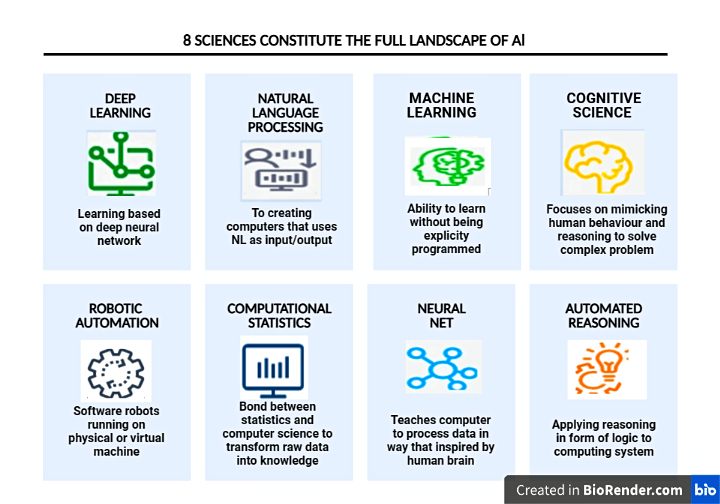
The landscape of clinical research will continue to benefit from the development of these tools as new opportunities present themselves. A comprehensive collection of artificial intelligence is represented by 8 Sciences like DL, NLP, ML, Cognitive science, Robotic automation, automated reasoning, Computational Statistics, and Neural net Figure1. The progression of AI into a more complex future state is enabled via a variety of linkages that build upon one another [8].
Problems with the Traditional Clinical Trial Process
Averages of 10-15 years are needed for the drug development process, of which 5–6 years are needed for Research & Development (R&D) and another 5–7 years are needed for clinical trials. During the clinical trial process, billions of dollars (about USD 1.5–2 billion) are invested to bring a single new drug to market [9]. Clinical trials take up around half of the total expenditure, with phase III trials being the most complex and demanding. The high failure rate of clinical trials is one of the biggest obstacles in the pipeline for developing new drugs. The amount of Phase II compounds that move on to Phase III is less than one-third. More than a third of Phase III compounds are never approved by the regulatory body. Only one of every ten compounds that enter clinical trials advances to FDA approval due to varying probabilities of success for compounds moving through each phase of the trials Figure 2. Every unsuccessful trial result in a loss ranging from US$0.8 to US$1.4 billion, which is a significant loss of the entire R&D expenditure [10]. Ironically, 10% of these extensive clinical trials are successful. Clinical trials are the most recent area of drug research that acknowledge and allow a beneficial impact of AI.
![Figure 2: Every unsuccessful trial result in a loss ranging from US$0.8 to US$1.4 billion, which is a significant loss of the entire R&D expenditure [10]. Ironically, 10% of these extensive clinical trials are successful. Clinical trials are the most recent area of drug research that acknowledge and allow a beneficial impact of AI.](/fulltextimages/10384/fig_2.png)
AI is useful to solve all these issues with the clinical trial process because it is challenging to mine various data sets for clinical trials and keeps data of every patient participating in the trial procedure. AI has the prospect to increase the likelihood of success in drug development by bringing significant improvements in multiple areas of R&D such as novel target identification, drug candidate selection, biometrics data analysis from wearable devices, and the prediction of the drug effects in patients with diseases [9].
Artificial Intelligence in Clinical Trial
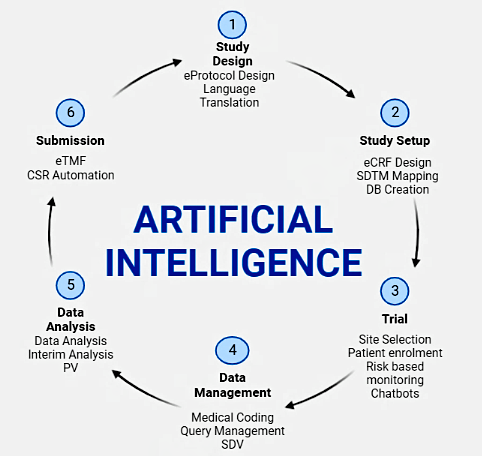
Clinical trial design, patient recruitment/selection, site selection, monitoring, data collecting, and analysis are parts of the execution and conduct of clinical trials. Out of these procedures, patient recruitment and selection is the one which poses the most difficulty; as a result, 30% of phase- III trials are early terminated and 80% of studies go through the enrolment deadline. Also, a multi-centered global study’s trial monitoring is a very costly and time-consuming operation. The time it takes from the “last subject last visit” to data submission to regulatory bodies, which involves extensive data collection and analysis procedures, is another difficulty in clinical trials. These difficulties in clinical trials have evolved due to AI and digitization [11] Figure 3.
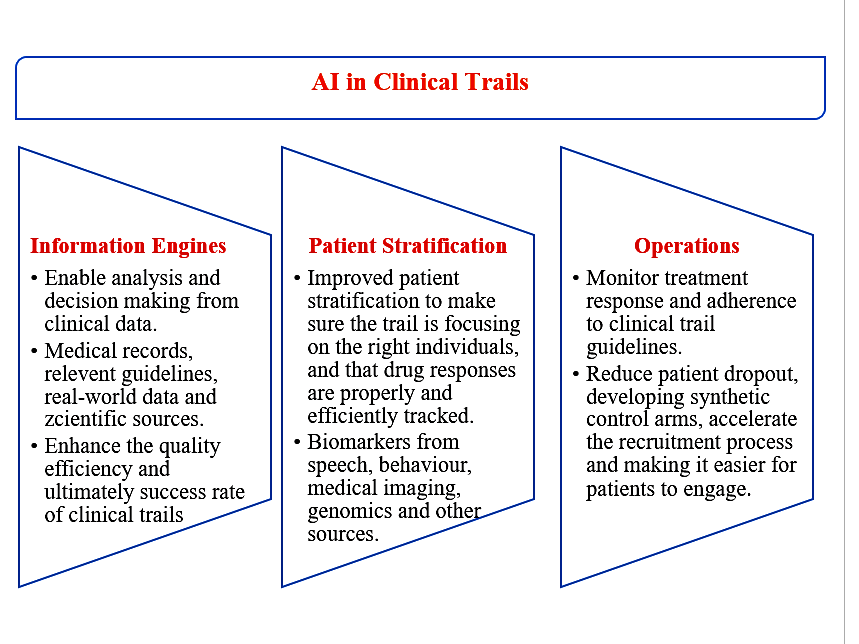
Researchers in this field are focusing on the use of AI- based software in three main areas like information engines, patient stratification, and trail operation represented in Figure 3. There is a lot of potential and opportunity for the use of artificial intelligence in clinical trials. Because of its efficiency, safety advantages (fewer errors), and cost savings, it is employed by companies all over the world. However, it also enables faster research advancements than ever before [12].
Artificial Intelligence in Protocol Development and Study Design
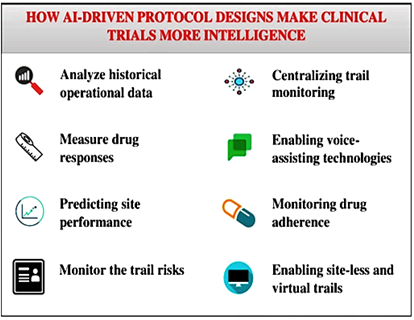
The development of a clinical protocol is the first element in every clinical trial. By extracting critical information from each protocol, providing crucial metadata, and creating a standardized protocol document, AI may improve this process. As medical compounds move closer to human trials, machine learning is playing a more significant role. To create AI-driven trial protocols make a clinical trial more efficient Figure 4 [13]. Researchers can upload procedures to also utilize NLP for protocol development to identify potential obstacles that could prevent an experiment from being completed successfully.
The poor study design harms clinical trial cost, effectiveness, and chance of success. The FDA claims that AI models help raise the standard of trial design. Bayesian nonparametric models (BNMs) have become an effective tool for designing clinical trials and have a wide range of additional uses. The clustering and trial designing time are reduced by this method. Dirichlet process mixture models and Markov Chain Monte Carlo (MCMC) methods are two BNMs that are frequently used, such BNMs have applications in clinical trial design, including dose selection in studies involving cancer patients, Immuno-oncology, and cell treatment [14]. Shorter protocol development cycles, fewer protocol modifications, and greater trial efficiency are all benefits of a more comprehensive research design [15].
Artificial Intelligence in Patient Selection
By minimizing population heterogeneity, prognostic enrichment, and predictive, AI can aid in improving patient selection. The process of choosing a patient for a clinical trial involves several steps. It would take a lot of time and money to gather the patients’ data, past medical history, or new test results. AI offers the chance to link patient data from the EMR with other patient data that is dispersed across several places, owners, and formats. An effective method for patient identification can be provided by such analysis employing computer vision techniques like OCR and NLP [5] Figure 5.
Reduced population heterogeneity, prognostic enrichment, and predictive enrichment are the three strategies provided in the FDA’s published guidance that the clinical sector can use to enhance patient selection and maximize a drug’s efficacy (Figure 5). All of these strategies could be improved by AI technologies.
Artificial Intelligence in Investigator and Site Selection
The selection of effective investigation sites is one of the most crucial trial components. Site characteristics that can affect both research durations and data quality and integrity include administrative practices, resource availability, and clinicians with extensive experience and knowledge of the disease [16]. Clinical research organizations (CROs) can use AI technology to find target sites, qualified investigators, and priority candidates. They can also gather and compile data to show regulators that the trial procedure complies with GCP guidelines [17].
Artificial Intelligence in Monitoring Trial and Endpoint Detection
By collecting and analyzing data in real-time, AI can assist a company to maintain track of a clinical trial. AI approaches, when combined with wearable technology, can provide efficient, real-time, and personalized monitoring of patients automatically and constantly during the trial. Risk-based monitoring (RBM) has recently developed as an AI-enabled, efficient, cost-effective technique alternative to traditional monitoring. A more advanced form of RBM may be able to minimize costs while increasing the efficiency and quality of data monitoring at the trial location [18]. When compared to manual reading, AI-enabled medical image- based endpoint and disease detection is much easier, cost- effective, and fast Figure 6.
Current discoveries imply that AI is capable of converting the traditional clinical trial process (Figure 6) into a more cost-effective, safer, and faster clinical trial. This can improve protocol adherence and endpoint assessment accuracy [19].
![Figure 6: Current discoveries imply that AI is capable of converting the traditional clinical trial process (Figure 6) into a more cost-effective, safer, and faster clinical trial. This can improve protocol adherence and endpoint assessment accuracy [19].](/fulltextimages/10384/fig_6.png)
Artificial Intelligence in Regulatory Submission
There is an enormous amount of record-keeping involved in the regulatory submission for a clinical trial. By using templates, ML can automate these. Clinical study report (CSR) automation can automatically create the Clinical Study Report using ML by evaluating the study protocol and the study analysis report [20, 21]. NLP techniques can be used to alter the language of the CSR and the narratives. After examining these, the medical writer can make the necessary modifications to create the final CSR. All of this could potentially be done in two to three days. The regulatory submission procedure is substantially accelerated by this technique, which also improves the submission’s quality [22]. In the future, all parties involved in clinical trial processes will make decisions that are patient-centered. Sponsors will communicate information regarding the trial, the procedure, and the participants with the patient [23]. Using AI-enabled digital health technologies and patient care systems, clinical trials can be revolutionized with more success in attracting, engaging, and keeping enthusiastic participants throughout every stage of the study until it is over.
Artificial Intelligence
Augmenting The Future Of Clinical Development
To establish clinical trials, future AI will be combined with enhanced breakthroughs in personalized healthcare and computer simulation [24]. Utilizing the capabilities of modern digital technology, virtual trials reduce the costs, delays, and difficulties faced by patients. Up to half of all studies might be supported by virtual trials, which would increase patient retention and accelerate the clinical development process. Human effort, time, and money will be conserved by AI. Large pharmaceutical companies are now starting to invest in AI. Even so, there is still potential for growth in the use of artificial intelligence in research studies mentioned in Figure 7. Investigations utilizing AI are carried out more quickly, safely, and affordably [25] Figure 7.
![Figure 7: Investigations utilizing AI are carried out more quickly, safely, and affordably [25] Figure 7.](/fulltextimages/10384/fig_7.png)
Talent, Technology, and Expertise
Sponsors require the most up-to-date information to make the most effective choices possible to maximize predictability, reduce time to market, and improve efficiency in the rapidly evolving clinical research environment.
Researchers can demonstrate and enhance the use of AI- derived insights in numerous aspects of development by implementing these techniques in clinical research [26]. To achieve the full potential of AI in clinical development, pharma companies in need partners who can provide the following information:
DEEP PHARMACEUTICAL KNOWLEDGE AND DOMAIN EXPERTISE In-depth knowledge of healthcare data for intelligent analysis, knowledge of international regulations, financial expectations, physician and patient behavior, and therapeutic abilities should all be part of this knowledge.
$$
\mathrm {B} ^ {\prime} = \mathrm {B} ^ {\prime} + \mathrm {B} ^ {\prime} + \mathrm {B} ^ {\prime} + \mathrm {B} ^ {\prime} + \mathrm {B} ^ {\prime} + \mathrm {B} ^ {\prime} + \mathrm {B} ^ {\prime} + \mathrm {B} ^ {\prime} + \mathrm {B} ^ {\prime} + \mathrm {B} ^ {\prime} + \mathrm {B} ^ {\prime} + \mathrm {B} ^ {\prime} + \mathrm {B} ^ {\prime} + \mathrm {B} ^ {\prime} + \mathrm {B} ^ {\prime} + \mathrm {B} ^ {\prime} + \mathrm {B} ^ {\prime} + \mathrm {B} ^ {\prime} + \mathrm {B} ^ {\prime} + \mathrm {B} ^ {\prime} + \mathrm {B} ^ {\prime} + \mathrm {B} ^ {\prime} + \mathrm {B} ^ {\prime} + \mathrm {B} ^ {\prime} + \mathrm {B} ^ {\prime} + \mathrm {B} ^ {\prime} + \mathrm {B} ^ {\prime} + \mathrm {B} ^ {\prime} + \mathrm {B} ^ {\prime} + \mathrm {B} ^ {\prime} + \mathrm {B} ^ {\prime} + \mathrm {B} ^ {\prime} + \mathrm {B} ^ {\prime} + \mathrm {B} ^ {\prime} + \mathrm {B} ^ {\prime} + \mathrm {B} ^ {\prime} + \mathrm {B} ^ {\prime} + \mathrm {B} ^ {\prime} + \mathrm {B} ^ {\prime} + \mathrm {B} ^ {\prime} + \mathrm {B} ^ {\prime} + \mathrm {B} ^ {\prime} + \mathrm {B} ^ {\prime} + \mathrm {B} ^ {\prime} + \mathrm {B} ^ {\prime} + \mathrm {B} ^ {\prime} + \mathrm {B} ^ {\prime} + \mathrm {B} ^ {\prime} + \mathrm {B} ^ {\prime} + \mathrm {B} ^ {\prime} STATE-OF-THE-SCIENCEAITECHNOLOGIES The solution should be able to combine discipline through the GXP Software Development Life Cycle (SDLC) approach with numerous datasets to build high-quality models and also identify global and regional trends and detailed physician and patient-level insights.
DATA ANALYTICS AND MACHINE LEARNING EXPERTS Technical professionals capable of developing machine learning algorithms relevant to the clinical development process should be a part of the vendor’s team.
ACCESS TO VAST HEALTHCARE DATASETS Algorithms using machine learning are only as effective as the data they are allowed access to. The most effective solutions will provide users access to numerous international healthcare databases, including regularly updated patient and illness trend data, prescriptions data, EMRs, drug sales data, and data from electronic medical records.
THEABILITYTOINTEGRATETHESE DISPARATE DATASETS The inconsistency of many healthcare datasets makes them challenging to analyze. An ideal partner will implement methods to “clean” the data so that the algorithms can produce more precise results.
The New Ecosystem in Clinical Trials
The clinical trial ecosystem is being drastically transformed as a result of the development of AI and new technologies. Table 1 discusses the significance of AI in the health sector [27]. In certain circumstances, CROs are considered both a partner and an opponent for these new AI-software entrants, especially for larger companies already able to execute the study through their network of clinical partner sites. CROs still supply the knowledge and network required to run a normal clinical trial. At this early point, the majority of CROs are still cautious to collaborate with AI start-ups, but now, they are beginning to observe some partnerships where CROs employ AI technologies as a differentiator for emerging companies. In addition, this will simplify start-ups’ go-to-market strategies. CROs will eventually appear to leverage AI-based technology to ensure they remain a central player in the clinical trials process. In the short term, this will be done through a combination of partnerships and start-up support, and in the longer term, this will be done through more integrated solutions [3]. The aggregate investment in AI for drug development & clinical trials has now passed $5.2B, and numerous agreements have already been established between AI start-ups and pharmaceutical companies.
| Categories | Description | |
|---|---|---|
| 1. | Recording and storage of clinical data | • It collects, stores, and analyses clinical data to provide faster access and decision-making. |
| 1. | Recording and storage of clinical data | • All patient data are electronically stored which facilitates diagnosis and treatment. |
| 2. | Clinical Trial Monitoring | • It helps to monitor patient’s the condition and follow up on all treatments. |
| 2. | Clinical Trial Monitoring | • It provides proper monitoring to obtain more information on exercise, needs and habits of the |
| 2. | Clinical Trial Monitoring | • It provides proper monitoring to obtain more information on the exercise, needs, and habits of the patient. |
| 3. | Medication alert | • It is a personal virtual assistant technology that can alert the patient of proper medication using the app. |
| 3. | Medication alert | • It provides proper monitoring and education and assists patients with personal clinical needs. |
| 4. | Trial management and services | • It improves service to the patient at the trial site. |
| 4. | Trial management and services | • It is applicable at any time for significant requirements, such as billing, time scheduling, and other clinical applications. |
| 5. | Decision-making | • AI provides human-like intelligence with the help of computer technology. |
| 5. | Decision-making | • Health professionals allow this technology for greater data accessibility which helps design/customize a decision support system. |
| 5. | Decision-making | • It seems to be the best tool to support medical decision-making with the help of available data. |
Table 1: Significance of AI in the clinical field.
Conclusion
Artificial Intelligence in clinical trials is a promising and emerging concern, and AI is allowed to hold the key to changing the way medications are developed in the future and opening up the possibility to a new paradigm of long-term, sustainable medical research. The strategy of integrating AI in the development and approval of medications is comprehensive and addresses every stage of a drug’s lifetime. The process, from target identification to medication clinical trials, has the potential to be made easier by AI. The majority of the time and money spent on the drug development process is spent on clinical trials for new molecules, and AI has been used to enhance the standard of trial design, patient selection, dose selection, patient adherence, trial monitoring, and endpoint analysis. Both the regulatory agencies and the end users are anticipating that AI technology will be comprehensible, moral, repeatable, and scalable. Regarding this, AI-enabled methodologies will be opening up a wide range of prospects in Clinical research, which may completely alter the direction of future research. About 5 to 8 years further needed to recognize the benefits of AI tools in the healthcare sector in complete. The widespread adoption of AI technology is still complicated with difficulties, and the sector needs specialized regulations, defined evaluation guidelines, and beneficial perspectives toward clinical validations.
References
-
McCarthy J (2007) What Is Artificial Intelligence? Stanford University, pp: 15.
-
Wang A, Xiu X, Liu S, Qian Q, Wu S (2022) Characteristics of Artificial Intelligence Clinical Trials in the Field of Healthcare: A Cross-Sectional Study on Clinical Trials. Gov. International Journal of Environmental Research and Public Health 19(20): 13-69.
-
Kristensen U (2020) The many faces of AI in clinical trials. Hit Consulant.
-
Taylor K, Properzi F, Cruz MJ, Ronte H, Haughey J (2020) Intelligent clinical trials: transforming through AI- enabled engagement. Deloitte Insights 21: 1-32.
-
Harrer S, Shah P, Antony B, Hu J (2019) Artificial intelligence for clinical trial design. Trends Pharmacol Sci 40(8): 577-591.
-
Bhattamisra SK, Banerjee P, Gupta P, Mayuren J, Patra S, et al. (2023) Artificial Intelligence in Pharmaceutical and Healthcare Research. Big Data and Cognitive Computing 7(1): 10.
-
Dorota-owczarek (2021) A comprehensive look at the use of AI for clinical trials. Disrupting clinical development with Artificial Intelligence. Nexcode.
-
Bohr A, Memarzadeh K (2020) The rise of artificial intelligence in healthcare applications. Artificial Intelligence in Healthcare, pp: 25-60.
-
Kolluri S, Lin J, Liu R, Zhang Y, Zhang W (2022) Machine Learning and Artificial Intelligence in Pharmaceutical Research and Development: A Review. AAPS J 24(1): 19.
-
Hay M, Thomas DW, Craighead JL, Economides C, Rosenthal J (2014) Clinical development success rates for investigational drugs. Nature biotechnology 32(1): 40-51.
-
Jiang F, Jiang Y, Zhi H, Dong Y, Li H, et al. (2017) Artificial intelligence in healthcare: past, present and future. Stroke Vasc. Neurol 2(4): 230-243.
-
Spreafico A, Hansen AR, R Abdul Razak A, Bedard PL, Siu LL (2021) The future of clinical trial design in oncology. Cancer discovery 11(4): 822-837.
-
Intelligent clinical trials transforming through AI- enabled engagement. Deloitte Insights.
-
Li M, Liu R, Lin J, Bunn V, Zhao H (2020) Bayesian semi- parametric design (BSD) for adaptive dose-finding with multiple strata. Journal of biopharmaceutical statistics 30(5): 806-820.
-
Liu R, Lin J, Li P (2020) Design considerations for phase I/II dose-finding clinical trials in Immuno-oncology and cell therapy. Contemporary clinical trials 96: 106083.
-
Calaprice-Whitty D, Galil K, Salloum W, Zariv A, Jimenez B (2020) Improving clinical trial participant pre-screening with artificial intelligence (AI): a comparison of the results of AI-assisted vs standard methods in 3 oncology trials. Therapeutic Innovation & Regulatory Science 54(1): 69-74.
-
Lee Y, Dinakarpandian D, Katakam N, Owens D (2010) MindTrial An intelligent system for clinical trials. InAMIA Annual Symposium Proceedings, American Medical Informatics Association 2010: 442-446.
-
Glass L, Shorter G, Patil R (2019) Improving safety, and accelerating results. Ai in Clinical Development.
-
Bhatt A (2021) Artificial intelligence in managing clinical trial design and conduct: Man, and machine still on the learning curve? Perspectives in Clinical Research 12(1): 1-3.
-
Yang KK, Wu Z, Arnold FH (2019) Machine-learning- guided directed evolution for protein engineering. Nature methods 16: 687-694.
-
Evans SR (2010) Fundamentals of clinical trial design. Journal of experimental stroke & translational medicine 3(1): 19-27.
-
Narayanan H, Dingfelder F, Butté A, Lorenzen N, Sokolov M, et al. (2021) Machine learning for biologics: opportunities for protein engineering, developability, and formulation. Trends in pharmacological sciences 42(3): 151-165.
-
Shah P, Kendall F, Khozin S, Goosen R, Hu J, et al. (2019) Artificial intelligence and machine learning in clinical development: a translational perspective. NPJ digital medicine 2: 69.
-
Wang Z, Gao C, Glass LM, Sun J (2022) Artificial Intelligence for In Silico Clinical Trials: A Review. Quantitative Biology.
-
Soni N, Sharma EK, Singh N, Kapoor A (2019) Impact of artificial intelligence on businesses: from research, innovation, market deployment to future shifts in business models. Economics.
-
Weissler EH, Naumann T, Andersson T, Ranganath R, Elemento O, et al. (2021) The role of machine learning in clinical research: transforming the future of evidence generation. Trials 22(1): 1-5.
-
Haleem A, Javaid M, Khan IH (2019) Current status and applications of artificial intelligence (AI) in the medical field: An overview. Current Medicine Research and Practice 9(6): 231-237.
- Effects of 5-HTP and Melatonin on the Sleep Cycle of Medical Students
- Adsorption of Bisphenol A on NH4OH- Modified Rice Husk and Sugar Cane Bagasse Biochar
- Comparative Assessment of the Reinforcement Efficiency of Palm Fruit Fibre and Coconut Fibre in High Density Polyethylene (HDPE) Matrix Composite
- Importance of Bio Compounds Naturally Present in Food with Functionality in Animal Metabolism
- Sub-Acute Study on the Cardiotoxic Effects of Monosodium Glutamate Ingestion in Albino Rat
- Weight Management and Its Natural Solutions: A Review