
Animal Models Used for Bioavailability and Bioequivalence Studies: Focus on Their Human Likeness
Bioequivalence (BE) and bioavailability (BA) studies are important for the development of new drugs and their approval by regulatory agencies. To determine the safety and efficacy of a drug, it is necessary to evaluate its bioavailability and bioequivalence. In vivo preclinical studies of BEBA are needed to explore the pharmacokinetic properties and behaviour of drugs. The in vivo BEBA studies data helps to get the proximate pharmacokinetic human values for clinical studies. The selection of animal models for BEBA studies plays a crucial role, which should mimic the anatomical and physiological state of humans. In this study, we have extensively reviewed the commonly used animal models for BEBA studies i.e. rodents, rabbits, canines, pigs, and non-human primates, and their relevance with human physiology. Besides the selected models rats have similar absorption, distribution, metabolism, and excretion profile to humans. Beagle dogs are an alternative commonly used in the study of oral bioavailability, as they share many similarities with humans in terms of gastrointestinal anatomy and physiology. This extensive review provides valuable information about the selection of proper animal models for BEBA studies.
Introduction
Bioequivalence (BE) and Bioavailability (BA) studies are much needed in drug development to ensure the efficacy, pharmacokinetic (PK) parameters, and safety profiles of drug candidates. Bioavailability refers to the fraction of an administered drug that reaches the systemic circulation and is available at the site of action, whereas bioequivalence refers to the comparison of the bioavailability of a new drug product with that of a reference drug product [1, 2]. The demonstration of bioequivalence of the innovator medication with generic drugs is a statutory requirement of regulatory approval. BEBA studies are required by regulatory agencies such as the FDA to ensure the quality, safety, and effectiveness of drug products. Bioavailability studies are necessary during the development of new drugs to determine optimal dosing regimens, and dose proportionality of the generic drugs and also provide pharmacokinetic and pharmacodynamic information about the therapeutic products [3]. The bioequivalence documentation is important during the Investigational New Drug Application (INDA) and New Drug Application (NDA) phase of drug development to establish the links between the formulations used in early and late clinical trials, stability studies, and then to be marketed therapeutic product [4]. Hence in drug development, preclinical BEBA studies in animal models are most needed to demonstrate whether the new drug is orally bioavailable and to gain first insight into in vivo pharmacokinetic parameters that can subsequently be used to predict human values. When conducting preclinical BEBA studies, researchers typically use animal models that have similar physiological characteristics to humans. The most commonly used models include mice, rats, rabbits, dogs, pigs, and non-human primates, depending on the drug being tested (Figure 1) [5, 6]. All these models have some advantages as well as challenges; the selection of in vivo model is the crucial factor to get reliable human values. Besides this study review the in vivo animal model used for BEBA studies and their physiological relevance to human in terms of pharmacokinetic profiles.
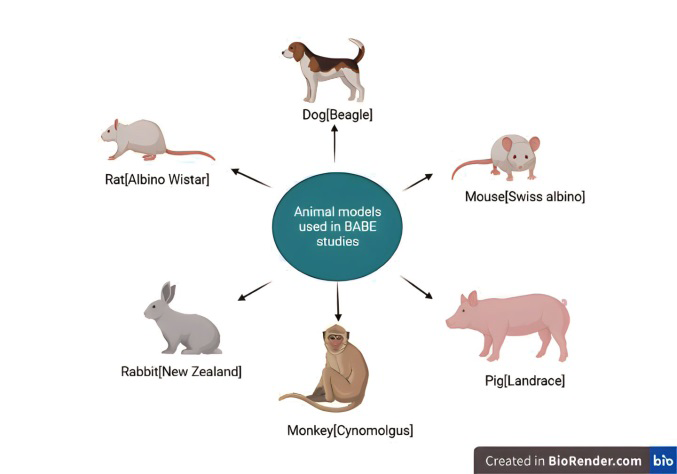
Animal Models Used in Bioequivalence and Bioavailability Studies
Rats & Mice Models
Rats and mice are the most commonly used rodent models for bioequivalence and bioavailability studies due to their size, and ease of handling. There are many similarities and difference in gastrointestinal physiology reported between human and rat, even though rat is considered to be good predictor model for oral absorption and intestinal permeability studies [7, 8, 9]. Because high reliability was reported in rats and humans, like jejuna permeability, gastric emptying time in the fasted rats (15-30 min) is somewhat nearer to humans (10-15 min), and gastric pH of rats in the fasting condition is also closer to humans. Additionally, the transporter protein expression in the small intestine is similar [10]. Both rats and mice are commonly used models for distribution studies because the organic anion transport polypeptides (OATPs) mediate the transport in rodents resemble the use of OATPs in humans. Rodents used in metabolic studies are limited due to a lack of proper data regarding metabolic enzymes. Rats also have different isoforms of CYP enzymes which are not found in humans. In the elimination studies rats share the organic cationic transporters (OCTs) and organic anionic transporters (OATs) families of transporter proteins in humans, if the drugs are eliminated by this family of transporters rat might be used as a model for elimination studies [9, 10].
The mouse model is the extensively used model in BEBA studies. The GI tract of mice shares some similarities with the human GIT; for instance, both have finger-shaped villus morphology [11]. Similar to rats, mice have lower pH in the small and large intestines than humans, which may have implications for evaluating the acidic drug absorption and oral drug delivery systems, especially pH-sensitive systems. The metabolic enzymes in mice are not abundant compared to other animal models and are mainly limited to ATP-binding cassette (ABC) transporters and CYP450 enzymes. Besides, in both rat and mouse models, the major limitation is the size of the species, which does not allow the use of intact dosage forms, such as tablets or capsules. The inability to administer the final intact dosage form orally is a crucial limiting factor for screening formulations in rodents [12, 13].
Rabbit Model
Unlike rodents, rabbit is the alternative model used in absorption and permeability studies by using the buccal mucosal route which has a non-keratinized mucosal lining similar to human tissue and is used extensively in experimental studies. Rabbits have a larger blood volume and can tolerate higher doses of drugs than rodents. It is one of the most often used animals in ophthalmic research studies, primarily because the shape and structure of the rabbit eye are analogous to those of the human eye. As a result, the rabbit is regularly used as a model in studies of the ocular distribution of various ophthalmic medication products. The advantages of using the rabbit model over other large species, such as dogs or primates, go beyond physical similarities. These include ease of handling for experimental manipulation and study observation, wide availability, and relative economy [14, 15].
Dog Model
Dogs are also commonly used models for bioequivalence and bioavailability studies, especially for oral drug delivery systems. It has traditionally been the most commonly used large animal model in drug development. Beagle dogs are commonly selected canine species in BEBA studies, as they share many similarities in human gastrointestinal tract anatomy and physiology [10, 16]. These are making them good models for studying gastrointestinal absorption, distribution, and metabolism of drugs. As dogs can easily be administered with human-sized dosage forms, this animal model appeared to be appropriate for the optimization of drug formulations during the developmental stage [17].
Dogs are observed to have high permeability intestinal mucosa when compared to rats. It may also be a good in vivo model for bioequivalent study for controlled release products and also the most commonly used model for in vivo absorption studies for drugs whose absorption is dependent upon pH. Dogs are known to have similar pH to human changes overall, although they have a higher stomach pH in the fasted dog is considered to be an average higher and more variable than in humans, ranging between 1.5 and 6.8 [10, 18]. The colonic bioavailability of drugs given in dogs has been similar to that of humans. Additionally, dogs have similar distribution and metabolic kinetics to humans [19]. Hence dogs are reasonable animal models, but there are clear species differences in regional intestinal metabolism that still need to be further evaluated.
Pig Model
Pigs are an alternative animal model for biomedical and pharmaceutical research. In recent years, pigs have been utilized more frequently as preclinical models to evaluate the oral bioavailability of pharmaceuticals. There are several breeds of pigs used in pharmaceutical research but the most widely used are Landrace (LR) and Gottingen mini pigs. The principal advantage of this model is that it closely resembles humans in terms of the anatomical, physiological, and biochemical characteristics of the GIT [20]. For instance, the GI pH profiles of pigs and humans have comparatively similar pH ranges and patterns throughout the GIT. Because of this resemblance, this model has a distinct advantage over the canine model, making pig models appropriate for testing pH-responsive drugs and drug delivery systems. In addition, the luminal surface of the small intestine, residence time, digestive properties, and colon microbiome are considered to be similar to humans [21, 22]. Thus, the aforementioned similarities, pigs can be used as useful models for assessing the absorption profiles of medications that are mostly absorbed in the small intestine, taking into account, the possibility of a slower gastric emptying rate.
Non-Human Primates
According to recent research, no animal can accurately duplicate the human gastrointestinal system [6]. The structure and physiology of the gastrointestinal tract in non- human primates, however, it is the most comparable to that of humans. Similar to those in humans, include the gastric pH, gastric emptying time, contraction force, and small intestine transit time. Cynomolgus monkeys, and rhesus monkeys, possess the most metabolic similarities related to humans, specifically regarding the CYP enzymes. The fact that use of non-human primates is that some monkeys have much higher first-pass metabolism, higher amounts of the CYP3A subfamily enzyme, and multi-drug resistance protein 1 and 2 [8, 11, 23]. If the drug of interest is anticipated to be metabolized by these enzymes, a different animal model should be utilized for absorption and metabolic research. The use of non-human primates is often limited due to ethical concerns.
Conclusion
In conclusion, preclinical in vivo bioequivalence and bioavailability studies are essential to assess the safety and efficacy of drug products in clinical studies. These studies involve comparing the pharmacokinetic profiles of test and reference formulations in animals. The results of these studies are mainly depending on the selection of the animal model and its similarity with human physiology. Various animal species are used in these studies, including rats, mice, dogs, rabbits, and non-human primates, which have different physiological and metabolic profiles compared to humans, making it important to select an appropriate model to accurately reflect human kinetics and pharmacodynamics. However, among all the animal models, rats are commonly used in bioequivalence and bioavailability studies due to their small size, ease of handling, and relatively low cost. Rats also have a similar absorption, distribution, metabolic, and excretion profile to humans, making them a useful model for predicting drug behavior in humans. However, rats have not been widely used in the optimization of formulations because of technical problems, such as the size of the tablets and gavage needles. Beagle dogs are another alternative commonly used in the study of oral bioavailability, as they share many similarities with humans in terms of gastrointestinal anatomy and physiology. It’s important to note that animal models are not perfect predictors of human responses, and the results obtained from these studies should be interpreted with caution. Therefore, it’s crucial to conduct human clinical trials to confirm the safety and efficacy of drug products before they are approved for use in humans.
References
-
Chow SC (2014) Bioavailability and bioequivalence in drug development. Wiley Interdiscip Rev Comput Stat 6(4): 304-312.
-
Rescigno A (2003) Bioavailability and bioequivalence. In: Foundations of Pharmacokinetics. Springer, Boston, USA, pp: 171-177.
-
Chen ML, Shah V, Patnaik R, Adams W, Hussain A, et al. (2001) Bioavailability and bioequivalence: an FDA regulatory overview. Pharmaceutical research 18(12): 1645-1650.
-
Williams RL, Adams W, Chen ML, Hare D, Hussain A, et al. (2000) Where are we now and where do we go next in terms of the scientific basis for regulation on bioavailability and bioequivalence. Eur j drug metab pharmacokinet 25(1): 7-12.
-
Mukherjee P, Roy S, Ghosh D, Nandi SK (2022) Role of animal models in biomedical research: a review. Lab Anim Res 38(1): 18.
-
Brake K, Gumireddy A, Tiwari A, Chauhan H, Kumari D, et al. (2017) In vivo Studies for Drug Development via Oral Delivery: Challenges, Animal Models and Techniques. Pharm Anal Acta 8(8): 560.
-
Kosugi Y, Yamamoto S, Sano N, Furuta A, Igari T, et al. (2015) Evaluation of acid tolerance of drugs using rats and dogs controlled for gastric acid secretion. J Pharm Sci 104(9): 2887-2893.
-
Tang C, Prueksaritanont T (2010) Use of in vivo animal models to assess pharmacokinetic drug-drug interactions. Pharm res 27(9): 1772-1787.
-
Cao X, Gibbs ST, Fang L, Miller HA, Landowski CP, et al. (2006) Why is it challenging to predict intestinal drug absorption and oral bioavailability in human using rat model. Pharm res 23(8): 1675-1686.
-
Xu Y, Shrestha N, Préat V, Beloqui A (2021) An overview of in vitro, ex vivo and in vivo models for studying the transport of drugs across intestinal barriers. Advanced Drug Delivery Reviews 175: 113795.
-
Sjogren E, Abrahamsson B, Augustijns P, Becker D, Bolger MB, et al. (2014) In vivo methods for drug absorption -comparative physiologies, model selection, correlations with in vitro methods (IVIVC), and applications for formulation/API/excipient characterization including food effects. Eur J Pharm Sci 57: 99-151.
-
Zhang QY, Dunbar D, Kaminsky LS (2003) Characterization of mouse small intestinal cytochrome P450 expression. Drug Metab Dispos 31(11): 1346-1351.
-
Mutch DM, Anderle P, Fiaux M, Mansourian R, Vidal K, et al. (2004) Regional variations in ABC transporter expression along the mouse intestinal tract. Physiol Genomics 17(1): 11-20.
-
Chockalingam A, Xu L, Stewart S, LeMerdy M, Tsakalozou E, et al. (2019) Protocol for evaluation of topical ophthalmic drug products in different compartments of fresh eye tissues in a rabbit model. J Pharmacol Toxicol Methods 96: 9-14.
-
Shojaei AH (1998) Buccal mucosa as a route for systemic drug delivery: a review. J Pharm Pharm Sci 1(1): 15-30.
-
Papich MG, Martinez MN (2015) Applying biopharmaceutical classification system (BCS) criteria to predict oral absorption of drugs in dogs: challenges and pitfalls. The AAPS journal 17(4): 948-964.
-
Dahlgren D, Roos C, Johansson P, Tannergren C, Lundqvist A, et al. (2018) The effects of three absorption-modifying critical excipients on the in vivo intestinal absorption of six model compounds in rats and dogs. Int j pharm 547(1-2): 158-168.
-
Sutton SC (2004) Companion animal physiology and dosage form performance. Adv Drug Deliv Rev 56(10): 1383-1398.
-
Haller S, Schuler F, Lazic SE, Bachir-Cherif D, Krämer SD, et al. (2012) Expression profiles of metabolic enzymes and drug transporters in the liver and along the intestine of beagle dogs. Drug Metab Dispos 40(8): 1603-1611.
-
Henze LJ, Koehl NJ, O’Shea JP, Kostewicz ES, Holm R, et al. (2019) The pig as a preclinical model for predicting oral bioavailability and in vivo performance of pharmaceutical oral dosage forms: a PEARRL review. J pharm pharmacol 71(4): 581-602.
-
Puccinelli P, Gervasi G, Longo V (2011) Xenobiotic metabolizing cytochrome P450 in pig, a promising animal model. Curr Drug Metab 12(6): 507-525.
-
Hossain M, Abramowitz W, Watrous BJ, Szpunar GJ, Ayres JW, et al. (1990) Gastrointestinal transit of nondisintegrating, nonerodible oral dosage forms in pigs. Pharm Res 7(11): 1163-1166.
-
Gibson G, Plant N, Swales K, Ayrton A, El-Sankary W, et al. (2002) Receptor dependent transcriptional activation of cytochrome P4503A genes: Induction mechanisms, species differences and interindividual variation in man. Xenobiotica 32(3): 165-206.
- Effects of 5-HTP and Melatonin on the Sleep Cycle of Medical Students
- Adsorption of Bisphenol A on NH4OH- Modified Rice Husk and Sugar Cane Bagasse Biochar
- Comparative Assessment of the Reinforcement Efficiency of Palm Fruit Fibre and Coconut Fibre in High Density Polyethylene (HDPE) Matrix Composite
- Importance of Bio Compounds Naturally Present in Food with Functionality in Animal Metabolism
- Sub-Acute Study on the Cardiotoxic Effects of Monosodium Glutamate Ingestion in Albino Rat
- Weight Management and Its Natural Solutions: A Review